Delilah Montoya Art

b. 1955
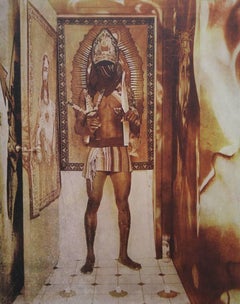
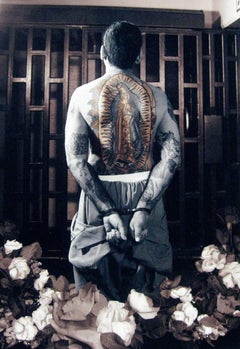
Although she was born in Texas and lived in Nebraska into her twenties, photographer and printmaker Delilah Montoya has deep roots in northern New Mexico through her mother's family. Raised by her mother, Montoya observes that women have empowered her family for five generations. Montoya studied photography and printmaking at the University of New Mexico, where she received her bachelor's degree, master's degree, and master of fine arts. She works in a variety of two-dimensional photographic and printing processes as well as creating larger installations. The artist describes her approach as postmodernist and uses documentary strategies to interpret her own distinct vision. Politically, Montoya is committed to exploring issues of identity in terms of a Chicano cultural context:"In my own evolving ideology I question my identity as a Chicana in occupied America, and articulate the experience of the minority woman. I work to understand the depth of my spiritual, political, emotional and cultural icons, realizing that in exploring the topography of my conceptual homeland, Aztlan, I am searching for the configuration of my own vision. " (Montoya n.d.) Montoya is committed to the expression of Chicana experience and history, but she does not consider herself as a feminist. Indeed, Montoya rejects identification as a United States-style feminist because she believes that "Feminists don't give us solidarity. As a Chicana my issues are multifaceted, not just gender, but class, race. " The border, for Montoya, is a politically imposed construct, a part of a United States colonialist enterprise that was forced upon the Chicano community. It is the environment in which Chicano life and history unfolds. Montoya's work explores contemporary and historical issues, sometimes win a humorous twist. Her artist's book for the 1992 Chicano Codices exhibition organized by the Mexican Museum in San Francisco, Codex Delilah: a Journey From Mechica to Chicana (including text by poet Cecilio Garcia-Camarillo), traces the imaginary journey of Six Deer, a character who embodies the contact between indigenous and Spanish culture in her trip "pal norte" towards Aztlan, the "spiritual homeland of her ancestors." As she journeys to the north, the character also journeys forward in time, meeting important Chicanas from the past, including La Llorona, La Conquistador, and activist Velia Silva. This effort to reimagine a forgotten and ignored history integrates several elements to affirm the importance of both historical and contemporary mestizaje to Chicana survival. Another project, "El Sagrado Corazon/The Sacred Heart," involved the Albuquerque Chicano community in an exploration of the syncretism, or mixing, of Catholicism and Aztec philosophy. These collotype portraits depict members of the community as well as cultural personages, such as "La Genizara" (a Hispanicized Native American) and "La Loca y Sweetie," barrio "home girls."
to
5
3
1
Overall Width
to
Overall Height
to
7
2
7
4
9
8
5
3
3
3
2
1
1
1
1
1
1
1
1
1
1
1
1
3
2
2
9
10,253
2,810
2,500
1,407
3
9
Artist: Delilah Montoya
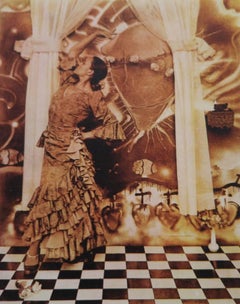
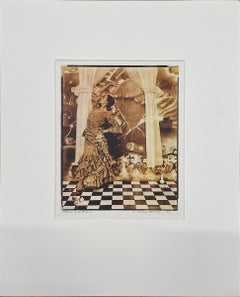
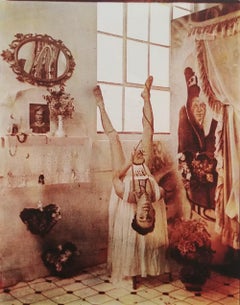
El Grito De La Gitana, from Corazon Sagrado series by Delilah Montoya, 1993

El Grito De La Gitana, from Corazon Sagrado series by Delilah Montoya, 1993

By Delilah Montoya

Located in Denton, TX

This image is a collotype print from Delilah Montoya's series, Corazon Sagrado, and is edition 1/1. It is signed, titled, dated and numbered in pencil on print margin by Delilah Montoya. This collotype print features a woman in a dress dancing in front of a backdrop on a checkered floor...

Category

1990s Conceptual Delilah Montoya Art

Materials

Other Medium

“Treyolia” Black and White Conceptual Contemporary Photograph

“Treyolia” Black and White Conceptual Contemporary Photograph

By Delilah Montoya

Located in Houston, TX

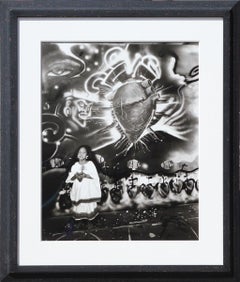
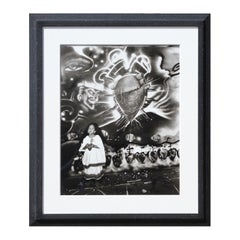
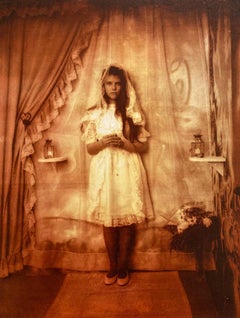
Black and white contemporary photograph by Houston, TX artist Delilah Montoya. This conceptual photograph captures a young child with long, dark, curly hair, resembling that of Christ's, also wearing a white dress with a thick, patterned lining. The young subject also holds what appears to be a heart figure, also replicated as a graffiti on the wall. Signed and labeled at the back. Framed and matted in a black wooden frame. Dimensions Without Frame: H 23 in. x W 18 in. Artist Biography: Although she was born in Texas and lived in Nebraska into her twenties, photographer and printmaker Delilah Montoya has deep roots in northern New Mexico through her mother's family. Raised by her mother, Montoya observes that women have empowered her family for five generations. Montoya studied photography and printmaking at the University of New Mexico, where she received her bachelor's degree, master's degree, and master of fine arts. She works in a variety of two-dimensional photographic and printing processes as well as creating larger installations. The artist describes her approach as postmodernist and uses documentary strategies to interpret her own distinct vision. Politically, Montoya is committed to exploring issues of identity in terms of a Chicano cultural context:"In my own evolving ideology I question my identity as a Chicana in occupied America, and articulate the experience of the minority woman. I work to understand the depth of my spiritual, political, emotional and cultural icons, realizing that in exploring the topography of my conceptual homeland, Aztlan, I am searching for the configuration of my own vision. " (Montoya n.d.) Montoya is committed to the expression of Chicana experience and history, but she does not consider herself as a feminist. Indeed, Montoya rejects identification as a United States-style feminist because she believes that "Feminists don't give us solidarity. As a Chicana my issues are multifaceted, not just gender, but class, race. " The border, for Montoya, is a politically imposed construct, a part of a United States colonialist enterprise that was forced upon the Chicano community. It is the environment in which Chicano life and history unfolds. Montoya's work explores contemporary and historical issues, sometimes win a humorous twist. Her artist's book for the 1992 Chicano Codices exhibition organized by the Mexican Museum in San Francisco, Codex Delilah: a Journey From Mechica to Chicana (including text by poet Cecilio Garcia-Camarillo), traces the imaginary journey of Six Deer, a character who embodies the contact between indigenous and Spanish culture in her trip "pal norte" towards Aztlan, the "spiritual homeland of her ancestors." As she journeys to the north, the character also journeys forward in time, meeting important Chicanas from the past, including La Llorona...

Category

1990s Contemporary Delilah Montoya Art

Materials

Silver Gelatin

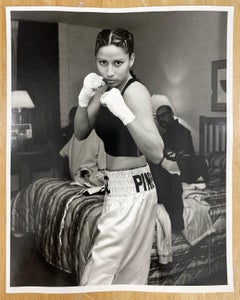
Jackie Chavez

Jackie Chavez

By Delilah Montoya

Located in Denton, TX

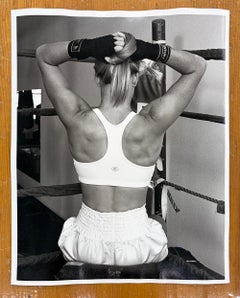
Signed, titled, and dated. Gelatin silver print 20 x 16 in.

Category

Early 2000s Conceptual Delilah Montoya Art

Materials

Silver Gelatin

“God’s Gift” Contemporary Photograph on Collotype

“God’s Gift” Contemporary Photograph on Collotype

By Delilah Montoya

Located in Houston, TX

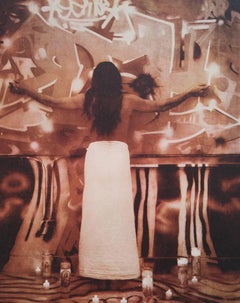
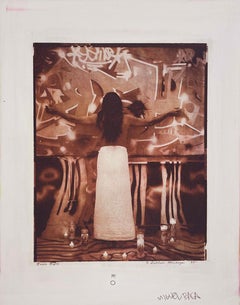
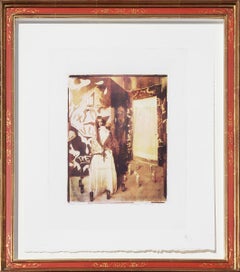
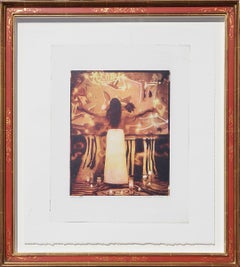
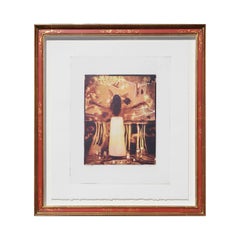
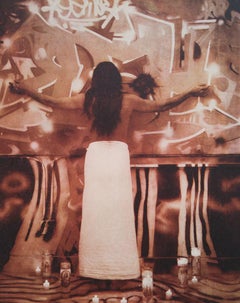
Contemporary photograph on collotype by Houston, TX artist Delilah Montoya. Photograph shows a young woman with long, dark hair with both arms stretched to the sides while surrounded by lit candles. Her back faces the camera as she faces a wall with graffiti. The scene is reminiscent of Jesus on the cross. Titled, signed, and dated by artist. Framed and matted in a red and gold wooden frame. Dimensions Without Frame: H 17.25 in. x W 16.13 Artist Biography: Although she was born in Texas and lived in Nebraska into her twenties, photographer and printmaker Delilah Montoya has deep roots in northern New Mexico through her mother's family. Raised by her mother, Montoya observes that women have empowered her family for five generations. Montoya studied photography and printmaking at the University of New Mexico, where she received her bachelor's degree, master's degree, and master of fine arts. She works in a variety of two-dimensional photographic and printing processes as well as creating larger installations. The artist describes her approach as postmodernist and uses documentary strategies to interpret her own distinct vision. Politically, Montoya is committed to exploring issues of identity in terms of a Chicano cultural context:"In my own evolving ideology I question my identity as a Chicana in occupied America, and articulate the experience of the minority woman. I work to understand the depth of my spiritual, political, emotional and cultural icons, realizing that in exploring the topography of my conceptual homeland, Aztlan, I am searching for the configuration of my own vision. " (Montoya n.d.) Montoya is committed to the expression of Chicana experience and history, but she does not consider herself as a feminist. Indeed, Montoya rejects identification as a United States-style feminist because she believes that "Feminists don't give us solidarity. As a Chicana my issues are multifaceted, not just gender, but class, race. " The border, for Montoya, is a politically imposed construct, a part of a United States colonialist enterprise that was forced upon the Chicano community. It is the environment in which Chicano life and history unfolds. Montoya's work explores contemporary and historical issues, sometimes win a humorous twist. Her artist's book for the 1992 Chicano Codices exhibition organized by the Mexican Museum in San Francisco, Codex Delilah: a Journey From Mechica to Chicana (including text by poet Cecilio Garcia-Camarillo), traces the imaginary journey of Six Deer, a character who embodies the contact between indigenous and Spanish culture in her trip "pal norte" towards Aztlan, the "spiritual homeland of her ancestors." As she journeys to the north, the character also journeys forward in time, meeting important Chicanas from the past, including La Llorona...

Category

1990s Contemporary Delilah Montoya Art

Materials

Photographic Paper
“Madonna and Child” Contemporary Photography on Collotype Edition 1/1

“Madonna and Child” Contemporary Photography on Collotype Edition 1/1

By Delilah Montoya

Located in Houston, TX

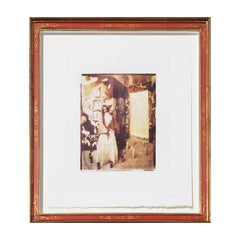
Contemporary photograph on collotype by Houston, TX artist Delilah Montoya. Photograph shows a young woman wearing a dress and a shawl over her head. The photographed subject holds an infant, a visual reminiscent of the Madonna and Child. The same subject, while surrounded by lit candles, sits against a graffiti backdrop with the word "time" in the bottom left standing out. She looks directly at the camera, confronting the viewer's inquisitive gaze. Titled, signed, and dated by artist. Framed and matted in a red and gold wooden frame. Dimensions Without Frame: H 17.25 in. x W 16.125 in. Artist Biography: Although she was born in Texas and lived in Nebraska into her twenties, photographer and printmaker Delilah Montoya has deep roots in northern New Mexico through her mother's family. Raised by her mother, Montoya observes that women have empowered her family for five generations. Montoya studied photography and printmaking at the University of New Mexico, where she received her bachelor's degree, master's degree, and master of fine arts. She works in a variety of two-dimensional photographic and printing processes as well as creating larger installations. The artist describes her approach as postmodernist and uses documentary strategies to interpret her own distinct vision. Politically, Montoya is committed to exploring issues of identity in terms of a Chicano cultural context:"In my own evolving ideology I question my identity as a Chicana in occupied America, and articulate the experience of the minority woman. I work to understand the depth of my spiritual, political, emotional and cultural icons, realizing that in exploring the topography of my conceptual homeland, Aztlan, I am searching for the configuration of my own vision. " (Montoya n.d.) Montoya is committed to the expression of Chicana experience and history, but she does not consider herself as a feminist. Indeed, Montoya rejects identification as a United States-style feminist because she believes that "Feminists don't give us solidarity. As a Chicana my issues are multifaceted, not just gender, but class, race. " The border, for Montoya, is a politically imposed construct, a part of a United States colonialist enterprise that was forced upon the Chicano community. It is the environment in which Chicano life and history unfolds. Montoya's work explores contemporary and historical issues, sometimes win a humorous twist. Her artist's book for the 1992 Chicano Codices exhibition organized by the Mexican Museum in San Francisco, Codex Delilah: a Journey From Mechica to Chicana (including text by poet Cecilio Garcia-Camarillo), traces the imaginary journey of Six Deer, a character who embodies the contact between indigenous and Spanish culture in her trip "pal norte" towards Aztlan, the "spiritual homeland of her ancestors." As she journeys to the north, the character also journeys forward in time, meeting important Chicanas from the past, including La Llorona...

Category

1990s Contemporary Delilah Montoya Art

Materials

Photographic Paper

Corazon Sagrado
Corazon Sagrado

Corazon Sagrado

By Delilah Montoya

Located in Denton, TX

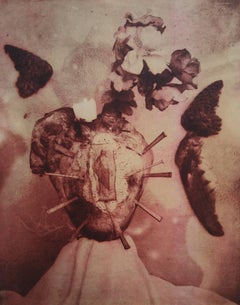
Edition 1/1 Signed, titled, dated and numbered in pencil on print margin by Delilah Montoya Collotype print, 10 x 8 in. Delilah Montoya was born in Texas to a Latina mother and an Anglo father. Her mother raised her in Nebraska until she relocated to New Mexico...

Category

1990s Conceptual Delilah Montoya Art

Materials

Other Medium

God's Gift by Delilah Montoya, 1993, Collotype Print

God's Gift by Delilah Montoya, 1993, Collotype Print

By Delilah Montoya

Located in Denton, TX

God's Gift by Delilah Montoya depicts a woman facing a graffitied wall, with her arms stretched out. Lit candles surround her on the floor. The woman's pose is reminiscent of Jesus o...

Category

1990s Conceptual Delilah Montoya Art

Materials

Other Medium

Related Items
Palazzo Zenobio I

Palazzo Zenobio I

By Reinhard Görner

Located in Los Angeles, CA

signed and numbered on label, verso Reinhard Görner, with his large format photographs orchestrates the monumentality of historical architecture, gardens, and masterpieces. An acti...

Category

21st Century and Contemporary Conceptual Delilah Montoya Art

Materials

Archival Pigment

Untitled Portrait
Untitled Portrait

Untitled Portrait

By Seydou Keïta

Located in New York, NY

Listing includes framing with UV Plexi ($900 value), free shipping, and a 14-day return policy. Seydou Keïta Untitled Portrait, 1952 - 1955 (02158) 23...

Category

1950s Delilah Montoya Art

Materials

Photographic Film, Photographic Paper, Silver Gelatin

Ted Higby at Skyline Rodeo, 1928

Ted Higby at Skyline Rodeo, 1928

Located in New York, NY

Listing includes framing with UV plexiglas, free shipping and a 14 day return policy. Ted Higby at Skyline Rodeo, 1928 15 x 12 inch gelatin silver print Image Size: 14 x 8.5 inches Frame size: 22.5 x 17.5 x 2 inches Edition of 15 Lora Webb Nichols was born in 1883 and grew up in the small mining town of Encampment, Wyoming. At the age of 16 Lora received her first camera and from that moment and for the next few decades she produced work that is both stunning in its singular voice and revealing in the world it opens up for us. At first Nichols photographed her family, friends, and the landscape around Encampment, but when the town experienced a copper mining boom Nichols expanded her scope to become a photographer for hire shooting portraits and industrial photographs. When the boom collapsed, Nichols took the risk of opening her own business in Encampment - The Rocky Mountain Studio - which opened in 1925. The studio ran for ten years, accumulating 24,000 negatives that illustrate the lives and environment of the people living in and around the town while creating a distinctive and surprising body of work. If one was to attempt an analogy – Nichols’ pictures fit somewhere between Lartigue and Lange - joyful and generous while objectively intimate. In particular what seems to distinguish Nichols’ work is the way she sees the world from a female perspective. As Vince Aletti...

Category

1920s Other Art Style Delilah Montoya Art

Materials

Silver Gelatin

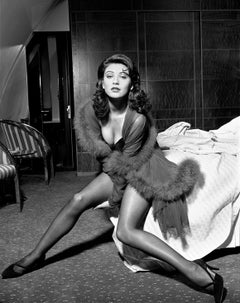
Catherine Zeta-Jones (Limited Edition of 25) - Celebrity Photography

Catherine Zeta-Jones (Limited Edition of 25) - Celebrity Photography

Located in New York, NY

This 1991 fine art print features Catherine Zeta-Jones when she was a TV actress in Britain and aspiring to be a Hollywood Star. Her success in The Darling Buds of May (English comed...

Category

1990s Contemporary Delilah Montoya Art

Materials

Silver Gelatin

Bea with a whip at The Other Side

Bea with a whip at The Other Side

By Nan Goldin

Located in New York, NY

Nan Goldin Bea with a whip at The Other Side 1973 Gelatin silver print 14 x 11 inches; 36 x 28 cm Edition of 100 Signed, titled, dated, and numbered in graphite (lower right verso) ...

Category

1970s Contemporary Delilah Montoya Art

Materials

Silver Gelatin

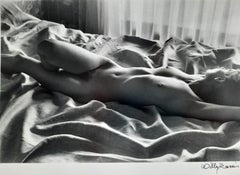
The Hair Willy Ronis Humanist black and white photography woman naked nude

The Hair Willy Ronis Humanist black and white photography woman naked nude

By Willy Ronis

Located in Paris, FR

Willy Ronis is one of the most famous members of the French Humanist photography. Silver print on photographic paper Hand-signed by the artist lower right Stamp of the artist's stud...

Category

Early 2000s Contemporary Delilah Montoya Art

Materials

Photographic Paper, Silver Gelatin

Avenue Simon Bolivar - Willy Ronis, 20th Century, French Humanist Photography

Avenue Simon Bolivar - Willy Ronis, 20th Century, French Humanist Photography

By Willy Ronis

Located in Paris, FR

One of the famous members of the Humanist photography in France. Signed lower right by the artist. Stamp of the artist's studio on the back.

Category

1950s Contemporary Delilah Montoya Art

Materials

Photographic Paper, Silver Gelatin

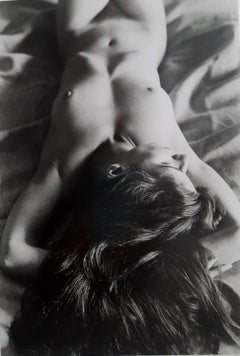
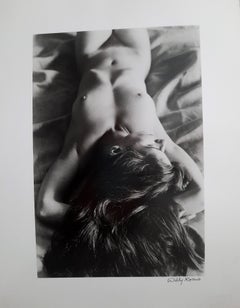
Nude Paris Willy Ronis 20th Century French Humanist photography black and white

Nude Paris Willy Ronis 20th Century French Humanist photography black and white

By Willy Ronis

Located in Paris, FR

Willy Ronis is one of the most famous members of the French Humanist photography. Silver print on photographic paper Hand-signed by the artist lower right Stamp of the artist's stud...
Category

1990s Contemporary Delilah Montoya Art

Materials

Photographic Paper, Silver Gelatin

Previously Available Items
La Malinche

Delilah MontoyaLa Malinche, 1993

Sold

H 10 in W 8 in D 0.07 in

La Malinche

By Delilah Montoya

Located in Denton, TX

Edition 1/1 Signed, titled, dated and numbered in pencil on print margin by Delilah Montoya Collotype print, 10 x 8 in. Delilah Montoya was born in Texas to a Latina mother and an A...

Category

1990s Conceptual Delilah Montoya Art

Materials

Other Medium

El Matachin/Moro
El Matachin/Moro

Delilah MontoyaEl Matachin/Moro, 1993

Sold

H 10 in W 8 in D 0.1 in

El Matachin/Moro

By Delilah Montoya

Located in Denton, TX

Edition 1/1 Signed, titled, dated and numbered in pencil on print margin. Collotype print

Category

1990s Contemporary Delilah Montoya Art

Materials

Other Medium

La Guadalupana

Delilah MontoyaLa Guadalupana, 1999

Sold

H 24 in W 18.75 in D 0.1 in

La Guadalupana

By Delilah Montoya

Located in Denton, TX

A/P Signed, titled, dated, and print date.

Category

1990s Contemporary Delilah Montoya Art

Materials

Archival Pigment

Delilah Montoya art for sale on 1stDibs.

Find a wide variety of authentic Delilah Montoya art available for sale on 1stDibs. You can also browse by medium to find art by Delilah Montoya in paper, photographic paper, silver gelatin print and more. Much of the original work by this artist or collective was created during the 1990s and is mostly associated with the contemporary style. Not every interior allows for large Delilah Montoya art, so small editions measuring 8 inches across are available. Customers who are interested in this artist might also find the work of Emily Cheng, Brenda Zlamany, and Shimon Attie. Delilah Montoya art prices can differ depending upon medium, time period and other attributes. On 1stDibs, the price for these items starts at $2,500 and tops out at $4,000, while the average work can sell for $2,900.