Felician Myrbach Art

1853-1940

Felician Myrbach was born on February 19th, 1853, in Zalishchyky. He was an Austrian painter, graphic designer and illustrator. He was a founding member of the Vienna Secession and the director of the University of Applied Arts Vienna and was instrumental in the creation of the Wiener Werkstätte. Myrbach's father was Franz Myrbach, the Administrator of Bukovina in 1865–70. His older brother Franz Xaver was an economist and professor at the University of Innsbruck. Myrbach attended the Theresian Military Academy in 1868–71, graduating as a Lieutenant, then at the Academy of Fine Arts, Vienna under August Eisenmenger. In 1875, he joined the 19th Feldjäger Battalion, and in 1877 became an Oberleutnant in the Military Geographic Institute, then, after campaigning in Bosnia in 1878, he taught drawing at the Infantry Cadet School in Vienna. He continued his artistic studies under C R Huber. In 1881, Myrbach went on military leave and moved to Paris, retiring totally from the military in 1884 as a Hauptmann, 2nd Class. He stayed in Paris until 1897, working as an illustrator, including illustrating the works of Alphonse Daudet, Victor Hugo and Jules Verne. Myrbach was a founding member of the Vienna Secession in 1897. In the same year, he became a professor of the Applied Arts School at the Museum of Art and Industry; Arthur von Scala, another reformer Modernist, was made head of the Museum. In 1889, Myrbach became the director of the school. He brought an enthusiastic Modernist attitude and encouraged integration between art, design and production. He added Koloman Moser and Josef Hoffmann to the staff, amongst other Secession artists. This had lead to the foundation of the Wiener Werkstätte in 1903. Myrbach leaned more towards an aesthetic approach than von Scala, but both worked together to bring about their combined vision of successful, popular Austrian applied art. Myrbach was a voice for reform towards Modernist ideals in the School, which was started in 1899 with the support of Alfred Roller, and completed by 1901. The reform of the school has been described as his "lasting merit". Ludwig Hevesi called Myrbach "probably the best (illustrator) in Vienna", partially for his work (with Moser) in the Secession magazine Ver Sacrum. Myrbach visited America on a state-funded study trip in 1904, part of which was to represent the Applied Arts School at the 1904 World's Fair in St Louis; from California, he submitted his resignation to the school due to ill health. He moved abroad in 1905, first returning to Paris and providing illustrations for Hachette, and then from 1914 living in Spain, mainly in Barcelona but also spent time in Bilbao. He returned to Austria in 1936. Myrbach created many scenes of military life, as well as bucolic pictures of farmers, horses and forests; as well, his work showed touches of Orientalism. Until 1898, he employed algraphy in his work; he painted in oil, watercolor and tempera. Myrbach passed away on January 14th, 1940.

to
6
Overall Width
to
Overall Height
to
4
2
1
6
6
5
5
3
2
1
1
1
5
1
6
10,218
2,810
2,500
1,401
5
6
Artist: Felician Myrbach
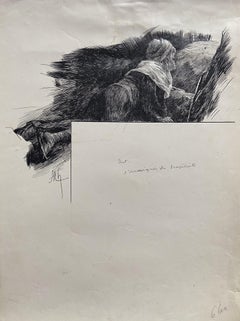
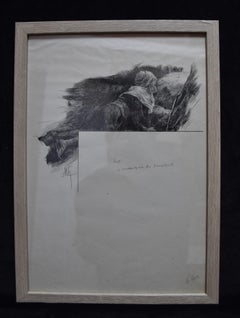
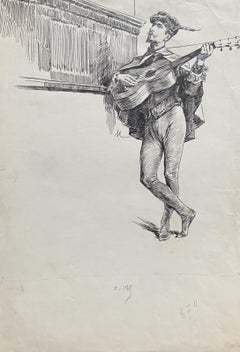
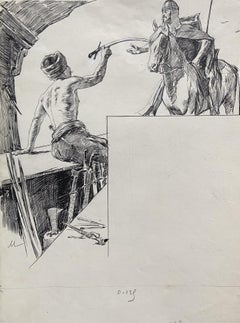
Felician Myrbach (1853-1940) Poèmes magyars original drawing

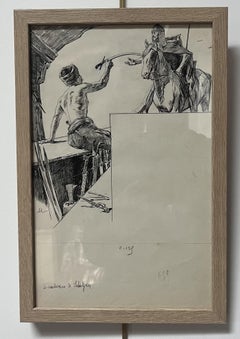
Felician Myrbach (1853-1940) Poèmes magyars original drawing

By Felician Myrbach

Located in Paris, FR

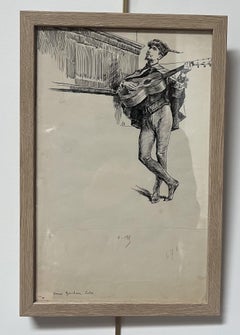
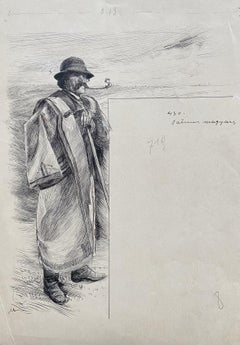
Felician Myrbach (1853-1940) Poèmes magyars, Magyar poems bears the monogram "M" on the lower left, titled in the upper right Ink on paper 29,8 x 19,8 cm in good condition, the sheet is slightly yellowed In a modern frame : 33 x 23 cm This is an illustration project by Felician Myrbach for François Coppée's work, "Poèmes magyars". He leaves the space to be occupied by the text blank on the sheet and arranges his composition accordingly. It is interesting to see the artist imagine his drawing with this constraint. Felician Myrbach (also Felicien de Myrbach, Felician von Myrbach, from 1919 Freiherr von Rheinfeld) was born on 9 February 1853 in Zalishchyky, he died 14 January 1940 in Klagenfurt He was an Austrian painter, graphic designer and illustrator. He was a founding member of the Vienna Secession and the director of the Applied Arts School in Vienna (now the University of Applied Arts Vienna), and was instrumental in the creation of the Wiener Werkstätte. Myrbach's father was Franz Myrbach (1818–1882), the Administrator of Bukovina in 1865–70. His older brother Franz Xaver (1850–1919) was an economist and professor at the University of Innsbruck. He attended the Theresian Military Academy in 1868–71, graduating as a Leutnant, then at the Academy of Fine Arts, Vienna under August Eisenmenger. In 1875, he joined the 19th Feldjäger Battalion, and in 1877 became an Oberleutnant in the Military Geographic Institute, then, after campaigning in Bosnia in 1878, he taught drawing at the Infantry Cadet School in Vienna. He continued his artistic studies under C R Huber. In 1881, he went on military leave and moved to Paris, retiring totally from the military in 1884 as a Hauptmann, 2nd Class. He stayed in Paris until 1897, working as an illustrator, including illustrating the works of Alphonse Daudet, Victor Hugo and Jules Verne. Myrbach was a founding member of the Vienna Secession in 1897. In the same year, he became the a professor of the Applied Arts School at the Museum of Art and Industry; Arthur von Scala, another reformer Modernist, was made head of the Museum. In 1889, Myrbach became the director of the school. He brought an enthusiastic Modernist attitude and encouraged an integration between art, design and production. He added Koloman Moser and Josef Hoffmann to the staff, amongst other Secession artists. This would lead to the foundation of the Wiener Werkstätte in 1903. Myrbach leant more towards an aesthetic approach than von Scala, but both worked together to bring about their combined vision of successful, popular Austrian applied art. Myrbach was a voice for reform towards Modernist ideals in the School, which was started 1899 with the support of Alfred Roller, and completed by 1901.The reform of the school has been described as his "lasting merit". Ludwig Hevesi called Myrbach "probably the best [illustrator] in Vienna", partially for his work (with Moser) in the Secession magazine Ver Sacrum. Myrbach visited America on a state-funded study trip in 1904, part of which was to represent the Applied Arts School at the 1904 World...

Category

Early 1900s Art Nouveau Felician Myrbach Art

Materials

Ink

Related Items
FLOWER ABSTRACT
FLOWER ABSTRACT

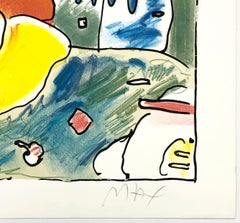
Peter MaxFLOWER ABSTRACT, 1980

$2,450Sale Price|30% Off

H 21.5 in W 26.75 in

FLOWER ABSTRACT

By Peter Max

Located in Aventura, FL

Lithograph in colors on paper. Hand signed and numbered by the artist. From the edition of 165. Frame size approx 28 x 33 inches. Artwork is in excellent condition. Certificate ...

Category

1980s Pop Art Felician Myrbach Art

Materials

Paper, Lithograph

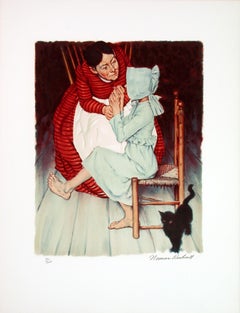
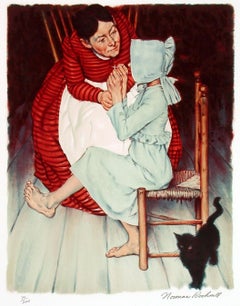
"My Hands Shook" (Huckleberry Finn)

"My Hands Shook" (Huckleberry Finn)

By Norman Rockwell

Located in Greenwich, CT

"My Hands Shook" is a lithograph on paper by Norman Rockwell from his 1972 Huckleberry Finn suite, printed by Atelier Mourlot, Paris. The image size is 18 x 14 inches and the framed ...

Category

20th Century Realist Felician Myrbach Art

Materials

Paper, Lithograph

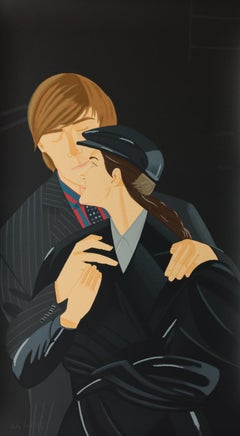
Pas de Deux II
Pas de Deux II

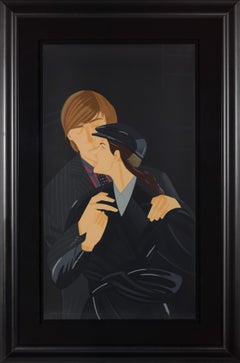
Alex KatzPas de Deux II, 1994

$14,850

H 47.5 in W 31.5 in

Pas de Deux II

By Alex Katz

Located in Greenwich, CT

Pas de Deux II (Danny Moynihan and Laura Faber) is a serigraph on paper with an image size of 36 x 20 inches, signed ‘Alex Katz’ lower left and numbered 107/150. From the edition of ...

Category

20th Century Pop Art Felician Myrbach Art

Materials

Paper, Screen

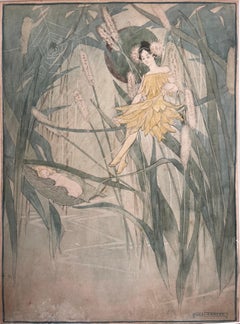
Fairy in the Pussy Willows with Baby and Spider Web Fantasy Children's  Book

Fairy in the Pussy Willows with Baby and Spider Web Fantasy Children's Book

Located in Miami, FL

This work is presented more as a concept piece since it's condition is destresed. Signed lower right Illustrator Hazel Frazee was a Female Illustrator in the first quarter of the 20...

Category

1920s Art Nouveau Felician Myrbach Art

Materials

Pencil, Watercolor, Paper

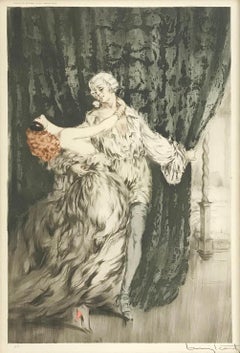
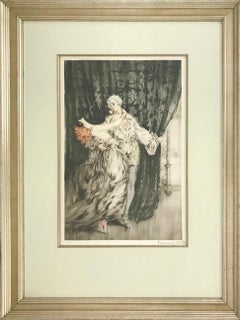
CASANOVA
CASANOVA

Louis IcartCASANOVA, 1928

$1,875Sale Price|25% Off

H 20 in W 13 in

CASANOVA

By Louis Icart

Located in Aventura, FL

Etching on paper. Hand signed lower right margin. Image size: 20 x 13 inches. Frame size approx 36 x 27 inches. Reference: Figure 331 page 156 in "Louis Icart: The complete etchin...

Category

1920s Art Deco Felician Myrbach Art

Materials

Paper, Etching

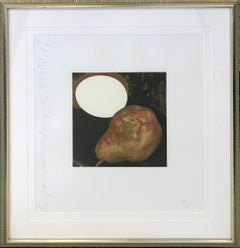
2 PEARS, A LEMON, AND AN EGG

Donald Sultan2 PEARS, A LEMON, AND AN EGG, 1994

$2,062Sale Price|25% Off

H 23 in W 22 in

2 PEARS, A LEMON, AND AN EGG

By Donald Sultan

Located in Aventura, FL

Hand titled, dated, initialed and numbered by the artist. From the Fruits and Flowers suite. Sheet size 23 x 22 inches. Image size 12 x 12 inches. Frame size approx 31 x 30 inches. A...

Category

1990s Pop Art Felician Myrbach Art

Materials

Paper, Screen

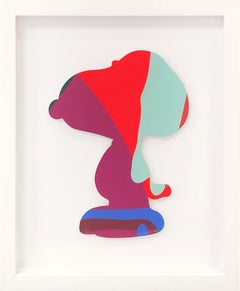
UNTITLED (SNOOPY)

KAWSUNTITLED (SNOOPY), 2020

$9,000Sale Price|40% Off

H 10.5 in W 8 in

UNTITLED (SNOOPY)

By KAWS

Located in Aventura, FL

Screen print cutout on Saunders Waterford 425gm HP Hi-White paper. Hand signed, dated and numbered by the artist. Artwork size 10.5 x 8 inches. Custom framed as pictured. Frame si...

Category

21st Century and Contemporary Street Art Felician Myrbach Art

Materials

Paper, Screen

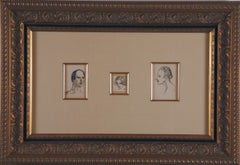
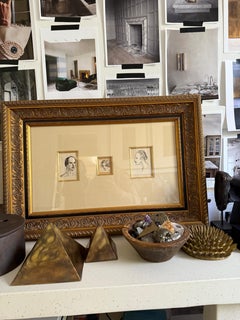
"Trois Portraits" drawings from the sketch book of Theophile Steinlen

"Trois Portraits" drawings from the sketch book of Theophile Steinlen

By Théophile Alexandre Steinlen

Located in Hinsdale, IL

Theophile Alexandre Steinlen "Trois Portraits" Original ink drawing, c. 1900 Initialed in ink by artist Bears artist monogram stamp in black image (with signature cat's tail) From...

Category

Early 20th Century Art Nouveau Felician Myrbach Art

Materials

Ink, Pen

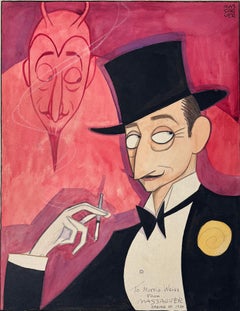
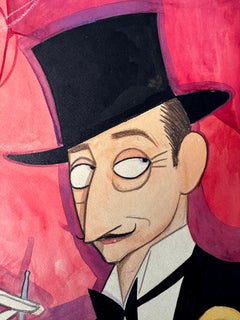
Cuban Artist  - Caricature of Adolphe Menjou Debonair Devil

Cuban Artist - Caricature of Adolphe Menjou Debonair Devil

Located in Miami, FL

Framed Cuban Artist/Caricaturist Conrado Walter Massaguer presents Hollywood star Adolphe Menjou in a satirical dual portrait. In the foreground, the subject is seen in a dapper top hat, tux, fashionable cigarette and boutonnière, and is shown as being the epitome of being stylishly debonair. To make a larger point about this subject, Massaguer paints a cast shadow of Menjou as a burning red devil who studies his alter ego from above. Keeping with the artist's sarcasm, we see the good and bad in one image. Works by Massaguer are rare and this work is in keeping with his signature style. This work was most likely done on assignment for Life Magazine, Cosmopolitan, The New Yorker or Vanity Fair. Signed upper right. Inscribe lower right. Titled on verso. Unframed, Slight bend to board; toning to board; scattered faint foxing; pin point abrasions to margins, not affecting image. 19-1/2 x 15-1/8 inches board size. Conrado Walter Massaguer y Diaz was a Cuban artist, political satirist, and magazine publisher. He is considered a student of the Art Nouveau. He was the first caricaturist in the world to broadcast his art on television.He was first caricaturist to exhibit on Fifth Avenue. He was the first caricaturist in the world to exhibit his caricatures on wood. He, and his brother Oscar, were the first magazine publishers in the world to use photolithographic printing. Self portrait of Conrado Walter Massaguer, depicted on a carrousel ride, with the devil over his left shoulder and an angel over his right. (1945) He created the magazine Social with his brother Oscar to showcase Cuban artistic talent. The duo later created the magazine Carteles, which became for a period the most popular magazine in Cuba, which was purchased by Miguel Ángel Quevedo in 1953. In his life, he met and drew caricatures of Franklin D. Roosevelt, Walt Disney, Albert Einstein, the King of Spain, and many others.[ In sum total, he was the author of more than 28 thousand caricatures and drawings.Ernest Hemingway once had to refrain himself from punching Massaguer in the face after the artist drew an unflattering caricature of him. The dictator Gerardo Machado, however, did not punch Massaguer for his own unflattering caricature - he had the artist deported. He was one of the most internationally renowned Cuban artists of his day, and his art is still regularly featured in galleries across the Western Hemisphere and Europe. Early life Massaguer was born on October 18, 1889, in Cárdenas, Cuba.[In 1892, his family moved to Havana. When the Cuban War of Independence broke out, Massaguer's family escaped the country. From 1896 to 1908, he lived in Mérida, Mexico. However, during this time, his parents enrolled him in the New York Military Academy, where he stayed during school years. In 1905, after graduating the military academy, he briefly attended the San Fernando school in Havana, where he was tutored by Ricardo de la Torriente and Leopoldo Romañach. In 1906, less than a year later, he returned to the family home in Mexico. Career as artist Early career While living in Yucatán, Mexico, Massaguer published his first caricatures in local newspapers and magazines. These included La Campana, La Arcadia, and the Diario Yucateco. In 1908, he moved back to Havana. After returning to the island in 1908, Massaguer began mingling with Havana's aristocratic circles, forming close friendships with some of the city's most powerful and influential men, as well as winning the favor of many women who were quickly charmed by him. Massaguer, largely self-taught, honed his style using the avant-garde techniques he studied from the European and American magazines that were widely available in Cuba at the time. Cover of the immensely popular Cuban magazine El Figaro, drawn by Massaguer in 1909. This cover depicts two bumbling, incompetent American tourists to the island. He started drawing for El Fígaro, and was featured prominently on the cover in 1909. After two years of refining his craft, Havana announced a poster contest aimed at attracting North American tourists to stay in the city during the winter months. Notable figures like Leopoldo Romañach, Armando Menocal, Rodríguez Morey, Jaime Valls, and others also entered the competition. The jury was particularly impressed by the modern execution and creative solution of one piece, signed by Massaguer, who was relatively unknown at the time. The jury deliberations caused a great controversy.[5] The prize was ultimately awarded to the Galician painter Mariano Miguel, who had recently married the daughter of Nicolás Rivero, the wealthy owner of the conservative newspaper Diario de la Marina. Although Massaguer received only an honorable mention, the fraud scandal caused such an uproar that his name quickly entered the public spotlight, and he became an overnight sensation. In 1910, he became co-owner of the advertising agency Mercurio, with Laureano Rodríguez Castells. At Mercurio, he led the Susini cigar campaign, and earned substantial wealth. Massaguer has been described as a restless man, in both mind and body.After earning enough money from his art to begin traveling, he was almost always doing so. He constantly traveled between New York City and Havana, Mexico and France, Europe and the Americas. In 1911, his reputation among the Havana socialites solidified when he organized his own first public caricature exhibit, and also the first Caricature Salon ever held in the Americas, hosted at Athenaeum of Havana (the Ateneo), and the Círculo de La Habana. Other exhibitors here included Maribona, Riverón, Portell Vilá, Valer, Botet, Barsó, García Cabrera, Carlos Fernández, Rafael Blanco, and Hamilton de Grau. "Messaguer Visits Broadway." Caricatures of theatrical and literary figures. Elsie Janis, Raymond Hitchcock, S. Jay Kaufman (columnist), Ibanez, author of The Four Horsemen, and Frances White In 1912, in the New York American Journal, he published his first Broadway drawings. From 1913 to 1918, he was an editor for Gráfico. Social Main article: Social (magazine) Cover of the magazine Social, July 7, 1923 In 1916, he created the magazine Social with his brother, Oscar H. Massaguer. Social's contributors included Guillén Carpentier, Chacón y Calvo, Enrique José Varona and others.Social has been described as Massaguer's great love in the magazine industry, and was the property that historians say he cared the most about. Social was an innovative magazine, being the first magazine in the world to use a modern printing process called photolithographic printing. Social set cultural trends, not only in the fashion of Cuba, but in art, politics, and Cuban identity.[11] Social catered to a certain aesthetic in Cuba - that of the sophisticated elite socialite - but Massaguer would also use this magazine to ridicule and jibe against that same class of society when he found their personalities worthy of his contempt. In Social, readers could find a variety of content, including short stories, avant-garde poetry, art reviews, philosophical essays, and serialized novels, as well as articles on interior design, haute couture, and fashion. Occasionally, the magazine also featured reports on sports such as motor racing, rowing, tennis, and horse riding.The cultural promotion efforts of both Massaguer and Emilio Roig de Leuchsenring are evident in the magazine. Notably, this period overlaps with their involvement in the Minorista Group, which was then at the forefront of the country's intellectual life.[5] Many contributors were devoted members of the group, leading some experts to consider Social as the cultural voice of the Minoristas. One of the features of Social magazine was its section called "Massa Girls," which was a play on his own name, and pronounced with a glottal 'g' in a similar fashion to the letter in Massaguer.[12] Massaguer drew women as independent and free-thinking, and never drew the woman celebrity as a caricature of herself, but as a free agent surrounded by caricatures.[11] However, Massaguer himself has been described as a womanizer in his personal life, and hesitant to fully embrace every facet of women's liberation. In 1916, he also established la Unión de Artes Gráficas and the advertising agency Kesevén Anuncios.[9] The art critic Bernardo González Barroa wrote: “Massaguer has solved the problem of working hard, living comfortably off what his art produces and not missing any artistic, sporting or social event. His broad, childish laugh, of a carefree individual who carries his luck hidden in a pocket, appears everywhere for the moment, disguising the pranks of pupils that lurk, mock and, finally, flash with satisfaction at finding the characteristic point after having analyzed a soul... Massaguer's personality is beginning to solidify now. He has been the best-known and most popular caricaturist for a long time, but his technique had not reached the security, the mastery of values that he presents in his latest works, which is very natural and explainable”[5] Carteles Main article: Carteles Cover of the magazine Carteles, November 29, 1931 In 1919, Massaguer and his brother created the magazine Carteles.[9] Carteles gained the widest circulation of any magazine in Latin America, and the most popular magazine in Cuba for a time, until that title was claimed by Revista Bohemia. Carteles remained in print until July 1960.This magazine showcased Cuban commerce, art, sports, and social life before the revolution. In 1924, Carteles took a more political turn, with articles criticizing Gerardo Machado's government. it became a prime example of the humor and graphic design employed by artists like Horacio Rodríguez Suria and Andrés García...

Category

1930s Art Nouveau Felician Myrbach Art

Materials

Ink, Watercolor, Illustration Board
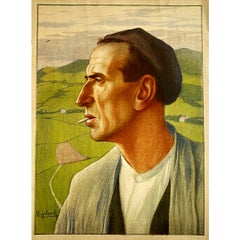
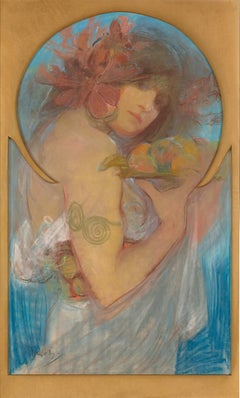
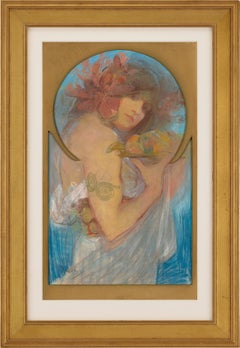
Fruit by Alphonse Mucha

Alphonse MuchaFruit by Alphonse Mucha, Circa 1897

$245,000

H 37.38 in W 26 in D 1.13 in

Fruit by Alphonse Mucha

By Alphonse Mucha

Located in New Orleans, LA

Alphonse Mucha 1860-1939 Czech Fruit Signed "Mucha" (lower left) Pastel on paper "Art only exists to communicate a spiritual message." —Alphonse Mucha Alphonse Mucha's distincti...

Category

19th Century Art Nouveau Felician Myrbach Art

Materials

Paper, Pastel

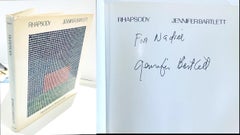
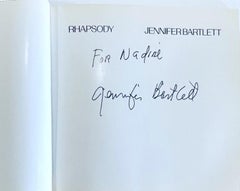
Rhapsody, hardback monograph (Hand signed and inscribed by Jennifer Bartlett)

Rhapsody, hardback monograph (Hand signed and inscribed by Jennifer Bartlett)

By Jennifer Bartlett

Located in New York, NY

Jennifer Losch Bartlett Rhapsody (hand signed and inscribed), 1985 Hardback monograph with dust jacket (hand signed and inscribed to Nadine) Hand signed and inscribed in black marker "for Nadine" by Jennifer Bartlett on the half title page 12 × 12 × 1 inches Provenance signed for the present owner at Paula Cooper Gallery on January 21, 2016 This substantial, lavishly illustrated hardback monograph with dust jacket, was hand signed by Jennifer Bartlett for the present owner at Paula Cooper Gallery on January 21, 2016. Makes an excellent gift Book information: Publisher‏: ‎ Harry N Abrams (November 1, 1985) English; Hardcover; 108 pages with color illustrations Editorial Review: Rhapsody'' is Bartlett's multi-part, multi-theme epic, a statement of the coming of age of an artist. A portable mural extended over 987 one-foot steel plates requiring 153 running feet of wall space, it is an enormous and infrequently mastered challenge to install and exhibit. In 1985-86, however, it will be on view in Minneapolis, Kansas City, Brooklyn, La Jolla, and Pittsburgh, and well worth a trip. In book form it becomes more available, with Smith's guided tour through sections, with Bartlett's notes giving conceptual coherence, and the opportunity to move from close-up to long view by turning a page. Rhapsody'' and this book afford a glimpse of a mind and art in action, a discovering and ordering process, an exciting demonstration of ways of growing and expressing the self and the world. Highly recommended. About Jennifer Bartlett: By the mid-1970s, Jennifer Bartlett (1941-2022, b. Long Beach, California) had emerged as a leading American artist of her time—particularly following the landmark presentation at Paula Cooper Gallery of Rhapsody (1976), Bartlett’s magnum opus, now in the collection of the Museum of Modern Art, New York. Bartlett’s first survey exhibition was held in 1985 at the Walker Art Center, Minneapolis, and traveled to the Brooklyn Museum, New York, and the Carnegie Museum of Art, Philadelphia, among others. In 2006, the Addison Gallery of American Art surveyed Bartlett’s early enameled steel plate paintings in the period from 1968–76. In 2013-14, Klaus Ottmann curated her second traveling survey, which visited the Pennsylvania Academy of the Fine Arts and the Parrish Art Museum, New York. In 2014, the Cleveland Museum of Art united her three monumental plate...

Category

1980s Contemporary Felician Myrbach Art

Materials

Paper, Ink, Mixed Media, Lithograph, Offset

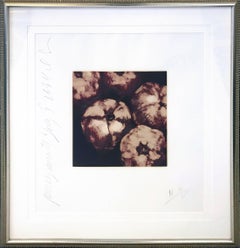
POMEGRANATES
POMEGRANATES

Donald SultanPOMEGRANATES, 1994

$1,762Sale Price|25% Off

H 23 in W 22 in

POMEGRANATES

By Donald Sultan

Located in Aventura, FL

Hand titled, dated, initialed and numbered by the artist. From the Fruits and Flowers suite. Sheet size 23 x 22 inches. Image size 12 x 12 inches. Frame size approx 31 x 30 inches. A...

Category

1990s Pop Art Felician Myrbach Art

Materials

Paper, Screen

Previously Available Items
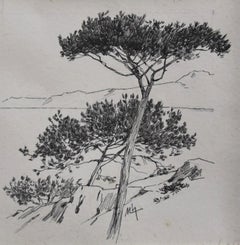
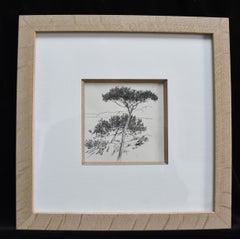
Felician Myrbach (1853-1940) Maritime pines, signed Ink drawing

Felician Myrbach (1853-1940) Maritime pines, signed Ink drawing

By Felician Myrbach

Located in Paris, FR

Felician Myrbach (1853-1940) Maritime pines Ink on paper 9 x 9 cm (window) Signed with the monogram lower middle In a modern frame : 24.5 x 24.5 cm in good condition, except a small foxing in the lower part (see photographs please) It's interesting to see the influence of japan art in this composition and how characteristic it is with very few efforts of the Art nouveau and Secession styles. Everything is suggestion, suggestion of the sea and and of a mediterranean landscape, all this with two lines of ink behind the pines.... Felician Myrbach (also Felicien de Myrbach, Felician von Myrbach, from 1919 Freiherr von Rheinfeld) was born on 9 February 1853 in Zalishchyky, he died 14...

Category

Early 1900s Art Nouveau Felician Myrbach Art

Materials

Ink

Felician Myrbach (1853-1940) A little sheppard and his pigs, signed Ink drawing
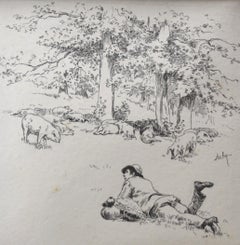
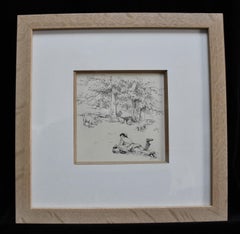
Felician Myrbach (1853-1940) A little sheppard and his pigs, signed Ink drawing

By Felician Myrbach

Located in Paris, FR

Felician Myrbach (1853-1940) A little sheppard and his pigs Ink on paper 11 x 11 cm (window) Signed with the monogram on the right In a modern frame : 26.5 x 26.5 cm in good condition, except a small foxing in the lower left part (see photographs please) Felician Myrbach (also Felicien de Myrbach, Felician von Myrbach, from 1919 Freiherr von Rheinfeld) was born on 9 February 1853 in Zalishchyky, he died...

Category

Early 1900s Art Nouveau Felician Myrbach Art

Materials

Ink

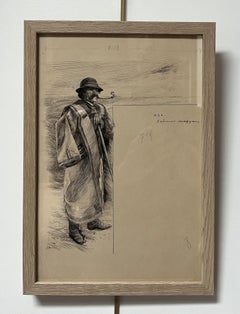
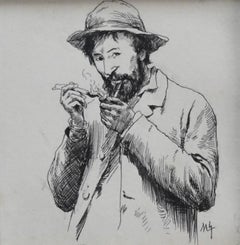
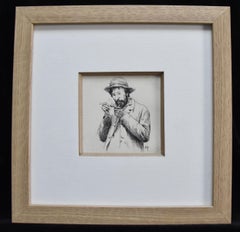
Felician Myrbach (1853-1940) A man lighting his pipe, signed Ink drawing

Felician Myrbach (1853-1940) A man lighting his pipe, signed Ink drawing

By Felician Myrbach

Located in Paris, FR

Felician Myrbach (1853-1940) A bearded man lighting his pipe Ink on paper 8 x 8 cm (window) Signed with the monogram lower right In a modern frame : 23.5 x 23.5 cm Felician Myrbach (also Felicien de Myrbach, Felician von Myrbach, from 1919 Freiherr von Rheinfeld) was born on 9 February 1853 in Zalishchyky, he died 14...

Category

Early 1900s Realist Felician Myrbach Art

Materials

Ink

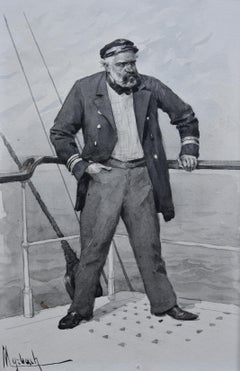
Felician Myrbach (1853-1940) Le Capitaine Scrapouchinat, Ink drawing

Felician Myrbach (1853-1940) Le Capitaine Scrapouchinat, Ink drawing

By Felician Myrbach

Located in Paris, FR

Felician Myrbach (1853-1940) Le Capitaine Scrapouchinat, study for an illustration of Alphonse Daudet's Port Tarascon (1890) Ink and Ink wash on paper 24 x 15.5 cm Signed lower left...

Category

1890s Realist Felician Myrbach Art

Materials

Ink

Felician Myrbach art for sale on 1stDibs.

Find a wide variety of authentic Felician Myrbach art available for sale on 1stDibs. You can also browse by medium to find art by Felician Myrbach in ink, paper and more. Not every interior allows for large Felician Myrbach art, so small editions measuring 8 inches across are available. Customers who are interested in this artist might also find the work of Lucien-Victor Guirand de Scévola, Louis Moe, and Marcel Bloch. Felician Myrbach art prices can differ depending upon medium, time period and other attributes. On 1stDibs, the price for these items starts at $305 and tops out at $890, while the average work can sell for $305.

Artists Similar to Felician Myrbach