By Henry Herbert La Thangue
Located in Petworth, West Sussex
Henry Herbert La Thangue RA (British, 1859-1929)
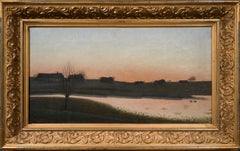
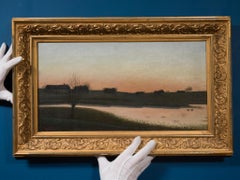
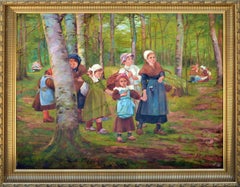
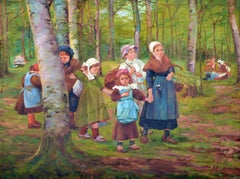
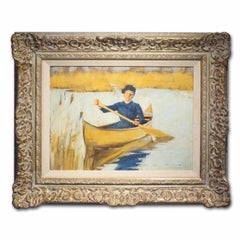
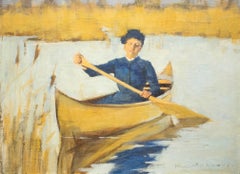
Paddling among the bulrushes
Signed `H.H.LA THANGUE’ (lower right)
Oil on canvas
12 x 16 in. (30.5 x 40.8 cm.)
Provenance: Sotheby’s London, Modern British Paintings, 11 November 1987, lot 9
£9000
Henry Herbert La Thangue was born in Croydon in 1859. He first studied painting at the Lambeth School or Art, progressing to the Royal Academy of Arts between 1874-79. After receiving a gold medal for his work in 1879, La Thangue secured a prestigious three-year scholarship at the Parisian École des Beaux-Arts, in the studio if Jean-León Gerome. It was here at the École des Beaux-Arts that La Thangue was heavily influenced by the Barbizon school of open-air landscape painting a movement is characterised by tonal and soft genre scenes of village life, farms, and the landscapes of Barbizon in France.
Early in his career, La Thangue spent time painting on the coast of Brittany and in Donzère in the Rhone valley. Returning to England 1886, after becoming a member of the Royal Institute of Oil painters, La Thangue exhibited at the Royal Academy of Arts, The Royal Society of British Artists, and the Royal Institute of Oil Painters. La Thangue’s interest in photography and photo-realistic depictions flourished in the late 1880’s, upon moving to South Walsham in Norfolk.
La Thangue’s two oil paintings, The Man with the Scythe and The Return of the Reapers both reflect La Thangue’s interest in photo-realism and have both been exhibited at the Tate, London. In the 1900’s, La Thangue spent time painting the landscapes of Provence, Liguria in Italy and the Balearic Islands of Mallorca, Ibiza, and Menorca.
La Thangue’s ‘Paddling amongst the bullrushes’ is an early work of La Thangue, perhaps a scene painted when the artist was working in France in 1883. This painting has undertones of French impressionism. This composition conveys La Thangue’s brilliant rendering of light. The golden hues of light, and yellow tone of the bullrushes create a hazy yet peaceful atmosphere. Later in his career, La Thangue was renowned for the use of dappled sunlight in his realistic rural scenes. It was noted that “Sunlight was a thing that attracted him”.
This is a beautiful example of La Thangue’s rural landscape painting, exhibiting a fabulously confident understanding of light.
La Thangue’s collection has been exhibited at distinguished galleries worldwide, including the Towner Gallery, the Royal Academy of Arts and various galleries in Manchester, Aberdeen, and Glasgow. La Thangue’s ‘In the Orchard...
Category
19th Century Impressionist Henry Herbert La Thangue Art