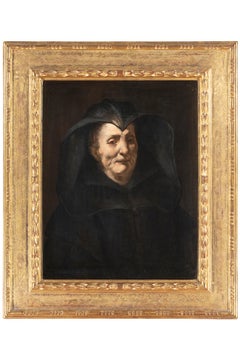
Jacopo Bassano Art

Italian, 1510-1592

Jacopo Bassano, also known as Jacopo dal Ponte, was an Italian painter who was born and died in Bassano del Grappa near Venice, and took the village as his surname. Trained in the workshop of his father, Francesco the Elder, and studying under Bonifazio Veronese in Venice, he painted mostly religious paintings including landscape and genre scenes. Bassano's pictures were very popular in Venice because of their depiction of animals and nocturnal scenes. After his father died in 1539, he returned to Bassano del Grappa and permanently set up residence there, even taking a local woman, Elisabetta Merzari, as his wife in 1546. He took over the management of his family workshop, which would eventually come to include his four sons, Leandro Bassano, Francesco Bassano the Younger, Giovanni Battista da Ponte, and Girolamo da Ponte. After he died in 1592, his sons continued to produce numerous works in his style, making it difficult for later art historians to establish which pieces were created by Jacopo himself and which works were created at the hands of his progeny. Bassano was considered unique amongst his fellow Renaissance artists by his ability to incorporate diverse artistic influences (including Dürer, Parmigianino, Tintoretto, and Raphael) into his work despite his reluctance to leave the comfort of his home town. He is believed to have learned about their art by seeing their prints, of which he was most likely an avid collector.

to
1
1
Overall Width
to
Overall Height
to
1
1
1
1
1
1
1
1
1
1
10,166
2,784
2,504
1,383
1
1
Artist: Jacopo Bassano
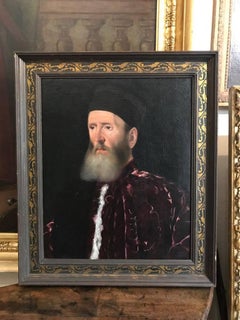
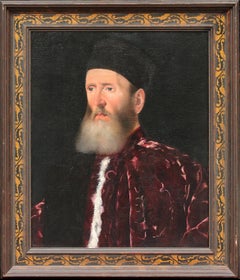
16th Century Italian Renaissance Old Master Portrait of a Procuratore
By Jacopo Bassano
Located in London, GB
Jacopo BASSANO (c. 1510-1592, Italian) Portrait of a Procuratore Oil on canvas 30 ¼ x 26 inches (including frame) Provenance: Lucien Bonaparte’s Collection (as Portrait of Doge Priuli, Tiziano); Rich-mond, Virginia Museum, Portrait of Doge Lorenzo Priuli. The painting is a portrait of a man half-length, on a black background. It is a three-quarter portrait, according to a custom very common in the genre of portraiture in sixteenth century. The man is wearing a decorated...
Category

16th Century Old Masters Jacopo Bassano Art
Materials

Oil

Related Items
Portrait Paint Oil on canvas Old master 16/17th Century Italian Raffaello Art
Located in Riva del Garda, IT
Tuscan painter active towards the end of the 16th century Portrait of Captain Niccolò Orsini (Pitigliano, 1442 - Lonigo, 1510), count of Pitigliano and Nola. Tuscany, end of the 16th century Oil on canvas, 64 x 47 cm., Framed 89 x 73 cm. The portrait we present to you shows the effigy of a vigorous high-ranking male figure in armor, in the most typical Renaissance pose, half-length and taken in profile, with his face and gaze turned to the side; the serious and intense expression and the facial features evoke at first glance the portraiture of early Florentine mannerism. He is Niccolò III Orsini (Pitigliano, 1442 - Lonigo, 1510), count of Pitigliano and Nola and son of Aldobrandino Orsini, famous leader and captain (or capitano di ventura) who lived between the fifteenth and sixteenth centuries, who served for the state Pontifical in Naples and Florence and above all for the Republic of Venice. Portraiture with these characters, which derives from ancient coinage, was used in the sixteenth century in the sequences of Portraits of Illustrious Men, both in painting and in sculpture. The profile portrait was in fact a genre reserved, according to the Renaissance tradition, for celebrations, presenting those characteristics of imperturbability typical of the military role covered. Our painting is a work created by an author active in Tuscany towards the end of the sixteenth century, adhering to those pictorial styles made famous by the portraitist Cristofano di Papi dell'Altissimo (1530-1605), a pupil of Bronzino and then of Pontormo, known for having created a collection of about 500 portraits of illustrious men, known as the 'Gioviana Series' (now in the Uffizi Gallery); and among these it is possible to identify one dedicated to Niccolò Orsini. Our painting is inspired, in particular, by a print taken from the collection of prints...
Category

16th Century Old Masters Jacopo Bassano Art
Materials

Oil

Saint Michael Archangel Tuscany school 16th Century Paint Oil on canvas Italy
Located in Riva del Garda, IT
Saint Michael the Archangel victorious over the Devil Tuscany - 16th century Oil on canvas 68 x 52 cm. - In frame 97 x 78 cm. Of great character is this interesting St. Michael the...
Category

16th Century Old Masters Jacopo Bassano Art
Materials

Oil

Saint Michael Archangel López 18th Century Paint Oil on canvas Spanish school
Located in Riva del Garda, IT
18th-century Spanish Colonial School Attributed to Juan Pedro López (Caracas, Venezuela, 1724 - 1787) Saint Michael the Archangel Oil on canvas 91 x...
Category

18th Century Old Masters Jacopo Bassano Art
Materials

Oil

Oil Portrait of a Victorian Lady, c. 1850
Located in Chicago, IL
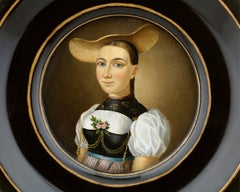
Painted in the 19th century, this exquisite miniature portrait wonderfully exemplifies realism in traditional oil painting. The small artwork is painted in the conventional portraiture style of the Old Masters, and achieves soft realism with fine brushwork and a subdued, neutral palette. The half length portrait depicts a fine Victorian woman dressed in all black with a delicate lace collar and bonnet. She wears a ruby broach...
Category

Mid-19th Century Old Masters Jacopo Bassano Art
Materials

Oil

Oil Portrait of a Victorian Lady, c. 1850
$1,480
H 13.75 in W 11.5 in D 1.75 in
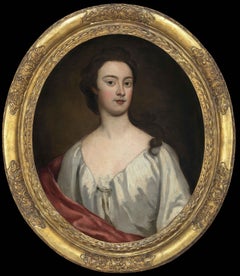
18th Century portrait oil painting of a lady in an ermine trimmed cloak
By Sir Godfrey Kneller
Located in Nr Broadway, Worcestershire
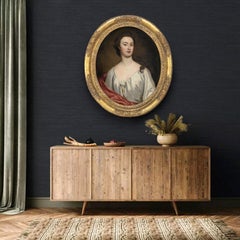
Circle of Sir Godfrey Kneller Dutch, (1646-1723) Portrait of a Lady in an Ermine Trimmed Cloak Oil on canvas Image size: 26.5 inches x 22.5 inches Size including frame: 33.5 inches x 29.5 inches A well-executed half-length portrait of a lady painted in a feigned oval, circle of Sir Godfrey Kneller. The use of a feigned oval was a device used in portraiture to give a sense of depth and add an intimacy to the painting, drawing your attention to the sitter. The subject, posed without her wig in the undressed fashion of the day, wears a blue ermine trimmed blue cloak over a white silk robe...
Category

18th Century Old Masters Jacopo Bassano Art
Materials

Canvas, Oil

Antique French Old Master Oil Painting Christ Healing the Sick in Jersusalem
Located in Cirencester, Gloucestershire
Christ Healing the Sick French School, 19th century oil on canvas, unframed canvas: 15 x 20.5 inches Provenance: private collection, Europe Condition: some craquelure throughout, mo...
Category

19th Century Old Masters Jacopo Bassano Art
Materials

Oil

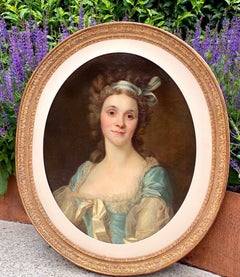
18th century French Old Master Portrait of a woman in oriental costume
Located in Aartselaar, BE
French 18th century old master portrait of a majestic lady dressed "à la Turque" The sitter at the viewer with a kind and enigmatic smile and twinkling eyes. She looks elegant and kind, yet also has an intelligent and determined aura, reflecting the character of someone who is in charge of her own life and destiny. De Silvestre paid great attention to her spectacular outfit, which is striking in its portrayal of the sumptuous fabrics and their decorative richness. She is wearing a luxurious royal blue robe à la...
Category

1740s Old Masters Jacopo Bassano Art

Materials

Canvas, Oil

Rare Jacobean Portrait on Panel Lady Elizabeth Wheeler née Cole 1623 Historical
By Cornelius Johnson
Located in London, GB
A Rare Jacobean Portrait of Lady Elizabeth Wheeler (née Cole), 1623 Attributed to Cornelius Johnson (1593–1661) This remarkably rare early oil on panel, presented by Titan Fine Art, has emerged as far more than an anonymous “Portrait of a Lady.” Preserved in outstanding condition—its surface retaining exceptional clarity in the lace and textiles—it has only recently been reunited with the identity of its sitter: Elizabeth Cole (1607–1670), later Lady Elizabeth Wheeler, a Westminster gentlewoman whose later life brought her into intimate royal service as laundress for His Majesty’s person. That combination—high quality, uncommon survival, a newly identified sitter, and a life that intersects directly with the last acts of Charles I—places this portrait in a category of genuine rarity. It is not simply a beautiful Jacobean likeness; it is a rediscovered historical document - legible and compelling. The sitter is presented half-length against a dark ground, enclosed within a painted sculpted oval surround that functions like an architectural frame. This device, fashionable in the 1620s, concentrates the viewer’s attention and heightens the sense of social presentation: the sitter appears both physically and symbolically “set apart,” as if viewed through a refined aperture. The portrait’s immediate power, however, lies in the costume—an ensemble of striking modernity for c. 1623 and rendered with a precision that survives with remarkable crispness. She wears a deep green gown—a fitted overgown with open sleeves—over a finely embroidered linen jacket (a stiffened bodice/waistcoat garment). The sleeves form pronounced “wings” at the shoulder, a structurally assertive fashion detail of the early 1620s that enlarges the silhouette and signals sophistication. Beneath the green overlayer, the white linen jacket is richly ornamented in gilt embroidery. The goldwork is arranged as scrolling foliate forms—looping, curling tendrils punctuated by seed-like stippling—organised into balanced compartments across the bodice and sleeves. The motifs read as stylised botanical forms with rounded fruit-like terminals and leaf elements: not literal naturalism, but controlled abundance. The technique is described with extraordinary intelligence, mimicking couched metallic thread through patterned, “stitched” marks, while tiny dots and short dashes create a lively tactile shimmer. This embroidered jacket sits above a newly fashionable high-waisted, sheer apron or overskirt. The translucent fabric falls in soft vertical folds and is articulated with narrow lace-edged bands, giving the skirt a crisp rhythm of alternating sheer and patterned strips. At the neck, a fine ruff frames the face: a disciplined structure of pleated linen finished with delicate lace. Draped diagonally across the torso are long gold chains, painted to suggest weight and metallic gleam; they function both as ornament and as a further signifier of status. The cumulative effect is controlled luxury: she is not overloaded with jewels, but clothed in textiles whose cost and craftsmanship speak unmistakably. The recent sitter’s identification rests on heraldic and genealogical analysis: the arms shown on the painting correspond to those recorded for several families in armorial sources, but when the lines of descent are tested against survival and chronology, the viable bearer by 1623 resolves to Cole, and—crucially—to the London branch. That resolution matters because it anchors the portrait to a very specific social world: London/Westminster civic gentry and Crown administration, the milieu in which portraiture served as both self-fashioning and social instrument. The recent identification of the sitter (the London Cole branch of the family) is not merely genealogical; it has direct implications for authorship. A London-based mercantile or civic-gentry family would have ready access to leading immigrant artists, familiarity with heraldic display conventions, and the means to commission oil on panel, still standard among Netherlandish-trained painters. In that context, the portrait’s age inscription and date become especially revealing. The painting states the sitter to be nineteen years of age. Yet Elizabeth Cole’s birth in 1607 suggests she would be younger if the portrait is dated as early as 1623. The key insight is that the “incorrect” age is best understood not as a mistake but as a deliberate social adjustment, a performative statement rather than a documentary one. The most persuasive explanation is strategic. Portraits of high-status unmarried women were frequently made in connection with marriage negotiations. In the early 1620s, Elizabeth’s future husband, William Wheeler, was resident abroad at Middelburg in Zeeland in the Dutch Republic. If a portrait was intended to support or facilitate a match with an educated, ambitious man—“a man of learning and letters,” —then presenting a seventeen-year-old as nineteen would subtly reposition her as more mature and more nearly a peer in age, Wheeler being around twenty-two. The portrait thus becomes an instrument of alliance, not merely a likeness: an image designed to persuade, reassure, and elevate. This reading aligns perfectly with the period’s wider conditions. The early 1620s in England were charged with anxiety and expectation: James I’s later reign was marked by court faction, diplomatic tension, and the pressures of European conflict. The so-called “art market” was inseparable from these dynamics. Portraiture flourished because it served multiple functions: it fixed lineage, advertised alliance, signalled readiness for marriage, and projected the stability of elite households in an uncertain world. For Westminster families whose power came through office, portraiture was also a declaration of belonging—proof that administrative elites possessed the cultural polish traditionally associated with older aristocratic rank. Elizabeth’s later life vindicates the portrait’s impression of steadiness. Although no record survives of her marriage ceremony to William Wheeler, wills suggest she had married him by the mid-1630s, and there are strong grounds—consistent with the portrait’s implications—for a union already in place by the early 1630s, possibly earlier. Wheeler himself rose rapidly. By 1639 he held a manor at Westbury Leigh in Wiltshire and sought letters of denization due to overseas birth, enabling him to stand as Member of Parliament for Westbury. He leased the principal manor of Westbury the following year, coinciding with his election. In government service he became Remembrancer of the Exchequer and held office across regime change, a testament to administrative skill and political pragmatism. It is Elizabeth, however, who makes this portrait exceptional. She became laundress for His Majesty’s person, responsible for the washing and oversight of the King’s personal linen—an office that, despite its domestic description, required unusual trust, discretion, and access. Her role becomes visible in 1643 when she was granted a warrant signed by the Speaker of the House of Commons to follow the King to Oxford with her servant after the outbreak of the Civil War. She continued to serve during the King’s captivity after 1646, and at Carisbrooke Castle in 1647 she and her maid were implicated in smuggling secret correspondence to and from Charles I, in service of escape plans. After the King’s failed attempt to escape in March 1648, she was removed—yet the King’s trust persisted: he was permitted to send her remaining jewels in an ivory casket...
Category

17th Century Old Masters Jacopo Bassano Art
Materials

Oil, Panel

Portrait Man Pourbus 16/17th Century Paint Oil on canvas Old master Flemish
Located in Riva del Garda, IT
Frans Pourbus (Bruges, 1545 - Antwerp, 1581) circle Portrait of a gentleman in Renaissance dress with a black doublet and ruff Late 16th century Oil on canvas 46 x 32 cm. - 65 x 53...
Category

16th Century Old Masters Jacopo Bassano Art
Materials

Oil

Portrait of lady, Mary Hammond in Rich Attire, Jewels, Lace c.1618-22 Historical
By Cornelius Johnson
Located in London, GB
Portrait of Mary Hammond in Sumptuous Attire, Jewels and Lace c.1618-22 Circle of Cornelius Johnson (1593-1661) This portrait of a lady, presented by Titan Fine Art, is an exquisite example of early seventeenth-century portraiture, remarkable both for the lavishness of its subject’s attire and for the distinguished provenance that has accompanied it across four centuries that adds a rich layer of historical significance. It was once part of the notable collection of Sir William Temple, 1st Baronet (1628–1699) at Moor Park, a stately mansion in Hertfordshire. Temple was a diplomat, essayist, philosopher, and the patron of Jonathan Swift. He was a key participate at an important period in English history, helping not only to negotiate the Triple Alliance, but also the marriage between William of Orange and Princess Mary. His collection at Moor Park was well known in its day, reflecting both his cultivated taste in art and literature and his international connections. Its fabulous attire, rendered with almost microscopic attention, is not merely decorative but emblematic of a world in which visual display was a language of power. Its provenance, stretching from the English country house and Enlightenment scholarship to modernist circles, forms a microcosm of cultural exchange across four centuries. Thus, the portrait of Mary Hammond stands as both a masterpiece of early seventeenth-century craftsmanship and a witness to the grand narrative of collecting and connoisseurship—a testament to the enduring fascination of beauty, status, and history intertwined. By tradition the portrait depicts Mary Hammond (born c.1602), who was Sir William Temple’s mother, and the daughter of the royal physician who served James I, Dr John Hammond (c.1555–1617) and whose family owned Chertsey Abbey in Surrey. The woman appears between 18 and 25 years old, and Mary would be about 18–20 when the portrait was painted circa 1620, therefore this matches the apparent age of the sitter and the fashion perfectly. Mary stood at the intersection of learned/courtly and gentry worlds. On 22 June 1627 she married her first cousin (a common practice for consolidating family wealth and influence during that era.) Sir John Temple (1600-1677) at St Michael, Cornhill in the City of London. The couple resided nearby, at Blackfriars. Her marriage to Sir Temple placed her at the heart of the social and political circles that shaped British history. The couple had at least five children, and they became highly significant historical figures: The eldest son, Sir William Temple, 1st Baronet, became a distinguished diplomat, statesman, and essayist, famous for his role in the Triple Alliance and as a patron and mentor to the writer Jonathan Swift – our portrait was in his collection. Their daughter, Martha Temple, later Lady Giffard, was a notable figure in her own right. She became her brother William's first biographer and a respected letter-writer, providing a rare female perspective on the events and high society of the time. Another son, also named Sir John Temple, became Attorney General for Ireland and was involved in the turbulent politics surrounding the English Civil War and the Act of Settlement in Ireland. Mary died in November 1638 after giving birth to twins and was buried at Penshurst, Kent. The family's connection to Penshurst Place is a major point of interest as this historic manor was the seat of the Sidney family, a major aristocratic and literary dynasty. The portrait was in the collection of the Mary’s son, Sir William Temple. From there it descended to his daughter, and then to her nephew, the Reverend Nicholas Bacon of Spixworth Park, Norfolk (his mother was Dorothy Temple who died in 1758). Indeed, by this time, many Temple relics were in the collection at Spixworth including the engagement ring of the illustrious Dorothy Osborne, Lady Temple, wife of Sir William Temple. The portrait thus linked two prominent English families—the Temples and the Bacons—for generations. It is listed in a Spixworth Park inventory of 27 October 1910 by the local collector and art historian, Prince Duleep Singh. He described it with characteristic precision as: “No. 69. Lady Half Length, body and face turned towards the sinister, hazel eyes upwards to the dexter, red hair dressed low and over the ears, a jewelled coronet behind, pearl ear-rings tied with black strings. Dress: black, bodice cut low and square, with lace all round the opening and over shoulders, sleeves with double slashes showing red lining and lace under, falling thin pleated lace collar, black strings tied behind it, a jewel suspended on a black string round the neck, and a double row of agate and silver beads all round to the shoulders. M. In brown veined stone frame. Age 30. Date c.1620. It is called ‘Dutch portrait from Moor Park, mentioned by Nicholas Bacon of Coddenham and Shrubland as a very valuable painting.’ A few years later, when Robert Bacon Longe’s executors sold the contents of Spixworth Park (19–22 May 1912), the portrait appeared as lot 262, described as: “A very valuable half-length portrait on panel, ‘Dutch Lady, with deep lace collar and pearl and amethyst necklace, pendant, and ear-rings, and auburn hair, with coronet’ Early Dutch School 1620.” Following this sale the painting entered the collection of David and Constance Garnett, prominent literary figures of the early twentieth century, before being gifted to Andre Vladimervitch Tchernavin by 1949, and subsequently passed by him to the present owners in 1994. The two great houses associated with the painting, Moor Park and Spixworth Park, further underscore its pedigree. Moor Park, in Hertfordshire, was among the grandest country estates of seventeenth-century England—its gardens famously redesigned by Sir William Temple himself and later influencing landscape design across Europe. Sir William's Temple's secretary was Jonathan Swift, who lived at Moor Park between 1689 and 1699. Swift began to write "A Tale of the Tub" and "The Battle of the Books" at Moor Park. Spixworth Park, near Norwich, was an Elizabethan country house in Spixworth, Norfolk, located just north of the city of Norwich. It was home to successive generations of the Bacon family, one of Norfolk’s most distinguished dynasties (later, the Bacon Longe family), who were considerable land owners (owning Reymerston Hall, Norfolk, Hingham Hall, Norfolk, Dunston Hall, Norfolk, Abbot's Hall, Stowmarket, and Yelverton Hall, Norfolk). Spixworth Hall and the surrounding parkland remained in the Longe family for 257 years until 1952, when it was demolished. Rendered with meticulous precision and sumptuous detail, the painting depicts an elegantly dressed woman—her poise, costume, and jewels all communicating a message of wealth, refinement, and social rank. Every brushstroke conveys an artist deeply attuned to the textures of luxury and the nuances of feminine dignity. The sitter’s attire is nothing short of magnificent. Her bodice and sleeves are fashioned from the finest black silk or satin, the fabric absorbing and reflecting light in equal measure, suggesting both depth and lustre. Around her shoulders lies an opulent lace ruff—a deep, radiating lace collar worked in such intricate detail that it testifies to both the artist’s technical skill and the sitter’s extravagant taste. Lace of this quality, especially Venetian or Flemish bobbin lace, was one of the costliest materials available in early seventeenth-century Europe, its weight worth more than gold, and was a marker of prestige that rivalled jewels in value. The painter has taken great care to delineate every loop and scallop of the lace, achieving an almost tactile realism. Pale skin was also a desired beauty standard, sometimes accentuated with contrasting black ribbons or strings. Her jewels amplify this display of affluence. Matching earrings and a delicate coronet or jewelled hair ornament with a feather adorn her hair, which is styled in the modest yet fashionable manner of the time. These details are far from decorative excess—they serve as visual emblems of social standing, refinement, and lineage. Portraits of this kind were statements of both identity and aspiration, intended to project a family’s prosperity and moral virtue to posterity. The portrait was most likely painted in London around 1618-1622. The low-cut, décolletage-revealing neckline was fashionable in the courts of England and France during the late Elizabethan and Jacobean eras (c. 1590s-1610s), this style did not prevail in the public fashion of the Low Countries at this time. This style of lace ruff — delicate needle lace with geometric openwork — was fashionable from c.1615 to 1622, and the jewelled caul (hair net) and lace edging over a stiffened coif are consistent with high-status English women’s portraiture between 1610–1620. The puffed sleeve slash and the use of pink satin beneath black velvet belong squarely to the late Jacobean...
Category

17th Century Old Masters Jacopo Bassano Art

Materials

Oil, Panel

The Flagellation of Christ Antique Oil on Wood Panel Painting
Located in Cirencester, Gloucestershire
The Flagellation of Christ Eastern European artist, late 19th century oil on wood panel, framed framed: 35 x 25.5 inches panel: 32 x 21 inches Provenance: private collection, Franc...
Category

Late 19th Century Old Masters Jacopo Bassano Art
Materials

Oil

Saint Lawrence Looking at the Treasures
Located in Fredericksburg, VA
"Saint Lawrence Looking at the Treasures" is a captivating painting attributed to the Bolognese School, a prominent art movement from Bologna, Italy, flourishing primarily in the 16t...
Category

Late 17th Century Old Masters Jacopo Bassano Art
Materials

Canvas, Oil

Jacopo Bassano art for sale on 1stDibs.

Find a wide variety of authentic Jacopo Bassano art available for sale on 1stDibs.

Artists Similar to Jacopo Bassano