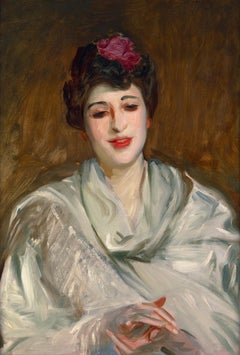
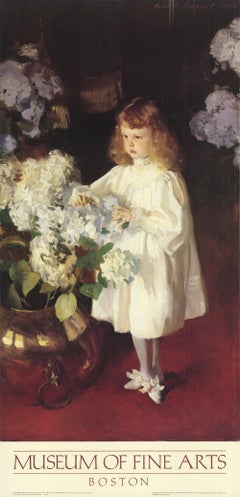
By John Singer Sargent
Located in New York, NY
John Singer Sargent
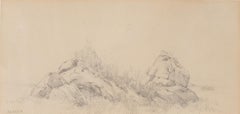
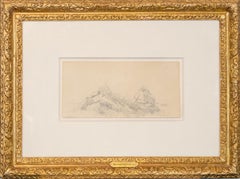
Study off Newport, Rhode Island, 1876
Signed in pencil "JS265A" lower left
Pencil on paper
5 x 10 inches
Provenance:
Estate of the artist
Grand Central Art Galleries, New York, 1959
Mr. William H. Bender Jr
Sotheby's New York, September 19, 1987
Private Collection 1987-2000
Mark Borghi Fine Art Inc., circa 2002
Private Collection (acquired from the above), New York
Recognized as the leading portraitist in England and the United States at the turn of the century, John Singer Sargent was acclaimed for his elegant and very stylish depictions of high society. Known for his technical precocity, he shunned traditional academic precepts in favor of a modern approach towards technique, color and form, thereby making his own special contribution to the history of grand manner portraiture.
A true cosmopolite, he was also a painter of plein air landscapes and genre scenes, drawing his subjects from such diverse locales as England, France, Italy and Switzerland. In so doing, Sargent also played a vital role in the history of British and American Impressionism.
Sargent was born in Florence in 1856. He was the first child of Dr. Fitzwilliam Sargent, a surgeon from an old New England family, and Mary Newbold Singer, the daughter of a Philadelphia merchant. His parents were among the many prosperous Americans who adopted an expatriate lifestyle during the later nineteenth century. Indeed, Sargent's family traveled constantly throughout the Continent and in England, a mode of living that enriched Sargent both culturally and socially. He ultimately became fluent in French, Italian and German, in addition to English.
Having developed an interest in drawing as a boy, Sargent received his earliest formal instruction in Rome in 1869, where he was taught by the German-American landscape painter Carl Welsch. Following this, he attended the Accademia di Belle Arti in Florence during 1873-74.
In the spring of 1874, Sargent's family moved to Paris, enabling him to continue his training there. He soon entered the studio of Charles-Emile-Auguste Carolus-Duran. In contrast to most French academic painters, Carolus-Duran taught his students to paint directly on the canvas, capturing the essence of his subject through relaxed brushwork, a tonal palette and strong chiaroscuro. Although Sargent also spent four years studying drawing under Léon Bonnat at the Ecole des Beaux-Arts, it was Carolus-Duran's approach that would form the aesthetic basis of his style.
Upon his teacher's advice, Sargent also traveled to Spain and Holland to study the work of old master painters such as Diego Velázquez and Frans Hals, both of whom also employed deft, fluid techniques.
In 1876, Sargent made his first visit to the United States, claiming his American citizenship and visiting the Philadelphia Centennial Exposition. One year later, he spent the summer in Cancale, in France's Brittany region, where he painted outdoors, applying Carolus-Duran's strategies to portrayals of fishing folk on sunlit beaches. His reputation in Paris was established in 1878 when his Oyster Gatherers of Cancale (1878; Corcoran Gallery of Art, Washington, D.C.) won an Honorable Mention at that year's Salon.
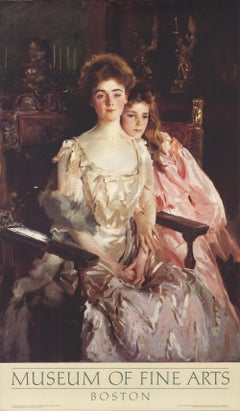
During the early 1880s, Sargent began making painting trips abroad, working in Venice in 1880 and 1882, where he painted street scenes and interiors notable for their brilliant play of light and shadow. He also embarked on what would be a lucrative career as a portraitist, producing such well known works as The Daughters of Edward Darley Boit (1882; Museum of Fine Arts, Boston).
His early commissions also included an image of Madame Pierre Gautreau. A renowned beauty and member of Parisian society, Madame Gautreau was known for her bold, unorthodox approach towards fashion. In her portrait, entitled "Madame X" (1884; Metropolitan Museum of Art, New York), Sargent effectively captured her distinctive aura. However, his daring realism, coupled with fact that he portrayed a diamond shoulder strap falling off one of her shoulders, caused such an uproar that his career in France was seriously compromised.
As a result of the controversy surrounding "Madame X,"Sargent left Paris in 1886, settling permanently in London. He subsequently flourished in the English capital, becoming the leading portrait painter to the upper classes. Those who shared Sargent's sense of refinement and sophistication, as well as his international viewpoint, were especially drawn to his fashionable French style.
In addition to patronage from such prominent British families as the Wertheimers and the Marlboroughs, Sargent received an equal number of American commissions, many of them secured by artists and architects he had met during his student days in Paris, among them painters J. Carroll Beckwith and Julian Alden Weir and architect Stanford White. On a painting tour to America during 1887-1888, he portrayed members of notable families from Boston and New York, including Mrs. Jacob Wendell and Elizabeth Allen...
Category
1870s Impressionist John Singer Sargent Art
MaterialsPaper, Pencil, Graphite