McVey Art
to
1
Overall Width
to
Overall Height
to
1
1
1
1
1
1
1
1
1
1
10,164
2,784
2,504
1,379
1
Artist: McVey
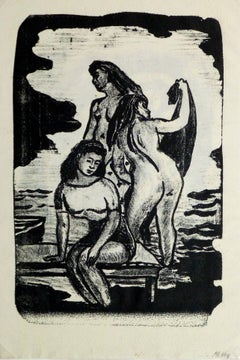
Three Nudes Bathing
By McVey
Located in Houston, TX
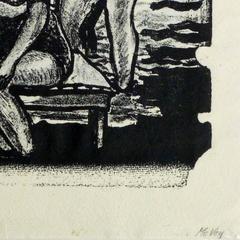
Alluring black and white fine art stone lithograph of three females frolicking in the shallow water around a dock by artist McVey, circa 1950. Signed lower right.
Original one-of-a-...
Category
1950s McVey Art
Materials
Ink, Paper
Related Items
"The Little One" - Rare Signed Figurative Lithograph in Ink on Paper
Located in Soquel, CA
"The Little One" - Figurative Lithograph in Ink on Paper
Bold lithograph by Eugene Hawkins (American, b. 1933). A young child is kneeling, facing away ...
Category
1960s American Modern McVey Art
Materials
Paper, Ink, Lithograph
$675
H 20.75 in W 16.75 in D 0.5 in
The Four Seasons: Spring Japanese Woodblock Triptych ink on Paper Tales of Genji
Located in Soquel, CA
The Four Seasons: Spring - Japanese Woodblock Triptych in Ink on Paper
Colorful kabuki scene by Utagawa Kuniteru (Japanese, active 1818-18...
Category
Early 19th Century Edo McVey Art
Materials
Paper, Ink, Woodcut
$1,850
H 18.75 in W 44.25 in D 0.75 in
Elegant Amusements of Eastern Genji - Japanese Triptych Woodblock Print on Paper
By Utagawa Kunisada (Toyokuni III)
Located in Soquel, CA
Elegant Amusements of Eastern Genji - Japanese Triptych Woodblock Print on Paper
Dynamic woodblock print with several elegantly dressed figures by Utag...
Category
1850s Edo McVey Art
Materials
Paper, Ink, Woodcut
$1,550
H 22.5 in W 32.5 in D 1 in
Native American Figurative Woodblock -- "Weaving" #5/12
By Virginia J Hughins
Located in Soquel, CA
Wonderful woodblock print titled "Weaving" by Aptos, California artist Virginia J Hughins (Virginia Brubaker DeWolf) (American, 1923-2004), circa 1990.
Signed "Virginia" bottom rig...
Category
1990s American Impressionist McVey Art
Materials
Paper, Ink
$550
H 24 in W 20 in D 0.25 in
"Various Himochi" Wagashi Festival Japanese Woodblock Print by Utagawa Toyokuni
By Utagawa Toyokuni
Located in Soquel, CA
"Various Himochi" Wagashi Festival Japanese Woodblock Print by Utagawa Toyokuni
Rare oversized early 19th century 5-tiered woodblock by Utagawa Ichiyosai Toyokuni, (Japan, 1769-1825), a Japanese lord and wife oversee a sekku festival of food, music, and dolls or toys. '"oshi" is the first day of “Mi (Snake)” in the third month of the lunar calendar. This day, known in modern Japan as the Girls' Festival, originated in China as a form of purification ceremony in which water and drinking peach blossom wine were used to drive away evil. Many kinds of hishi-mochi appear in this picture of hina ningyo (dolls associated with Hinamatsuri, or the Girl’s Day) from Omochae.
The custom of eating special dishes at events throughout the year and at milestones in people's lives has existed since ancient times. This paragraph specifically focuses on the annual event called sekku, and life events that involve eating sweets. Joshi is the first day of “Mi (Snake)” in the third month of the lunar calendar. This day, known in modern Japan as the Girls' Festival, originated in China as a form of purification ceremony in which water and drinking peach blossom wine were used to drive away evil. According to the Keiso saijiki, in ancient China, on the third day of the third lunar month, people ate “ryuzetsuhan,” which is the juice of gogyo (Jersey cudweed) mixed with rice flour and nectar. In Japan, there is a record in the Heian period history book Nihon Montoku tenno jitsuroku [839-5] that it was an annual event to make kusamochi using gogyo on the third day of the third month of the lunar calendar, which may have been influenced by Chinese customs.
The tradition of eating kusamochi on the third day of the third month of the lunar calendar continued after that. By the Edo period, however, hishimochi had come to be used as a sweet to serve on the third day of the third month. A picture of a hishimochi is included in the Morisada manko , which we mentioned in Part 1. According to it, hishimochi in the Edo period were often three layers of green-white-green instead of the now common red-white-green. However, it is possible to see from our collection that not all hishimochi were made in this way. Omochae published in 1857, is a good example. Omochae is a type of ukiyoe print...
Category
1820s Edo McVey Art
Materials
Ink, Rice Paper, Woodcut
$1,850
H 26.75 in W 21.75 in D 0.25 in
Japanese Artisans - Silk Dying -Japanese Woodblock Print
By Tosa Mitsuyoshi
Located in Soquel, CA
Japanese Artisans - Japanese Woodblock Print J
Japanese woodblock depicting six women, all wearing vibrant kimonos, working on crafts by Tosa Mitsuoki (Japanese, 1617-1691). Japanese,c. 1600. Handcraft depiction (dye works).Section from a painted screen with presentations of handcraft.Kita-in, Saitama.
Stamped lower left.
Presented in a white mat and giltwood frame.
Frame: 19"H x 14"W
Mat: 18.25"H x 13.25"W
Image: 14.5"H x 9.5"W
Tosa Mitsuoki was a Japanese painter, reinvigorating the Yamato style of classical Japanese painting. Yamato-e originated from interest in reproducing early Tang dynasty paintings, and was later reinvented and further refined to fit Japanese cultural perceptions in the late Heian period. Yamato, sometimes referred to as wa or kazu had become synonymous with the Tosa-ha by the Muromachi period as a way for Japanese artist to distinguish their works from those of mainland Chinese paintings, kara-e. Yamato-e incorporated various visual and literary techniques for establishing narrative. Works were not always accompanied with text and may rely on heavily on period specific visual motifs, icons, and symbols to relay a story or theme. Tosa style by the time of Mitsuoki focused heavily on depicting themes of plants and nature, famous places, meisho, the four seasons, shik, bird-and-flower, kacho. Many of these popular symbols and icons from mimicking Chinese practices, treating the original Chinese masterwork as a sort of prototype to improve upon. Popular formats for Mitsuoki's pictures were wall scrolls kakemono, or handscrolls that would be read from right to left with the accompanied story, sliding doors fusuma and folding screen panels byobu that featured up to six panels. Mitsuoki's style incorporated the depth and calligraphy techniques of ink wash brushwork similar to Song dynasty and Yuan dynasty Chinese court paintings...
Category
1920s Edo McVey Art
Materials
Paper, Ink, Woodcut
$1,550
H 19 in W 14 in D 0.5 in
Finely Detailed Abstract W/Woman Carrying a Young Child Collotype on paper
Located in Soquel, CA
Finely Detailed Abstract W/Woman Carrying a Young Child Collotype on paper
Finely detailed etching or collotype of a complicated fine line drawing o...
Category
1990s Abstract Expressionist McVey Art
Materials
Paper, Ink, Etching
$525
H 11.25 in W 15 in D 0.07 in
"Sister Water" - St Francis of Assisi Linocut
Located in Soquel, CA
"Sister Water" - St Francis of Assisi Linocut
Wood Black pring of St Francis by Italian artist (printer of Assisi) Gastone Vignati (Italian, 20C)...
Category
1990s Baroque McVey Art
Materials
Paper, Ink, Linocut
“Inside Out 1” Black & White Photography 24" x 36" in Ed. of 7 by Brian Ziff
By Brian Ziff
Located in Culver City, CA
“Inside Out 1” Black & White Photography 24" x 36" in Ed. of 7 by Brian Ziff
Giclee (Archival Ink) Print on Canson Platine Fibre Rag
From "Park Drive" series
Brian Ziff is a ...
Category
21st Century and Contemporary Surrealist McVey Art
Materials
Archival Ink, Rag Paper, Giclée
$2,500
H 24 in W 36 in D 0.1 in
Sumiyoshi: Dengaku dance performed during an Onda ceremony - Woodblock Print
By Utagawa Hiroshige
Located in Soquel, CA
Sumiyoshi: Dengaku dance performed during an Onda ceremony - Woodblock Print
Bright woodblock print by Utagawa Hiroshige (Japanese, 1797-1858). In this scene, two dancers with swords and fans are facing each other, in the center of a courtyard. There are spectators surrounding them, including nobles in black clothing on a balcony.
Presented in a new off-white mat with foamcore backing.
Mat size: 16"H x 20"W
Paper size: 9.63"H x 14.5W"
Utagawa Hiroshige (1797-1858, sometimes called Ando Hiroshige) was the second of the two great masters of the Japanese landscape woodblock print...
Category
1830s Edo McVey Art
Materials
Ink, Rice Paper, Woodcut
$850
H 16 in W 20 in D 0.25 in
Mid Century French Color Lithograph "Homme au Feuillage" (Man with Foliage)
By Jean Lurçat
Located in Soquel, CA
Beautiful early 20th Century color linocut of abstracted man with leaves titled "Homme au Feuillage" (Man with Foliage) by French artist Jean Lucat (French, 1892 - 1966), circa 1950....
Category
1950s Modern McVey Art
Materials
Paper, Ink, Linocut
$3,500
H 24 in W 20 in D 0.2 in
"The Battle of the Golden Spurs" Avante Garde Print
By James Ensor
Located in Soquel, CA
"The Battle of the Golden Spurs" Avante Garde Print
This print of the massive Bataille des Éperons d’Or, or Battle of the Golden Spurs, is considered one of Jame's Ensor's (Belgian ...
Category
1890s Expressionist McVey Art
Materials
Paper, Ink, Etching
$2,000
H 15.5 in W 17.75 in D 0.75 in
Mcvey art for sale on 1stDibs.
Find a wide variety of authentic McVey art available for sale on 1stDibs. You can also browse by medium to find art by McVey in ink, paper and more. Not every interior allows for large McVey art, so small editions measuring 1 inch across are available. Customers who are interested in this artist might also find the work of Pompeo Borra, Percy Drake Brookshaw, and Elias Newman. McVey art prices can differ depending upon medium, time period and other attributes. On 1stDibs, the price for these items starts at $225 and tops out at $225, while the average work can sell for $225.