By Rembrandt van Rijn
Located in New Orleans, LA
Rembrandt van Rijn
1606-1669 Dutch
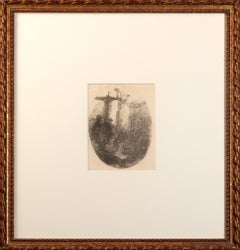
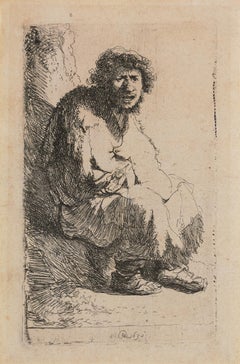
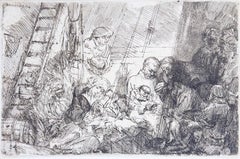
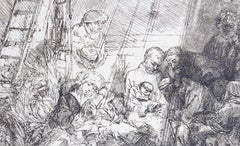
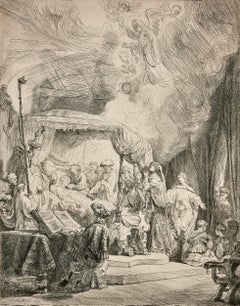
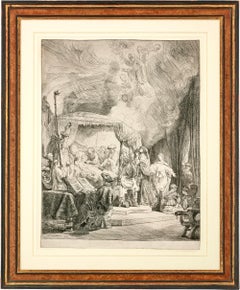
The Death of the Virgin
Etching and drypoint on laid paper
State II of V
Signed and dated "Rembrandt f. 1639" (lower left)
In The Death of the Virgin, Rembrandt engages with traditional iconography but approaches it through a markedly humanized lens. Departing from the more common portrayal of a youthful, idealized Virgin, he depicts Mary as aged, emphasizing the gravity of her final moments. Unlike earlier compositions that typically include only Apostles, Rembrandt broadens the scene to incorporate women and a physician who gently checks her pulse, elements that, while not drawn from canonical scripture, enrich the scene’s emotional and narrative realism. At 15 1/2” high, it is also a remarkably large etching by the artist, adding to its dramatic impact and rarity.
This emotionally rich scene unfolds within a shadowed, timbered chamber, its earthly gravity offset by a host of angels who hover above, delicately sketched in wisps of light. Rembrandt's handling of the etching needle is particularly free and expressive in this upper register, suggesting spiritual transcendence. Notably, he leaves visible the traces of earlier compositional decisions, such as the repositioned risers supporting the bed, offering rare insight into his creative process.
The son of a miller, Rembrandt van Rijn is believed to have been born in Leiden on July 15, 1606. He studied first at the Latin School and was then enrolled at the University of Leiden at the age of 14. He soon left to study art—first with a local master, Jacob van Swanenburch, and then, in Amsterdam, with Pieter Lastman, known for his historical paintings. Rembrandt was an exceptionally gifted student and mastered his art in a mere six months. Now 22 years old, he returned to Leiden and was soon so highly regarded that he was able to take students of his own.
Though known today primarily for his paintings, Rembrandt's fame spread outside the Netherlands thanks to his etchings...
Category
17th Century Old Masters Rembrandt van Rijn Art
MaterialsLaid Paper, Drypoint, Etching