By Vincent van Gogh
Located in New Orleans, LA
Vincent van Gogh
1853-1890 Dutch
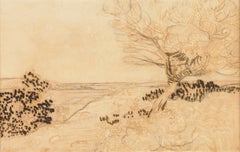
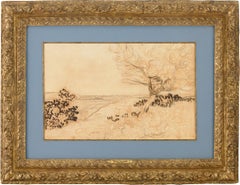
View of La Crau with Tree in the Foreground
Signed "Vincent" (lower left)
Pencil, Reed Pen and Ink on Paper
“In my opinion the two views of the Crau and of the country on the banks of the Rhone are the best things I have done in pen and ink”— Vincent van Gogh to his brother Theo, Letter 509.
Drawn in the countryside of Arles, France in May of 1888, Vincent van Gogh’s View of La Crau with Tree in the Foreground, is an exceptional example of the artist’s groundbreaking artistic approach, innovative understanding of spatial planes and expressive rendering of untamed nature.
Prior to his time in Arles, much of van Gogh’s work fell in line with the standards put forth by the Academy — traditional subject matters rendered in the accepted techniques. In 1888, upon his arrival in the French countryside, van Gogh entered a decisively new creative phase, experimenting with the thrilling abstraction and brushwork that would come to define his genius. Works produced between 1888 and 1890 are the best of van Gogh’s career and the most desired compositions among collectors and museums. Because of van Gogh’s prolific correspondence during this time, the creation of this drawing has been extremely well documented, emphasizing how importantly van Gogh himself viewed this work during his lifetime.
In Arles, the hill of the Abbey of Mont Majour was a favorite drawing spot for van Gogh – it was within walking distance of his famed “Yellow House” studio and its slopes afforded excellent panoramic views of La Crau, the plain through which the river Rhone meanders towards the Mediterranean. Van Gogh made a number of drawings of the rocky hill and the ancient abbey, but his most impressive drawings were composed when the artist was perched atop the hill.
This view of La Crau is taken from the vantage point at the top of Mont Majour. Van Gogh kept the horizon low and rendered an abundance of sky, against which he silhouetted a large tree swirling with voluminous branches and leaves. The expressive abstraction seen in the lines of the tree recalls the mystifying swirls of van Gogh’s later masterpiece Starry Night. The composition, with enlarged foreground and diminished middle distance and background offers a dramatic contrast and underscores van Gogh’s unique understanding of space.
Van Gogh’s drawings of La Crau were not preparatory studies or sketches, but rather, conceived as individual works of art in their own right. This view of La Crau was part of a group of seven drawings that van Gogh executed during May 1888. Van Gogh was quite taken with this composition, writing to his brother Theo that, "The contrast between the wild romantic foreground, and the distant perspective, wide and still, with horizontal lines sloping into the chain of the Alps ... is very striking”(Letter no. 470), adding that the view to him was, “as beautiful and as infinite as the sea.”
As evidenced by van Gogh’s own glowing writings on these works, it is clear that these drawings are some of the artist’s most beloved. Other drawings of La Crau from this series reside in the British Museum and at the Van Gogh Museum in Amsterdam. This drawing has been featured in several exhibitions, holding a privileged position in the Metropolitan Museum of Art’s 1984 exhibition Van Gogh in Arles, as reflected in the popular exhibition catalogue.
Van Gogh’s period in Arles was marked by revelatory creative development and a most impressive artistic output against the backdrop of the artist’s growing mental duress. Van Gogh was open about his struggles, reflecting sentiments like, “My brain is still feeling tired and dried up.” However, he found solace in his work, noting that in spite of his deteriorating state, “some good canvases have come out of it.”
This beautiful and rare drawing is an important work by the modern master and reflects van Gogh’s profound and persistent desire to create and evolve despite his struggles.
Paper: 11 1/4“ high by 18 1/4" wide
Framed: 21 7/8" high by 28 5/8" wide by 1 1/4" deep
Exhibited:
European Master Drawings of the Nineteenth and Twentieth Centuries, Mills College Art Gallery, Oakland, CA, February 19-March 29, 1939, no. 118. Exhibition traveled to Seattle, Art Museum, April 5-May 7, 1939
Master Drawings, Wildenstein, New York, NY, February-March, 1973
From Bosch to Klee, Wildenstein, New York, NY, September 11-October 12, 1974
Scenes of France, Wildenstein, New York, NY, September 7-October 2, 1976
Van Gogh in Arles The Metropolitan Museum of Art, New York, NY, October 18-December 30, 1984, no. 31, (cat. by Ronald Pickvance)
References:
Jacob-Baart de la Faille, L'Œuvre de Vincent van Gogh: catalogue raisonné, Paris and Brussels, 1928, III, p. 129, no. 1418. Illustrated IV, pl. CXLIX, no. 1418
Annet Tellegen, “Van Gogh en Montmajour,” Bulletin Museum Boymans-van Beuningen, XVIII, No. 1, 1967, p. 29. Illustrated fig. 23
Jacob-Baart de la Faille, The Works of Vincent van Gogh: His Paintings and Drawings, Amsterdam, 1970, pp. 497, no. F 1418; cited under no. F 1417; 662, no. F 1418. Illustrated p. 497
Charles W. Millard, “A Chronology for Van Gogh's Drawings of 1888,” Master Drawings, vol. XII, No. 2, 1974, p. 158
Jan Hulsker, The Complete Van Gogh: Paintings, Drawings, Sketches, New York, 1980, p. 324, no. 1431; also cited p. 322. Illustrated p. 324
Otterlo, Rijksmuseum Kröller-Müller, Vincent van Gogh, dessins, 1990, pp. 221, 222, 227
Jan Hulsker, The New Complete Van Gogh: Paintings, Drawings, Sketches, Amsterdam and Philadelphia, 1996, p. 324, no. 1431; also cited pp. 318/320. Illustrated p. 324
New York, The Metropolitan Museum of Art, and Amsterdam, The Van Gogh Museum, Vincent Van Gogh: The Drawings, 2005, cited in essay by Susan Alyson Stein, “First Encounters,” p. 150; and in essay by S. van Heugten, “Metamorphoses: Van Gogh’s Drawings Then and Now,” p. 55 note 10
Leo Jansen...
Category
19th Century Post-Impressionist Vincent van Gogh Art
MaterialsPaper, Ink, Pen, Pencil