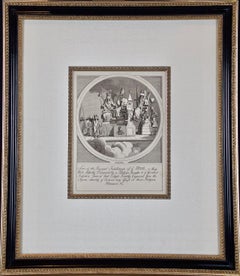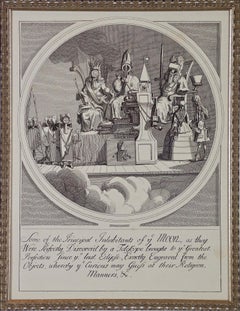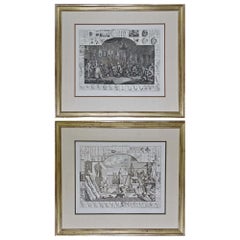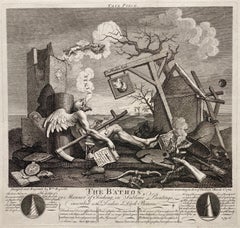
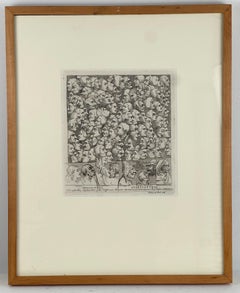
BATHOS / Tail PIece
By William Hogarth
Located in Santa Monica, CA
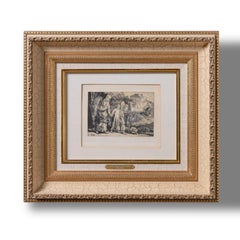
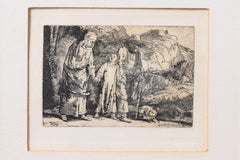
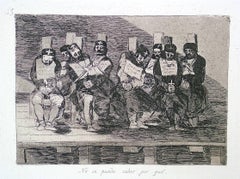
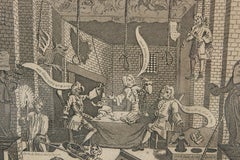
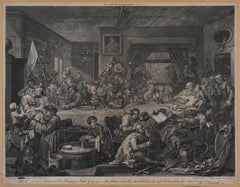
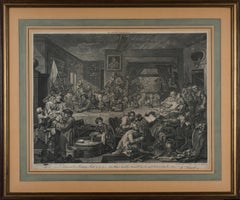
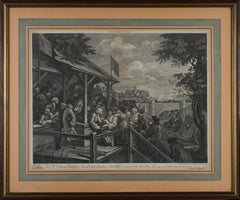
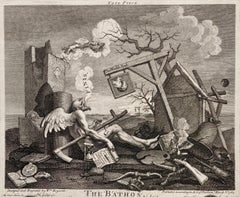
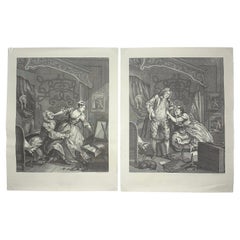
WILLIAM HOGRATH (1767- 1764) THE BATHOS / Tail Piece 1764 (Paulson 1989: 216 I/I Paulson 1965/70: 216 I/I) Engraving Plate 12 7/8 x 13 3/8, sheet 17 ¾ x 18 ¾ Designed & Engrav’d by Wm Hogarth at left and Published according to Act of Parliam’t March 3, 1764 at right. Good condition on thick laid paper Small bit of tape on the left & right sheet edges small stan lower sheet edge all on recto. This Hogarth’s last print is fascinating as it is prophacy about death. Various institutions have interesting commentaries - to wit: Chicago Art Institute: Hogarth created The Bathos toward the end of his life. It is considered one of the bleakest artworks of the 18th century because it depicts the Apocalypse without an afterlife. The Angel of Death even collapses in exhaustion after having destroyed the world. In his hand is an execution decree and around him lies a mass of broken objects. Princeton: Hogarth’s last print, The Bathos,….. is filled with all manner of images denoting the end of life as we know it. Entry no. 216 in Ronald Paulson’s catalogue raisonne Hogarth’s Graphic Works, 3rd revised edition says “This print is the culmination of such pessimistic images . . . . [taking] his general composition, the configuration of objects, and some of the particular items, from Dürer’s engraving, Melancholia; but he also recalls Salvator Rosa’s Democritus in Meditation (which derives from Dürer’s print) with a scroll at the bottom of the etching: ‘Democritus the mocker of all things, confounded by the ending of All Things’ (Antal, p.168).” Newfields (Indianapolis Museum of Art): Hogarth intended this engraving to serve as the tailpiece to bound volumes of his collected engravings and, appropriately, it proved to be his last engraving. Father Time has died and his last will and testament has been witnessed by the three Fates. He is surrounded by a landscape of death, decay, and ruin. Hogarth aimed this print at dealers in “dark” Old Masters paintings who promoted the idea that ruins evoked sublime feelings in viewers—a sentiment, Hogarth wrote, that was reducing the world to ruin. British Caricature...
1760s Old Masters William Hogarth Art
Woodcut

![[1896] The Complete Works of William Hickling Prescott](https://a.1stdibscdn.com/1896-the-complete-works-of-william-hickling-prescott-for-sale/f_89252/f_449273521746717258337/f_44927352_1746717258707_bg_processed.jpg?width=240)
![[1896] The Complete Works of William Hickling Prescott](https://a.1stdibscdn.com/1896-the-complete-works-of-william-hickling-prescott-for-sale-picture-2/f_89252/f_449273521746717363812/935p1_55__master.jpg?width=240)