Want more images or videos?
Request additional images or videos from the seller
1 of 9

Frank Stella
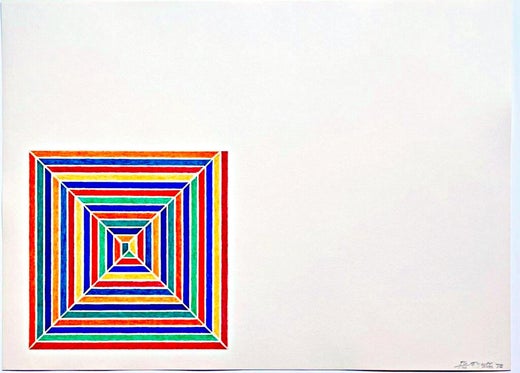
Frank Stella -Attica Defense Fund historic LtEd Geometric abstraction lithograph

1974

$9,200
£7,005.79
€8,000.17
CA$12,927.14
A$14,183.53
CHF 7,471.20
MX$168,728.06
NOK 95,705.21
SEK 87,391.93
DKK 59,768.97

About the Item

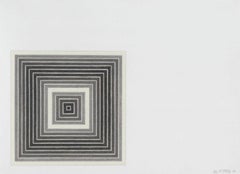
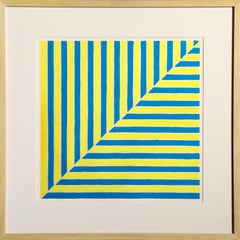
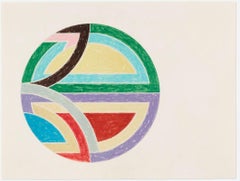
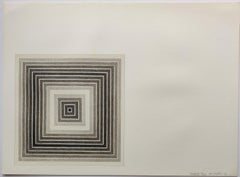
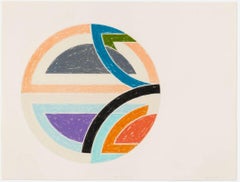
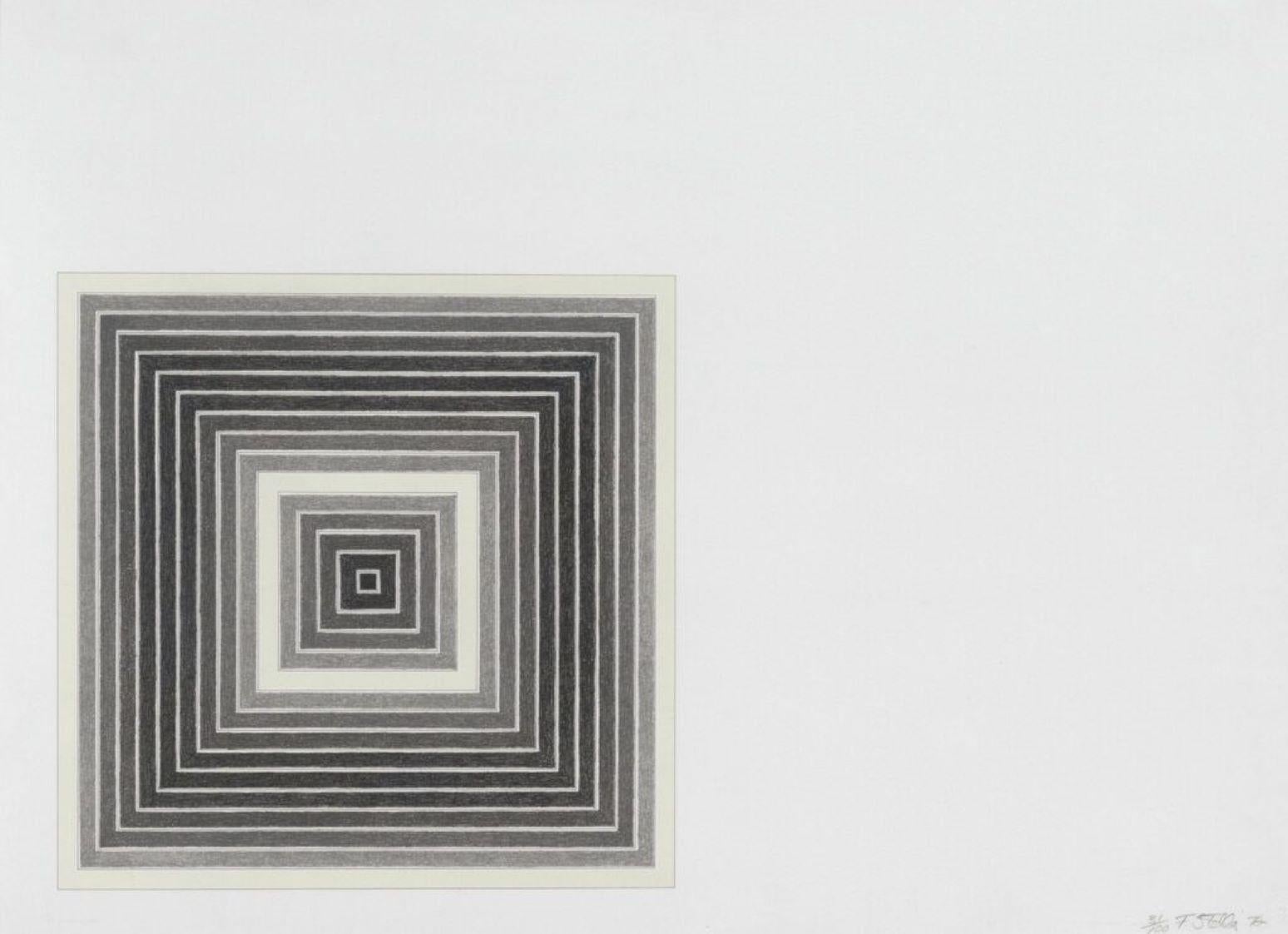
Another example of this iconic Frank Stella print can be found at the Poster House Museum in Manhattan. For inspiration only are photographs from their display. "The concentric square is just a powerful pictorial image. Its so good that you can us it, abuse it, and even work against it to the point of ignoring it. It has a strength that's almost indestructible - at least for me. It's one of those givens, and it's very hard for me not to paint it. It is a successful picture before you start, and it's pretty hard to blow it." - Frank Stella Frank Stella Attica Defense Fund print, 1974 Limited Edition Offset lithograph print on high quality lithographic paper 29 1/2 × 29 1/2 in 74.9 × 74.9 cm Edition: 3000* (note: although the stated edition is 3,000, these were posted publicly and outside all over the state, so very few have survived in this condition) Published by Attica Brothers Legal Defense Fund, New York; printed by Graphic Press, NY Unframed The print is gorgeous - done on high quality lithographic art paper, so it doesn't have the feel of of a more common smooth poster. This historic poster was created by Frank Stella as a show of solidarity and to raise funds for the Attica Defense Fund, which was created to aid the inmates charged during the 1971 riots. Fans of popular culture recognize the word "ATTICA" - made famous by Al Pacino in the 1975 movie "Dog Day Afternoon" when his character, Sonny, a bank robber, invokes the famous prison riots and subsequent murder trials by taking to the street shouting, like a mantra "Attica, Attica, Attica.." The Attica Prison uprising, also known as the Attica Prison rebellion or Attica Prison riot, occurred at the Attica Correctional Facility in Attica, New York, United States, in 1971. Based upon prisoners' demands for better living conditions and political rights, the uprising was one of the most well-known and significant uprisings of the Prisoners' Rights Movement. As a result of the Attica uprisings, 43 people died, and in 1975 an Attica Defense Fund was created to help pay the legal fees for many of those involved. Frank Stella's "Attica" was his contribution to the cause. On June 8, 2017, Frank Stella's 1975 Study for this famous "Attica" poster -- a gouache on paper, sold at Christie's for almost $550,000 (more than half a million dollars.) FRANK STELLA BIOGRAPHY b. 1936, Malden, Massachusetts; d, 2024, New York Frank Stella was born in 1936 in Malden, Massachusetts. After attending high school at Phillips Academy in Andover, Massachusetts, he went on to Princeton University, where he painted and majored in history. Early visits to New York art galleries would prove to be an influence upon his artistic development. Stella moved to New York in 1958 after his graduation. Stella’s art was recognized for its innovations before he was twenty-five. In 1959, several of his paintings were included in Three Young Americans at the Allen Memorial Art Museum at Oberlin College, as well as in Sixteen Americans at the Museum of Modern Art in New York (1959–60). Stella joined dealer Leo Castelli’s stable of artists in 1959. In his early series, including the Black Paintings (1958–60), Aluminum Paintings (1960), and Copper Paintings (1960–61), Stella cast aside illusionistic space for the physicality of the flat surface and deviated from the traditional rectangular-shaped canvas. Stella married Barbara Rose, later a well-known art critic, in 1961. Stella’s Irregular Polygon canvases (1965–67) and Protractor series (1967–71) further extended the concept of the shaped canvas. Stella began his extended engagement with printmaking in the mid-1960s, working first with master printer Kenneth Tyler at Gemini G.E.L. In 1967, Stella designed the set and costumes for Scramble, a dance piece by Merce Cunningham. The Museum of Modern Art in New York presented a retrospective of Stella’s work in 1970. During the following decade, Stella introduced relief into his art, which he came to call “maximalist” painting for its sculptural qualities. Ironically, the paintings that had brought him fame before 1960 had eliminated all such depth. After introducing wood and other materials in the Polish Village series (1970–73), created in high relief, he began to use aluminum as the primary support for his paintings. As the 1970s and 1980s progressed, these became more elaborate and exuberant. Indeed, his earlier Minimalism became baroque, marked by curving forms, DayGlo colors, and scrawled brushstrokes. Similarly, his prints of these decades combined various printmaking and drawing techniques. In 1973, he had a print studio installed in his New York house. From the mid-1980s to the mid-1990s, Stella created a large body of work that responded in a general way to Herman Melville’s Moby Dick. During this time, the increasingly deep relief of Stella’s paintings gave way to full three-dimensionality, with sculptural forms derived from cones, pillars, French curves, waves, and decorative architectural elements. To create these works, the artist used collages or maquettes that were then enlarged and re-created with the aid of assistants, industrial metal cutters, and digital technologies. In the 1990s, Stella began making freestanding sculpture for public spaces and developing architectural projects. In 1992–93, for example, he created the entire decorative scheme for Toronto’s Princess of Wales Theatre, which includes a 10,000-square-foot mural. His 1993 proposal for a kunsthalle (arts center) and garden in Dresden did not come to fruition. His aluminum bandshell, inspired by a folding hat from Brazil, was built in downtown Miami in 1999. In 2001, a monumental Stella sculpture was installed outside the National Gallery of Art in Washington, D.C. Stella’s work was included in several important exhibitions that defined 1960s art, among them the Solomon R. Guggenheim Museum’s The Shaped Canvas (1964–65) and Systemic Painting (1966). His art has been the subject of several retrospectives in the United States, Europe, and Japan. Among the many honors he has received was an invitation from Harvard University to give the Charles Eliot Norton lectures in 1983–84. Calling for a rejuvenation of abstraction by achieving the depth of baroque painting, these six talks were published by Harvard University Press in 1986. -Courtesy Guggenheim
  • Creator:
    Frank Stella (1936, American)
  • Creation Year:
    1974
  • Dimensions:
    Height: 29.5 in (74.93 cm)Width: 29.5 in (74.93 cm)
  • Medium:
  • Movement & Style:
  • Period:
  • Condition:
  • Gallery Location:
    New York, NY
  • Reference Number:
    1stDibs: LU1745217369442

More From This Seller

View All
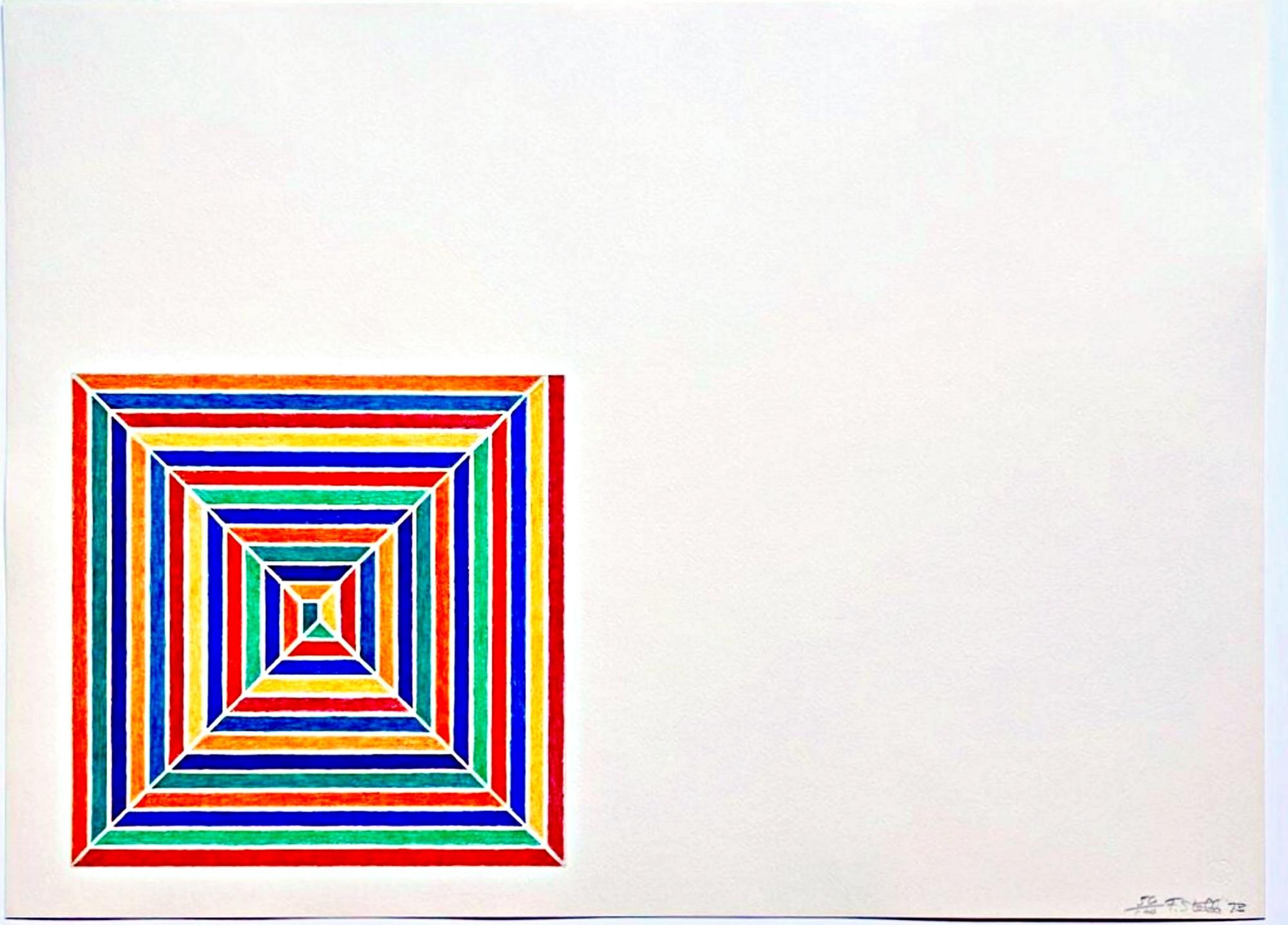
Frank Stella, Sharpesville from Multicolored Squares I (Axsom 79) Lithograph S/N
By Frank Stella
Located in New York, NY
Frank Stella Sharpesville, from Multicolored Squares I (Axsom 79), 1972 Lithograph on J. Green mould-made paper Signed in graphite pencil, dated and numbered 31/100 (there were also ...
Category

1970s Abstract Geometric Abstract Prints

Materials

Lithograph

Frank Stella Hand Signed 93/100 Whitney Museum Lithograph Abstract Expressionist
By Frank Stella
Located in New York, NY
Frank Stella Large Limited Edition Hand Signed Whitney Museum Print, 1985 Offset Lithograph Hand signed, dated and numbered 93 from the edition of 100, lower left front 75 7/10 × 52 ...
Category

1980s Abstract Expressionist Abstract Prints

Materials

Lithograph, Offset

Frank Stella, Line Up, from Jasper's Dilemma, signed/n, geometric abstraction
By Frank Stella
Located in New York, NY
Frank Stella Line Up, from Jasper's Dilemma (Axsom 85), 1973 Lithograph in colors on J. Green mould-made paper Signed, dated and numbered 56/100 in pencil lower right front 16 × 22 i...
Category

1970s Abstract Geometric Abstract Prints

Materials

Lithograph

Frank Stella, Whitney Museum exhibited graphic work with Label, Signed/N, Framed
By Frank Stella
Located in New York, NY
Frank Stella (Whitney Museum Exhibited) Shards IVA (Axsom 151), 1982 Lithograph & Silkscreen on Arches Cover Paper (Whitney Museum exhibition label verso of frame) 45 1/2 × 39 1/...
Category

1980s Abstract Expressionist Abstract Prints

Materials

Mixed Media, Lithograph, Screen

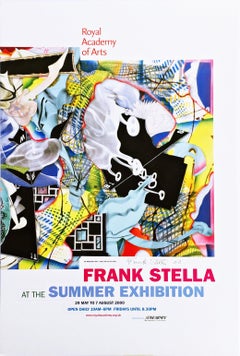
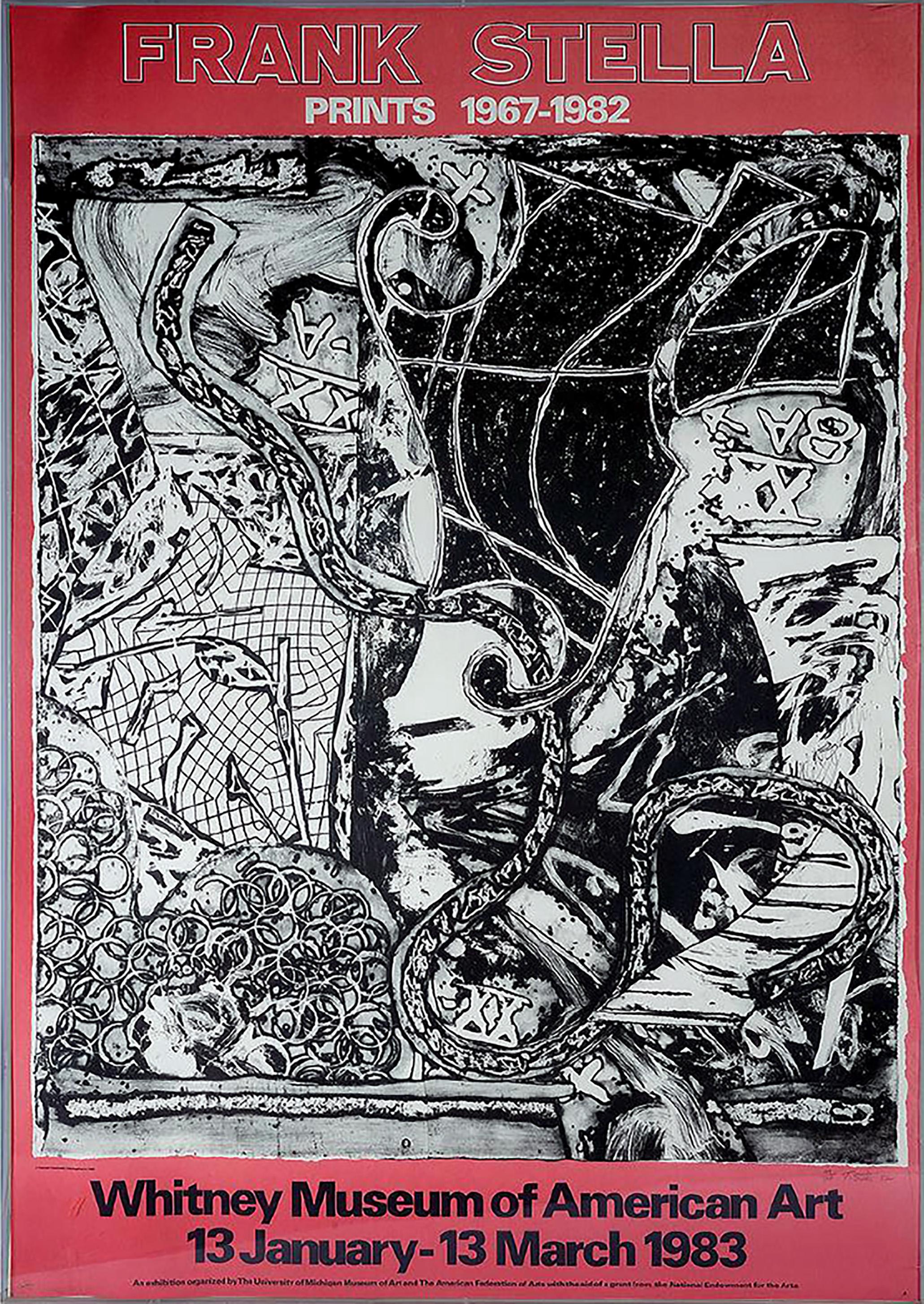
Royal Academy of Arts, London UK offset lithograph (Hand Signed by Frank Stella)
By Frank Stella
Located in New York, NY
Frank Stella Frank Stella, Royal Academy of Arts (Hand Signed), 2000 Offset Lithograph poster on thin Boldly hand signed and dated by Frank Stella in ink on the front 29 3/4 x 20 inches Unframed Accompanied by Certificate of Guarantee issued by Alpha 137 Gallery This Frank Stella poster...
Category

Early 2000s Abstract Expressionist Abstract Prints

Materials

Lithograph, Offset

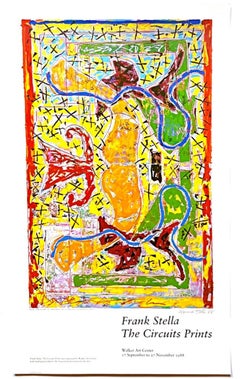
Limited Edition Walker Art Center exhibition print, Hand Signed by Frank Stella
By Frank Stella
Located in New York, NY
Frank Stella Frank Stella The Circuit Prints (Hand Signed), 1988 Color offset lithograph poster (hand signed by Frank Stella) Signed and dated 88 in ink by Frank Stella directly unde...
Category

1980s Abstract Expressionist Abstract Prints

Materials

Lithograph, Offset

You May Also Like

Frank Stella 'Union Pacific' from Aluminum Series, Limited Edition, Signed Print
By Frank Stella
Located in San Rafael, CA
Frank Stella (American, 1936-2024) 'Union Pacific' (from the Aluminum Series), 1970 Lithograph and screenprint in metallic silver on Special Arjomari paper Edition 33/75 (there were ...
Category

1970s Abstract Geometric Abstract Prints

Materials

Lithograph

Untitled (Rabat), Geometric Abstract Screenprint by Frank Stella 1964
By Frank Stella
Located in Long Island City, NY
An original screenprint by Frank Stella from X + X (Ten Works by Ten Painters) published in 1964 by Wadsworth Atheneum, CT. The print was printed by Ives-Sillman, CT and referenced i...
Category

1960s Abstract Geometric Abstract Prints

Materials

Screen

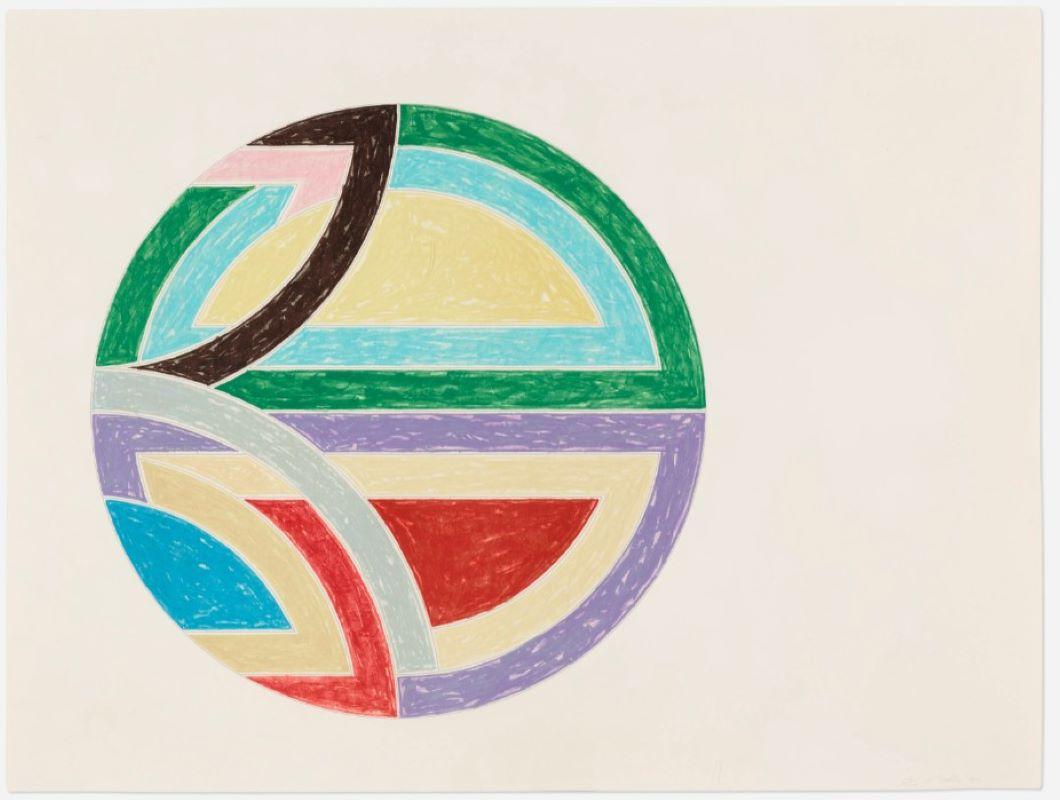
Sinjerli Variation I Lithograph & Screenprint Hand Signed Ed 100. Created 1977
By Frank Stella
Located in Philadelphia, PA
Frank Stella b.1936 Sinjerli Variation I 1977 lithograph and screenprint in colors on Arches Cover 31¾ h × 42 w in (81 × 107 cm) Signed, dated and numbered to lower right edition of...
Category

1970s Abstract Geometric Prints and Multiples

Materials

Lithograph, Screen

Frank Stella -- Sharpesville, from Multicolored Squares I
By Frank Stella
Located in BRUCE, ACT
Frank Stella Sharpesville, from Multicolored Squares I, 1972 Hang signed and numbered A.P. 3 /20 lower right Image size: 26.1 x 26.1 cm Sheet size: 41 x 55.6 cm Published by Petersb...
Category

1970s Prints and Multiples

Materials

Lithograph

Sinjerli Variation Ia Lithograph & Screenprint Hand Signed Ed 100. Created 1977
By Frank Stella
Located in Philadelphia, PA
Frank Stella b.1936 Sinjerli Variation Ia 1977 lithograph and screenprint in colors on Arches Cover 31¾ h × 42 w in (81 × 107 cm) Signed, dated, and numbered to lower right edition ...
Category

1970s Abstract Geometric Prints and Multiples

Materials

Lithograph, Screen

Frank Stella (1936-2024) “Rabat” Abstract Screenprint Unframed Edition of 500
By Frank Stella
Located in Fort Lauderdale, FL
Frank Stella (1936-2024) “Rabat” Abstract Screenprint Unframed Edition of 500 Frank Stella’s “Rabat” Screenprint (1964) is a mid century abstract geometric composition. Created on w...
Category

Mid-20th Century American Mid-Century Modern Prints

Materials

Paper