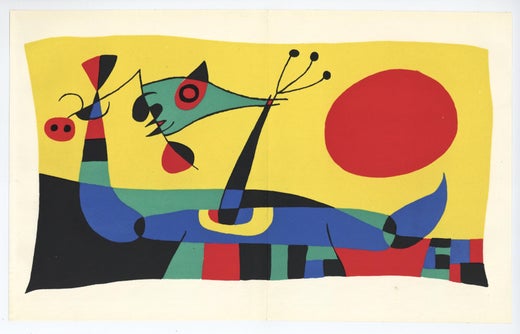
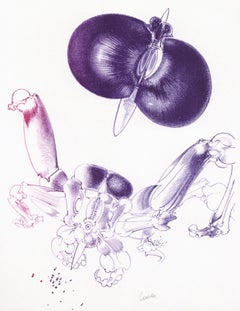
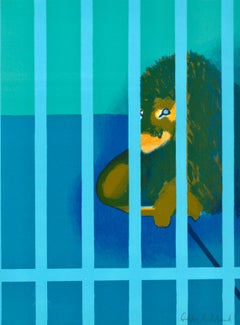
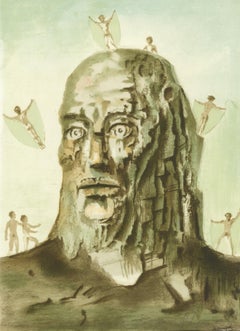
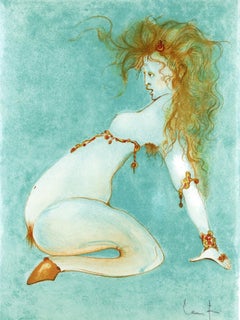
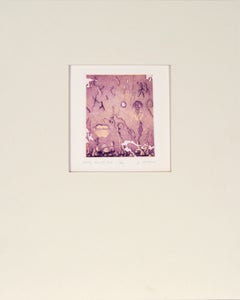
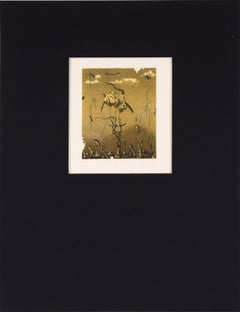
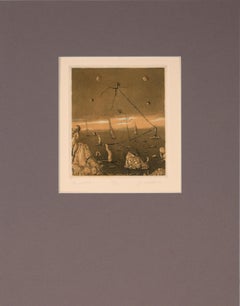
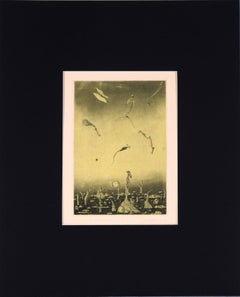
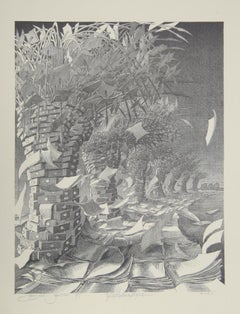
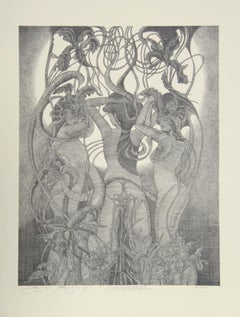
This exquisite lithograph by Joan Miro (1893–1983), titled Miro a l'encre II (Miro in Ink II), originates from the 1972 album Indelible Miro. Published by Societe Internationale d'Art XXe Siecle, Paris, under the direction of Gualtieri di San Lazzaro, and printed by Arte, Adrien Maeght, Paris, September 30, 1972, this work reflects Miros mastery of spontaneous gesture, fluid line, and the lyrical freedom that defined his late graphic production.
Executed as a lithograph on velin paper, this work measures 13.75 x 10 inches. Unsigned and unnumbered as issued. Printed by Arte, Adrien Maeght, Paris, one of the foremost ateliers of the modern era.
Artwork Details:
Artist: Joan Miro (1893–1983)
Title: Miro a l'encre II (Miro in Ink II), from the album Indelible Miro, 1972
Medium: Lithograph on velin paper
Dimensions: 13.75 x 10 inches (34.92 x 25.4 cm)
Inscription: Unsigned and unnumbered as issued
Date: 1972
Publisher: Societe Internationale d'Art XXe Siecle, Paris
Printer: Arte, Adrien Maeght, Paris
Catalogue raisonne reference: Miro, Joan, et al. Catalogue des Lithographies de Miro. Vol. IV. Maeght, 1981, illustrations 837-838. Cramer, Patrick. Joan Miro: The Illustrated Books: Catalogue Raisonne. Patrick Cramer, 1989, illustration 161.
Condition: Well preserved, consistent with age and medium
Provenance: From the 1972 album Indelible Miro, published by Societe Internationale d'Art XXe Siecle, Paris; printed by Arte, Adrien Maeght, Paris, September 30, 1972
Notes:
Excerpted from the album This work, conceived by G. Di San Lazzaro as a graphic-art production, has been made possible by the gracious collaboration of Joan Miro and Yvon Taillandier, and through the kindness of M. and Mme. Aime Maeght, Mme. Ben Houra, and MM. Jacques Dupin and Daniel Lelong. We also thank M. Jean Hugues, MM. Le Moigne and Dutrou, foremen of the studios of the Imprimerie Arte, as well as MM. Fernand Mourlot and Jean Celestin. Layout designed by G. Di San Lazzaro, assisted by Christine Gintz. Photos by Jacqueline Hyde. Translated from the French by Phyllis Freeman. 1972 by Societe Internationale D'Art XX Siecle, Paris. The printing of the text of this album was completed in France on September 30, 1972 on the presses of the Imprimerie Union. The color plates were printed in France by the Imprimerie Moderne du Lion from offset color-separations of Joan Miro's graphics that were made by the Perrot & Griset engraving studio. The frontispiece lithograph was pulled by Jean Celestin at Mourlot and the lithograph on pages 16-17 was pulled at the Imprimerie Arte by Rene Le Moigne, who was also responsible for printing the jacket lithograph, an original work by Joan Miro conceived specially for this edition.
About the Publication:
Indelible Miro, published in 1972 by Societe Internationale d'Art XXe Siecle under the direction of Gualtieri di San Lazzaro, stands among the most ambitious graphic-art tributes dedicated to Joan Miro in the later decades of his career. Designed as an artistically rigorous and scholarly edition, the album combines critical texts, photographic documentation, and a series of original lithographs that showcase Miros extraordinary vitality and inventiveness in the graphic arts. Produced in close collaboration with Miro, Yvon Taillandier, and the Maeght family, the album honors Miro's creative universe across drawing, painting, sculpture, ceramics, and printmaking. Its production involved some of the most respected print ateliers in France—including Imprimerie Union, Imprimerie Moderne du Lion, Imprimerie Arte, and the legendary Mourlot Freres—each contributing to the albums exceptionally high technical and aesthetic standards. The project reflects San Lazzaro's long-standing role as one of Miro’s most important champions, publishing major monographs and portfolios that helped define the international reception of Miro’s work. As a complete object, Indelible Miro embodies the intellectual refinement, curatorial ambition, and graphic excellence that characterize the finest 20th-century artist albums.
About the Artist:
Joan Miro (1893–1983) was a Catalan painter, sculptor, printmaker, and ceramicist whose visionary imagination and lyrical abstraction made him one of the most influential and beloved artists of the 20th century. Born in Barcelona, Miro drew inspiration from Catalan folk art, Romanesque frescoes, and the luminous landscapes of Mont-roig del Camp, developing a deep connection to nature that infused his work with vitality and symbolism. After formal training at the Escola d'Art in Barcelona, he absorbed the lessons of Post-Impressionism and Cubism before moving to Paris in the early 1920s, where he became a leading figure in the Surrealist movement. There, Miro forged a personal visual language of biomorphic shapes, floating symbols, and radiant color harmonies that reflected both spontaneity and spiritual depth. In creative dialogue with peers such as Alexander Calder, Alberto Giacometti, Salvador Dali, Wassily Kandinsky, Marcel Duchamp, and Man Ray, he helped revolutionize modern art by dissolving the boundaries between abstraction and dream imagery. Miros inventive approach extended far beyond painting, embracing sculpture, ceramics, and monumental public commissions that redefined how art could interact with space and emotion. His expressive freedom and gestural abstraction profoundly influenced later artists including Jackson Pollock, Mark Rothko, Alexander Calder, Jean Dubuffet, Antoni Tapies, and Joan Mitchell, inspiring generations who sought to merge instinct, color, and imagination. Today, Miros work remains a cornerstone of modernism, prized by collectors and celebrated in major museums worldwide. His highest auction record was achieved by Peinture (Etoile Bleue) (1927), which sold for 23561250 GBP (approximately 37 million USD) at Sotheby's, London, on June 19, 2012.
Joan Miro Indelible Miro 1972, Miro a l'encre II, Miro Arte Adrien Maeght, Miro velin paper, Miro collectible lithograph.