Want more images or videos?
Request additional images or videos from the seller
1 of 6
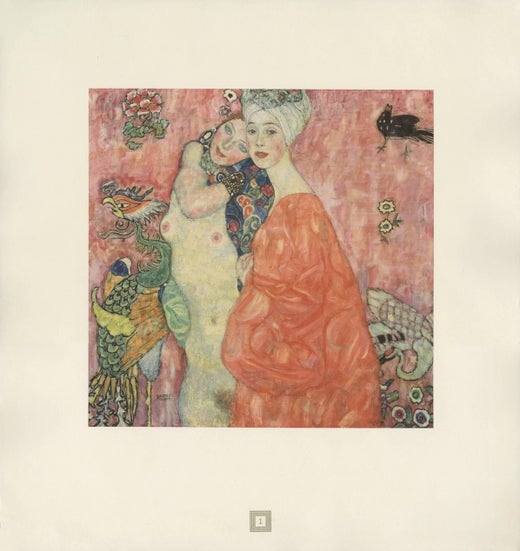
(after) Gustav KlimtMax Eisler Eine Nachlese folio "Girlfriends II" collotype print1931
1931
Price:$10,000
$12,000List Price
About the Item
- Creator:(after) Gustav Klimt (1862 - 1918, Austrian)
- Creation Year:1931
- Dimensions:Height: 18 in (45.72 cm)Width: 19 in (48.26 cm)
- Medium:
- Movement & Style:
- Period:
- Condition:
- Gallery Location:Palm Beach, FL
- Reference Number:1stDibs: LU46732710653
(after) Gustav Klimt
Gustav Klimt was an Austrian symbolist painter and a prominent member of the Vienna Secession movement. Klimt's primary subject was the female body and his works are mostly erotic in nature.
About the Seller
5.0
Gold Seller
Premium sellers maintaining a 4.3+ rating and 24-hour response times
Established in 2013
1stDibs seller since 2016
102 sales on 1stDibs
Typical response time: 4 hours
Authenticity Guarantee
In the unlikely event there’s an issue with an item’s authenticity, contact us within 1 year for a full refund. DetailsMoney-Back Guarantee
If your item is not as described, is damaged in transit, or does not arrive, contact us within 7 days for a full refund. Details24-Hour Cancellation
You have a 24-hour grace period in which to reconsider your purchase, with no questions asked.Vetted Professional Sellers
Our world-class sellers must adhere to strict standards for service and quality, maintaining the integrity of our listings.Price-Match Guarantee
If you find that a seller listed the same item for a lower price elsewhere, we’ll match it.Trusted Global Delivery
Our best-in-class carrier network provides specialized shipping options worldwide, including custom delivery.You May Also Like
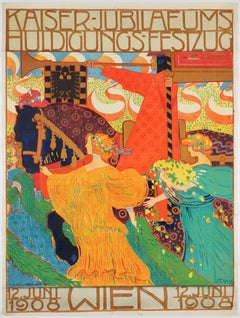
Original Vintage Secession Poster celebrating the emperor's jubilee
Located in Zurich, CH
Original Vintage Poster by the Austrian artist Ferdinand Ludwig Graf, a member of the Hagenbund. This Viennese artist association moved as soon a...
Category
Early 1900s Vienna Secession Figurative Prints
Materials
Paper
$13,700
Free Shipping
H 48.82 in W 36.42 in D 0.04 in
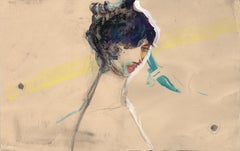
portrait, female, male, Angie, print, limited edition
Located in London, London
"Angie"
Portrait, limited edition, print on paper, hand signed,
black hair, red lips,
50x70cm
5/30
Is it a good investment?
1. There is nothing like this on the contemporary art m...
Category
21st Century and Contemporary Vienna Secession Portrait Prints
Materials
Color, Digital, Paper
$2,265
H 19.69 in W 27.56 in D 0.4 in
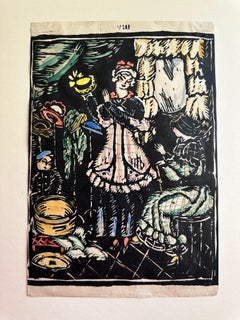
Untitled Woodcut
Located in Wilton, CT
Original hand-colored woodcut from a portfolio of Secessionist fashion illustrations. Signed in the lower right margin by the artist, Reni Schaschl (1895-1979), a talented member of...
Category
1910s Vienna Secession Figurative Prints
Materials
Woodcut
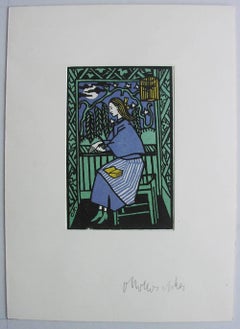
Mädchen am Fenster. 1906-08.
By Oskar Kokoschka
Located in New York, NY
Mädchen am Fenster. 1906-08. Color lithograph printed on smooth card stock. Full margins. , signed by the artist in pencil, on the recto. Published by the Wiener Werkstätte, Vienna, with the printed postcard text on verso. Among Kokoschka's earliest prints were a series of 14 postcards, the current work and the following lot that he produced for the Wiener Werkstätte. Wingler/Welz 4.
Oskar Kokoschka was an Austrian artist, poet and playwright best known for his intense expressionistic portraits...
Category
Early 1900s Vienna Secession Figurative Prints
Materials
Lithograph
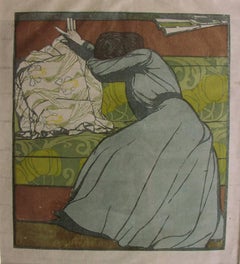
Der Polster
By Max Kurzweil
Located in New York, NY
Kurzweil, Maximilian. Der Polster, 1903. Color woodcut on japon. Included as an insert in Pan. Unsigned. Framed.11 1/4 x 10 1/4. 1
Ref: Hofstatter, p. 241; Pabst, p. 154.
Maximillian Kurzweil was the co-founder of the Vienna Secession in 1897 and editor and illustrator of the influential Secessionist magazine Ver Sacrum...
Category
Early 1900s Vienna Secession Figurative Prints
Materials
Lithograph
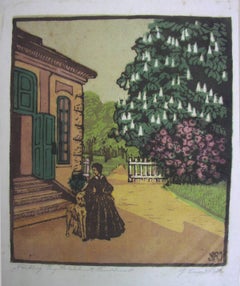
Fruhling
By Josef Siccard-Redl
Located in New York, NY
Siccard-Redl, Josef. Fruhling, Ca 1910. Color wood engraving, Signed and titled in pencil by the artist.
Little is known of this artist other than he worked in Vienna during the
...
Category
1910s Vienna Secession Figurative Prints
Materials
Engraving
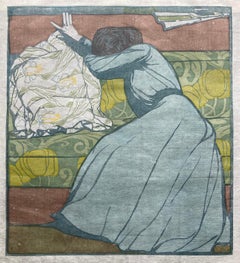
POLSTER (The Cushion)
By Max Kurzweil
Located in Santa Monica, CA
MAXIMILLIAN KURZWEIL (Austrian 1867-1916)
DER POLSTER / THE CUSHION, 1903. Color woodcut printed on laid japon paper, affixed as usual to a support sheet from its upper sheet edge...
Category
Early 1900s Vienna Secession Figurative Prints
Materials
Woodcut
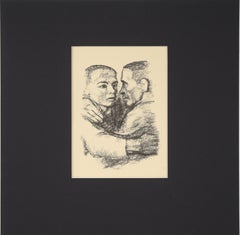
"Brotherhood" lithograph by Käthe Kollwitz
By Käthe Kollwitz
Located in Soquel, CA
Bold print of "Brotherhood" by Kathe Kollwitz (German, 1867-1945). This piece is one of the Lithographic reproductions of the original lithographs, plate 3 from a series of 10, print...
Category
1940s Expressionist Figurative Prints
Materials
Paper, Ink, Lithograph
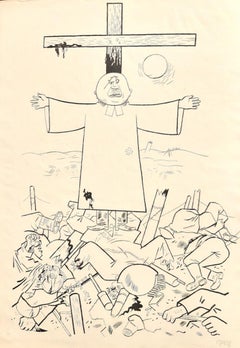
They Thunder forth from Their Clouds-Lithograph by George Grosz - 1922
By George Grosz
Located in Roma, IT
They Thunder forth from Their Clouds is an original lithograph, realized by George Grosz in 1922, from Die Raüber, edition Malik Verlag in 100 prints, plate n°8 da Die Raüber, hand-signed in pencil.
"They thunder forth from their clouds about gentleness and forbearance, while they sacrifice human victims to the God of love." (Da donnern sie Sanftmut und Duldung aus ihren Wolken und bringen dem Gott der Liebe Menschenopfer.)"
Sheet dimension: 61,5 x 42 cm.
In very good conditions.
Here representing a man in front of cross miserably praying, below of his feet laid down many dead bodies and ruined part of the city. here is one of his artwork affected by consequences drama of war.
George Grosz (1893 -1959) was a German artist known especially for his caricatural drawings and paintings of Berlin life in the 1920s. He was a prominent member of the Berlin Dada and New Objectivity group during the Weimar Republic.
He studied drawing at the Dresden Academy 1909-11 and at the School of Arts and Crafts in Berlin 1912-14, He was in the army 1914-15 and again for a short time in 1917, but spent the rest of the war in Berlin where he made violently anti-war drawings...
Category
1920s Expressionist Figurative Prints
Materials
Lithograph, Paper
$3,398
H 24.22 in W 16.54 in D 0.04 in
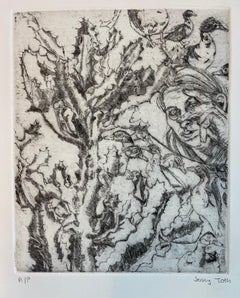
Ducks Quacking, Cactus Peeking, linear style, monochromatic
By Jenny Toth
Located in Brooklyn, NY
This is an artist proof aquatint of a woman peeking around a cactus with ducks mysteriously hovering in the upper right corner and a giant beautiful cactus overgrowing. The mood is ...
Category
2010s Expressionist Figurative Prints
Materials
Paper, Ink, Archival Ink, Aquatint
$600
H 17 in W 14.5 in D 0.6 in
More From This Seller
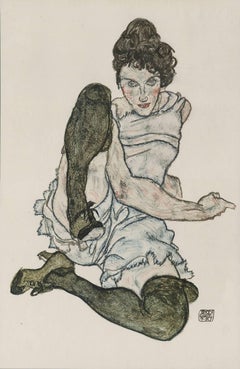
View AllE. Strache, Handzeichnungen folio, "Female Model, Seated" Collotype plate
By (after) Egon Schiele
Located in Palm Beach, FL
After Egon Schiele (1890 – 1918), AUSTRIA
“ART CANNOT BE MODERN, ART IS PRIMORDIALLY ETERNAL.” -SCHIELE
Defiantly iconoclastic in life and art, Egon Schiele is esteemed for his mas...
Category
1920s Vienna Secession Figurative Prints
Materials
Paper
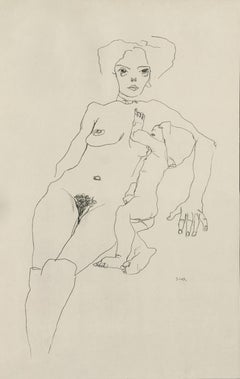
E. Strache, Handzeichnungen folio, "Nursing Mother with Child" Collotype plate
By (after) Egon Schiele
Located in Palm Beach, FL
after Egon Schiele (1890 – 1918), AUSTRIA
“ART CANNOT BE MODERN, ART IS PRIMORDIALLY ETERNAL.” -SCHIELE
Defiantly iconoclastic in life and art, Egon Schiele is esteemed for his mas...
Category
1920s Vienna Secession Figurative Prints
Materials
Paper
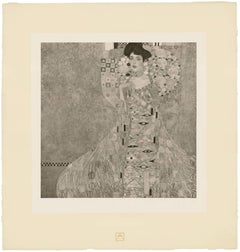
H.O. Miethke Das Werk folio "Portrait of Adele Bloch-Bauer" collotype print
By Gustav Klimt & K.K. Hof-und Staatsdruckerei
Located in Palm Beach, FL
This listing is for a single print, pictured, from the Das Werk portfolio by Gustav Klimt and k.k. Hof-und Staatsdruckerei, published by H.O. Miethke. Gu...
Category
Early 1900s Vienna Secession Figurative Prints
Materials
Paper
E. Strache, Handzeichnungen folio, "Crouching Female Nude" Collotype plate V
By (after) Egon Schiele
Located in Palm Beach, FL
Egon Schiele (1890 – 1918), AUSTRIA
“ART CANNOT BE MODERN, ART IS PRIMORDIALLY ETERNAL.” -SCHIELE
Defiantly iconoclastic in life and art, Egon Schiele is esteemed for his masterful...
Category
1920s Vienna Secession Figurative Prints
Materials
Paper
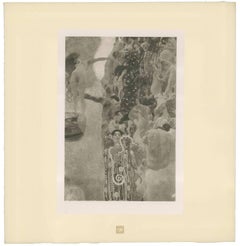
H.O. Miethke Das Werk folio "University of Vienna Murals" 3 collotype prints
By Gustav Klimt & K.K. Hof-und Staatsdruckerei
Located in Palm Beach, FL
This listing is for 3 collotypes: "Medicine", "Jurisprudence", and "Philosophy", pictured, from the Das Werk portfolio by Gustav Klimt and k.k. Hof-und Staatsdruckerei, published by H.O. Miethke. Gustav Klimt created glyphs, unique to each of these pieces, specifically for this portfolio. Further information below:
About the portfolio:
DAS WERK GUSTAV KLIMTS, a portfolio of 50 prints, ten of which are multicolor collotypes on chine colle paper laid down on hand-made heavy cream wove paper with deckled edges; under each of the 50 prints is a gold signet intaglio printed on the cream paper each of which Klimt designed for the publication as unique and relating to its corresponding image; H.O. Miethke, Editor-Publisher; k.k. Hof-und Staatsdruckerei, Printer; printed in a limited edition of 300 numbered plus several presentation copies; Vienna, 1908-1914.
The idea of collaboration in the arts is anything but new; however it has so often been viewed and assessed as somehow devaluing the intrinsic worth of art. It’s as if it was a dirty secret to be hidden away. More so even than the eroticism explored by Klimt, which divided public opinion, the artistic avant-garde began to boldly flaunt artistic collaboration beginning in the 19th century- which gained steam in the first part of the 20th century- to become a driving vehicle of contemporary artistic creation. Viewed in this context, the folios of collotype prints published by H.O. Miethke in Vienna between 1908-1914 known as Das Werk Gustav Klimts, are important art documents worthy of as much consideration for their bold stand they take on established ways of thinking about artistic collaboration as they are for their breathtakingly striking images.
1908 is indeed a watershed moment in the history of art. To coincide with the 60th anniversary of the reign of Emperor Franz Joseph I, Kunstschau opened in Vienna in May of that year. It was there that Klimt delivered the inaugural speech. Speaking about the avant-garde group’s unifying philosophy of Gesamtkunstwerk, or the synthesis of the arts, Klimt shared his belief that the ideal means to bring artists and an audience together was via “work on major art projects.” It was at Kunstschau 1908 that Klimt first exhibited his most iconic painting, The Kiss, as well as The Sunflower, Water Snakes I and II and Danae. It was at Kunstschau 1908 that Das Werk Gustav Klimts was first available for purchase. Thanks to Galerie Miethke’s organization, Kunstschau 1908 was possible. Miethke’s pioneering art...
Category
Early 1900s Vienna Secession Figurative Prints
Materials
Paper
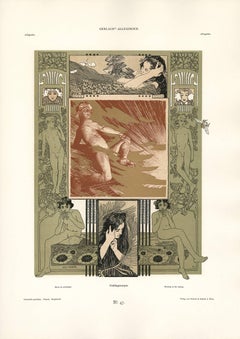
Gerlach's Allegorien Plate #47: "Morning in the Spring" Lithograph
By Koloman Moser
Located in Palm Beach, FL
Koloman Moser
(1868 –1918), AUSTRIAN
Instead of applying his flair and art education solely to painting, Koloman Moser embodied the idea of Gesamt Kunstwerk (all-embracing art work) by designing architecture, furniture, jewelry, graphics, and tapestries meant to coordinate every detail of an environment. His work transcended the imitative decorative arts of earlier eras and helped to define Modernism for generations to come. Moser achieved a remarkable balance between intellectual structure (often geometric) and hedonistic luxury.
Collaborating with Gustav Klimt and Josef Hoffmann, the artist was an editor and active contributor to Ver Sacrum, (Sacred Spring), the journal of the Viennese Secession that was so prized for its aesthetics and high quality production that it was considered a work of art. The magazine featured drawings and designs in the Jugendstil style (Youth) along with literary contributions from distinguished writers from across Europe. It quickly disseminated both the spirit and the style of the Secession.
In 1903 Moser and Hoffmann founded and led the Wiener Werkstatte (Viennese Workshop) a collective of artisans that produced elegant decorative arts items, not as industrial prototypes but for the purpose of sale to the public. The plan, as idealistic then as now, was to elevate the lives of consumers by means of beautiful and useful interior surroundings.
Moser’s influence has endured throughout the century. His design sensibility is evident from the mid-century modern furniture of the 1950s and ‘60s to the psychedelic rock posters...
Category
1890s Vienna Secession Figurative Prints
Materials
Paper