Want more images or videos?
Request additional images or videos from the seller
1 of 11
Joseph Webster GolinkinArm Scissorsc. 1938
c. 1938
Price:$1,100
About the Item
- Creator:Joseph Webster Golinkin (1896 - 1977, American)
- Creation Year:c. 1938
- Dimensions:Height: 23 in (58.42 cm)Width: 16 in (40.64 cm)Depth: 0.98 in (2.49 cm)
- Medium:
- Movement & Style:
- Period:
- Framing:Framing Options Available
- Condition:Good to excellent condition. There is some very subtle spotting at the lower and upper paper edge.
- Gallery Location:New York, NY
- Reference Number:Seller: 68645.11stDibs: LU33127829462

Joseph Webster Golinkin
JOSEPH WEBSTER GOLINKIN (1896-1977) Painter, printmaker, naval officer, politician, environmentalist, and philanthropist. He was a true Renaissance man – excelling in everything he pursued. Joseph Golinkin was born in Chicago on September 10, 1896, and studied at the Art Institute of Chicago. He entered the United States Naval Academy and, upon graduation, was commissioned as an Ensign and immediately deployed to serve in World War I. He remained in the Navy until 1922, when he resigned his commission to pursue his original career as an artist. He remained, however, in the active reserve as a Lieutenant Commander. After leaving the Navy, Golinkin moved to New York, where he studied at the Art Students League with Ash Can school artist George Luks. The two artists became fast friends, and Luks introduced him to many other artists. During the 1920s and 1930s, Golinkin exhibited with several other well-known artists, including George Bellows, Joseph Margulies, and David Shotwell. He was also represented by several renowned dealers in New York City, including Ferargil Galleries, Macbeth Gallery, and Van der Straeten. He had one-person shows at the Museum of the City of New York, the Macbeth Gallery, Ferargil Galleries, Gump's in San Francisco, the San Francisco Art Gallery, and the Los Angeles Olympics in 1984. His works are part of many museum collections, including the Metropolitan Museum, New York Public Library, Museum of the City of New York, Library of Congress, and the Art Institute of Chicago. As an artist, Golinkin worked in many mediums, including painting, watercolor, and lithography. While his subjects varied, two would dominate his work – scenes of New York and sports. He produced a large body of prints, drawings, and lithographs surrounding these two subjects. His images of New York include scenes of both city life and the structures, capturing the ambiance of the late 1920s and early 1930s. The sporting events Golinkin depicted include baseball, bicycle racing, bowling, boxing, football, hockey, horse racing, horse shows, golf, polo, tennis, track and field, wrestling, and yacht racing. He was awarded the Gold Medal for Artistic Excellence in Relation to Sport at the X Olympiad in 1932 and again at the XI Olympiad in 1936. Golinkin's sporting scenes have been reproduced as posters for several Olympic Games. His work is also in the collections of the Baseball Hall of Fame, the Palm Beach Polo Club, Madison Square Garden, numerous yacht clubs, and in the personal collections of well-known athletes and sports enthusiasts throughout the world. When the Navy reactivated him in 1938, his artistic career was put on hold. He served with great distinction during WWII, was awarded the Bronze Star, and retired from the Navy in 1958 with the rank of Rear Admiral. His other careers include serving for twelve years as Mayor of Centre Island, New York. As an early environmentalist, he formed a nonpartisan civic association that successfully opposed building a Robert Moses proposed bridge that would have connected Oyster Bay and Rye, New York.
About the Seller
4.7
Recognized Seller
These prestigious sellers are industry leaders and represent the highest echelon for item quality and design.
Established in 1898
1stDibs seller since 2015
59 sales on 1stDibs
Associations
International Fine Print Dealers Association
Authenticity Guarantee
In the unlikely event there’s an issue with an item’s authenticity, contact us within 1 year for a full refund. DetailsMoney-Back Guarantee
If your item is not as described, is damaged in transit, or does not arrive, contact us within 7 days for a full refund. Details24-Hour Cancellation
You have a 24-hour grace period in which to reconsider your purchase, with no questions asked.Vetted Professional Sellers
Our world-class sellers must adhere to strict standards for service and quality, maintaining the integrity of our listings.Price-Match Guarantee
If you find that a seller listed the same item for a lower price elsewhere, we’ll match it.Trusted Global Delivery
Our best-in-class carrier network provides specialized shipping options worldwide, including custom delivery.You May Also Like
Parasitic Plants, German antique botanical chromolithograph print.
Located in Melbourne, Victoria
'Schmarotzerpflanzen I'
(Parasitic plants)
German chromolithograph, circa 1910. Central vertical fold as issued.
245mm by 305mm (sheet)
Category
Early 20th Century Naturalistic More Prints
Materials
Lithograph

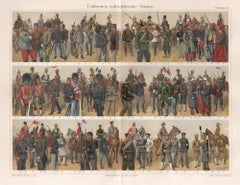
Military Uniforms, German antique army soldier chromolithograph print.
Located in Melbourne, Victoria
'Uniformen ausserdeutscher Staaten'
(Uniforms of non-German states)
German chromolithograph, circa 1910. Central vertical fold as issued.
245mm by 305mm (sheet)
Category
Early 20th Century Naturalistic More Prints
Materials
Lithograph
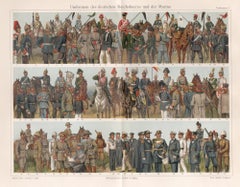
Military Uniforms, German antique army soldier chromolithograph print.
Located in Melbourne, Victoria
'Uniformen des deutschen Reichsheeres und der Marine'
(Uniforms of the German Imperial Army and Navy)
German chromolithograph, circa 1910. Central vertical fold as issued.
245mm ...
Category
Early 20th Century Naturalistic More Prints
Materials
Lithograph
Descente aux enfers
By Georges Braque
Located in Paris, FR
Lithograph on Japan Paper, 1961
handsigned by the artist in pencil
23 x 19 cm (image) - 32 x 25 cm (sheet)
very good condition
LCD2804
Category
1960s Modern Figurative Prints
Materials
Lithograph
Al Hirschfeld "Phantom of the Opera" Signed Lithograph Printers Proof, circa 988
By Albert Al Hirschfeld
Located in San Francisco, CA
Al Hirschfeld "Phantom of the Opera" hand signed lithograph printers proof, circa 1988
Sarah Brightman and Michael Crawford in Phantom of the Opera.
This is a rare printers proof.
...
Category
Late 20th Century Other Art Style Figurative Prints
Materials
Lithograph
$3,800
H 24 in W 33 in D 2 in
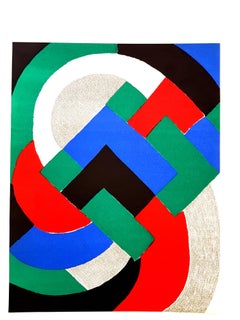
Sonia Delaunay - Composition - Original Lithograph
By Sonia Delaunay
Located in Collonge Bellerive, Geneve, CH
Sonia Delaunay - Composition
Original Lithograph
1969
Dimensions: 32 x 25 cm
Revue XXe Siècle
Cahiers d'art published under the direction of G. di San Lazzaro.
Sonia Delaunay was known for her vivid use of color and her bold, abstract patterns, breaking down traditional distinctions between the fine and applied arts as an artist, designer and printmaker.
Born Sarah Stern on November 14, 1885 in Gradizhsk, Ukraine, she was adopted in 1890 by her maternal uncle, Henri Terk, a lawyer in St. Petersburg, where she grew up, exposed to music and art, and learning several foreign languages. In 1903, she moved to Germany to study drawing with Ludwig Schmidt-Reutler (1863–1909) at the Karlsruhe academy of fine arts; Arnold Schoenberg (1874–1951), composer-to-be, was among her classmates there. In 1905, she traveled to Paris where she attended art classes at the Académie de la Palette, learned printmaking from Rudolf Grossman (1889–1941), and met Amédée Ozenfant (1886–1966), André Dunoyer de Segonzac (1884–1974), and Jean-Louis Boussingault (1883–1943). Sonia spent much of her time at exhibitions and galleries in Paris, which showed works by Paul Cézanne, Vincent Van Gogh, Pierre Bonnard, and Edouard Vuillard, as well as Les Fauves, Henri Matisse and André Derain. She did, however, maintain contact with Germany, exhibiting at the Galerie Der Sturm, Berlin, in 1913, 1920 and 1921.
During her first year in Paris, Sonia met the German collector and art-dealer, Wilhelm Uhde (1874–1947), whom she married on December 5, 1908, and whose Montparnasse gallery, the Galerie Notre-Dame des Champs, showed her first solo exhibition. Through Uhde, Sonia encountered many painters, including Pablo Picasso, Georges Braque, Maurice de Vlaminck, and Robert Delaunay (1885–1941). In 1910, Sonia divorced Uhde by mutual agreement, married Delaunay that same year, and gave birth to their son, Charles, in January 1911.
Together Sonia and Robert Delaunay pursued the study of color, influenced by theories of Michel-Eugène Chevreul (1786–1889). Sonia’s interest in simultaneous contrast, as evidenced in her early collages, book bindings, small painted boxes, cushions, waistcoats and lampshades, led to one of her first large-scale works, the painting of the Bal Bullier (1912–1913), a popular Parisian dance-hall. Sonia’s first “simultaneous dresses,” a mix of squares and triangles of taffeta, tulle, flannelette, moiré, and corded silk, date from this period.
Friendship with the poet Blaise Cendrars...
Category
1970s Abstract Geometric Figurative Prints
Materials
Lithograph
$1,545
H 12.6 in W 9.85 in D 0.04 in
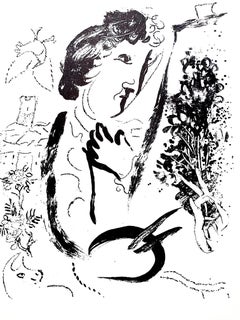
Marc Chagall - Original Lithograph
By Marc Chagall
Located in Collonge Bellerive, Geneve, CH
Marc Chagall
Original Lithograph
1963
Dimensions: 32 x 24 cm
Reference: Chagall Lithographe 1957-1962. VOLUME II.
Unsigned edition of over 5,000
Condition : Excellent
Marc Chagall (born in 1887)
Marc Chagall was born in Belarus in 1887 and developed an early interest in art. After studying painting, in 1907 he left Russia for Paris, where he lived in an artist colony on the city’s outskirts. Fusing his own personal, dreamlike imagery with hints of the fauvism and cubism popular in France at the time, Chagall created his most lasting work—including I and the Village (1911)—some of which would be featured in the Salon des Indépendants exhibitions. After returning to Vitebsk for a visit in 1914, the outbreak of WWI trapped Chagall in Russia. He returned to France in 1923 but was forced to flee the country and Nazi persecution during WWII. Finding asylum in the U.S., Chagall became involved in set and costume design before returning to France in 1948. In his later years, he experimented with new art forms and was commissioned to produce numerous large-scale works. Chagall died in St.-Paul-de-Vence in 1985.
The Village
Marc Chagall was born in a small Hassidic community on the outskirts of Vitebsk, Belarus, on July 7, 1887. His father was a fishmonger, and his mother ran a small sundries shop in the village. As a child, Chagall attended the Jewish elementary school, where he studied Hebrew and the Bible, before later attending the Russian public school. He began to learn the fundamentals of drawing during this time, but perhaps more importantly, he absorbed the world around him, storing away the imagery and themes that would feature largely in most of his later work.
At age 19 Chagall enrolled at a private, all-Jewish art school and began his formal education in painting, studying briefly with portrait artist Yehuda Pen. However, he left the school after several months, moving to St. Petersburg in 1907 to study at the Imperial Society for the Protection of Fine Arts. The following year, he enrolled at the Svanseva School, studying with set designer Léon Bakst, whose work had been featured in Sergei Diaghilev's Ballets Russes. This early experience would prove important to Chagall’s later career as well.
Despite this formal instruction, and the widespread popularity of realism in Russia at the time, Chagall was already establishing his own personal style, which featured a more dreamlike unreality and the people, places and imagery that were close to his heart. Some examples from this period are his Window Vitebsk (1908) and My Fianceé with Black Gloves (1909), which pictured Bella Rosenfeld, to whom he had recently become engaged.
The Beehive
Despite his romance with Bella, in 1911 an allowance from Russian parliament member and art patron Maxim Binaver enabled Chagall to move to Paris, France. After settling briefly in the Montparnasse neighborhood, Chagall moved further afield to an artist colony known as La Ruche (“The Beehive”), where he began to work side by side with abstract painters such as Amedeo Modigliani and Fernand Léger as well as the avant-garde poet Guillaume Apollinaire. At their urging, and under the influence of the wildly popular fauvism and cubism, Chagall lightened his palette and pushed his style ever further from reality. I and the Village (1911) and Homage to Apollinaire (1912) are among his early Parisian works, widely considered to be his most successful and representative period.
Though his work stood stylistically apart from his cubist contemporaries, from 1912 to 1914 Chagall exhibited several paintings at the annual Salon des Indépendants exhibition, where works by the likes of Juan Gris, Marcel Duchamp and Robert Delaunay were causing a stir in the Paris art world. Chagall’s popularity began to spread beyond La Ruche, and in May 1914 he traveled to Berlin to help organize his first solo exhibition, at Der Sturm Gallery. Chagall remained in the city until the highly acclaimed show opened that June. He then returned to Vitebsk, unaware of the fateful events to come.
War, Peace and Revolution
In August 1914 the outbreak of World War I precluded Chagall’s plans to return to Paris. The conflict did little to stem the flow of his creative output, however, instead merely giving him direct access to the childhood scenes so essential to his work, as seen in paintings such as Jew in Green (1914) and Over Vitebsk (1914). His paintings from this period also occasionally featured images of the war’s impact on the region, as with Wounded Soldier (1914) and Marching (1915). But despite the hardships of life during wartime, this would also prove to be a joyful period for Chagall. In July 1915 he married Bella, and she gave birth to a daughter, Ida, the following year. Their appearance in works such as Birthday (1915), Bella and Ida by the Window (1917) and several of his “Lovers” paintings give a glimpse of the island of domestic bliss that was Chagall’s amidst the chaos.
To avoid military service and stay with his new family, Chagall took a position as a clerk in the Ministry of War Economy in St. Petersburg. While there he began work on his autobiography and also immersed himself in the local art scene, befriending novelist Boris Pasternak, among others. He also exhibited his work in the city and soon gained considerable recognition. That notoriety would prove important in the aftermath of the 1917 Russian Revolution when he was appointed as the Commissar of Fine Arts in Vitebsk. In his new post, Chagall undertook various projects in the region, including the 1919 founding of the Academy of the Arts. Despite these endeavors, differences among his colleagues eventually disillusioned Chagall. In 1920 he relinquished his position and moved his family to Moscow, the post-revolution capital of Russia.
In Moscow, Chagall was soon commissioned to create sets and costumes for various productions at the Moscow State Yiddish...
Category
1960s Surrealist Figurative Prints
Materials
Lithograph
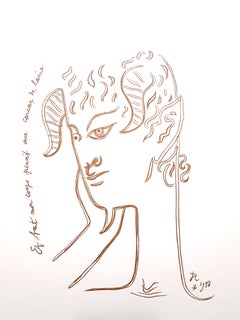
Jean Cocteau - Reflections - Original Lithograph
By Jean Cocteau
Located in Collonge Bellerive, Geneve, CH
Original Lithograph by Jean Cocteau
Title: Reflections
Signed in the plate
Dimensions: 32 x 25.5 cm
Edition: 200
1959
Publisher: Bibliophiles Du Palais
Unnumbered as issued
Category
1950s Modern More Prints
Materials
Lithograph
$1,426
H 12.6 in W 10.04 in D 0.04 in
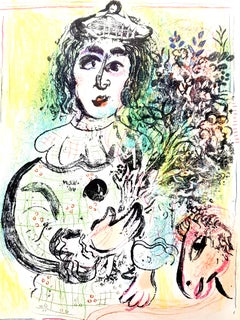
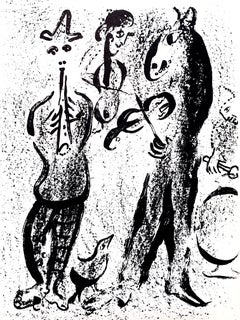
Marc Chagall - Flowered Clown - Original Lithograph
By Marc Chagall
Located in Collonge Bellerive, Geneve, CH
Marc Chagall
Original Lithograph
1963
Dimensions: 32 x 24 cm
From Chagall Lithograph II
Reference: Mourlot 399
Condition : Excellent
Unsigned and unumbered as issued
Category
1960s Surrealist Figurative Prints
Materials
Lithograph
$1,486
H 9.45 in W 12.6 in D 0.04 in
Marc Chagall - Original Lithograph
By Marc Chagall
Located in Collonge Bellerive, Geneve, CH
Marc Chagall
Original Lithograph
1963
Dimensions: 32 x 24 cm
Reference: Chagall Lithographe 1957-1962. VOLUME II.
Unsigned edition of over 5,000
Condition : Excellent
Marc Chagall (born in 1887)
Marc Chagall was born in Belarus in 1887 and developed an early interest in art. After studying painting, in 1907 he left Russia for Paris, where he lived in an artist colony on the city’s outskirts. Fusing his own personal, dreamlike imagery with hints of the fauvism and cubism popular in France at the time, Chagall created his most lasting work—including I and the Village (1911)—some of which would be featured in the Salon des Indépendants exhibitions. After returning to Vitebsk for a visit in 1914, the outbreak of WWI trapped Chagall in Russia. He returned to France in 1923 but was forced to flee the country and Nazi persecution during WWII. Finding asylum in the U.S., Chagall became involved in set and costume design before returning to France in 1948. In his later years, he experimented with new art forms and was commissioned to produce numerous large-scale works. Chagall died in St.-Paul-de-Vence in 1985.
The Village
Marc Chagall was born in a small Hassidic community on the outskirts of Vitebsk, Belarus, on July 7, 1887. His father was a fishmonger, and his mother ran a small sundries shop in the village. As a child, Chagall attended the Jewish elementary school, where he studied Hebrew and the Bible, before later attending the Russian public school. He began to learn the fundamentals of drawing during this time, but perhaps more importantly, he absorbed the world around him, storing away the imagery and themes that would feature largely in most of his later work.
At age 19 Chagall enrolled at a private, all-Jewish art school and began his formal education in painting, studying briefly with portrait artist Yehuda Pen. However, he left the school after several months, moving to St. Petersburg in 1907 to study at the Imperial Society for the Protection of Fine Arts. The following year, he enrolled at the Svanseva School, studying with set designer Léon Bakst, whose work had been featured in Sergei Diaghilev's Ballets Russes. This early experience would prove important to Chagall’s later career as well.
Despite this formal instruction, and the widespread popularity of realism in Russia at the time, Chagall was already establishing his own personal style, which featured a more dreamlike unreality and the people, places and imagery that were close to his heart. Some examples from this period are his Window Vitebsk (1908) and My Fianceé with Black Gloves (1909), which pictured Bella Rosenfeld, to whom he had recently become engaged.
The Beehive
Despite his romance with Bella, in 1911 an allowance from Russian parliament member and art patron Maxim Binaver enabled Chagall to move to Paris, France. After settling briefly in the Montparnasse neighborhood, Chagall moved further afield to an artist colony known as La Ruche (“The Beehive”), where he began to work side by side with abstract painters such as Amedeo Modigliani and Fernand Léger as well as the avant-garde poet Guillaume Apollinaire. At their urging, and under the influence of the wildly popular fauvism and cubism, Chagall lightened his palette and pushed his style ever further from reality. I and the Village (1911) and Homage to Apollinaire (1912) are among his early Parisian works, widely considered to be his most successful and representative period.
Though his work stood stylistically apart from his cubist contemporaries, from 1912 to 1914 Chagall exhibited several paintings at the annual Salon des Indépendants exhibition, where works by the likes of Juan Gris, Marcel Duchamp and Robert Delaunay were causing a stir in the Paris art world. Chagall’s popularity began to spread beyond La Ruche, and in May 1914 he traveled to Berlin to help organize his first solo exhibition, at Der Sturm Gallery. Chagall remained in the city until the highly acclaimed show opened that June. He then returned to Vitebsk, unaware of the fateful events to come.
War, Peace and Revolution
In August 1914 the outbreak of World War I precluded Chagall’s plans to return to Paris. The conflict did little to stem the flow of his creative output, however, instead merely giving him direct access to the childhood scenes so essential to his work, as seen in paintings such as Jew in Green (1914) and Over Vitebsk (1914). His paintings from this period also occasionally featured images of the war’s impact on the region, as with Wounded Soldier (1914) and Marching (1915). But despite the hardships of life during wartime, this would also prove to be a joyful period for Chagall. In July 1915 he married Bella, and she gave birth to a daughter, Ida, the following year. Their appearance in works such as Birthday (1915), Bella and Ida by the Window (1917) and several of his “Lovers” paintings give a glimpse of the island of domestic bliss that was Chagall’s amidst the chaos.
To avoid military service and stay with his new family, Chagall took a position as a clerk in the Ministry of War Economy in St. Petersburg. While there he began work on his autobiography and also immersed himself in the local art scene, befriending novelist Boris Pasternak, among others. He also exhibited his work in the city and soon gained considerable recognition. That notoriety would prove important in the aftermath of the 1917 Russian Revolution when he was appointed as the Commissar of Fine Arts in Vitebsk. In his new post, Chagall undertook various projects in the region, including the 1919 founding of the Academy of the Arts. Despite these endeavors, differences among his colleagues eventually disillusioned Chagall. In 1920 he relinquished his position and moved his family to Moscow, the post-revolution capital of Russia.
In Moscow, Chagall was soon commissioned to create sets and costumes for various productions at the Moscow State Yiddish...
Category
1960s Surrealist Figurative Prints
Materials
Lithograph
More From This Seller
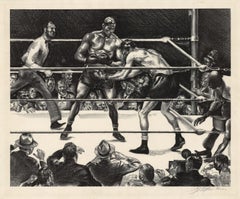
View AllJoe Louis vs. Max Baer at Yankee Stadium
By Joseph Webster Golinkin
Located in New York, NY
LOUIS & BAER AT YANKEE STADIUM.
This lithograph from circa 1935 was printed in an edition of 50. This particular impression is signed in pencil and inscribed “25/50.” The image size is 15 7/8 x 19 ¾ inches and the paper (sheet) size is 19 1/8 x 22 7/8 inches. There are two small purple estate stamps on verso.
"I define fear as standing across the ring from Joe Louis and knowing he wants to go home early." – Max Baer...
Category
1930s Naturalistic Figurative Prints
Materials
Lithograph
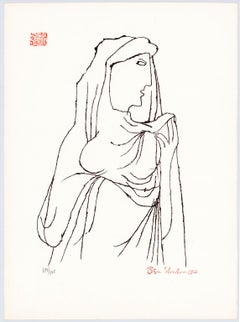
Levana
By Ben Shahn
Located in New York, NY
This elegant Ben Shahn lithograph entitled “Levana” was created in 1966. It was printed by Gemini G. E. L., Los Angeles, California, in an editi...
Category
1960s Modern Figurative Prints
Materials
Lithograph
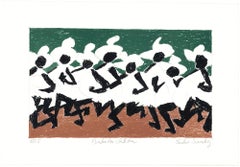
Barbados Children.
By Emilio Sanchez
Located in New York, NY
Emilio Sanchez (1921-1999) created this color lithograph entitled “Barbados Children” in 1996. This signed impression came to us directly from the Sanchez estate. Estate stamped on v...
Category
Late 20th Century American Modern Figurative Prints
Materials
Lithograph
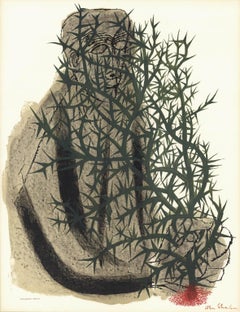
Blind Botanist
By Ben Shahn
Located in New York, NY
This 1963 lithograph, printed in color, is a fine example of Ben Shahn’s long preoccupation with the theme of the blind botanist and illustrates his con...
Category
Late 20th Century Modern Figurative Prints
Materials
Lithograph
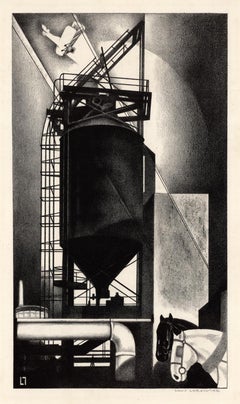
Tanks #1.
By Louis Lozowick
Located in New York, NY
This 1929 lithograph by Louis Lozowick was printed in an edition of 50. Lozowick signed this impression in pencil lower right with a monogram on stone, in the lower left. The sheet...
Category
Mid-20th Century Modern Figurative Prints
Materials
Lithograph
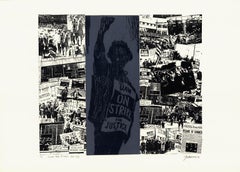
United Auto Workers, 1936-1937.
By Antonio Frasconi
Located in New York, NY
Antonio Frasconi created this woodcut and offset lithograph entitled "United Auto Worker, 1936-1937" in 1991. It is signed, titled, dated and inscribed “2/10” in pencil. The paper ...
Category
1990s Contemporary More Prints
Materials
Lithograph, Woodcut
Recently Viewed
View AllMore Ways To Browse
Matisse Sofa
Matsuno Sofu
Maud Hunt Squire
Maurice Goossens
Metka Krasovec
Michel Delacroix Bicycles
Miller Botanical Prints
Mizuno Toshikata On Sale
Modigliani Lithographs Hand Signed
Mostly Mozart Poster
Mozart Engraving
Mr Brainwash Hold On
Mr Brainwash Mickey Mouse
Mustafa Ayaz On Sale
Nan Goldin Prints Poster
Natalie Henry
Navaja Knife
Nic Jonk On Sale