Want more images or videos?
Request additional images or videos from the seller
1 of 5

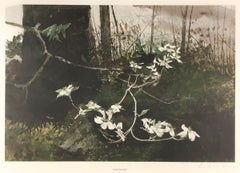
Wallace Nutting
Blossoms at the Bend

Price:$375

You May Also Like

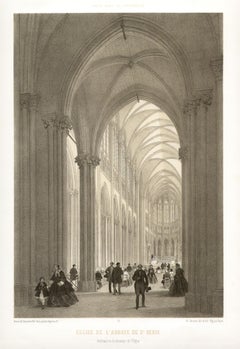
Paris - Eglise de L'abbaye de St Denis, French lithograph, 1861
By Philippe Benoist
Located in Melbourne, Victoria
'Eglise de L'abbaye de St Denis', tinted lithograph by Felix Benoist (1818-1896). From a series of lithographs depicting the famous buildings of Paris - 'Paris dans sa Splendeur', p...
Category

Late 19th Century Naturalistic Landscape Prints

Materials

Lithograph

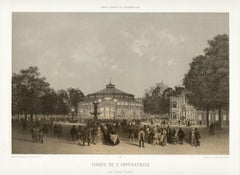
Paris - Cirque de L'Imperatrice, French lithograph, 1861
By Felix Benoist
Located in Melbourne, Victoria
'Cirque de l'Imperatrice aux Champs-Elysses', tinted lithograph by Felix Benoist (1818-1896). From a series of lithographs depicting the famous buildings of Paris - 'Paris dans sa S...
Category

Late 19th Century Naturalistic Landscape Prints

Materials

Lithograph

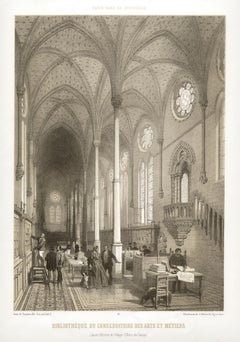
Paris - Bibliotheque du Conservatoire des Arts et Metiers, lithograph, 1861
By Philippe Benoist
Located in Melbourne, Victoria
'Bibliotheque du Conservatoire des Arts et Metiers', tinted lithograph by Felix Benoist (1818-1896). From a series of lithographs depicting the famous buildings of Paris - 'Paris da...
Category

Late 19th Century Naturalistic Landscape Prints

Materials

Lithograph

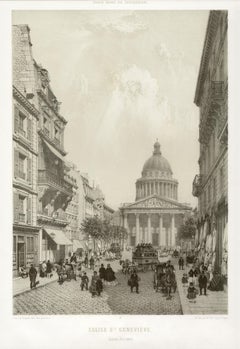
Paris - Eglise Saint Genevieve (Ancien Pantheon), French lithograph, 1861
By Philippe Benoist
Located in Melbourne, Victoria
'Eglise St Genevieve', tinted lithograph by Felix Benoist (1818-1896). From a series of lithographs depicting the famous buildings of Paris - 'Paris dans...
Category

Late 19th Century Naturalistic Landscape Prints

Materials

Lithograph

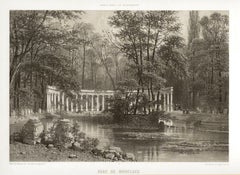
Paris - Parc de Monceaux, French lithograph, 1861
By Philippe Benoist
Located in Melbourne, Victoria
'Parc de Monceaux', tinted lithograph by Felix Benoist (1818-1896). From a series of lithographs depicting the famous buildings of Paris - 'Paris dans sa Splendeur', published in Na...
Category

Late 19th Century Naturalistic Landscape Prints

Materials

Lithograph

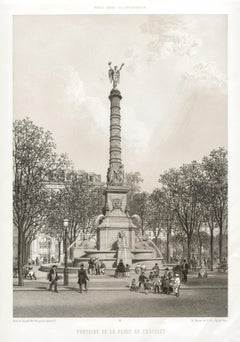
Paris - Fontaine de la Place du Chatelet, French lithograph, 1861
By Philippe Benoist
Located in Melbourne, Victoria
'Fontaine de la Place du Chatelet', tinted lithograph by Felix Benoist (1818-1896). From a series of lithographs depicting the famous buildings of Paris -...
Category

Late 19th Century Naturalistic Landscape Prints

Materials

Lithograph

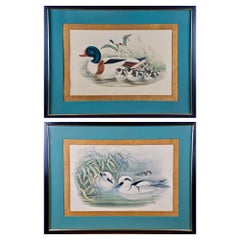
Pair of 19th C. Hand-colored Lithographs of Ducks by John Gould
By John Gould
Located in Alamo, CA
A pair of hand-colored lithographs of ducks entitled "Tadorna Vulpanser" (Sheldrake Ducks) and "Mergus Umbellus' (Smew or Nun Ducks) from John Gould's publication "Birds of Great Br...
Category

1860s Naturalistic Animal Prints

Materials

Lithograph

Rough-legged Buzzard: 19th C. Hand-colored Lithograph by J. Gould & Edward Lear
By Edward Lear
Located in Alamo, CA
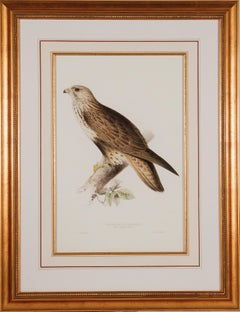
This is an original 19th century hand-colored folio-sized lithograph entitled "Archibuteo Lagopus" (Rough-Legged Buzzard) by John Gould and Edward Lear, from Gould's "Birds of Great Britain", published in London between 1862 and 1873. The print depicts an adult Rough-Legged Buzzard perched on a branch of a tree looking to the left. This beautiful framed Gould hand-colored lithograph is presented in a gold-colored wood frame and cream-colored French mat, embellished by a gold-colored fillet. The frame measures 33" high, 25.5" wide and 1.25" thick. It is in excellent condition There are several other unframed Gould bird lithographs available on our 1stdibs and InCollect storefronts. Two or more of these striking lithographs would make an attractive display grouping. A discount is available for purchase of a set depending on the number. These additional Gould hummingbirds may be viewed by typing Timeless Intaglio in the 1stdibs or InCollect search field to be taken to our storefront. John Gould (1804-1881]) was an English ornithologist and artist. He, like his American contemporary John James Audubon, published a number of books on birds in the mid 19th century, illustrated by hand-colored lithographs. His wife and fellow artist, Elizabeth Gould, and several other artists including Edward Lear and Henry Constantine Richter produced lithographs for his various publications. He has been considered the father of bird study in Australia and the Gould League in Australia is named after him. Charles Darwin referenced Gould’s work in his book, "On the Origin of Species" and Gould named a bird after Darwin; "Darwin's finches". Gould began his career in London as a taxidermist, but in 1827 became the first curator and conservator at the museum of the Zoological Society of London. In this position naturalists brought him collections of birds from all over the world. He began creating drawings and eventually hand-colored lithographs with his wife and Edward Lear, which were the basis for his first publications. Darwin brought him specimens from the Galapagos Islands, including 12 species of finches which had never been described. In 1838, Gould and his wife travelled to Australia and their work led to the seven volume publication of “The Birds of Australia”. Gould had a fascination for hummingbirds and collected specimens of 320 varieties before ever seeing a live hummingbird on a trip to the United States in 1857. He eventually published “A Monograph of the Trochilidae, or Family of Humming-birds". Other large publications include: "The Birds of Europe"," A Monograph of the Ramphastidae, or Family of Toucans”, “A Synopsis of the Birds of Australia, and the Adjacent Islands”, “A Monograph of the Odontophorinae, or Partridges of America”, “The Birds of Asia”, “The Birds of Great Britain” and "The Birds of New Guinea and the Adjacent Papuan Islands, including many new species recently discovered in Australia". John Gould (1804-1881) was a British ornithologist and illustrator who is best known for his monumental work, "The Birds of Europe," published between 1832 and 1837. Gould was born in Lyme Regis, Dorset, England, and began working as a taxidermist and natural history dealer in London in the 1820s. In 1827, Gould was appointed the first curator and preserver of birds at the Zoological Society of London, where he began to build his collection of specimens and began to study the birds of the world. He published his first monograph, "A Century of Birds from the Himalaya Mountains," in 1831, which included 80 plates of Himalayan birds. Gould continued to publish numerous volumes on the birds of the world throughout his life, including "The Birds of Australia" (1840-1848) and "The Birds of Great Britain" (1862-1873). His works were highly regarded for their accuracy and detail, and he was one of the most prominent ornithologists of his time. In addition to his work as an ornithologist, Gould was also a successful businessman, and he used his profits to fund expeditions and to support the scientific community. He was elected a Fellow of the Royal Society in 1843, and he was awarded the Royal Medal...
Category

Mid-19th Century Naturalistic Animal Prints

Materials

Lithograph

Blue-eyed Cockatoo: A Framed Original 19th C. Hand-colored Lithograph by Gould
By John Gould and Henry Constantine Richter
Located in Alamo, CA
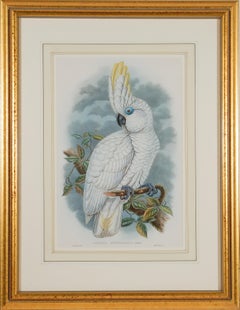
This is a framed original 19th century hand-colored folio-sized lithograph entitled “Cacatua Ophthalimica” (Blue-eyed Cockatoo) by John Gould, from the supplement to his "Birds of Australia", published in London between 1851 and 1869. The print depicts a large blue-eyed cockatoo perched on a branch, with its head turned to the left. The scene is enhanced with leaves and sky and clouds in the background. This striking framed Gould...
Category

Mid-19th Century Naturalistic Animal Prints

Materials

Lithograph

Thorn-Bill Hummingbirds: A Framed 19th C. Hand-colored Lithograph by Gould
By John Gould and Henry Constantine Richter
Located in Alamo, CA
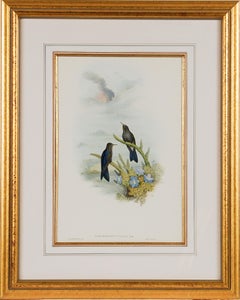
This is an original framed 19th century hand-colored folio-sized lithograph entitled "Ramphomicron vulcani" (Southern Thorn-Bill Hummingbirds) by John Gould, Pl. 186 from his "Monograph of the Trochilidae, or Family of Hummingbirds", published in London in 1853. The print depicts two Southern Thorn-Bill hummingbirds sitting on branches of a flowering plant. This striking framed Gould hand-colored lithograph is presented in a antiqued gold frame, a gold-colored fillet, and a light tan French mat, embellished with a mint-colored broad band. The frame measures 32" high, 25.5" wide and 1.25" thick. The hand-coloring is enhanced by the use of gum-arabic paint...
Category

Mid-19th Century Naturalistic Animal Prints

Materials

Lithograph

More From This Seller

View All
Montmartre at Sacre Coeur
By Jean Dufy
Located in Missouri, MO
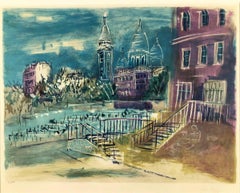
Jean Dufy "Montmartre et La Basilique du Sacre Coeur" c. 1950s Color Lithograph Signed in Pencil Lower Right Numbered 78/250 Lower Left Image Size: approx...
Category

1950s Impressionist Landscape Prints

Materials

Lithograph

Dogwood
By Andrew Wyeth
Located in Missouri, MO
Andrew Wyeth "Dogwood" 1983 Collotype Ed. 115/300 Signed and Numbered Lower Right Image Size: 21 x 28 3/4 inches Framed Size: approx. 29 x 36.5 inches A painter of landscape and figure subjects in Pennsylvania and Maine, Andrew Wyeth became one of the best-known American painters of the 20th century. His style is both realistic and abstract, and he works primarily in tempera and watercolor, often using the drybrush technique. He is the son of Newell Convers and Carolyn Bockius Wyeth of Chadds Ford, Pennsylvania, and was home-schooled because of delicate health. His art instruction came from his famous-illustrator father, who preached the tying of painting to life--to mood and to essences and to capturing the subtleties of changing light and shadows. The Wyeth household was a lively place with much intellectual and social stimulation. Because of the prominence of N.C. Wyeth, persons including many dignitaries came from all over the country to visit the family. Andrew's sisters Carolyn and Henriette became noted artists as did his brother-in-law, Peter Hurd. The non-art oriented brother, Nathaniel Wyeth...
Category

1980s American Modern Landscape Prints

Materials

Paper, Lithograph

Dogwood
Price Upon Request
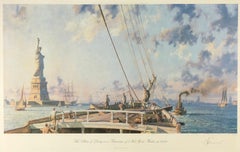
The Statue of Liberty in a Panorama of New York City in 1886
By John Stobart
Located in Missouri, MO
John Stobart "The Statue of Liberty in a Panorama of New York City in 1886" Color Lithograph approx 32 x 43 inches framed Signed in Pencil and Numbered 914/950 A marine painter of ...
Category

1970s American Realist Landscape Prints

Materials

Lithograph

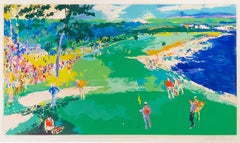
The 18th at Pebble Beach
By LeRoy Neiman
Located in Missouri, MO
The 18th at Pebble Beach Leroy Neiman (American, 1921-2012) Signed in pencil lower right Edition 176/400 lower left 26 x 43 inches 37.25 x 54.5 inches with frame Known for his bright, colorful paintings and screen prints of famous sports stars...
Category

20th Century American Modern Landscape Prints

Materials

Color, Lithograph

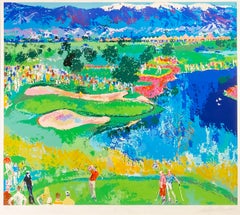
Cove at Vintage
By LeRoy Neiman
Located in Missouri, MO
Cove at Vintage Leroy Neiman (American, 1921-2012) Signed in pencil lower right Edition 237/375 lower left 34 x 36.5 inches 43 x 45.5 inches with frame Known for his bright, colorful paintings and screen prints of famous sports stars...
Category

20th Century American Modern Landscape Prints

Materials

Color, Lithograph

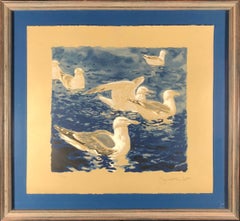
Herring Gulls
By Jamie Wyeth
Located in Missouri, MO
Jamie Wyeth "Herring Gulls" 1978 Color Lithograph Signed Lower Right Numbered Lower Left 149/300 Born in 1946, James Browning Wyeth came of age when the meaning of patriotism was clouded by the traumas of the Vietnam War and the scandals of Watergate. Working in an era of turmoil and questioning of governmental authority, he did art that encompassed both marching off to war and marching in protest. One of James's early masterworks, Draft Age (1965) depicts a childhood friend as a defiant Vietnam-era teenager resplendent in dark sunglasses and black leather jacket in a suitably insouciant pose. Two years later Wyeth painstakingly composed a haunting, posthumous Portrait of President John F. Kennedy (1967) that seems to catch the martyred Chief Executive in a moment of agonized indecision. As Wyeth Center curator Lauren Raye Smith points out, Wyeth "did not deify the slain president, [but] on the contrary made him seem almost too human." Based on hours of study and sketching of JFK's brothers Robert and Edward - documented by insightful studies in the exhibition - the final, pensive portrait seemed too realistic to family members and friends. "His brother Robert," writes Smith in the exhibition catalogue, "reportedly felt uneasy about this depiction, and said it reminded him of the President during the Bay of Pigs invasion." In spite of these misgivings, James's JFK likeness has been reproduced frequently and is one of the highlights of this show. The poignancy, appeal and perceptiveness of this portrait, painted when the youngest Wyeth was 21 years old, makes one wish he would do more portraits of important public figures. James himself feels he is at his best painting people he knows well, as exemplified by his vibrant Portrait of Jean Kennedy Smith (1972), which captures the vitality of the slain President's handsome sister. He did paint a portrait of Jimmy Carter for the January 1977 man-of-the-year cover of Time magazine, showing the casually dressed President-elect as a straightforward character posed under a flag-draped water tower next to the family peanut plant in Plains, Ga. James recalls that Carter had one Secret Service agent guarding him as he posed outdoors, a far cry from the protection our Chief Executives require today. As a participating artist in the "Eyewitness to Space" program organized by the National Aeronautics and Space Administration in collaboration with the National Gallery of Art in the late 1960s, Wyeth deftly recorded in a series of watercolors his eyewitness observations of dramatic spacecraft launchings and more mundane scenes associated with the space program. Commissioned by Harper's Magazine to cover the 1974 congressional hearings and trials of Watergate figures, James Wyeth executed a series of perceptive and now evocative sketches that recall those dark chapters in our history. Memorable images include a scowling John Ehrlichman, a hollow-eyed Bob Haldeman, an owlish Charles Colson, a focused Congressman Peter Rodino, a grim visaged Father/ Congressman Robert Drinan, and vignettes of the press and various courtroom activities. An 11-by-14-inch pencil sketch of the unflappable Judge John Sirica is especially well done. These "images are powerful as historical records," observes Smith, "and as lyrically journalistic impressions of events that changed the nation forever." Wyeth's sketch of early-morning crowds lined up outside the Supreme Court building hoping to hear the Watergate case, with the ubiquitous TV cameramen looking on, is reminiscent of recent scenes as the high court grappled with the Bush-Gore contest. The Wyeth family penchant for whimsy and enigmatic images is evident in Islanders (1990), showing two of James's friends, wearing goofy hats, sitting on the porch of a small Monhegan Island (Me.) cottage draped with a large American flag. Mixing the serious symbolism of Old Glory with the irreverent appearance of the two men, James has created a puzzling but interesting composition. Painting White House...
Category

1970s American Modern Animal Prints

Materials

Lithograph, Paper

Still Thinking About These?

All Recently Viewed