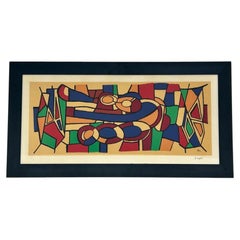
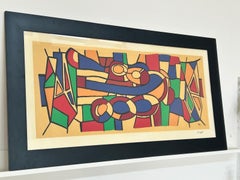
Ballet Steven For Sale on 1stDibs
On 1stDibs, you can find the most appropriate ballet steven for your needs in our varied inventory. There are many
abstract,
modern and
street art versions of these works for sale. Finding the perfect ballet steven may mean sifting through those created during different time periods — you can find an early version that dates to the 20th Century and a newer variation that were made as recently as the 21st Century. On 1stDibs, the right ballet steven is waiting for you and the choices span a range of colors that includes
gray,
beige,
black and
purple. Finding an appealing ballet steven — no matter the origin — is easy, but
Jack Mitchell,
Anh Duong,
Fred W. McDarrah,
Fred McDarrah and
(after) Alexander Calder each produced popular versions that are worth a look. Artworks like these of any era or style can make for thoughtful decor in any space, but a selection from our variety of those made in
paint,
synthetic resin paint and
vinyl paint can add an especially memorable touch.
How Much is a Ballet Steven?
A ballet steven can differ in price owing to various characteristics — the average selling price for items in our inventory is $6,000, while the lowest priced sells for $860 and the highest can go for as much as $110,000.
Fernand Léger for sale on 1stDibs
A painter as well as a filmmaker, illustrator, stage-set designer, ceramicist and printmaker, Fernand Léger was one of the most prolific artists of the first half of the 20th century. His early mature work as a Cubist was marked by the use of bold colors and contrasts and a visual vocabulary inspired by industrial technology. In his later career, Léger turned to idiomatic, almost naïve depictions of human figures, in a belief that his work should be accessible to ordinary people and relevant to their lives.
Born in Normandy, the son of a cattle trader, Léger worked as an architectural draftsman in Paris while studying art. By 1908 he was a member of an artistic circle that included Marc Chagall, Robert Delaunay, sculptor Jacques Lipchitz, and the poet Guillaume Appolinaire, and through them he became connected to the Cubists. As opposed to the flat planes and neutral hues seen in the paintings of Pablo Picasso and Georges Braque, Léger’s Cubist abstractions were devised with vivid colors and forms that had dimensionality. Soon after his army service in World War I — he was gassed at the Battle of Verdun — Léger entered his “mechanical” period. Convinced that technology would improve the human condition, he painted compositions of tubular shapes and cylinders that are reminiscent of machine parts. In other work, Léger sought to capture the bustle and brio of modern life with references to railroad stations, factories, street signs and billboards.
Léger had also emerged from the trenches with a deep concern to make his art engage the sorts of men and women he had met during the war. He sought to bring his work to a wider audience through film, theater sets and book illustrations. In the 1920s, influenced by Purism — a variant on Cubism that promoted a simpler and more direct approach to forms and compositions — Léger produced a series of paintings depicting everyday objects: a soda siphon, an accordion, a guitar and vase. The human figure returned to his work. By 1930, pure abstraction disappeared almost completely from Léger’s art in favor of simple studies of people. Their boldly outlined forms, placed against a bright background, can be regarded as an assemblage of parts — yet in these representations of dancers, acrobats and folks on bicycles, Léger seems to be articulating a kind of kinship and affection. You will see from the works on offer why Fernand Léger is often regarded as the warmest and most humane of the great modern artists.
Find a collection of original Fernand Léger art today on 1stDibs.
A Close Look at Mid-century-modern Furniture
Organically shaped, clean-lined and elegantly simple are three terms that well describe vintage mid-century modern furniture. The style, which emerged primarily in the years following World War II, is characterized by pieces that were conceived and made in an energetic, optimistic spirit by creators who believed that good design was an essential part of good living.
ORIGINS OF MID-CENTURY MODERN FURNITURE DESIGN
CHARACTERISTICS OF MID-CENTURY MODERN FURNITURE DESIGN
MID-CENTURY MODERN FURNITURE DESIGNERS TO KNOW
ICONIC MID-CENTURY MODERN FURNITURE DESIGNS
VINTAGE MID-CENTURY MODERN FURNITURE ON 1STDIBS
The mid-century modern era saw leagues of postwar American architects and designers animated by new ideas and new technology. The lean, functionalist International-style architecture of Le Corbusier and Bauhaus eminences Ludwig Mies van der Rohe and Walter Gropius had been promoted in the United States during the 1930s by Philip Johnson and others. New building techniques, such as “post-and-beam” construction, allowed the International-style schemes to be realized on a small scale in open-plan houses with long walls of glass.
Materials developed for wartime use became available for domestic goods and were incorporated into mid-century modern furniture designs. Charles and Ray Eames and Eero Saarinen, who had experimented extensively with molded plywood, eagerly embraced fiberglass for pieces such as the La Chaise and the Womb chair, respectively.
Architect, writer and designer George Nelson created with his team shades for the Bubble lamp using a new translucent polymer skin and, as design director at Herman Miller, recruited the Eameses, Alexander Girard and others for projects at the legendary Michigan furniture manufacturer.
Harry Bertoia and Isamu Noguchi devised chairs and tables built of wire mesh and wire struts. Materials were repurposed too: The Danish-born designer Jens Risom created a line of chairs using surplus parachute straps for webbed seats and backrests.
The Risom lounge chair was among the first pieces of furniture commissioned and produced by celebrated manufacturer Knoll, a chief influencer in the rise of modern design in the United States, thanks to the work of Florence Knoll, the pioneering architect and designer who made the firm a leader in its field. The seating that Knoll created for office spaces — as well as pieces designed by Florence initially for commercial clients — soon became desirable for the home.
As the demand for casual, uncluttered furnishings grew, more mid-century furniture designers caught the spirit.
Classically oriented creators such as Edward Wormley, house designer for Dunbar Inc., offered such pieces as the sinuous Listen to Me chaise; the British expatriate T.H. Robsjohn-Gibbings switched gears, creating items such as the tiered, biomorphic Mesa table. There were Young Turks such as Paul McCobb, who designed holistic groups of sleek, blond wood furniture, and Milo Baughman, who espoused a West Coast aesthetic in minimalist teak dining tables and lushly upholstered chairs and sofas with angular steel frames.
Generations turn over, and mid-century modern remains arguably the most popular style going. As the collection of vintage mid-century modern chairs, dressers, coffee tables and other furniture for the living room, dining room, bedroom and elsewhere on 1stDibs demonstrates, this period saw one of the most delightful and dramatic flowerings of creativity in design history.
Finding the Right Prints for You
Prints are works of art produced in multiple editions. Though several copies of a specific artwork can exist, collectors consider antique and vintage prints originals when they have been manually created by the artist or are “impressions” that are part of the artist’s intent for the work.
Modern artists use a range of printmaking techniques to produce different types of prints such as relief, intaglio and planographic. Relief prints are created by cutting away a printing surface to leave only a design. Ink or paint is applied to the raised parts of the surface, and it is used to stamp or press the design onto paper or another surface. Relief prints include woodcuts, linocuts and engravings.
Intaglio prints are the opposite of relief prints in that they are incised into the printing surface. The artist cuts the design into a block, plate or other material and then coats it with ink before wiping off the surface and transferring the design to paper through tremendous pressure. Intaglio prints have plate marks showing the impression of the original block or plate as it was pressed onto the paper.
Artists create planographic prints by drawing a design on a stone or metal plate using a grease crayon. The plate is washed with water, then ink is spread over the plate and it adheres to the grease markings. The image is then stamped on paper to make prints.
All of these printmaking methods have an intricate process, although each can usually transfer only one color of ink. Artists use separate plates or blocks for multiple colors, and together these create one finished work of art.
Find prints ranging from the 18th- and 19th-century bird illustrations by J.C. Sepp to mid-century modern prints, as well as numerous other antique and vintage prints at 1stDibs. Browse the collection today and read about how to arrange wall art in your space.