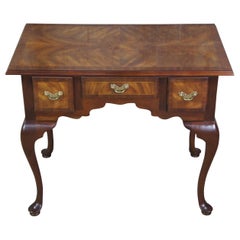
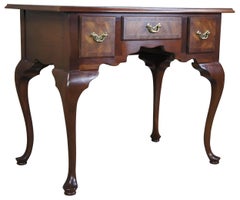
Although named for the last Stuart monarch of England, antique Queen Anne furniture, with its curvy cabriole legs and pad feet, has its origins in the earlier reign of King William III, which began in 1689 and ended with his death in 1702. Later evolving during Anne’s rule from 1702–14, the style would continue to influence design in the decades after her death.
Sometimes called late Baroque or early Georgian, Queen Anne chairs, bedroom furniture and tables are subdued yet ornate and characterized by a graceful blend of influences ranging from Asian design to classical motifs. Furnishings of this era — with their curvilinear supports and novel emphasis on comfort and versatility — are marked by a shift away from the more opulent and angular William and Mary style.
Chairs designed in the Queen Anne style are more functional and lightweight than their predecessors. They often feature a vase or fiddle-shaped splat, which refers to the central vertical back element, in order to support the spine and plush cushions. Craftsmen of the era predominantly worked in walnut, maple and pine. Any embellishments they introduced in their furnishings were frequently minimal and refined and expressed by way of modest flourishes such as shells or scrolls. Some pieces were more lavish with “japanned” finishes, or varnished interpretations of East Asian lacquer art. Almost every piece of furniture, whether a tea table or desk, included S-shaped, animalistic cabriole legs that end in a paw or claw-and-ball form.
These qualities made Queen Anne furniture popular throughout Europe and North America. Boston and Philadelphia became hubs for the production of this style of furniture, spurred by the arrival of British artisans who fostered a market for well-heeled colonists. While the showier Chippendale style later surpassed it in popularity, Queen Anne’s simple elegance still draws an enduring appreciation.
Find a collection of antique Queen Anne dining tables, seating, cabinets and other authentic period furniture on 1stDibs.
Few pieces of furniture are celebrated for their functionality as much as their decorative attributes in the way that console tables are. While these furnishings are not as common in today’s interiors as their coffee-table and side-table counterparts, console tables are stylish home accents and have become more prevalent over the years.
The popularity of wood console tables took shape during the 17th and 18th centuries in French and Italian culture, and were exclusively featured in the palatial homes of the upper class. The era’s outwardly sculptural examples of these small structures were paired with mirrors or matching stools and had tabletops of marble. They were most often half-moon-shaped and stood on two scrolled giltwood legs, and because they weren’t wholly supported on their two legs rather than the traditional four, their flat-backed supports were intended to hug the wall behind them and were commonly joined by an ornate stretcher. The legs were affixed or bolted to the wall with architectural brackets called console brackets — hence, the name we know them by today — which gave the impression that they were freestanding furnishings. While console tables introduced a dose of drama in the foyer of any given aristocrat — an embodiment of Rococo-style furniture — the table actually occupied minimal floor space (an attractive feature in home furniture). As demand grew and console tables made their way to other countries, they gained recognition as versatile additions to any home.
Contemporary console tables comprise many different materials and are characterized today by varying shapes and design styles. It is typical to find them made of marble, walnut or oak and metal. While modern console tables commonly feature four legs, you can still find the two-legged variety, which is ideal for nestling behind the sofa. A narrow console table is a practical option if you need to save space — having outgrown their origins as purely ornamental, today’s console tables are home to treasured decorative objects, help fill empty foyers and, outfitted with drawers or a shelf, can provide a modest amount of storage as needed.
The rich collection of antique, new and vintage console tables on 1stDibs includes everything from 19th-century gems designed in the Empire style to unique rattan pieces and more.