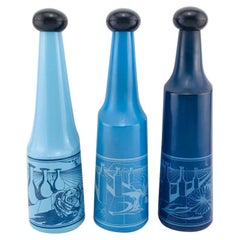
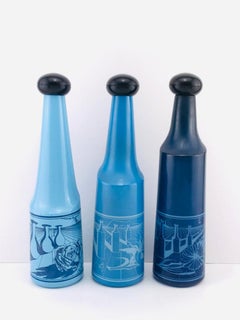
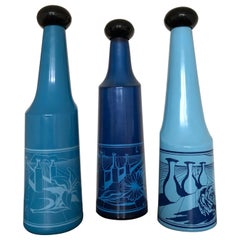
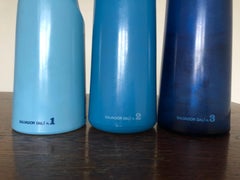
Salvador Dali Signed Bottles For Sale on 1stDibs
Find a variety of salvador dali signed bottles available on 1stDibs. There are many
modern and
Pop Art versions of these works for sale. There are many variations of these items available, from those made as long ago as the 20th Century to those made as recently as the 20th Century. If you’re looking to add salvador dali signed bottles that pop against an otherwise neutral space in your home, the works available on 1stDibs include that feature elements of
gray,
brown and more. Many versions of these artworks are appealing in their rich colors and composition, but
Julio Moisés Fernández de Villasante and
Leonor Fini produced especially popular works that are worth a look. Each of these unique pieces was handmade with extraordinary care, with artists most often working in
canvas,
fabric and
paint.
How Much are Salvador Dali Signed Bottles?
Salvador dali signed bottles can differ in price owing to various characteristics — the average selling price for items in our inventory is $1,310, while the lowest priced sells for $750 and the highest can go for as much as $9,450.
(after) Salvador Dali for sale on 1stDibs
Salvador Dali (1904 – 1989) was a Spanish surrealist artist renowned for his technical skill, precise draftsmanship and the striking and bizarre images in his work.
Born in Figueres, Catalonia, Dali received his formal education in fine arts in Madrid. Influenced by Impressionism and the Renaissance masters from a young age, he became increasingly attracted to Cubism and avant-garde movements. He moved closer to Surrealism in the late 1920s and joined the Surrealist group in 1929, soon becoming one of its leading exponents. His best-known work, The Persistence of Memory, was completed in August 1931, and is one of the most famous Surrealist paintings. Dali lived in France throughout the Spanish Civil War (1936 to 1939) before leaving for the United States in 1940 where he achieved commercial success. He returned to Spain in 1948 where he developed his "nuclear mysticism" style, based on his interest in classicism, mysticism and recent scientific developments.
Dali's artistic repertoire included painting, graphic arts, film, sculpture, design and photography, at times in collaboration with other artists. He also wrote fiction, poetry, autobiography, essays and criticism. Major themes in his work include dreams, the subconscious, sexuality, religion, science and his closest personal relationships. Some trends in Dali's work that would continue throughout his life were already evident in the 1920s. Dali was influenced by many styles of art, ranging from the most academically classic, to the most cutting-edge avant-garde. His classical influences included Raphael, Bronzino, Francisco de Zurbaran, Vermeer and Velazquez. Exhibitions of his works attracted much attention and a mixture of praise and puzzled debate from critic
A Close Look at Mid-century-modern Furniture
Organically shaped, clean-lined and elegantly simple are three terms that well describe vintage mid-century modern furniture. The style, which emerged primarily in the years following World War II, is characterized by pieces that were conceived and made in an energetic, optimistic spirit by creators who believed that good design was an essential part of good living.
ORIGINS OF MID-CENTURY MODERN FURNITURE DESIGN
CHARACTERISTICS OF MID-CENTURY MODERN FURNITURE DESIGN
MID-CENTURY MODERN FURNITURE DESIGNERS TO KNOW
ICONIC MID-CENTURY MODERN FURNITURE DESIGNS
VINTAGE MID-CENTURY MODERN FURNITURE ON 1STDIBS
The mid-century modern era saw leagues of postwar American architects and designers animated by new ideas and new technology. The lean, functionalist International-style architecture of Le Corbusier and Bauhaus eminences Ludwig Mies van der Rohe and Walter Gropius had been promoted in the United States during the 1930s by Philip Johnson and others. New building techniques, such as “post-and-beam” construction, allowed the International-style schemes to be realized on a small scale in open-plan houses with long walls of glass.
Materials developed for wartime use became available for domestic goods and were incorporated into mid-century modern furniture designs. Charles and Ray Eames and Eero Saarinen, who had experimented extensively with molded plywood, eagerly embraced fiberglass for pieces such as the La Chaise and the Womb chair, respectively.
Architect, writer and designer George Nelson created with his team shades for the Bubble lamp using a new translucent polymer skin and, as design director at Herman Miller, recruited the Eameses, Alexander Girard and others for projects at the legendary Michigan furniture manufacturer.
Harry Bertoia and Isamu Noguchi devised chairs and tables built of wire mesh and wire struts. Materials were repurposed too: The Danish-born designer Jens Risom created a line of chairs using surplus parachute straps for webbed seats and backrests.
The Risom lounge chair was among the first pieces of furniture commissioned and produced by celebrated manufacturer Knoll, a chief influencer in the rise of modern design in the United States, thanks to the work of Florence Knoll, the pioneering architect and designer who made the firm a leader in its field. The seating that Knoll created for office spaces — as well as pieces designed by Florence initially for commercial clients — soon became desirable for the home.
As the demand for casual, uncluttered furnishings grew, more mid-century furniture designers caught the spirit.
Classically oriented creators such as Edward Wormley, house designer for Dunbar Inc., offered such pieces as the sinuous Listen to Me chaise; the British expatriate T.H. Robsjohn-Gibbings switched gears, creating items such as the tiered, biomorphic Mesa table. There were Young Turks such as Paul McCobb, who designed holistic groups of sleek, blond wood furniture, and Milo Baughman, who espoused a West Coast aesthetic in minimalist teak dining tables and lushly upholstered chairs and sofas with angular steel frames.
Generations turn over, and mid-century modern remains arguably the most popular style going. As the collection of vintage mid-century modern chairs, dressers, coffee tables and other furniture for the living room, dining room, bedroom and elsewhere on 1stDibs demonstrates, this period saw one of the most delightful and dramatic flowerings of creativity in design history.
Finding the Right Bottles for You
Over time, many different styles of vintage, new and antique bottles have found second lives as coveted decorative objects in pristine display cases all over the world. Originally, these bottles may have been decanters and flasks for spirits and liqueurs, medicine and perfume bottles or functional vases for fresh floral arrangements.
We know that glass can be a radical art form. So your vintage art glass or Art Deco pieces will stand on their own to be admired by all alongside your other treasured collectibles in your living room or dining room. But maybe you’re thinking about decorating elsewhere in your home with the other types of glass bottles that you’ve picked up over the years.
There are many corners of your space that can be brightened by an arrangement of bottles of various sizes, shapes and colors. Spruce up your kitchen, bedroom, craft room or art studio by lining the window sill with an array of glass bottles. In this case, you’ll want to use glass bottles instead of ceramic or metal, as transparent material in the sunlight — particularly colored bottles — will introduce energy and pops of color to adjacent walls and surfaces.
Grouping short, tall, thin and wide bottles — some with flowers, some without — on a tabletop, buffet or desk in your home office can bring a much-needed dynamic as a centerpiece or merely dress up a workspace.
On 1stDibs, find a collection of vintage, new and antique glass bottles that includes mid-century modern bottles, Murano glass and more.