Arnold Ronnebeck Art

1885-1947
Modernist sculptor, lithographer and museum administrator, Rönnebeck was a noted member of European and American avant-garde circles in the early twentieth century before settling in Denver, Colorado, in 1926. After studying architecture at the Royal Art School in Berlin for two years beginning in 1905, he moved to Paris in 1908 to study sculpture with Aristide Maillol and Émile-Antoine Bourdelle. While there he met and befriended American modernist painter, Marsden Hartley, of whom he sculpted a bronze head that was exhibited at the Salon d’Automne in Paris in 1912 and the following year at Hartley’s solo show of paintings at Alfred Stieglitz’s Gallery 291 in New York. After World War I Rönnebeck traveled in Italy with German writer, Max Sidow, and German poet, Theodor Daubler, doing a series of drawings of Positano and the Amalfi Coast that formed the basis for his lithographs on the subject. The death of his finacée, the young American opera singer Alice Miriam in 1922 and his own family’s increasing financial problems in post-World War I Germany led him to immigrate to the United States in 1923. After living briefly with Miriam’s family in Washington, DC, he moved to New York where he became part of the avant-garde circle around Alfred Stieglitz. In the summer of 1925, as the guest of Mabel Dodge Luhan, Rönnebeck first saw Taos, New Mexico, which Marsden Hartley had encouraged him to visit. It was there that he met his future wife, Louise Emerson, an easel painter and muralist. A year later they were married in New York before relocating to Denver. He served as director of the Denver Art Museum from 1926 to 1930 where he invited Marsden Hartley to lecture on Cézanne’s art in 1928. Rönnebeck fostered the development of the museum’s collection of American Indian art and the curation of modernist art exhibitions. In addition to his work at the museum, he was professor of sculpture at the University of Denver’s College of Fine and Applied Arts from 1929 to 1935, and wrote a weekly art column in the Rocky Mountain News. In Colorado, the subject matter of his lithographs became the state’s landscape and its mining towns, as well as Native Americans from the pueblos in neighboring New Mexico. By the early 1930s Colorado’s old mining towns became a popular genre for artists because they were easily accessible, and their architectural components provided a welcome break from the nineteenth-century panoramic landscape tradition and the overwrought cowboy-and-Indian subject matter of the previous generation. As an amateur actor and music enthusiast, Rönnebeck had an additional connection with Central City. In June 1947, some five months before his death, the Denver Art Museum organized a solo exhibition of his sculptures, watercolors and prints. © copyright Stan Cuba for David Cook Galleries
to
2
4
2
3
Overall Width
to
Overall Height
to
9
2
6
1
7
1
7
2
4
4
3
3
2
2
1
1
1
1
1
1
1
1
7
1
1
1
1
9
10,732
2,836
2,495
1,414
5
7
9
Artist: Arnold Ronnebeck
Arnold Rönnebeck WPA Modernist Lithograph Central City Colorado 1930s Cityscape

Arnold Rönnebeck WPA Modernist Lithograph Central City Colorado 1930s Cityscape

By Arnold Rönnebeck

Located in Denver, CO

A compelling WPA-era lithograph by Arnold Rönnebeck, this 1930s composition presents a modernist interpretation of Central City, Colorado—one of the state’s most historically signifi...

Category

1930s American Modern Arnold Ronnebeck Art

Materials

Lithograph

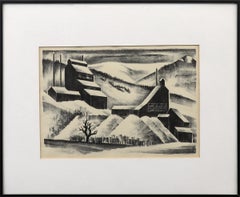
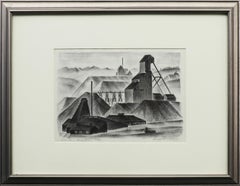
Arnold Ronnebeck 1933 Lithograph Colorado Mine Winter Scene Framed

Arnold Ronnebeck 1933 Lithograph Colorado Mine Winter Scene Framed

By Arnold Rönnebeck

Located in Denver, CO

A rare and striking 1933 lithograph by Arnold Ronnebeck, this evocative black-and-white composition depicts a Colorado mountain mine set within a quiet winter landscape. Blanketed in...

Category

1930s American Modern Arnold Ronnebeck Art

Materials

Lithograph

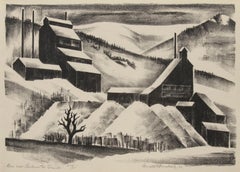
Arnold Ronnebeck Lithograph "Silver Mine, Russell Gulch" Colorado Scene

Arnold Ronnebeck Lithograph "Silver Mine, Russell Gulch" Colorado Scene

By Arnold Rönnebeck

Located in Denver, CO

"Silver Mine, Russell Gulch (12/25)" is a striking black-and-white lithograph by German-born American Modernist Arnold Ronnebeck (1885–1947). This rare print depicts a historic minin...

Category

1930s American Modern Arnold Ronnebeck Art

Materials

Lithograph

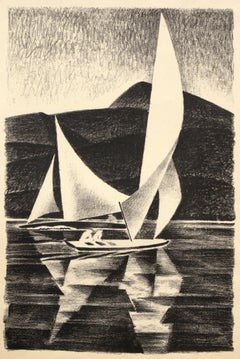
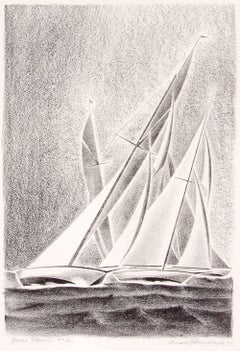
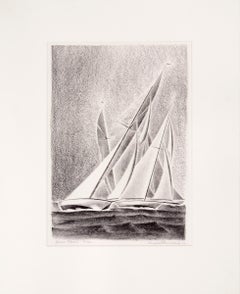
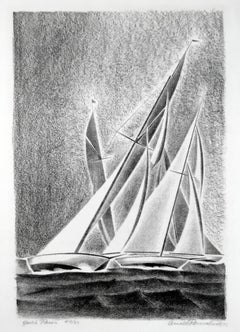
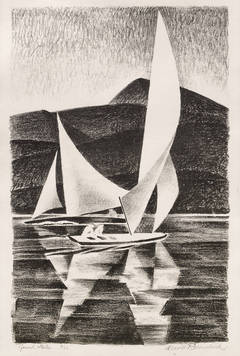
Arnold Ronnebeck 1933 Grand Lake Colorado Sailboat Race Modernist Print

Arnold Ronnebeck 1933 Grand Lake Colorado Sailboat Race Modernist Print

By Arnold Rönnebeck

Located in Denver, CO

“Yacht Races, Grand Lake, Colorado” is a rare and visually striking 1933 black-and-white lithograph by German-born American modernist Arnold Rönnebeck. This limited-edition print, nu...

Category

1930s Modern Arnold Ronnebeck Art

Materials

Lithograph

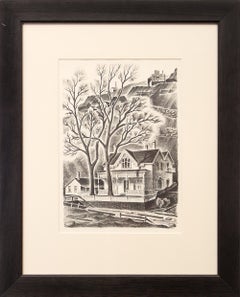
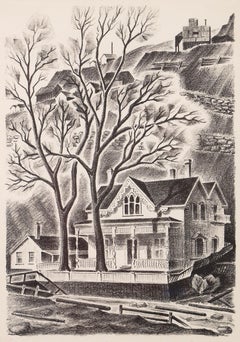
Arnold Ronnebeck 1937 Gregory Point Colorado Lithograph Modernist

Arnold Ronnebeck 1937 Gregory Point Colorado Lithograph Modernist

By Arnold Rönnebeck

Located in Denver, CO

A rare and highly collectible original 1937 lithograph by Arnold Ronnebeck, this striking composition depicts a historic home at Gregory Point near Central City, Colorado, rendered t...

Category

1930s American Modern Arnold Ronnebeck Art

Materials

Paper, Lithograph

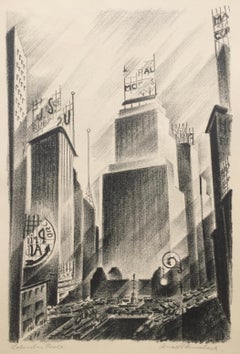
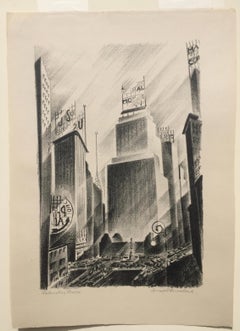
Columbus Circle
Columbus Circle

Columbus Circle

By Arnold Rönnebeck

Located in Santa Monica, CA

ARNOLD RONNEBECK (1885 – 1947) COLUMBUS CIRCLE ca. 1929 Lithograph, edition probably 50. Signed and titled in pencil, 12 ½” x 8 ¼” In very good condit...

Category

1920s American Modern Arnold Ronnebeck Art

Materials

Lithograph

Related Items
Lithograph of American rural life timeless with architecture monochrome

Lithograph of American rural life timeless with architecture monochrome

By Thomas Hart Benton

Located in London, GB

A man raises his hand to his chin, his neck tilted and face turned to look at a dilapidated farmhouse, barely held together by planks of wood and exposed to the elements. Behind him ...

Category

1930s American Modern Arnold Ronnebeck Art

Materials

Lithograph

Lithograph of American rural life timeless and romantic monochrome

Lithograph of American rural life timeless and romantic monochrome

By Thomas Hart Benton

Located in London, GB

In this sentimental work from 1939, Benton expresses his admiration for the rural lifestyle of the Midwest. He highlights the connection between man and the land by depicting two fig...

Category

1930s American Modern Arnold Ronnebeck Art

Materials

Lithograph

Lithograph of American rural life timeless figures monochrome

Lithograph of American rural life timeless figures monochrome

By Thomas Hart Benton

Located in London, GB

In this charming regionalist lithograph, Benton captures a classic Midwestern American scene: two men talking, drinking, and smoking together in a bar. Titled 'Discussion', the artwo...

Category

1930s American Modern Arnold Ronnebeck Art

Materials

Lithograph

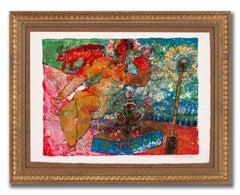
Theo Tobiasse “New York et l’Esprit des Fleurs” 1987 Color Lithograph, Signed

Theo Tobiasse “New York et l’Esprit des Fleurs” 1987 Color Lithograph, Signed

By Théo Tobiasse

Located in Miami, FL

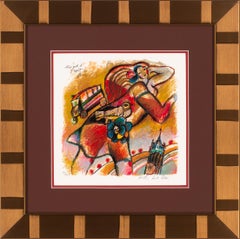
THÉO TOBIASSE (1927–2012) – “NEW YORK ET L’ESPRIT DES FLEURS” Lithograph ⚜ Hand Signed and Numbered ⚜ Crosshatch Gilt Wood Frame A LYRICAL VISION OF NEW YORK IN FULL BLOOM Created ...

Category

1980s Modern Arnold Ronnebeck Art

Materials

Lithograph

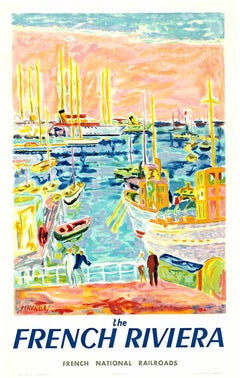
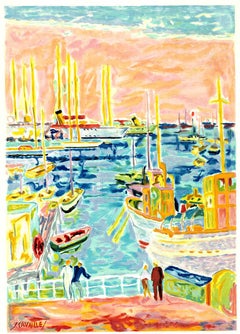
Original The French Riviera (Cote d'Azur) French Railways vintage travel poster

Original The French Riviera (Cote d'Azur) French Railways vintage travel poster

By Jules Cavailles

Located in Spokane, WA

Original vintage travel advertising poster for the FRENCH RIVIERA FRENCH NATIONAL RAILROADS SNCF (French National Railways) - the French Riviera. (Cote D'Azur, known as the French Riviera) The image features people looking out towards a marina full of sailing boats. Colorful artwork by the French painter Jules Cavailles (1901-1977). Printed by Perceval, Paris in 1953. Mid-Century Modern. Grade A- This is the English version of the poster compared to the design created for Cote d'Azur. The English version is much rarer (both are rare today). The poster gives the impression of a naive painting at this Mediterranean beach and seaport. Step into a world of timeless elegance and sunlit dreams with this exquisite French Riviera Vintage...

Category

1950s American Modern Arnold Ronnebeck Art

Materials

Lithograph

Making Camp
Making Camp

Thomas Hart BentonMaking Camp

$8,640

H 24.75 in W 29.5 in

Making Camp

By Thomas Hart Benton

Located in Columbia, MO

Thomas Hart Benton (American, 1889 - 1975) was a painter, muralist, and printmaker whose sinuous, rhythmic style came to define the Regionalist movement. His paintings and lithograph...

Category

20th Century American Modern Arnold Ronnebeck Art

Materials

Lithograph

Winter on Cruise
Winter on Cruise

Jim DineWinter on Cruise, 2005

$8,500

H 30 in W 44 in

Winter on Cruise

By Jim Dine

Located in New York, NY

A very good impression of this color woodcut and lithograph diptych. Signed and dated in pencil by Dine. From a limited edition of 12.

Category

Early 2000s Modern Arnold Ronnebeck Art

Materials

Color, Lithograph, Woodcut

'Financial District', New York City — American Modernism

'Financial District', New York City — American Modernism

By Howard Norton Cook

Located in Myrtle Beach, SC

Howard Cook, 'Financial District', lithograph, 1931, edition 75, Duffy 155. A fine, richly-inked impression, on cream wove paper, the full sheet with wide margins (2 3/4 to 5 5/8 inches), in excellent condition. Image size 13 5/16 x 10 3/8 inches (338 x 264 mm); sheet size 23 x 16 inches (584 x 406 mm). Matted to museum standards, unframed. Literature: 'American Master Prints from the Betty and Douglas Duffy Collection', the Trust for Museum Exhibitions, Washington, D.C., 1987. Collections: Crystal Bridges Museum of American Art, Library of Congress, Metropolitan Museum of Art, Philadelphia Museum of Art, Smithsonian American Art Museum. ABOUT THE ARTIST Howard Norton Cook (1901-1980) was one of the best-known of the second generation of artists who moved to Taos. A native of Massachusetts, he studied at the Art Students League in New York City and at the Woodstock Art Colony. Beginning his association with Taos in 1926, he became a resident of the community in the 1930s. During his career, he received two Guggenheim Fellowships and was elected an Academician in the National Academy of Design. He earned a national reputation as a painter, muralist, and printmaker. Cook’s work in the print mediums received acclaim early in his career with one-person exhibitions at the Denver Art Museum (1927) and the Museum of New Mexico (1928). He received numerous honors and awards over the years, including selection in best-of-the-year exhibitions sponsored by the American Institute of Graphics Arts, the Brooklyn Museum, the Society of American Etchers, and the Philadelphia Print Club. His first Guggenheim Fellowship took him to Taxco, Mexico in 1932 and 1933; his second in the following year enabled him to travel through the American South and Southwest. Cook painted murals for the Public Works of Art Project in 1933 and the Treasury Departments Art Program in 1935. The latter project, completed in Pittsburgh, received a Gold Medal from the Architectural League of New York. One of his most acclaimed commissions was a mural in the San Antonio Post Office in 1937. He and Barbara Latham settled in Talpa, south of Taos, in 1938 and remained there for over three decades. Cook volunteered in World War II as an Artist War Correspondent for the US Navy, where he was deployed in the Pacific. In 1943 he was appointed Leader of a War Art Unit...

Category

1930s American Modern Arnold Ronnebeck Art

Materials

Lithograph

Original California Ferrari Louis Vuitton Parc de Bagatelle hand signed poster

Original California Ferrari Louis Vuitton Parc de Bagatelle hand signed poster

By Razzia (Gérard Courbouleix–Dénériaz)

Located in Spokane, WA

Original 1989 Louis Vuitton Automobile Classiques Poster –Hand Signed, Archival Linen-Backed. This poster was created for the Concours d’Elegance ...

Category

1980s American Modern Arnold Ronnebeck Art

Materials

Lithograph

Cat and Busybody

Cat and Busybody

By Benton Murdoch Spruance

Located in Middletown, NY

A 1933 lithograph on cream wove paper 14 x 18 inches (354 x 452mm), full margins. Signed, titled, and numbered 17/33 in pencil, lower margin. Minor mat tone around the perimeter of t...

Category

1930s American Modern Arnold Ronnebeck Art

Materials

Lithograph

1970 EROTIC Original Pencil Signed ‘Erotic #5’ ‘Erotic Threesome’ Bag One Series

1970 EROTIC Original Pencil Signed ‘Erotic #5’ ‘Erotic Threesome’ Bag One Series

By John Lennon

Located in New York, NY

JOHN LENNON & YOKO ONO (1940-1980) 1970 “EroticNumber #5” Pencil Signed John Lennon Lower right Numbered H.C. XXXV1/VL 23 x 30 inches Image size 33x40 inches with frame Original COA ...

Category

1970s American Modern Arnold Ronnebeck Art

Materials

Lithograph

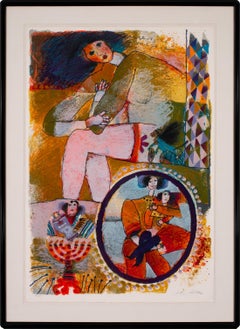
Théo Tobiasse "Les Siècles Coulent Entre Nos Rêves" Signed Color Lithograph

Théo Tobiasse "Les Siècles Coulent Entre Nos Rêves" Signed Color Lithograph

By Théo Tobiasse

Located in Miami, FL

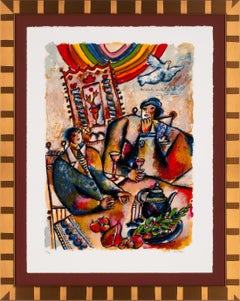
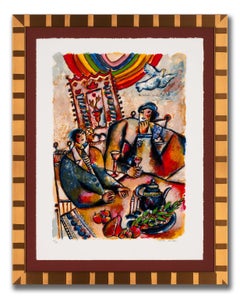
THÉO TOBIASSE (1927–2012) – “LES SIÈCLES COULENT ENTRE NOS RÊVES” Lithograph on Arches Paper ⚜ Hand Signed and Numbered ⚜ Gilt Wood Frame A LUMINOUS MEDITATION ON MEMORY, INTIMACY, AND THE PASSAGE OF TIME From the acclaimed suite Un Chant d’Exil et de Lumière (A Song of Exile and Light), this richly saturated lithograph is one image from a series of six distinct compositions published in 1997 by Klim Art Publisher, Toronto, and printed by master lithographer Pierre Chave at his celebrated atelier in Saint-Paul-de-Vence. The multi-color lithographic process, employing up to twenty-three separate color passes, produces the extraordinary depth and chromatic intensity visible across the entire composition. Two figures sit together at a table, each holding a glass of wine. A samovar and two lit candles anchor the still life at center, surrounded by scattered fruit and a bowl bearing an olive branch. A vibrant rainbow canopy arcs across the upper portion of the image, while a dove takes flight at upper right. Behind the couple hangs a decorative tablet adorned with flowering branches and scrolled columns. The title, inscribed in the artist’s hand within the composition, translates as “The centuries flow between our dreams,” a poetic distillation of the suite’s overarching contemplation of generational memory passing through shared moments of intimacy. What initially reads as a warm, intimate gathering reveals itself as a layered reflection on heritage, belonging, and the rituals that connect one generation to the next. The samovar recalls Tobiasse’s Eastern European childhood, while the olive branch and candles carry associations of renewal and hope. The dove and rainbow reinforce themes of peace and covenant that recur throughout Tobiasse’s oeuvre. Rendered on heavy Arches paper with deckled edges, the print retains a tactile, handmade quality that complements its emotional warmth. Presented in a crosshatch gilt wood frame the work suits interiors that embrace color and narrative, from a Mediterranean-inspired living space to a collector’s library or a gallery wall dedicated to the School of Paris tradition. WHY COLLECT THIS WORK? ✓ Suite Provenance – One of six distinct compositions from Tobiasse’s acclaimed Un Chant d’Exil et de Lumière series, published in 1997 ✓ Master Printed – Produced by Pierre Chave in Saint-Paul-de-Vence using up to twenty-three color passes ✓ Hand Signed and Numbered – Pencil signed lower right, numbered 87/199 ✓ Rich Symbolic Composition – Dove, rainbow, samovar, olive branch, and candle layered with personal and cultural meaning ✓ Gilt Wood Frame – Crosshatch gilt finish, ready to display ARTWORK DETAILS: ▸ Title: Les Siècles Coulent Entre Nos Rêves (The Centuries Flow Between Our Dreams) ▸ Suite: Un Chant d’Exil et de Lumière (A Song of Exile and Light) ▸ Artist: Théo Tobiasse (1927–2012) ▸ Medium: Lithograph on Arches Paper with Deckled Edges ▸ Year of Creation: 1997 ▸ Signature: Hand Signed Lower Right in Pencil ▸ Edition: 87/199 ▸ Publisher: Klim Art Publisher, Toronto, Canada ▸ Printer: Pierre Chave, Saint-Paul-de-Vence, France ▸ Provenance: Michael Hittleman Gallery, Los Angeles ▸ Country of Origin: France ▸ Dimensions: — ◼︎ Image Area: 30.5 x 22 inches — ◼︎ Paper Size: 36 x 27.25 inches — ◻︎ Frame Size: 44 x 35 x 0.875 inches ▸ Condition: Excellent, commensurate with age ▸ Framing: Crosshatch Gilt Wood Frame, ready to display INCLUDED DOCUMENTATION: ✓ Certificate of Authenticity ✓ Artist Biography Document THE ARTIST: Théo Tobiasse (born Tobias Eidesas, 1927, Jaffa, Israel; died 2012...

Category

1990s Modern Arnold Ronnebeck Art

Materials

Lithograph

Previously Available Items
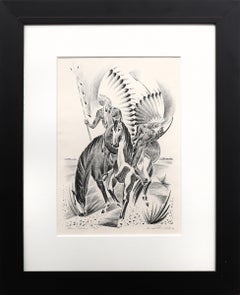
Framed 1930s Signed Lithograph 'Plains Indians' (6/75) by Arnold Ronnebeck

Framed 1930s Signed Lithograph 'Plains Indians' (6/75) by Arnold Ronnebeck

By Arnold Rönnebeck

Located in Denver, CO

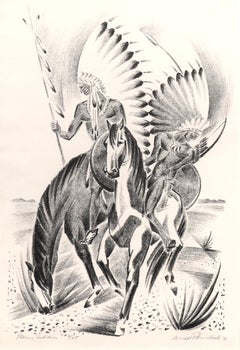
Original lithograph by Arnold Ronnebeck (1885-1947) titled 'Plains Indians' (6-75) created in 1931. Features two figures on horseback in black and white, signed, dated, titled and numbered in lower margin. Presented in a custom frame with all archival materials measuring 24 1⁄4 x 19 1⁄2 x 1⁄2 inches. About the Artist: Born Nassau, Germany 1885 Died Colorado 1947 Modernist sculptor, lithographer and museum administrator, Rönnebeck was a noted member of European and American avant-garde circles in the early twentieth century before settling in Denver, Colorado, in 1926. In 1908, Rönnebeck moved to Paris to study sculpture. A frequent guest of Gertrude Stein’s Saturday "evenings" in Paris, she described Rönnebeck as "charming and always invited to dinner,” After the outbreak of World War I in 1914, Rönnebeck returned to Germany where he served as an officer in the German Imperial Army. The death of his finacée, young American opera singer Alice Miriam in 1922 and his own family’s increasing financial problems in post-World War I Germany led him to immigrate to the United States in 1923. He moved to New York where he became part of the avant-garde circle around Alfred Stieglitz. In New York Rönnebeck began producing Precisionist-style lithographs of the city’s urban landscapes which he termed "living cubism." Through Stieglitz he met Erhard Weyhe head of the Weyhe Gallery who arranged Rönnebeck’s first solo American exhibition in May 1925 at the gallery in New York. Comprising some sixty works – prints, drawings and sculpture – the show subsequently traveled on a thirteen-month tour of major American cities. In the summer of 1925, as the guest of Mabel Dodge Luhan...

Category

1930s American Modern Arnold Ronnebeck Art

Materials

Archival Paper, Lithograph

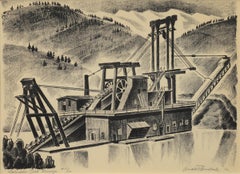
Colorado Gold Dredge, Breckenridge, Signed Black and White Mining Lithograph

Colorado Gold Dredge, Breckenridge, Signed Black and White Mining Lithograph

By Arnold Rönnebeck

Located in Denver, CO

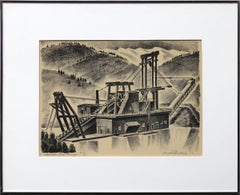
Lithograph on paper titled 'Colorado Gold Dredge, Breckenridge' by Arnold Ronnebeck (1885-1947) from 1932. Numbered 15/25. Depicted is a gold dredge in Colorado mining town Breckenridge with a mountain landscape in the background. Presented in a custom frame measuring 17 ¼ x 21 ¼ inches. Image size measures 10 ¼ x 14 ¼ inches. Print is clean and in very good vintage condition - please contact us for a detailed condition report. Provenance: Estate of Arnold Ronnebeck Expedited and international shipping is available - please contact us for a quote. About the Artist: Modernist sculptor, lithographer and museum administrator, Rönnebeck was a noted member of European and American avant-garde circles in the early twentieth century before settling in Denver, Colorado, in 1926. After studying architecture at the Royal Art School in Berlin for two years beginning in 1905, he moved to Paris in 1908 to study sculpture with Aristide Maillol and Émile-Antoine Bourdelle. While there he met and befriended American modernist painter, Marsden Hartley, of whom he sculpted a bronze head that was exhibited at the Salon d’Automne in Paris in 1912 and the following year at Hartley’s solo show of paintings at Alfred Stieglitz’s Gallery 291 in New York. A frequent guest of Gertrude Stein’s Saturday "evenings" in Paris, she described Rönnebeck as "charming and always invited to dinner," along with Pablo Picasso, Mabel Dodge (Luhan) and Charles Demuth. After the outbreak of World War I in 1914, Rönnebeck returned to Germany where he served as an officer in the German Imperial Army on the front lines. Twice wounded, including in the Battle of Marne in France, Kaiser Wilhelm II awarded him the Iron Cross. During the war Hartley fell in love with Rönnebeck’s cousin, Lieutenant Karl von Freyburg, who was killed in combat. As a tribute to Freyburg, Hartley created Portrait of a German Officer (1914) now in the Metropolitan Museum of Art in New York. After the war Rönnebeck traveled in Italy with German writer, Max Sidow, and German poet, Theodor Daubler, doing a series of drawings of Positano and the Amalfi Coast that formed the basis for his lithographs on the subject. The death of his finacée, the young American opera singer Alice Miriam in 1922 and his own family’s increasing financial problems in post-World War I Germany led him to immigrate to the United States in 1923. After living briefly with Miriam’s family in Washington, DC, he moved to New York where he became part of the avant-garde circle around Alfred Stieglitz. His essay, "Through the Eyes of a European Sculptor," appeared in the catalog for the Anderson Gallery exhibition, "Alfred Stieglitz Presents Seven Americans: 159 Paintings, Photographs & Things, Recent & Never Publicly Shown, by Arthur G. Dove, Marsden Hartley, John Marin, Charles Demuth, Paul Strand, Georgia O’Keeffe, Alfred Stieglitz." In New York Rönnebeck began producing Precisionist-style lithographs of the city’s urban landscapes which he termed "living cubism." Some of them were reproduced in Vanity Fair magazine. Through Stieglitz he met Erhard Weyhe head of the Weyhe Gallery who, with its director Carl Zigrosser, arranged Rönnebeck’s first solo American exhibition in May 1925 at the gallery in New York. Comprising some sixty works – prints, drawings and sculpture – the show subsequently traveled on a thirteen-month tour of major American cities. Until the end of his life, the gallery represented him, along with other American artists Adolf Dehn, Wanda Gag, Rockwell Kent, J.J. Lankes, Louis Lozowick, Reginald Marsh and John Sloan. In the summer of 1925, as the guest of Mabel Dodge Luhan, Rönnebeck first saw Taos, New Mexico, which Marsden Hartley had encouraged him to visit. It was there that he met his future wife, Louise Emerson, an easel painter and muralist. A year later they were married in New York before relocating to Denver. He served as director of the Denver Art Museum from 1926 to 1930 where he invited Marsden Hartley to lecture on Cézanne’s art in 1928. Rönnebeck fostered the development of the museum’s collection of American Indian art and the curation of modernist art exhibitions. In addition to his work at the museum, he was professor of sculpture at the University of Denver’s College of Fine and Applied Arts from 1929 to 1935, and wrote a weekly art column in the Rocky Mountain News. His best known Denver sculptures from the late 1920s in bronze, copper, stone, wood and terra cotta include a reredos, The Epiphany, at St. Martin’s Chapel; The History of Money (six panels) at the Denver National Bank; The Ascension at the Church of Ascension; and the William V. Hodges Family Memorial at Fairmount Cemetery. At the same time he did a series of terra cotta relief panels for La Fonda Hotel in Santa Fe, New Mexico. In the 1930s his bas-relief aluminum friezes of stylized Pueblo and Hopi Indian Kachina masks...

Category

1930s American Modern Arnold Ronnebeck Art

Materials

Paper, Lithograph

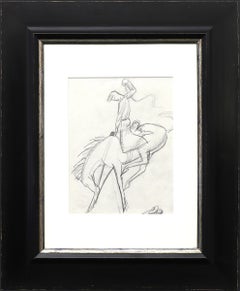
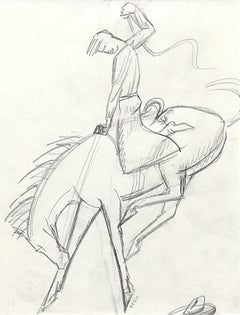
Bucking Bronco, Original Sketch of Horse and Cowboy, Modernist Framed Drawing

Bucking Bronco, Original Sketch of Horse and Cowboy, Modernist Framed Drawing

By Arnold Rönnebeck

Located in Denver, CO

Graphite on paper drawing by Arnold Ronnebeck of a bucking bronco and cowboy, signed by the artist in the lower right corner. Presented in a custom black frame, outer dimensions measure 22 ⅜ x 18 ⅜ x ¾ inches. Image sight size is 10 ½ x 8 ¾ inches. Drawing is clean and in very good vintage condition - please contact us for a detailed condition report. Expedited and international shipping is available - please contact us for a quote. About the artist: Modernist sculptor, lithographer and museum administrator, Rönnebeck was a noted member of European and American avant-garde circles in the early twentieth century before settling in Denver, Colorado, in 1926. After studying architecture at the Royal Art School in Berlin for two years beginning in 1905, he moved to Paris in 1908 to study sculpture with Aristide Maillol and Émile-Antoine Bourdelle. While there he met and befriended American modernist painter, Marsden Hartley, of whom he sculpted a bronze head that was exhibited at the Salon d’Automne in Paris in 1912 and the following year at Hartley’s solo show of paintings at Alfred Stieglitz’s Gallery 291 in New York. A frequent guest of Gertrude Stein’s Saturday "evenings" in Paris, she described Rönnebeck as "charming and always invited to dinner," along with Pablo Picasso, Mabel Dodge (Luhan) and Charles Demuth. After the outbreak of World War I in 1914, Rönnebeck returned to Germany where he served as an officer in the German Imperial Army on the front lines. Twice wounded, including in the Battle of Marne in France, Kaiser Wilhelm II awarded him the Iron Cross. During the war Hartley fell in love with Rönnebeck’s cousin, Lieutenant Karl von Freyburg, who was killed in combat. As a tribute to Freyburg, Hartley created Portrait of a German Officer (1914) now in the Metropolitan Museum of Art in New York. After the war Rönnebeck traveled in Italy with German writer, Max Sidow, and German poet, Theodor Daubler, doing a series of drawings of Positano and the Amalfi Coast that formed the basis for his lithographs on the subject. The death of his finacée, the young American opera singer Alice Miriam in 1922 and his own family’s increasing financial problems in post-World War I Germany led him to immigrate to the United States in 1923. After living briefly with Miriam’s family in Washington, DC, he moved to New York where he became part of the avant-garde circle around Alfred Stieglitz. His essay, "Through the Eyes of a European Sculptor," appeared in the catalog for the Anderson Gallery exhibition, "Alfred Stieglitz Presents Seven Americans: 159 Paintings, Photographs & Things, Recent & Never Publicly Shown, by Arthur G. Dove, Marsden Hartley, John Marin, Charles Demuth, Paul Strand, Georgia O’Keeffe, Alfred Stieglitz." In New York Rönnebeck began producing Precisionist-style lithographs of the city’s urban landscapes which he termed "living cubism." Some of them were reproduced in Vanity Fair magazine. Through Stieglitz he met Erhard Weyhe head of the Weyhe Gallery who, with its director Carl Zigrosser, arranged Rönnebeck’s first solo American exhibition in May 1925 at the gallery in New York. Comprising some sixty works – prints, drawings and sculpture – the show subsequently traveled on a thirteen-month tour of major American cities. Until the end of his life, the gallery represented him, along with other American artists Adolf Dehn, Wanda Gag, Rockwell Kent, J.J. Lankes, Louis Lozowick, Reginald Marsh and John Sloan. In the summer of 1925, as the guest of Mabel Dodge Luhan, Rönnebeck first saw Taos, New Mexico, which Marsden Hartley had encouraged him to visit. It was there that he met his future wife, Louise Emerson, an easel painter and muralist. A year later they were married in New York before relocating to Denver. He served as director of the Denver Art Museum from 1926 to 1930 where he invited Marsden Hartley to lecture on Cézanne’s art in 1928. Rönnebeck fostered the development of the museum’s collection of American Indian art and the curation of modernist art exhibitions. In addition to his work at the museum, he was professor of sculpture at the University of Denver’s College of Fine and Applied Arts from 1929 to 1935, and wrote a weekly art column in the Rocky Mountain News. His best known Denver sculptures from the late 1920s in bronze, copper, stone, wood and terra cotta include a reredos, The Epiphany, at St. Martin’s Chapel; The History of Money (six panels) at the Denver National Bank; The Ascension at the Church of Ascension; and the William V. Hodges Family Memorial at Fairmount Cemetery. At the same time he did a series of terra cotta relief panels for La Fonda Hotel in Santa Fe, New Mexico. In the 1930s his bas-relief aluminum friezes of stylized Pueblo and Hopi Indian Kachina masks...

Category

20th Century American Modern Arnold Ronnebeck Art
Materials

Graphite

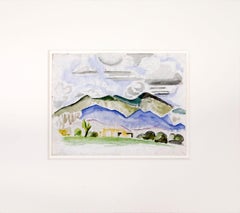
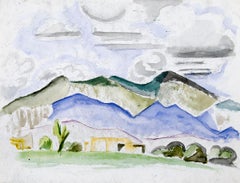
Summer Afternoon, Taos, New Mexico, 1920s Modern Watercolor Mountain Landscape

Summer Afternoon, Taos, New Mexico, 1920s Modern Watercolor Mountain Landscape

By Arnold Rönnebeck

Located in Denver, CO

Watercolor on paper. Image size is 7 ¾ x 10 ¼ inches, dimensions with mat measure 16 ¼ x 18 ¼ inches. This piece is unframed, housed in an archival mat. Framed pictures are mock-ups and custom framing options are available. Painting is clean and in very good vintage condition - please contact us for a complete condition report. Expedited and international shipping is available - please contact us for a quote. Provenance: Estate of Arnold Ronnebeck About the artist: Modernist sculptor, lithographer and museum administrator, Rönnebeck was a noted member of European and American avant-garde circles in the early twentieth century before settling in Denver, Colorado, in 1926. After studying architecture at the Royal Art School in Berlin for two years beginning in 1905, he moved to Paris in 1908 to study sculpture with Aristide Maillol and Émile-Antoine Bourdelle. While there he met and befriended American modernist painter, Marsden Hartley, of whom he sculpted a bronze head that was exhibited at the Salon d’Automne in Paris in 1912 and the following year at Hartley’s solo show of paintings at Alfred Stieglitz’s Gallery 291 in New York. A frequent guest of Gertrude Stein’s Saturday "evenings" in Paris, she described Rönnebeck as "charming and always invited to dinner," along with Pablo Picasso, Mabel Dodge (Luhan) and Charles Demuth. After the outbreak of World War I in 1914, Rönnebeck returned to Germany where he served as an officer in the German Imperial Army on the front lines. Twice wounded, including in the Battle of Marne in France, Kaiser Wilhelm II awarded him the Iron Cross. During the war Hartley fell in love with Rönnebeck’s cousin, Lieutenant Karl von Freyburg, who was killed in combat. As a tribute to Freyburg, Hartley created Portrait of a German Officer (1914) now in the Metropolitan Museum of Art in New York. After the war Rönnebeck traveled in Italy with German writer, Max Sidow, and German poet, Theodor Daubler, doing a series of drawings of Positano and the Amalfi Coast that formed the basis for his lithographs on the subject. The death of his finacée, the young American opera singer Alice Miriam in 1922 and his own family’s increasing financial problems in post-World War I Germany led him to immigrate to the United States in 1923. After living briefly with Miriam’s family in Washington, DC, he moved to New York where he became part of the avant-garde circle around Alfred Stieglitz. His essay, "Through the Eyes of a European Sculptor," appeared in the catalog for the Anderson Gallery exhibition, "Alfred Stieglitz Presents Seven Americans: 159 Paintings, Photographs & Things, Recent & Never Publicly Shown, by Arthur G. Dove, Marsden Hartley, John Marin, Charles Demuth, Paul Strand, Georgia O’Keeffe, Alfred Stieglitz." In New York Rönnebeck began producing Precisionist-style lithographs of the city’s urban landscapes which he termed "living cubism." Some of them were reproduced in Vanity Fair magazine. Through Stieglitz he met Erhard Weyhe head of the Weyhe Gallery who, with its director Carl Zigrosser, arranged Rönnebeck’s first solo American exhibition in May 1925 at the gallery in New York. Comprising some sixty works – prints, drawings and sculpture – the show subsequently traveled on a thirteen-month tour of major American cities. Until the end of his life, the gallery represented him, along with other American artists Adolf Dehn, Wanda Gag, Rockwell Kent, J.J. Lankes, Louis Lozowick, Reginald Marsh and John Sloan. In the summer of 1925, as the guest of Mabel Dodge Luhan, Rönnebeck first saw Taos, New Mexico, which Marsden Hartley had encouraged him to visit. It was there that he met his future wife, Louise Emerson, an easel painter and muralist. A year later they were married in New York before relocating to Denver. He served as director of the Denver Art Museum from 1926 to 1930 where he invited Marsden Hartley to lecture on Cézanne’s art in 1928. Rönnebeck fostered the development of the museum’s collection of American Indian art and the curation of modernist art exhibitions. In addition to his work at the museum, he was professor of sculpture at the University of Denver’s College of Fine and Applied Arts from 1929 to 1935, and wrote a weekly art column in the Rocky Mountain News. His best known Denver sculptures from the late 1920s in bronze, copper, stone, wood and terra cotta include a reredos, The Epiphany, at St. Martin’s Chapel; The History of Money (six panels) at the Denver National Bank; The Ascension at the Church of Ascension; and the William V. Hodges Family Memorial at Fairmount Cemetery. At the same time he did a series of terra cotta relief panels for La Fonda Hotel in Santa Fe, New Mexico. In the 1930s his bas-relief aluminum friezes of stylized Pueblo and Hopi Indian Kachina masks...

Category

1920s American Modern Arnold Ronnebeck Art
Materials

Watercolor

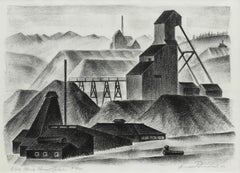
Mine Near Contintental Divide, Colorado, 1930s Black & White Original Lithograph

Mine Near Contintental Divide, Colorado, 1930s Black & White Original Lithograph

By Arnold Rönnebeck

Located in Denver, CO

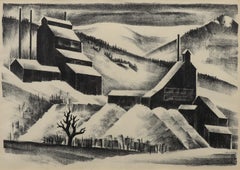
Mine Near Contintental Divide, Colorado, original vintage 1933 black and white lithograph by WPA era modernist, Arnold Ronnebeck (1885-1947), number 22 in an edition of 25 prints. M...

Category

1930s American Modern Arnold Ronnebeck Art
Materials

Lithograph

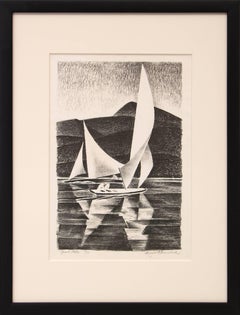
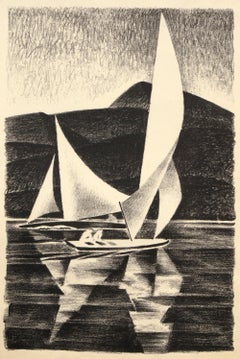
Grand Lake (Yacht Races, Colorado)

Grand Lake (Yacht Races, Colorado)

By Arnold Rönnebeck

Located in Denver, CO

Sailboats on Grand Lake in Colorado, 1932. Number 8 in an edition of 25. Presented in a custom frame with all archival materials; outer dimensions measure...

Category

1930s American Modern Arnold Ronnebeck Art
Materials

Lithograph

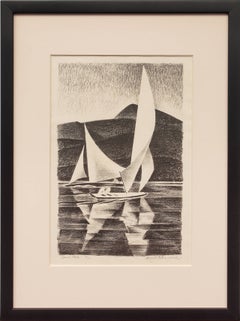
Yacht Races (Grand Lake, Colorado)

Yacht Races (Grand Lake, Colorado)

By Arnold Rönnebeck

Located in New York, NY

Arnold Ronnebeck (1890-1983) Yacht Races (Grand Lake, Colorado)= 1933, Lithograph Edition 25. Signed, titled and numbered in pencil. Image size 13 ...

Category

1930s American Modern Arnold Ronnebeck Art
Materials

Lithograph

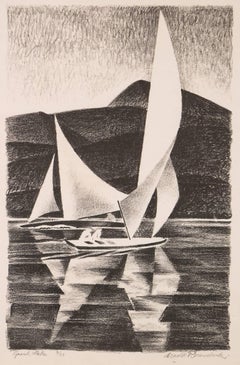
Grand Lake (Colorado)

Grand Lake (Colorado)

By Arnold Rönnebeck

Located in Denver, CO

Sailboats on Colorado's Grand Lake. Created in 1932, this is number 8 in an edition of only 25 prints. Custom frame with all archival materials; framed di...

Category

1930s American Modern Arnold Ronnebeck Art
Materials

Etching

Arnold Ronnebeck art for sale on 1stDibs.
Find a wide variety of authentic Arnold Ronnebeck art available for sale on 1stDibs. You can also browse by medium to find art by Arnold Ronnebeck in lithograph, paper, graphite and more. Much of the original work by this artist or collective was created during the 20th century and is mostly associated with the modern style. Not every interior allows for large Arnold Ronnebeck art, so small editions measuring 8 inches across are available. Customers who are interested in this artist might also find the work of Paul Landacre, Lawrence Wilbur, and Rockwell Kent. Arnold Ronnebeck art prices can differ depending upon medium, time period and other attributes. On 1stDibs, the price for these items starts at $1,225 and tops out at $28,000, while the average work can sell for $2,515.
Artists Similar to Arnold Ronnebeck