By Charles Meryon
Located in Plano, TX
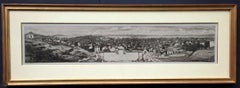
San Francisco. 1855-56. Etching on steel, based upon photographs. Delteil-Wright catalog 73; Schneiderman catalog 54 state iv (with lettering). 9 1/2 x 39 1/4 (sheet - sight size 8 1/8 x 38 1/2). frame 16 x 45 1/2). Printed by A. Delâtre in an edition of 100. A rich lifetime impression printed on laid japan paper. A rich, bright impression in good condition. Provenance: Property from the Credit Suisse Americana Collection. Signed and dated in the plate. Annotated in the plate, "Imprimée chez A. Delâtre, rue du Fbg Poissonnièr 145, Paris." The etching is elegantly presented in a silk mat with a gold liner and a 16 x 45 1/2-inch gold leaf frame.
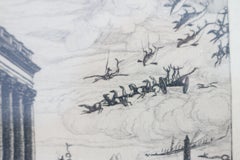
In the spring of 1856 from François Louis Alfred Pioche (1818-1872), a banker, investor and art collector, who traveled between his native Paris and his adopted home of San Francisco. Pioche had made his fortune in San Francisco, but was back in Paris seeking investors for his rapidly growing American business interests. Poiche asked Meryon to create a panoramic landscape of San Francisco, although the artist had never been there. For inspiration, he was given a five-daguerreotype panorama of the city (now in the Art Institute of Chicago), from which five large paper photographs were made for his use. While much of the landscape was copied directly from the photographs, Meryon added a cartouche to the center foreground with allegorical figures of Abundance and Labor, as well as portrait medallions of Pioche and his partner Jules B. Bayerque. The etching took nearly a year to complete. Meryon pulled the first proofs in September and finished some time that winter.
San Francisco was a point of interest in Europe after the gold rush of 1848, as people from within America and abroad rushed to California to seek their fortune. The population grew rapidly, forcing the city to expand haphazardly with narrow streets that survive to this day. The large title cartouche is supported by river gods who appear to be holding sieves, a reference to the activity that was making the city rich.
Meryon depicts San Francisco as a bustling yet still growing metropolis, rife with opportunity for the investor. There is almost empty farmland in the foreground, followed by a jam-packed cityscape, and ending with a busy port-scene densely populated with cargo ships. The symbols of California's wealth, gold mining equipment...
Category
Mid-19th Century Modern Charles Meryon Art