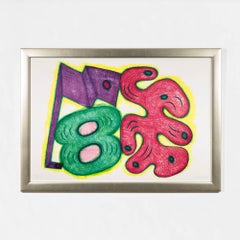
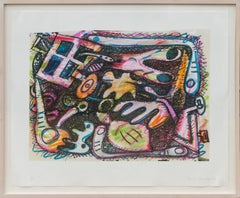
By Elizabeth Murray
Located in Surfside, FL
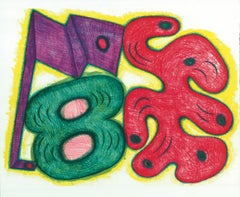
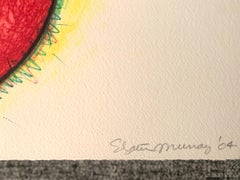
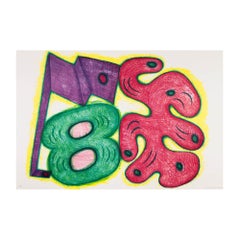
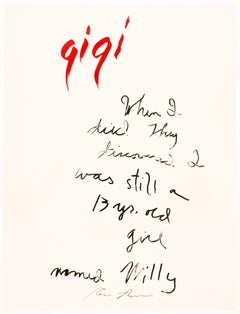
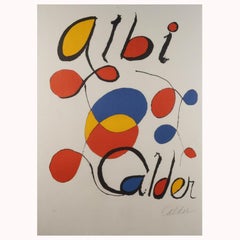
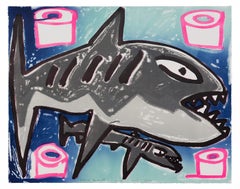
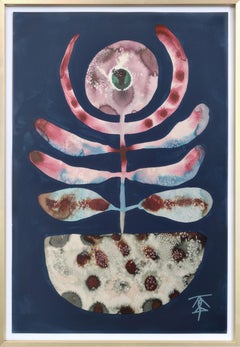
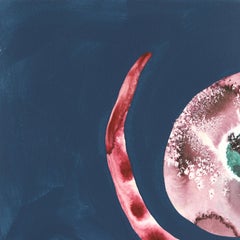
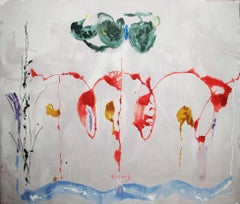
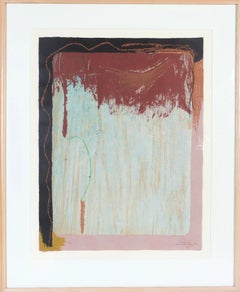
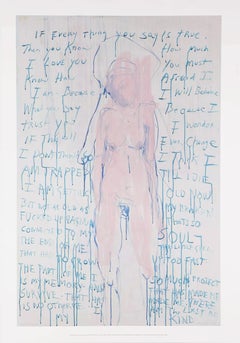
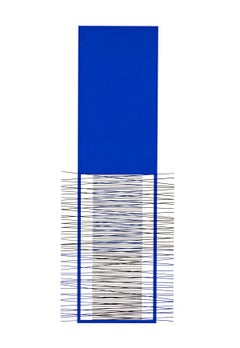
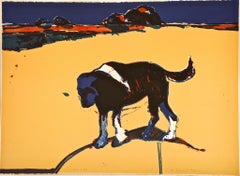
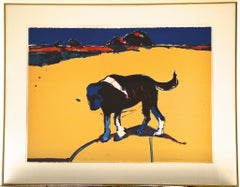
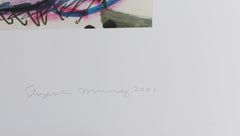
A bright, colorful expressive piece signed verso on the stretcher.
Elizabeth Murray, a New York painter who reshaped Modernist abstraction into a high-spirited, cartoon-based, language of form whose subjects included domestic life, relationships and the nature of painting itself.
Pace Wildenstein, has represented her work since 1995.
Murray received a full-dress retrospective spanning her 40-year career at the Museum of Modern Art in 2006, one of handful of women to be so honored. In 1999 she was the recipient of a MacArthur Foundation “genius” grant.
Ms. Murray belonged to a sprawling generation of Post-Minimal artists who spent the 1970s reversing the reductivist tendencies of Minimalism and reinvigorating art with a sense of narrative, process and personal identity. Her art never fit easily into the available Post-Minimal subcategories like Conceptual, Process or performance art. This may have been because her loyalty to painting, which was out of fashion, was unwavering. At the same time, her blithe indifference to the distinctions between abstraction and representation or high and low could put off serious painting buffs.
Both tendencies enabled her to be one of a small group of painters — including Philip Guston, Frank Stella and Brice Marden — who during the 1970s rebuilt the medium from scratch, recomplicating and expanding its parameters and proving that it was still ripe for innovation, in part because of its rich history. Her sources ranged from Cézanne, Picasso, Gris and Miró to Stuart Davis, Al Held and Agnes Martin. As she remarked in the 1987 catalog to her first big museum show, which traveled to the Whitney in 1988: “Everything has been done a million times. Sometimes you use it and it’s yours; another time you do it and it’s still theirs.”
In Ms. Murray’s mature work, eccentrically shaped or multipanel canvases fused Cubism’s shattered forms and Surrealism’s suggestive biomorphism with the scale and some of the angst of Abstract Expressionism and more than a touch of Disneyesque humor and motion.
Born in Chicago in 1940, Ms. Murray had a hardscrabble childhood that included bouts of homelessness caused in part by the ill health of her father. Ms. Murray traced her interest in art to watching a nursery-school teacher cover a sheet of paper with thick red crayon, an experience that she said gave her an indelible sense of the physicality of color. She drew constantly from an early age, inspired mostly by newspaper comic strips, and once sent a sketchbook to Walt Disney asking for a job as his secretary. By the fifth grade she was selling erotic drawings to classmates for a quarter.
In 1958, she entered the School of the Art Institute of Chicago. Her goal, to become a commercial artist, was derailed by a Cézanne still life...
Category
20th Century Neo-Expressionist Elizabeth Murray Art