Frank Weston Benson Art
to
2
1
Overall Width
to
Overall Height
to
3
1
1
2
2
1
3
2
2
1
1
1
1
1
1
1
1
1
3
1
3
9,988
2,754
1,377
1,375
2
1
3
Artist: Frank Weston Benson
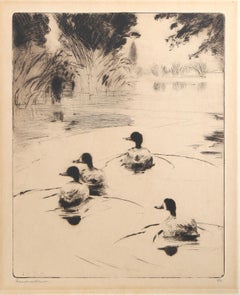
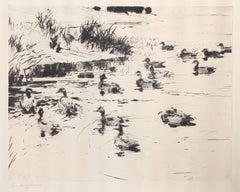
Ducks at Play, Signed Modern Etching Mounted to Board by Frank Weston Benson
By Frank Weston Benson
Located in Long Island City, NY
Ducks at Play
Frank Weston Benson, American (1862–1951)
Date: 1940
Etching mounted to board, signed and dated in pencil
Image Size: 10 x 8 inches
Size: 12 x 10 in. (30.48 x 25.4 cm)
Category
1940s Modern Frank Weston Benson Art
Materials
Etching
Frank Weston Benson Original Etching, Early 20th Century
By Frank Weston Benson
Located in New York, NY
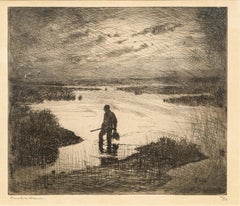
Frank Weston Benson (American, 1862-1951)
Untitled, 20th Century
Etching
Sight: 10 1/3 x 12 1/8 in.
Framed: 16 3/4 x 19 x 1/2 in.
Signed lower left
Numb...
Category
20th Century Modern Frank Weston Benson Art
Materials
Etching
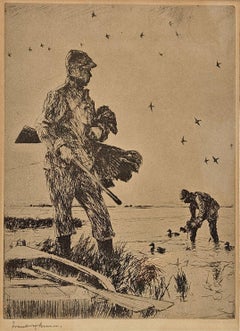
"Winter Wildfowling" Frank Weston Benson, Hunting Scene, Outdoors, Marshes
By Frank Weston Benson
Located in New York, NY
Frank Weston Benson
Winter Wildfowling, 1927
Signed lower left
Etching on paper
Image 8 1/2 x 7 inches
Born in Salem, Massachusetts, a descendant of a long line of sea captains, Benson first studied art at Boston’s Museum School where he became editor of the student magazine. In 1883, Benson enrolled at the Académie Julian in Paris where artists such as Bouguereau, Lefebvre, Constant, Doucet and Boulanger taught students from all over Europe and America. It was Boulanger who gave Benson his highest commendation. “Young man,” he said, “Your career is in your hands . . . you will do very well.” Benson’s parents gave him a present of one thousand dollars a twenty-first birthday and told him to return home when it ran out. The money lasted long enough to provide Benson with two years of schooling in Paris, a summer at the seaside village of Concarneau in Brittany and travel in England.
Upon returning to America, Benson opened a studio on Salem’s Chestnut Street and began painting portraits of family and friends. An oil of his wife, Ellen Perry Peirson, dressed in her wedding gown is representative of this period. It demonstrates not only the academic techniques he learned at the Academie Julian but also his own growing emphasis on the effects of light. And yet, despite all the technical mastery displayed in the work, the painting exudes the warmth that existed between model and artist. More than a likeness, it is a study in serenity. Perhaps it was of a work such as this that Benson was thinking when he said, “The more a painter knows about his subject, the more he studies and understands it, the more the true nature of it is perceived by whoever looks at it, even though it is extremely subtle and not easy to see or understand. A painter must search deeply into the aspects of a subject, must know and understand it thoroughly before he can represent it well.”
Following a brief stint as an instructor at the Portland, Maine, Society of Art, Benson was appointed as instructor of antique drawing at the Museum School in Boston in the spring of l889. Benson’s long association with the school was particularly fruitful. Under the leadership of Edmund Tarbell and Benson the Museum School became a national and internationally recognized institution. The students won numerous prizes, enrollment tripled, a new school building was erected and visiting delegations from other schools sought the secret of their success. Benson cherished his role as teacher and was held in high esteem by his students, many of whom called him “Cher Maitre.” Reminiscing about his long career with the school Benson once said, “I may have taught many students, but it was I who learned the most.”
In 1890, Benson won the Hallgarten Prize at the National Academy in New York. It was the first of a long series of awards, that earning for him the sobriquet “America’s Most Medalled Painter.” In the early years of his career, Benson’s studio works were mostly portraits or paintings of figures set in richly appointed interiors. Young women in white stretch their hands out towards the glow of an unseen fire; girls converse on an antique settee in a room full of objets d’arts; his first daughter, Eleanor, poses with her cat. Works of this sort, together with a steady influx of portrait commissions, earned Benson both renown and financial rewards, yet it was in his outdoor works that gave Benson his greatest pleasure.
In the latter half of the 1890s, Benson summered in Newcastle, on New Hampshire’s short stretch of seacoast. It was here, in 1899, that Benson made his first foray into impressionism with Children in the Woods and The Sisters, the latter a sun-dappled study of his two youngest daughters, Sylvia and Elisabeth.
This painting was one of the first works that Benson hung at an exhibition with nine friends. The resignation of these ten illustrious artists rocked the American art establishment but, the catalogue for their first exhibition was titled, simply, “Ten American Painters.” When, in 1898, the three Bostonians and seven New Yorkers began to exhibit their best work in exquisitely arranged small shows, the group (dubbed by newspapers, “The Ten” ) quickly became known as the American Impressionists, a bow to the style of their French predecessors. The Ten’s annual shows soon became an eagerly awaited part of the annual exhibition calendar and were always well reviewed. Held annually in New York City, the group’s yearly exhibitions usually traveled to Boston and were occasionally seen in other cities. Benson’s association with other members of the group such as Childe Hassam, Thomas Dewing, William Merrit Chase and J. Alden Weir, only reinforced his growing emphasis on the tenets of Impressionism. As he later said to his daughter Eleanor, “I follow the light, where it comes from, where it goes.”
The principles of Impressionism began to dominate Benson’s work by 1901, the year that the Bensons first summered on the island of North Haven in Maine’s Penobscot Bay. His summer home “Wooster Farm,” which they rented and finally bought in 1906, became the setting for some of Benson’s best known work and there, it seemed, he found endless inspiration. Benson’s sparkling plein-air paintings of his children–Eleanor, George, Elisabeth and Sylvia–capture the very essence of summer and have been widely reproduced: In The Hilltop, George and Eleanor watch the sailboat races from the headland near their house.
As a boy, Benson dreamed of being an ornithological illustrator. In mid-life, he returned to the wildfowl and sporting subjects that had remained his lifelong passion. Using etching and lithography, watercolor, oil and wash, Benson portrayed the birds observed since childhood and captured scenes of his hunting and fishing expeditions.
Together with his two brothers-in-law, Benson bought a small hunting retreat on a hill overlooking Cape Cod’s Nauset Marsh. Here, in the late 1890s, he began experimenting with black and white wash drawings. These paintings became so popular that Benson was not able to keep up with the demand. He turned to an art publishing company to have several made into it intaglio prints; twelve wash drawings are known to have been reproduced in this manner. At least two of them were given as gifts to associate members of the Boston Guild of artists, of which Benson was a founding member.
Benson was also an avid fisherman and his salmon fishing expeditions to Canada’s Gaspé Peninsula where one of the high points of his summer. There, in 1921, he began the first in a series of watercolors that would eventually over 500 works.
Benson’s watercolors conveyed the joy and beauty of a sportsman’s life whether in a painting of a hunter setting out decoys, a flock of ducks coming in for a landing or a grouse flushed from cover. The critics favorably compared Benson’s watercolors to those of Homer. “The love of the almost primitive wilderness which appears in many of Homer’s landscapes and the swift, sure touch with which he suggests rather than describes–these also characterize Benson’s work,” one critic wrote. “The solitude of the northern woods is very much like Homer’s.”
Like the wash drawings before them, Benson’s watercolors proved...
Category
1920s Academic Frank Weston Benson Art
Materials
Paper, Etching
Related Items
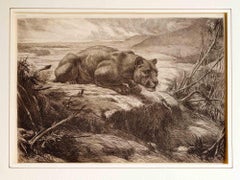
Lioness i- Etching by Evert Louis van Muyden - 1900
By Evert Louis van Muyden
Located in Roma, IT
Lioness is a modern artwork realized by Evert Louis van Muyden (Albano, Lazio 1853 - 1922 Orsay) in 1900 .
Black and white etching.
Signature and date on plate.
Includes passe-pa...
Category
Early 1900s Modern Frank Weston Benson Art
Materials
Etching

$534
H 7.09 in W 10.24 in D 0.04 in
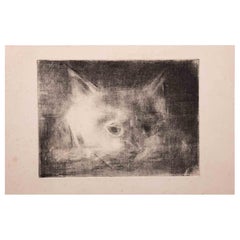
The Cat - Original Etching by Giselle Halff - 1950s
By Giselle Halff
Located in Roma, IT
The Cat is an Original etching print on paper realized by Giselle Halff in 1950 ca.
Good conditions with some foxing.
.
Category
1950s Modern Frank Weston Benson Art
Materials
Etching
$401
H 7.49 in W 11.03 in D 0.04 in
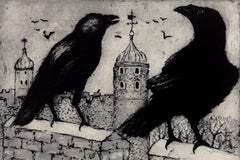
Tim Southall, Ravens at the Tower, Etching, Affordable Art, Art Online
By Tim Southall
Located in Deddington, GB
Tim Southall
Ravens at the Tower
Limited Edition Etching and Aquatint
Edition of 75
Image Size: H 10cm x W 15cm
Sheet Size: H 20cm x W 24cm x D 0.1cm
Sold Unframed
Please note that i...
Category
21st Century and Contemporary Contemporary Frank Weston Benson Art
Materials
Paper, Etching, Aquatint
$293
H 7.88 in W 9.45 in
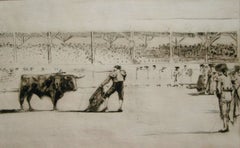
The Matador.
By James McBey
Located in Storrs, CT
The Matador. 1911. Drypoint. Hardie 109. 6 7/8 x 10 7/8 (sheet 7 7/8 x 12). Edition 15. A few scattered foxing marks and slight mat line; otherwise fine o...
Category
1910s Modern Frank Weston Benson Art
Materials
Drypoint, Etching
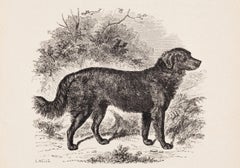
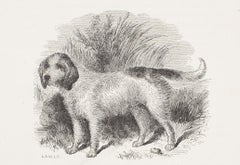
Retriever Crossed with a Setter
Located in Columbia, MO
Retriever Crossed with a Setter
1887
Etching
3 x 5
Category
Late 19th Century Naturalistic Frank Weston Benson Art
Materials
Etching
Lumbermen.
By Edmund Blampied
Located in Storrs, CT
Lumbermen. 1923. Etching. Appleby 91. 9 x 12 (sheet 12 3/8 x 18 1/8). Edition 100. A cleanly-wiped impression printed on off-white 'FG Head & Co' laid paper with full margins. Signed...
Category
1920s Modern Frank Weston Benson Art
Materials
Drypoint, Etching
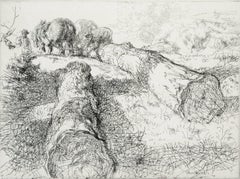
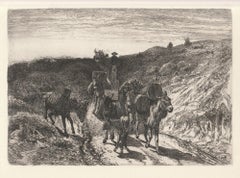
A Burro Train, New Mexico
By Peter Moran
Located in Middletown, NY
Etching with aquatint on heavy laid paper, 7 x 9 1/4 inches (172 x 233 mm), full margins. Signed in the plate, lower right image area. Minor corner loss, top right, and a 1/4 inch ed...
Category
Late 19th Century American Realist Frank Weston Benson Art
Materials
Laid Paper, Etching
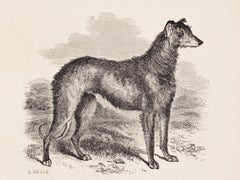
"Cader, " a Deerhound of the Pure Glengarry Breed
Located in Columbia, MO
"Cader," a Deerhound of the Pure Glengarry Breed
1887
Etching
3 x 5
Category
Late 19th Century Naturalistic Frank Weston Benson Art
Materials
Etching
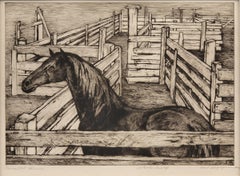
Ethel Magafan “Corralled Horse” 1940s WPA-Era Modernist Etching, Artist’s Proof
By Ethel Magafan
Located in Denver, CO
Corralled Horse is a rare WPA-era modernist etching by acclaimed American artist Ethel Magafan, created in the 1940s. This artist’s proof depicts a lone dark horse within a wooden co...
Category
1940s American Modern Frank Weston Benson Art
Materials
Etching
"Bellman, " an Otter-Hound
Located in Columbia, MO
"Bellman, " an Otter-Hound
1887
Etching
3 x 5
Category
Late 19th Century Naturalistic Frank Weston Benson Art
Materials
Etching
Three Gould Hand-colored Lithographs from Birds of Australia and New Zealand
By John Gould
Located in Alamo, CA
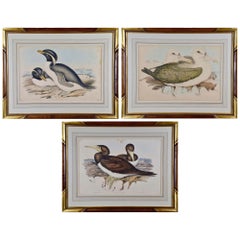
Three hand-colored lithographs from John Gould's seven volume book "The Birds of Australia", which included New Zealand, depicting: pairs of "Eudyptes Chrysocome" (New Zealand Rock-hopper Crested Penguins), "Diomedea O Thalassarche Cauta" (Australian Shy Albatross) and "Sula Fusca" (Brown Gannets).
These beautiful sea bird prints are presented in identical very attractive brown wood frames, embellished with gold highlights in the corners and gold inner trim, along with light cream-colored French mats, each with a medium cream-colored band and a gold highlight line. There is scattered spotting. There is a small tear in the lower right corner of the penguin lithograph...
Category
1840s Academic Frank Weston Benson Art
Materials
Lithograph
$2,540 Sale Price
20% Off
H 22 in W 28.25 in D 1 in
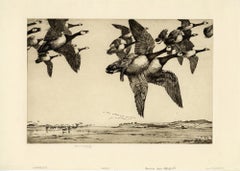
Barnacle Geese Affrighted
Located in Middletown, NY
Etching and drypoint on cream wove paper, full margins. Signed and numbered 59/75 in pencil, lower margin. Notations in pencil along the lower sheet edge, recto, well outside of ima...
Category
Mid-20th Century Modern Frank Weston Benson Art
Materials
Handmade Paper, Drypoint, Etching
Previously Available Items
Mount Monadnock
By Frank Weston Benson
Located in Milford, NH
An exceptional watercolor of Mount Monadnock snow capped in winter in New Hampshire by American artist Frank Weston Benson (1862-1951). Benson was born in Salem, Massachusetts and went on to study in Boston at the Museum School of Fine Arts and later with Julian Lefebvre and Gustave Boulanger at the Academie Julian in Paris. Benson was well known for his impressionist landscapes and seascapes, and etchings of hunting scenes.
Watercolor on paper, signed lower left F.W. Benson with inscription “To Mrs Bush,” titled on Vose Galleries...
Category
Early 20th Century American Impressionist Frank Weston Benson Art
Materials
Watercolor, Paper

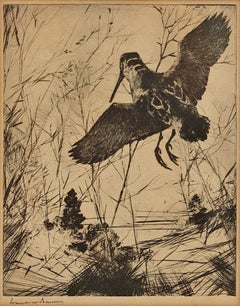
"Woodcock" Frank Weston Benson, 1930s Etching of Bird, Sandpiper, Nature
By Frank Weston Benson
Located in New York, NY
Frank Weston Benson
Woodcock, 1930
Signed lower right
Etching on paper
Image 8 3/4 x 7 inches
Edition of 150
Born in Salem, Massachusetts, a descendant of a long line of sea captains, Benson first studied art at Boston’s Museum School where he became editor of the student magazine. In 1883, Benson enrolled at the Académie Julian in Paris where artists such as Bouguereau, Lefebvre, Constant, Doucet and Boulanger taught students from all over Europe and America. It was Boulanger who gave Benson his highest commendation. “Young man,” he said, “Your career is in your hands . . . you will do very well.” Benson’s parents gave him a present of one thousand dollars a twenty-first birthday and told him to return home when it ran out. The money lasted long enough to provide Benson with two years of schooling in Paris, a summer at the seaside village of Concarneau in Brittany and travel in England.
Upon returning to America, Benson opened a studio on Salem’s Chestnut Street and began painting portraits of family and friends. An oil of his wife, Ellen Perry Peirson, dressed in her wedding gown is representative of this period. It demonstrates not only the academic techniques he learned at the Academie Julian but also his own growing emphasis on the effects of light. And yet, despite all the technical mastery displayed in the work, the painting exudes the warmth that existed between model and artist. More than a likeness, it is a study in serenity. Perhaps it was of a work such as this that Benson was thinking when he said, “The more a painter knows about his subject, the more he studies and understands it, the more the true nature of it is perceived by whoever looks at it, even though it is extremely subtle and not easy to see or understand. A painter must search deeply into the aspects of a subject, must know and understand it thoroughly before he can represent it well.”
Following a brief stint as an instructor at the Portland, Maine, Society of Art, Benson was appointed as instructor of antique drawing at the Museum School in Boston in the spring of l889. Benson’s long association with the school was particularly fruitful. Under the leadership of Edmund Tarbell and Benson the Museum School became a national and internationally recognized institution. The students won numerous prizes, enrollment tripled, a new school building was erected and visiting delegations from other schools sought the secret of their success. Benson cherished his role as teacher and was held in high esteem by his students, many of whom called him “Cher Maitre.” Reminiscing about his long career with the school Benson once said, “I may have taught many students, but it was I who learned the most.”
In 1890, Benson won the Hallgarten Prize at the National Academy in New York. It was the first of a long series of awards, that earning for him the sobriquet “America’s Most Medalled Painter.” In the early years of his career, Benson’s studio works were mostly portraits or paintings of figures set in richly appointed interiors. Young women in white stretch their hands out towards the glow of an unseen fire; girls converse on an antique settee in a room full of objets d’arts; his first daughter, Eleanor, poses with her cat. Works of this sort, together with a steady influx of portrait commissions, earned Benson both renown and financial rewards, yet it was in his outdoor works that gave Benson his greatest pleasure.
In the latter half of the 1890s, Benson summered in Newcastle, on New Hampshire’s short stretch of seacoast. It was here, in 1899, that Benson made his first foray into impressionism with Children in the Woods and The Sisters, the latter a sun-dappled study of his two youngest daughters, Sylvia and Elisabeth.
This painting was one of the first works that Benson hung at an exhibition with nine friends. The resignation of these ten illustrious artists rocked the American art establishment but, the catalogue for their first exhibition was titled, simply, “Ten American Painters.” When, in 1898, the three Bostonians and seven New Yorkers began to exhibit their best work in exquisitely arranged small shows, the group (dubbed by newspapers, “The Ten” ) quickly became known as the American Impressionists, a bow to the style of their French predecessors. The Ten’s annual shows soon became an eagerly awaited part of the annual exhibition calendar and were always well reviewed. Held annually in New York City, the group’s yearly exhibitions usually traveled to Boston and were occasionally seen in other cities. Benson’s association with other members of the group such as Childe Hassam, Thomas Dewing, William Merrit Chase and J. Alden Weir, only reinforced his growing emphasis on the tenets of Impressionism. As he later said to his daughter Eleanor, “I follow the light, where it comes from, where it goes.”
The principles of Impressionism began to dominate Benson’s work by 1901, the year that the Bensons first summered on the island of North Haven in Maine’s Penobscot Bay. His summer home “Wooster Farm,” which they rented and finally bought in 1906, became the setting for some of Benson’s best known work and there, it seemed, he found endless inspiration. Benson’s sparkling plein-air paintings of his children–Eleanor, George, Elisabeth and Sylvia–capture the very essence of summer and have been widely reproduced: In The Hilltop, George and Eleanor watch the sailboat races from the headland near their house.
As a boy, Benson dreamed of being an ornithological illustrator. In mid-life, he returned to the wildfowl and sporting subjects that had remained his lifelong passion. Using etching and lithography, watercolor, oil and wash, Benson portrayed the birds observed since childhood and captured scenes of his hunting and fishing expeditions.
Together with his two brothers-in-law, Benson bought a small hunting retreat on a hill overlooking Cape Cod’s Nauset Marsh. Here, in the late 1890s, he began experimenting with black and white wash drawings. These paintings became so popular that Benson was not able to keep up with the demand. He turned to an art publishing company to have several made into it intaglio prints; twelve wash drawings are known to have been reproduced in this manner. At least two of them were given as gifts to associate members of the Boston Guild of artists, of which Benson was a founding member.
Benson was also an avid fisherman and his salmon fishing expeditions to Canada’s Gaspé Peninsula where one of the high points of his summer. There, in 1921, he began the first in a series of watercolors that would eventually over 500 works.
Benson’s watercolors conveyed the joy and beauty of a sportsman’s life whether in a painting of a hunter setting out decoys, a flock of ducks coming in for a landing or a grouse flushed from cover. The critics favorably compared Benson’s watercolors to those of Homer. “The love of the almost primitive wilderness which appears in many of Homer’s landscapes and the swift, sure touch with which he suggests rather than describes–these also characterize Benson’s work,” one critic wrote. “The solitude of the northern woods is very much like Homer’s.”
Like the wash drawings before them, Benson’s watercolors proved...
Category
1930s Realist Frank Weston Benson Art
Materials
Paper, Etching
Ducks on Lake, Signed Modern Etching by Frank Weston Benson
By Frank Weston Benson
Located in Long Island City, NY
Ducks on Lake
Frank Weston Benson, American (1862–1951)
Date: 1923
Etching on thin wove paper, signed in pencil and dated in the plate
Image Size: 11 x 14 inches
Size: 14 x 16.5 in. ...
Category
1920s Modern Frank Weston Benson Art
Materials
Etching
A Strike
By Frank Weston Benson
Located in New York, NY
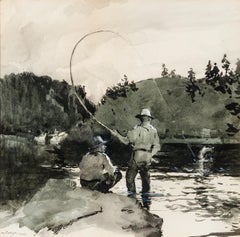
Watercolor on paper, en grisaille, 10 3/4 x 10 3/4 in.
Signed and dated (at lower left): F. W. Benson. 1907.
RECORDED: Patricia Jobe Pierce, The Ten (Hingham, Massachusetts: Pierce Galleries, Inc., 1976), p. 49 illus. as “Two Men Fishing”
EX COLL: [Marine Arts Gallery, Salem, Massachusetts]; [Vincent J. LaFlamme, Castine, Maine]; to Robert C. Vose, Jr., Boston, Massachusetts; [Vose Galleries, Boston, 1975]; to private collection, Tahoe City, California, 1976, until the present
One of the most successful painters working in Boston during the late nineteenth and early twentieth centuries, Frank Benson melded the light and coloristic concerns of Impressionism with the solid draftsmanship, structured designs, and fine craftsmanship associated with academicism––an approach that collectors and critics of his day found highly appealing. A dedicated artist who created his own niche in a highly competitive art world, Benson explored a variety of motifs that reflected his personal life and interests, ranging from joyous portrayals of his wife and children to sparkling
views of the New England coastline and countryside where he spent his summers. Benson also set himself apart from his contemporaries by creating classic sporting scenes and images of wildfowl, deftly melding accuracy of representation with his enduring concern for light. He also applied his brush to sensuous still lifes featuring exotic family heirlooms. Benson’s aesthetic versatility was also manifested through his use of different media and his innate command of oil, watercolor, and etching.
Born into one of the oldest families in Salem, Massachusetts, Benson was the son of George Wiggin Benson, an affluent cotton merchant, and his wife, Elisabeth Frost Poole, an amateur painter. Along with his five siblings, he grew up in a comfortable house owned by his grandfather, Samuel Benson, a sea captain in the China trade who accumulated an enviable collection of oriental antiques during his travels to the Far East. Having been exposed to art and culture while growing up, Bensondecided to pursue an artistic career at age sixteen. He subsequently received a thorough grounding in traditional painting techniques at the Boston Museum School, where he studied under Otto Grundman and Frederic Crowninshield from 1880 to 1883.
In 1883, accompanied by his friend and classmate Edmund C. Tarbell (1862–1938), Benson went to Paris, refining his skills as a figure painter at the Académie Julian under Gustave-Rodolphe Boulanger and Jules-Joseph Lefebvre. During the summer of 1884, he investigated plein-air painting techniques while visiting Concarneau, Brittany, a popular gathering place for artists of all nationalities. Benson was no doubt pleased when his After the Storm (1884; Peabody Essex Museum, Salem, Massachusetts), a portrayal of a Breton peasant woman and her daughter standing by the sea, was featured in the annual exhibition of the Royal Academy in London in 1885.
Benson first delved into teaching in 1881, when he taught evening drawing classes for the town of Salem. He continued this pursuit upon returning from Europe in 1885, giving instruction in drawing and painting techniques at the Portland Society of Art in Maine in 1887 and 1888. In 1889, Benson began a lengthy tenure at the Museum School (where Tarbell had also received an appointment), initially teaching the antique class. Four years later, he was appointed an instructor at his alma mater, teaching drawing and painting classes until 1912, when he changed his status to that of a visiting instructor. During these years, Benson undertook portrait commissions from well-to-do Bostonians in addition to painting outdoor landscapes on seasonal visits to New Hampshire. He also began exhibiting his work locally, as well as in New York, at the annuals of the Society of American Artists and at the National Academy of Design, where he would later be elected an associate member (1897) and a full academician (1905). Following his marriage in 1888 to Ellen Pierson (who
also hailed from Salem), Benson settled in his hometown but maintained a studio at various locales in Boston until 1944.
Throughout the late 1880s and early 1890s, Benson focused his attention on intimate depictions of genteel young women in well-appointed interiors illuminated by subdued artificial light, as in works such as By Firelight (1889; private collection). However, as he became increasingly interested in the effects of outdoor luminosity, Benson changed course and after 1898 turned his attention to dazzling, impressionist-inspired images of family members (notably his wife, son, and three daughters) relaxing in idyllic sun-dappled settings, as in The Sisters (1899; Terra Foundation for American Art, Daniel J. Terra Collection). Throughout these years, Benson exhibited his work in solo and group exhibitions at local venues such as the Boston Art Club, the St. Botolph Club, and Chase’s Gallery.
His profile on the national art scene was given a major boost through his membership in Ten American Painters, an informal exhibiting organization composed of well-established artists (primarily impressionists) from New York and Boston who banded together in opposition to the restrictive policies set forth by the now more conservative Society of American Artists. Along with his fellow members––Tarbell, J. Alden Weir, Robert Reid, Thomas Wilmer Dewing, Edward
Simmons, Willard Metcalf, Joseph De Camp, Childe Hassam, John Henry Twachtman––Benson displayed some of his finest work at the annuals of The Ten, which continued to exhibit together until 1918. (After Twachtman’s death in 1902, his place was taken by William Merritt Chase.) Benson also participated in other major group shows at museums and galleries throughout the country. In fact, his paintings received so many awards and honors, including silver medals at the Paris Exposition (1900) and the Pan-American Exposition in Buffalo (1901) and a gold medal at the Louisiana Purchase Exposition, held in St. Louis in 1904, that he became known as the most medaled American artist of his day.
Benson made a good living from the sale of his art, so much so that in 1906 he purchased Wooster Farm, a colonial farmhouse in North Haven, Maine, on Penobscot Bay, where he and his family had been spending their summers since 1901. In the ensuing years, Benson’s commercial success continued as he expanded his repertoire of media and motifs. Indeed, in the wake of the Armory Show of 1913, as the stylish Boston School paintings of lovely young ladies came to be seen as outmoded, Benson (in keeping with the business acumen he inherited from his father and grandfather) shifted his iconographical concerns from the feminine to the masculine domain by turning increasingly to fishing and hunting themes––motifs that first occupied his attention during the late 1890s. (For this aspect of Benson’s oeuvre, see Faith Andrews Bedford, The Sporting Art of Frank W. Benson [Boston: David R. Godine, 2000].)
An avid outdoorsman, Benson’s earliest sustained forays into sporting art took the form of etchings and drypoints that be began creating in 1912. However, during the 1920s and 1930s he explored this imagery in oil and watercolor, taking a special interest in the portrayal of birds in flight, as in Pintails Decoyed (1921; Museum of Fine Arts, Boston). His unique ability to combine a realistic rendering of his subject while continuing, as he put it, to “follow the light, where it comes from [and] where it goes to,” soon brought him widespread patronage, especially from fellow sporting enthusiasts, as well as a commission to design the Federal Duck Stamp in 1935 (Frank W. Benson, as quoted in Faith Andrews Bedford, “Frank W. Benson: Master of Light,” in Faith Andrews Bedford, et al., The Art of Frank Benson: American Impressionist, exhib. cat. [Salem: Peabody Essex Museum, 2001], p. 11). A prolific artist, Benson’s later oeuvre also includes opulent, light-filled still lifes. Prior to his death in Salem on November 14, 1951, he was honored with several retrospectives, the most significant of which was a joint exhibition with Tarbell held at the Museum of Fine Arts in Boston in 1938.
Benson’s love of piscatorial pursuits––especially salmon and trout fishing––is apparent in A Strike , which features two figures perched on a rocky ledge on the edge of a northern lake. While his comrade looks on, the man on the right steadies himself as he sweeps his rod backwards to secure the hook in the mouth of a struggling fish, a procedure known as “striking.” The painting was presumably inspired by a fishing outing that Benson may have taken during his annual summer visit to North Haven in 1907, when his roster of visitors that year included Willard Metcalf, who
“enjoyed his peaceful times with Benson fishing and bird watching,” (Faith Andrews Bedford, “Frank W. Benson: A Biography,” in Faith Andrews Bedford, et al., Frank W. Benson: A Retrospective, exhib. cat. [New York Berry-Hill Galleries, 1989], p. 63). Benson also fished local, regional, and eastern Canadian waterways with his son, George, and other family members, as well as with artists such as Abbott Thayer and Philip Little...
Category
21st Century and Contemporary American Realist Frank Weston Benson Art
Materials
Paper, Watercolor
Teal
By Frank Weston Benson
Located in Missouri, MO
Frank Weston Benson (1862-1951)
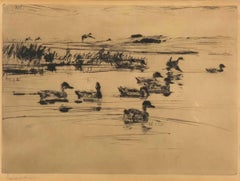
"Teal" 1925 (Paff 243)
Etching
Ed. 150
Signed Lower Left
Image Size: approx 8 x 10 inches
Framed Size: approx 14.5 x 16 inches
Born in Salem, Massac...
Category
1920s American Realist Frank Weston Benson Art
Materials
Etching
The Alarm
By Frank Weston Benson
Located in Missouri, MO
Frank Weston Benson (1862-1951)
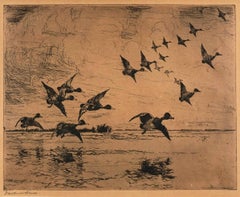
"The Alarm" 1917
Etching
Ed. 80
Signed Lower Right
Image Size: approx 8 x 10 inches
Framed Size: approx 14.5 x 16 inches
Born in Salem, Massachusett...
Category
1910s Realist Frank Weston Benson Art
Materials
Etching
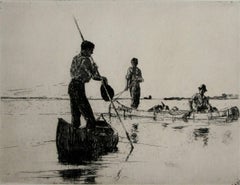
Two Canoes.
By Frank Weston Benson
Located in Storrs, CT
Two Canoes 1927. Etching. Paff catalog 266 state iii. 5 7/8 x 7 3/4 (sheet 9 x 11 1/4). Edition 150. An extremely rich impression with plate tone, printed on cream laid paper on the full sheet with deckle edges. Provenance: the artist's family. Signed in pencil. Housed in a 16 x 20-inch archival mat, suitable for framing.
Frank W. Benson was born and raised in Salem, Massachusetts. He spent a great deal of time in the salt marshes that surrounded this costal town studying, as well as hunting, various waterfowl. He painted his first oil of shore birds at the age of twelve. At nineteen he attended the School of Drawing and Painting of the Museum of Fine Arts, Boston. While attending the school he produced his first etching, "Salem Harbor." In 1883 he traveled to Paris to study at the Academie Julie and for the next thirty years devoted his artistic talent to painting and watercolor.
In 1912 at the age of fifty he again began to produce prints. At first, these prints were portraits, then of waterfowl and nature oriented subjects, totaling over 355 various prints before his death in 1951. Today, Benson is considered the founder of the school of American sporting art...
Category
1920s American Modern Frank Weston Benson Art
Materials
Etching, Drypoint
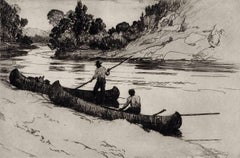
On the Kedgwick
By Frank Weston Benson
Located in Storrs, CT
On the Kedgwick 1923. Etching. Paff 222. 7 3/4 x 11 3/4 (sheet 11 1/2 x 15 9/16). Edition 150. Illustrated: Fine Prints of the Year, 1923. A rich impression in excellent condition, printed on cream laid paper on the full sheet with deckle edges. Signed in pencil. Housed in a 16 x 20- inch archival mat, suitable for your choice of frame.
In the late summer of 1894, a friend invited Benson to go to New Brunswick, Canada, to fish for salmon. The artist discovered he loved the sport as well as camping out in the wilderness and thereafter made annual trips to Canada for almost 40 years. The Kedgwick River in New Brunswick was his favorite river for salmon fishing.
Frank W. Benson was born and raised in Salem, Massachusetts. He sepnt a great deal of time in the salt marshes that surrounded this costal town studying, as well as hunting, various waterfowl. He painted his first oil of shore birds at the age of twelve. At nineteen he attended the School of Drawing and Painting of the Museum of Fine Arts, Boston. While attending the school he produced his first etching, "Salem Harbor." In 1883 he traveled to Paris to study at the Academie Julie and for the next thirty years devoted his artistic talent to painting and watercolor.
In 1912 at the age of fifty he again began to produce prints. At first, these prints were portraits, then of waterfowl and nature oriented subjects, totaling over 355 various prints before his death in 1951. Today, Benson is considered the founder of the school of American sporting art...
Category
1920s American Modern Frank Weston Benson Art
Materials
Etching
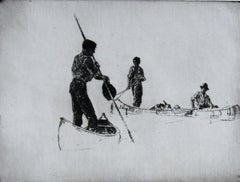
Two Canoes
By Frank Weston Benson
Located in Storrs, CT
Two Canoes 1927. Etching. Paff 266.i/iii 5 7/8 x 7 3/4 (sheet 9 5/8 x 10 3/4). Trial proof A-5, prior to the edition 150. An extremely rich impression of a fascinating window into the way the artist developed the image. Housed in a 16 x 20-inch archival mat, suitable for your choice of frame.
Frank W. Benson was born and raised in Salem, Massachusetts. He sepnt a great deal of time in the salt marshes that surrounded this costal town studying, as well as hunting, various waterfowl. He painted his first oil of shore birds at the age of twelve. At nineteen he attended the School of Drawing and Painting of the Museum of Fine Arts, Boston. While attending the school he produced his first etching, "Salem Harbor." In 1883 he traveled to Paris to study at the Academie Julie and for the next thirty years devoted his artistic talent to painting and watercolor.
In 1912 at the age of fifty he again began to produce prints. At first, these prints were portraits, then of waterfowl and nature oriented subjects, totaling over 355 various prints before his death in 1951. Today, Benson is considered the founder of the school of American sporting art...
Category
1920s American Modern Frank Weston Benson Art
Materials
Etching, Drypoint
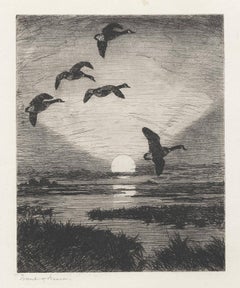
November Moon.
By Frank Weston Benson
Located in New York, NY
Signed in pencil.
Etching and aquatint, 1931.
Edition 150.
Image size 9 13/16 x 8" (25.1 x 20.4 cm).
Paff #316.
Very good condition.
Category
1930s American Impressionist Frank Weston Benson Art
Materials
Etching
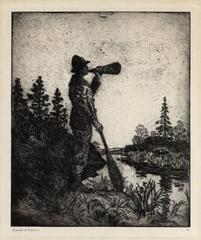
The Moose Caller.
By Frank Weston Benson
Located in New York, NY
Signed and numbered "10" in pencil. A very nice and rich impression.
Etching, 1915.
Edition 50.
Image size 7 3/4 x 11 7/8" (19.7 x 30.2 cm).
Good condi...
Category
1910s American Impressionist Frank Weston Benson Art
Materials
Etching
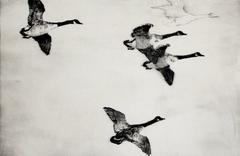
Geese.
By Frank Weston Benson
Located in Storrs, CT
Geese. 1917. Drypoint. Paff 124. 10 x 15 1/2 (sheet 13 3/16 x 17 3/4). Trial proof, before the edition of 79 proofs in 4 states. Illustrated: Salaman, Modern Masters of Etching: Fran...
Category
1910s American Modern Frank Weston Benson Art
Materials
Drypoint
Frank Weston Benson art for sale on 1stDibs.
Find a wide variety of authentic Frank Weston Benson art available for sale on 1stDibs. You can also browse by medium to find art by Frank Weston Benson in etching, paint, canvas and more. Much of the original work by this artist or collective was created during the 20th century and is mostly associated with the modern style. Not every interior allows for large Frank Weston Benson art, so small editions measuring 12 inches across are available. Customers who are interested in this artist might also find the work of Marsden Hartley, Luigi Lucioni, and Charles Turzak. Frank Weston Benson art prices can differ depending upon medium, time period and other attributes. On 1stDibs, the price for these items starts at $2,250 and tops out at $595,000, while the average work can sell for $8,000.