Fritz Eichenberg. Art
American, German, 1901-1990
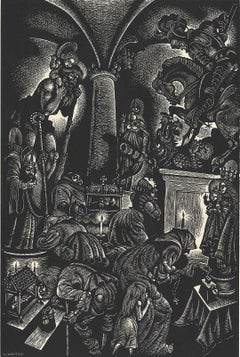
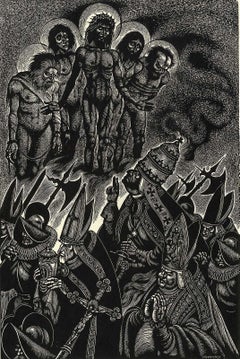
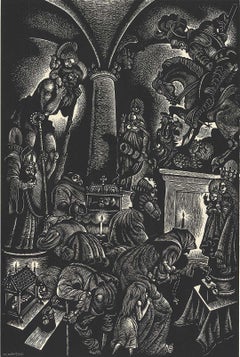
Fritz Eichenberg was one of the world's most sought-after illustrators of literary classics, including The Brothers Karamazov and Crime and Punishment, as well as works by Edgar Allan Poe, Dylan Thomas, the Brontë sisters, and others. Born in Cologne, Germany in 1901, he learned lithography, wood-engraving, and etching and by his early twenties had produced masterful illustrations for Gulliver's Travels and Till Eulenspiegel. He came to the United States in 1933 and over the next five decades produced an astonishing range of individual images and book illustrations. Throughout his life, he was preoccupied with the tragedy of war. He became a close friend and great supporter of Dorothy Day and The Catholic Worker and used his art to express his hope for more justice in the world. to
3
Overall Width
to
Overall Height
to
3
1
1
1
2
3
2
2
1
1
1
1
1
2
1
3
10,138
2,779
1,375
1,369
3
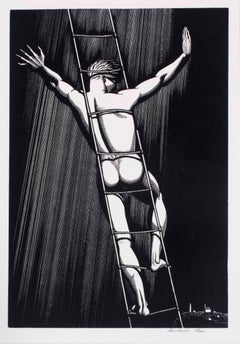
Artist: Fritz Eichenberg.
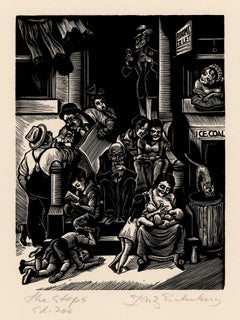
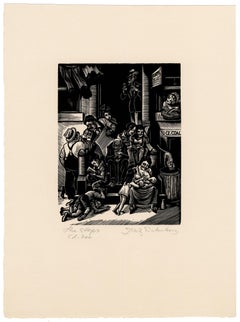
'The Steps' — WPA Era Graphic Modernism
By Fritz Eichenberg
Located in Myrtle Beach, SC
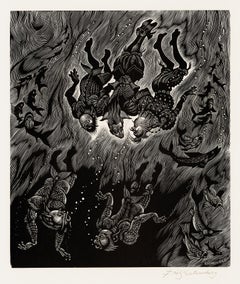
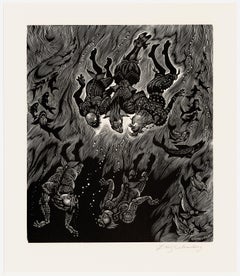
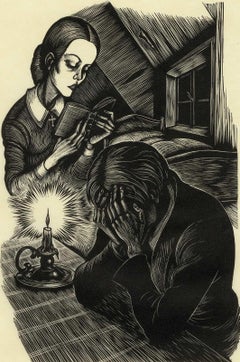
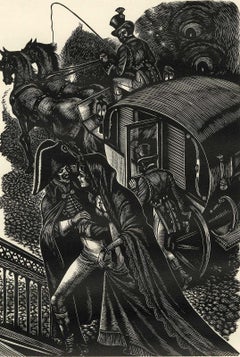
Fritz Eichenberg, 'The Steps', wood engraving, 1933, edition 200. Signed, titled, and annotated 'Ed. 200' in pencil. Initialed in the block, lower right. A superb, richly-inked impr...
Category
1930s American Modern Fritz Eichenberg. Art
Materials
Woodcut
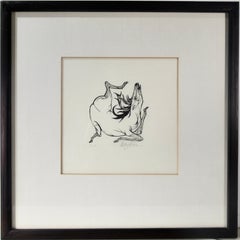
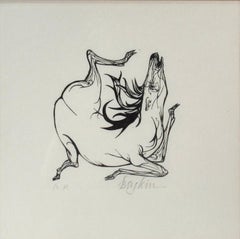
original lithograph
By Fritz Eichenberg
Located in Henderson, NV
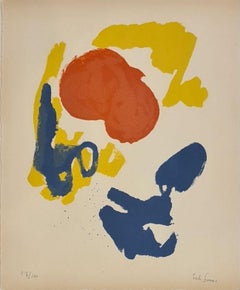
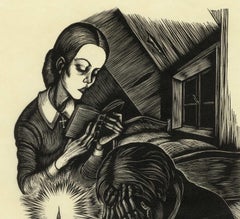
Medium: original lithograph. This lithograph was printed in 1953 for the "Improvisations" portfolio, published by the Artists Equity Association of New York on the occasion of the 19...
Category
1950s Fritz Eichenberg. Art
Materials
Lithograph
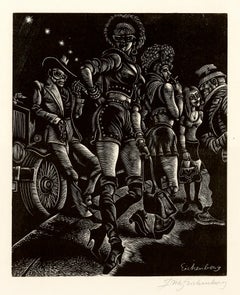
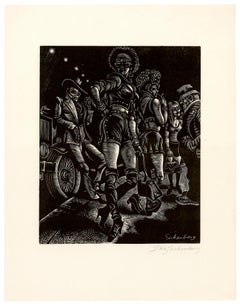
'The Pimp' — Graphic Modernism
By Fritz Eichenberg
Located in Myrtle Beach, SC
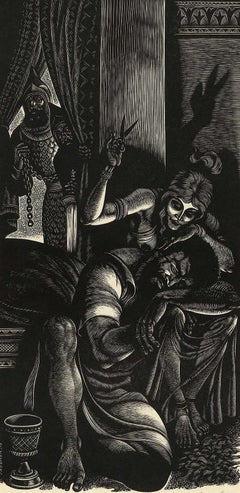
Fritz Eichenberg, 'The Pimp', wood engraving, 1980, artist's proof before the edition. Signed in pencil. Signed in the block, lower right. A fine, richly-inked impression, on cream wove paper, with full margins (2 3/16 to 3 1/2 inches), in excellent condition. Archivally sleeved, unmatted.
Image size 12 x 9 3/4 inches (305 x 248 mm); sheet size 18 x 14 inches (457 x 356 mm).
ABOUT THE ARTIST
Fritz Eichenberg (1901–1990) was a German-American illustrator and arts educator who worked primarily in wood engraving. His best-known works were concerned with religion, social justice, and nonviolence.
Eichenberg was born to a Jewish family in Cologne, Germany, where the destruction of World War I helped to shape his anti-war sentiments. He worked as a printer's apprentice and studied at the Municipal School of Applied Arts in Cologne and the Academy of Graphic Arts in Leipzig, where he studied under Hugo Steiner-Prag. In 1923 he moved to Berlin to begin his career as an artist, producing illustrations for books and newspapers. In his newspaper and magazine work, Eichenberg was politically outspoken and sometimes wrote and illustrated his reporting.
In 1933, the rise of Adolf Hitler drove Eichenberg, who was a public critic of the Nazis, to emigrate with his wife and children to the United States. He settled in New York City, where he lived most of his life. He worked in the WPA Federal Arts Project and was a member of the Society of American Graphic Artists.
In his prolific career as a book illustrator, Eichenberg portrayed many forms of literature but specialized in works with elements of extreme spiritual and emotional conflict, fantasy, or social satire. Over his long career, Eichenberg was commissioned to illustrate more than 100 classics by publishers in the United States and abroad, including works by renowned authors Dostoyevsky, Tolstoy, Charlotte and Emily Brontë, Poe, Swift, and Grimmelshausen. He also wrote and illustrated books of folklore and children's stories.
Eichenberg was a long-time contributor to the progressive magazine The Nation, his illustrations appearing between 1930 and 1980. Eichenberg’s work has been featured by such esteemed publishers as The Heritage Club, Random House, Book of the Month Club, The Limited Editions Club, Kingsport Press, Aquarius Press, and Doubleday.
Raised in a non-religious family, Eichenberg had been attracted to Taoism as a child. Following his wife's unexpected death in 1937, he turned briefly to Zen Buddhist meditation, then joined the Religious Society of Friends in 1940. Though he remained a Quaker until his death, Eichenberg was also associated with Catholic charity work through his friendship with Dorothy Day...
Category
1980s American Modern Fritz Eichenberg. Art
Materials
Woodcut
Related Items
Elwood W. Bartlett, Wisconsin Farm, about 1945, mid-century wood engraving
Located in New York, NY
Elwood Warren Bartlett is a Wisconsin native who also worked in Indiana.
Largely self taught as a printmaker, Bartlett worked in a style that once identified as his, immediately t...
Category
1940s American Modern Fritz Eichenberg. Art
Materials
Woodcut
Starry Night - Limited Edition, Figurative, Contemporary, Star, Night, Child
By Charlie Mackesy
Located in Knowle Lane, Cranleigh
Starry Night is a lithograph based on a watercolour by Charlie Mackesy. The edition is limited to 150 and each piece has been signed by Charlie Mackesy...
Category
2010s Other Art Style Fritz Eichenberg. Art
Materials
Lithograph
$3,442
H 11.82 in W 7.88 in D 0.4 in
Hand of Africa - Mandela, Former South African President, Signed Artwork, Hand
By Nelson Mandela
Located in Knowle Lane, Cranleigh
Nelson Mandela, Hand of Africa, Signed Limited Edition Lithograph
Many people are unaware that Nelson Mandela turned his hand to art in his 80's as a way of leaving a legacy for his ...
Category
Early 2000s Contemporary Fritz Eichenberg. Art
Materials
Lithograph
$20,654
H 25.5 in W 20 in D 2 in
Werner Drewes, Winter, 1933, modernist woodcut
By Werner Drewes
Located in New York, NY
A modernist fantasy winter scene created by Werner Drewes, this print brings key aspects of the period together. His cubist-inspired woodcut technique is utilized here to bring the s...
Category
1930s American Modern Fritz Eichenberg. Art
Materials
Woodcut
EARTH - Mandela, Former South African President, Signed Art, Symbol, Crescent
By Nelson Mandela
Located in Knowle Lane, Cranleigh
Nelson Mandela, Earth, Signed Limited Edition Lithograph
Many people are unaware that Nelson Mandela turned his hand to art in his 80's as a way of leaving a legacy for his family. H...
Category
2010s Contemporary Fritz Eichenberg. Art
Materials
Lithograph
$11,704
H 27.56 in W 25.6 in D 1.58 in
Stevan Dohanos, Backyard
By Stevan Dohanos
Located in New York, NY
Stevan Dohanos was an accomplished draftsman who work was widely known through the Saturday Evening Post. This print 'Backyard,' however, leaves aside the illustrative magazine work ...
Category
1930s American Modern Fritz Eichenberg. Art
Materials
Woodcut
Elwood W. Bartlett, Water's Edge (Wisconsin), about 1945, mid-century wood eng.
Located in New York, NY
Elwood Warren Bartlett is a Wisconsin native who also worked in Indiana.
Largely self taught as a printmaker, Bartlett worked in a style that once identified as his, immediately t...
Category
1940s American Modern Fritz Eichenberg. Art
Materials
Woodcut
The Owl that calls upon the Night speaks the Unbeliever's ...
By Leonard Baskin
Located in San Francisco, CA
This artwork titled "The Owl that calls upon the Night speaks the Unbeliever's" 1968 is an original woodcut on Makuroko paper by noted American artist Leonard Baskin, 1922-2000. It i...
Category
Mid-20th Century American Modern Fritz Eichenberg. Art
Materials
Woodcut
$750
H 14.5 in W 12.5 in D 0.6 in
The Tennis Court - Mandela, South African President, Signed, Robben Island, sport
By Nelson Mandela
Located in Knowle Lane, Cranleigh
Nelson Mandela, The Tennis Court, Signed Limited Edition Lithograph
Many people are unaware that Nelson Mandela turned his hand to art in his 80's as a way of leaving a legacy for hi...
Category
Early 2000s Contemporary Fritz Eichenberg. Art
Materials
Lithograph
$10,327
H 15.75 in W 20.08 in D 1.58 in
By Night On My Bed
Located in New York, NY
Woodcut. Signed by the artist and dated in pencil, lower right. Titled in pencil, lower left, and numbered "28" in pencil, lower center.
This woodcut was made by Esherick to ill...
Category
1920s American Modern Fritz Eichenberg. Art
Materials
Woodcut
Artist Motivation - Mandela, Former South African President, Inspirational Words
By Nelson Mandela
Located in Knowle Lane, Cranleigh
Nelson Mandela, Artist's Motivation, Signed Limited Edition Lithograph
Many people are unaware that Nelson Mandela turned his hand to art in his 80's as a way of leaving a legacy for his family. He spent time with an art tutor and learnt to draw. In 2002, when creating the The Motivation print, he told Anna and Laura from Belgravia Gallery of his desire to become a full time artist when he retired.
This artwork is a handwritten Artist’s Motivation by Nelson Mandela and reads:
“Today when I look at Robben Island I see it as a celebration of the struggle and a symbol of the finest qualities of the human spirit, rather than as a monument to the brutal tyranny and oppression of apartheid.
Robben Island is a place where courage endured in the face of endless hardship, a place where people kept on believing when it seemed their dreams were hopeless and a place where wisdom and determination overcame fear and human frailty.
It is true that Robben Island was once a place of darkness, but out of that darkness has come a wonderful brightness, a light so powerful that it could not be hidden behind prison walls, held back by prison bars...
Category
Early 2000s Contemporary Fritz Eichenberg. Art
Materials
Lithograph
Nelson MandelaArtist Motivation - Mandela, Former South African President, Inspirational Words, 2002
$10,327
H 19.69 in W 22.05 in D 1.58 in
The Lighthouse - Mandela, Former South African President, Signed, Robben Island
By Nelson Mandela
Located in Knowle Lane, Cranleigh
Nelson Mandela, The Lighthouse, Signed Limited Edition Lithograph
Many people are unaware that Nelson Mandela turned his hand to art in his 80's as a way of leaving a legacy for his family. He spent time with an art tutor and learnt to draw. In 2002, when creating the The Lighthouse print...
Category
Early 2000s Contemporary Fritz Eichenberg. Art
Materials
Lithograph
$12,393
H 19.69 in W 22.05 in D 1.58 in
Previously Available Items
'The Aquarium' — WPA Era Graphic Modernism
By Fritz Eichenberg
Located in Myrtle Beach, SC
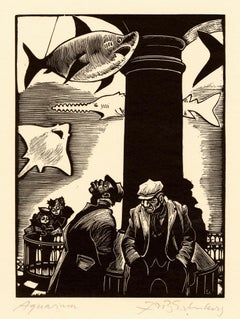
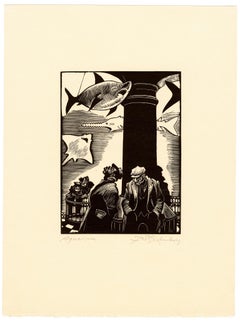
Fritz Eichenberg, 'The Aquarium', wood engraving, 1933, edition 200. Signed and titled in pencil. Initialed in the block, lower right. A superb, richly-inked impression, on pale yel...
Category
1930s American Modern Fritz Eichenberg. Art
Materials
Woodcut
'The Wolf and the Little Kids' — Graphic Modernism
By Fritz Eichenberg
Located in Myrtle Beach, SC
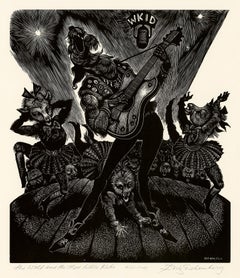
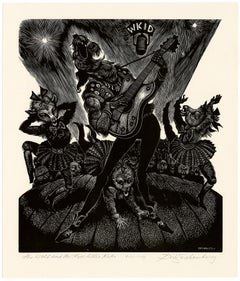
Fritz Eichenberg, 'The Wolf and the Little Kids' from the suite 'Fables with a Twist', wood engraving, 1975-76, artist's proof apart from the edition of c. 50. Signed, titled, and annotated 'Artist’s Proof' in pencil. Signed in the block, lower right. A fine, richly-inked impression, on cream wove paper, with full margins (7/8 to 1 1/2 inches), in excellent condition. Complete with vellum folder with descriptive text in red and black linotype. Printed by master printer Harold McGrath at The Gehenna Press, Northampton, MA. Image size 13 15/16 x 12 1/8 inches (354 x 308 mm); sheet size 16 1/2 x 14 inches (419 x 356 mm). Archivally sleeved, unmatted.
Collection: Harvard Museums.
ABOUT THE ARTIST
Fritz Eichenberg (1901–1990) was a German-American illustrator and arts educator who worked primarily in wood engraving. His best-known works were concerned with religion, social justice, and nonviolence.
Eichenberg was born to a Jewish family in Cologne, Germany, where the destruction of World War I helped to shape his anti-war sentiments. He worked as a printer's apprentice and studied at the Municipal School of Applied Arts in Cologne and the Academy of Graphic Arts in Leipzig, where he studied under Hugo Steiner-Prag. In 1923 he moved to Berlin to begin his career as an artist, producing illustrations for books and newspapers. In his newspaper and magazine work, Eichenberg was politically outspoken and sometimes wrote and illustrated his reporting.
In 1933, the rise of Adolf Hitler drove Eichenberg, who was a public critic of the Nazis, to emigrate with his wife and children to the United States. He settled in New York City, where he lived most of his life. He worked in the WPA Federal Arts Project and was a member of the Society of American Graphic Artists.
In his prolific career as a book illustrator, Eichenberg portrayed many forms of literature but specialized in works with elements of extreme spiritual and emotional conflict, fantasy, or social satire. Over his long career, Eichenberg was commissioned to illustrate more than 100 classics by publishers in the United States and abroad, including works by renowned authors Dostoyevsky, Tolstoy, Charlotte and Emily Brontë, Poe, Swift, and Grimmelshausen. He also wrote and illustrated books of folklore and children's stories.
Eichenberg was a long-time contributor to the progressive magazine The Nation, his illustrations appearing between 1930 and 1980. Eichenberg’s work has been featured by such esteemed publishers as The Heritage Club, Random House, Book of the Month Club, The Limited Editions Club, Kingsport Press, Aquarius Press, and Doubleday.
Raised in a non-religious family, Eichenberg had been attracted to Taoism as a child. Following his wife's unexpected death in 1937, he turned briefly to Zen Buddhist meditation, then joined the Religious Society of Friends in 1940. Though he remained a Quaker until his death, Eichenberg was also associated with Catholic charity work through his friendship with Dorothy Day...
Category
1970s American Modern Fritz Eichenberg. Art
Materials
Woodcut
'Simplicius' Farewell to the World' — Graphic Modernism
By Fritz Eichenberg
Located in Myrtle Beach, SC
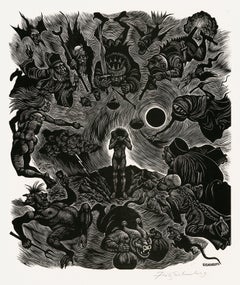
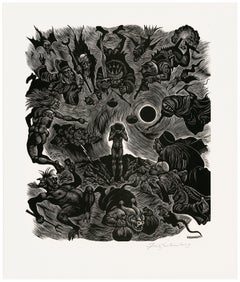
Fritz Eichenberg, 'Simplicius’ Farewell To The World' from the suite 'The Adventurous Simplicissimus', wood engraving, 1977, artist's proof apart from the edition of 50. Signed in pencil. Signed in the block, lower right. A fine, richly-inked impression, on cream wove paper, with full margins (1 1/2 to 2 inches), in excellent condition. Image size 14 x 12 inches (356 x 305 mm); sheet size 17 1/2 x 15 inches (445 x 381 mm). Archivally sleeved, unmatted.
ABOUT THIS WORK
'Simplicius Simplicissimus' (German: Der abenteuerliche Simplicissimus Teutsch) is a picaresque novel of the lower Baroque style, written in five books by Hans Jakob Christoffel von Grimmelshausen published in 1668, with the sequel Continuatio appearing in 1669.
The novel is told from the perspective of its protagonist Simplicius, a rogue or picaro typical of the picaresque novel, as he traverses the tumultuous world of the Holy Roman Empire during the Thirty Years' War. Raised by a peasant family, he is separated from his home by foraging dragoons. He is adopted by a hermit living in the forest, who teaches him to read and introduces him to religion. The hermit also gives Simplicius his name because he is so simple that he does not know his own name. After the death of the hermit, Simplicius must fend for himself. He is conscripted at a young age into service and, from there, embarks on years of foraging, military triumph, wealth, prostitution, disease, bourgeois domestic life, and travels to Russia, France, and an alternate world inhabited by mermen. The novel ends with Simplicius turning to a life of hermitage, denouncing the world as corrupt.
ABOUT THE ARTIST
Fritz Eichenberg (1901–1990) was a German-American illustrator and arts educator who worked primarily in wood engraving. His best-known works were concerned with religion, social justice, and nonviolence.
Eichenberg was born to a Jewish family in Cologne, Germany, where the destruction of World War I helped to shape his anti-war sentiments. He worked as a printer's apprentice and studied at the Municipal School of Applied Arts in Cologne and the Academy of Graphic Arts in Leipzig, where he studied under Hugo Steiner-Prag. In 1923 he moved to Berlin to begin his career as an artist, producing illustrations for books and newspapers. In his newspaper and magazine work, Eichenberg was politically outspoken and sometimes wrote and illustrated his reporting.
In 1933, the rise of Adolf Hitler drove Eichenberg, who was a public critic of the Nazis, to emigrate with his wife and children to the United States. He settled in New York City, where he lived most of his life. He worked in the WPA Federal Arts Project and was a member of the Society of American Graphic Artists.
In his prolific career as a book illustrator, Eichenberg portrayed many forms of literature but specialized in works with elements of extreme spiritual and emotional conflict, fantasy, or social satire. Over his long career, Eichenberg was commissioned to illustrate more than 100 classics by publishers in the United States and abroad, including works by renowned authors Dostoyevsky, Tolstoy, Charlotte and Emily Brontë, Poe, Swift, and Grimmelshausen. He also wrote and illustrated books of folklore and children's stories.
Eichenberg was a long-time contributor to the progressive magazine The Nation, his illustrations appearing between 1930 and 1980. Eichenberg’s work has been featured by such esteemed publishers as The Heritage Club, Random House, Book of the Month Club, The Limited Editions Club, Kingsport Press, Aquarius Press, and Doubleday.
Raised in a non-religious family, Eichenberg had been attracted to Taoism as a child. Following his wife's unexpected death in 1937, he turned briefly to Zen Buddhist meditation, then joined the Religious Society of Friends in 1940. Though he remained a Quaker until his death, Eichenberg was also associated with Catholic charity work through his friendship with Dorothy Day...
Category
1970s American Modern Fritz Eichenberg. Art
Materials
Woodcut
'A Visit to the King of the Waters' — Graphic Modernism
By Fritz Eichenberg
Located in Myrtle Beach, SC
Fritz Eichenberg, 'A Visit to the King of the Waters' from the suite 'The Adventurous Simplicissimus', wood engraving, 1977, artist's proof apart from the edition of 50. Signed in pencil. Signed in the block, lower right. A fine, richly-inked impression, on cream wove paper, with full margins (1 1/2 to 2 inches), in excellent condition. Image size 14 x 12 inches (356 x 305 mm); sheet size 17 1/2 x 15 inches (445 x 381 mm). Archivally sleeved, unmatted.
ABOUT THIS WORK
'Simplicius Simplicissimus' (German: Der abenteuerliche Simplicissimus Teutsch) is a picaresque novel of the lower Baroque style, written in five books by Hans Jakob Christoffel von Grimmelshausen published in 1668, with the sequel Continuatio appearing in 1669.
The novel is told from the perspective of its protagonist Simplicius, a rogue or picaro typical of the picaresque novel, as he traverses the tumultuous world of the Holy Roman Empire during the Thirty Years' War. Raised by a peasant family, he is separated from his home by foraging dragoons. He is adopted by a hermit living in the forest, who teaches him to read and introduces him to religion. The hermit also gives Simplicius his name because he is so simple that he does not know his own name. After the death of the hermit, Simplicius must fend for himself. He is conscripted at a young age into service and, from there, embarks on years of foraging, military triumph, wealth, prostitution, disease, bourgeois domestic life, and travels to Russia, France, and an alternate world inhabited by mermen. The novel ends with Simplicius turning to a life of hermitage, denouncing the world as corrupt.
ABOUT THE ARTIST
Fritz Eichenberg (1901–1990) was a German-American illustrator and arts educator who worked primarily in wood engraving. His best-known works were concerned with religion, social justice, and nonviolence.
Eichenberg was born to a Jewish family in Cologne, Germany, where the destruction of World War I helped to shape his anti-war sentiments. He worked as a printer's apprentice and studied at the Municipal School of Applied Arts in Cologne and the Academy of Graphic Arts in Leipzig, where he studied under Hugo Steiner-Prag. In 1923 he moved to Berlin to begin his career as an artist, producing illustrations for books and newspapers. In his newspaper and magazine work, Eichenberg was politically outspoken and sometimes wrote and illustrated his reporting.
In 1933, the rise of Adolf Hitler drove Eichenberg, who was a public critic of the Nazis, to emigrate with his wife and children to the United States. He settled in New York City, where he lived most of his life. He worked in the WPA Federal Arts Project and was a member of the Society of American Graphic Artists.
In his prolific career as a book illustrator, Eichenberg portrayed many forms of literature but specialized in works with elements of extreme spiritual and emotional conflict, fantasy, or social satire. Over his long career, Eichenberg was commissioned to illustrate more than 100 classics by publishers in the United States and abroad, including works by renowned authors Dostoyevsky, Tolstoy, Charlotte and Emily Brontë, Poe, Swift, and Grimmelshausen. He also wrote and illustrated books of folklore and children's stories.
Eichenberg was a long-time contributor to the progressive magazine The Nation, his illustrations appearing between 1930 and 1980. Eichenberg’s work has been featured by such esteemed publishers as The Heritage Club, Random House, Book of the Month Club, The Limited Editions Club, Kingsport Press, Aquarius Press, and Doubleday.
Raised in a non-religious family, Eichenberg had been attracted to Taoism as a child. Following his wife's unexpected death in 1937, he turned briefly to Zen Buddhist meditation, then joined the Religious Society of Friends in 1940. Though he remained a Quaker until his death, Eichenberg was also associated with Catholic charity work through his friendship with Dorothy Day...
Category
1970s American Modern Fritz Eichenberg. Art
Materials
Woodcut
'City Lights' — Vintage Wood Engraving, New York City, 1934
By Fritz Eichenberg
Located in Myrtle Beach, SC
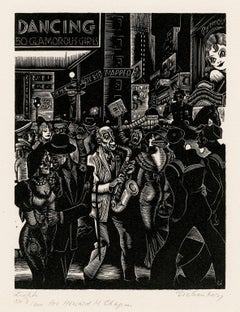
Fritz Eichenberg, 'City LIghts', wood engraving, 1934, edition 200. Signed, titled 'Lights', and annotated 'No 2/200 for Howard M. Chapin' in pencil. Initialed in the block, lower right. A fine, richly-inked black impression, on cream wove paper, with full margins (1 1/4 to 1 7/8 inches); a small loss (5/8 inch) in the top right sheet corner, well away from the image, otherwise in excellent condition. Printed by master printer Ernest Roth...
Category
1930s American Modern Fritz Eichenberg. Art
Materials
Woodcut
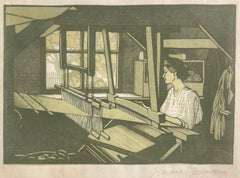
Follies of the Monks -- Erasmus
By Fritz Eichenberg
Located in New Orleans, LA
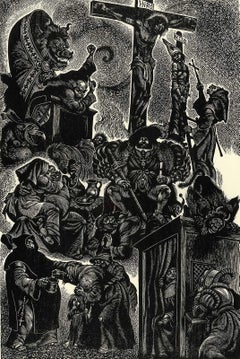
Trouble is not new to the church. Eichenberg illustrated In Praise Of Folly created this image called Folly of the Monks and Erasmus was writing in the 16th century. Erasmus was an...
Category
1970s American Modern Fritz Eichenberg. Art
Materials
Wood, Engraving
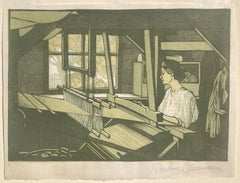
Follies of the Popes (1500 to 2019 - Erasmus
By Fritz Eichenberg
Located in New Orleans, LA
Trouble is not new to religion. Eichenberg illustrated In Praise Of Folly and created this image called Folly of the Popes and Erasmus was writing in the 16...
Category
1970s American Modern Fritz Eichenberg. Art
Materials
Wood, Engraving
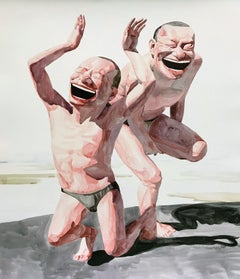
Folly of Worshipping Idols
By Fritz Eichenberg
Located in New Orleans, LA
Trouble is not new to religion. Eichenberg illustrated In Praise Of Folly and created this image called Folly of Worshipping Idols and Erasmus was writing in the 16th century. Eras...
Category
1970s American Modern Fritz Eichenberg. Art
Materials
Wood, Engraving
Folly of Worshipping Idols
By Fritz Eichenberg
Located in New Orleans, LA
Trouble is not new to religion. Eichenberg illustrated In Praise Of Folly and created this image called Folly of Worshipping Idols and Erasmus was writing in the 16th century. Eras...
Category
1970s American Modern Fritz Eichenberg. Art
Materials
Wood, Engraving
Crime and Punishment
By Fritz Eichenberg
Located in New Orleans, LA
In 1966, Fritz Eichenberg moved to Rhode Island and chaired the Art Department of the University of Rhode Island in Kingston. His wood engravings and lithographs are almost always as...
Category
Late 20th Century American Modern Fritz Eichenberg. Art
Materials
Wood, Engraving
And His Strength Went From Him (Samson And Delilah)
By Fritz Eichenberg
Located in New Orleans, LA
Fritz Eichenberg created wood engravings to illustrate the biblical scene of Samson and Goliath
German born wood engraver and lithographer, Eichenberg studied at the School of Appli...
Category
Late 20th Century American Modern Fritz Eichenberg. Art
Materials
Wood, Engraving
Mlle. Celine and Escort (Celine is a dancer former mistress of Mister Rochester)
By Fritz Eichenberg
Located in New Orleans, LA
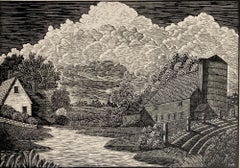
Fritz Eichenberg did some original wood engravings for "Jane Eyre." Céline Varens was Adèle's mother and Mr. Rochester's former mistress. A French opera dancer, Céline pretended to ...
Category
Late 20th Century American Modern Fritz Eichenberg. Art
Materials
Wood, Engraving
Fritz Eichenberg. art for sale on 1stDibs.
Find a wide variety of authentic Fritz Eichenberg. art available for sale on 1stDibs. You can also browse by medium to find art by Fritz Eichenberg. in woodcut print, engraving, wood and more. Much of the original work by this artist or collective was created during the 20th century and is mostly associated with the modern style. Not every interior allows for large Fritz Eichenberg. art, so small editions measuring 4 inches across are available. Customers who are interested in this artist might also find the work of Charles Frederick William Mielatz, Harry Sternberg, and Jacques Monory. Fritz Eichenberg. art prices can differ depending upon medium, time period and other attributes. On 1stDibs, the price for these items starts at $125 and tops out at $1,800, while the average work can sell for $450.