Myles Birket Foster Art

British, 1825-1899

Myles Birket Foster was a popular English illustrator, watercolor artist and engraver in the Victorian period. His name is also to be found as Myles Birkett Foster. Foster was born in North Shields, England of a primarily Quaker family, but his family moved south to London in 1830, where his father founded M. B. Foster & sons — a successful beer-bottling company. He was schooled at Hitchin, Hertfordshire and on leaving, he initially went into his father's business. However, noticing his talent for art, his father secured an apprenticeship with the notable wood engraver, Ebenezer Landells, where he worked on illustrations for Punch magazine and the Illustrated London News. On leaving Landells' employ, he continued to produce work for the Illustrated London News and the Illustrated London Almanack. He also found work as a book illustrator and, during the 1850s, trained himself to paint in watercolors. His illustrations of Longfellow’s Evangeline and books of poetry by other contemporaries were a great success, and he quickly became a successful artist in watercolors. Foster became an Associate of the "Old" Watercolor Society (Later the Royal Watercolor Society) in 1860 and exhibited some 400 of his paintings at the Royal Academy of Arts for over more than two decades. He traveled widely, painting the countryside around Scotland, the Rhine Valley, the Swiss lakes and in Italy, especially Venice. In 1863, he moved to Witley, near Godalming in Surrey, where he had a house named The Hill built. Being friendly with Edward Burne-Jones and William Morris, he had the house decorated and furnished in contemporary style, with tiles and paintings by Burne-Jones and Morris' firm, Morris and Company. The same year, he published a volume of English Landscapes, with text by Tom Taylor. Although he had painted great numbers of landscape scenes from Scotland to the Mediterranean, it was after moving to Witley that Birket Foster produced the works for which he is best known—a sentimentalized view of the contemporary English countryside, particularly in the West Surrey area. Although criticized for their idealized view of rural life, they were recognized for their detail and execution. Foster's work (along with that of other artists) was used by Cadbury, the chocolate manufacturer, on the cover of their chocolate boxes from the 1860s onwards. He became ill in 1893 and moved to Weybridge. He continued painting but died on 27th March 1899. His obituary in The Times referred to him as "certainly the most popular watercolor artist of our time." He is buried at All Saints' Church in Witley.

to
2
3
1
Overall Width
to
Overall Height
to
3
1
2
3
1
3
1
1
1
1
1
1
1
1
1
1
4
4
2
2
4
10,681
2,826
2,495
1,414
4
2
2
Artist: Myles Birket Foster
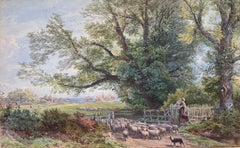
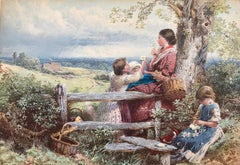
“Tending the Sheep”
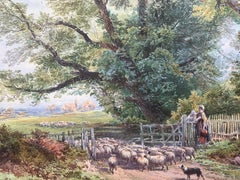
“Tending the Sheep”

“Tending the Sheep”

By Myles Birket Foster

Located in Southampton, NY

Beautifully executed original hand colored lithograph using gouache and watercolor. Scene in Surrey, England. Signedxwith monogram in plate lower left, Myles Birket Foster. Published by M. H. Long. Condition is very good. In original 2 inch wide birdseye maple antique frame with thick museum mat with gold innner edge. Overall 22 by 26 inches. Biography Myles Birket Foster (4 February 1825 – 27 March 1899) was a popular English illustrator, watercolour artist and engraver in the Victorian period. His name is also to be found as Myles Birkett Foster. Life and work Foster was born in North Shields, England of a primarily Quaker family, but his family moved south to London in 1830, where his father founded M. B. Foster & sons — a successful beer-bottling company. He was schooled at Hitchin, Hertfordshire and on leaving initially went into his father's business. However, noticing his talent for art, his father secured an apprenticeship with the notable wood engraver, Ebenezer Landells, where he worked on illustrations for Punch magazine and the Illustrated London News. On leaving Landells' employ, he continued to produce work for the Illustrated London News and the Illustrated London Almanack. He also found work as a book illustrator and, during the 1850s, trained himself to paint in watercolours. His illustrations of Longfellow’s Evangeline and books of poetry by other contemporaries were a great success, and he quickly became a successful artist in watercolours. Birket Foster became an Associate of the "Old" Watercolour Society (Later the Royal Watercolour Society) in 1860 and exhibited some 400 of his paintings at the Royal Academy over more than 2 decades. Birket Foster travelled widely, painting the countryside around Scotland, the Rhine Valley, the Swiss lakes and in Italy, especially Venice. In 1863 he moved to Witley, near Godalming in Surrey where he had a house ("The Hill") built. Being friendly with Edward Burne-Jones and William Morris, he had the house decorated and furnished in contemporary style, with tiles and paintings by Burne-Jones and Morris' firm, Morris and Company. The same year he published a volume of "English Landscapes," with text by Tom Taylor...

Category

1880s Impressionist Myles Birket Foster Art

Materials

Lithograph, Watercolor, Gouache

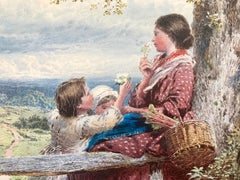
“Flower Picking”
“Flower Picking”

“Flower Picking”

By Myles Birket Foster

Located in Southampton, NY

Beautifully executed original hand colored lithograph using gouache and watercolor. Scene in Surrey, England. Signedxwith monogram in plate lower left, Myles Birket Foster. Published by M. H. Long. Condition is very good. In original 2 inch wide birdseye maple antique frame with thick museum mat with gold innner edge. Overall 22 by 26 inches. Biography Myles Birket Foster (4 February 1825 – 27 March 1899) was a popular English illustrator, watercolour artist and engraver in the Victorian period. His name is also to be found as Myles Birkett Foster. Life and work Foster was born in North Shields, England of a primarily Quaker family, but his family moved south to London in 1830, where his father founded M. B. Foster & sons — a successful beer-bottling company. He was schooled at Hitchin, Hertfordshire and on leaving initially went into his father's business. However, noticing his talent for art, his father secured an apprenticeship with the notable wood engraver, Ebenezer Landells, where he worked on illustrations for Punch magazine and the Illustrated London News. On leaving Landells' employ, he continued to produce work for the Illustrated London News and the Illustrated London Almanack. He also found work as a book illustrator and, during the 1850s, trained himself to paint in watercolours. His illustrations of Longfellow’s Evangeline and books of poetry by other contemporaries were a great success, and he quickly became a successful artist in watercolours. Birket Foster became an Associate of the "Old" Watercolour Society (Later the Royal Watercolour Society) in 1860 and exhibited some 400 of his paintings at the Royal Academy over more than 2 decades. Birket Foster travelled widely, painting the countryside around Scotland, the Rhine Valley, the Swiss lakes and in Italy, especially Venice. In 1863 he moved to Witley, near Godalming in Surrey where he had a house ("The Hill") built. Being friendly with Edward Burne-Jones and William Morris, he had the house decorated and furnished in contemporary style, with tiles and paintings by Burne-Jones and Morris' firm, Morris and Company. The same year he published a volume of "English Landscapes," with text by Tom Taylor...

Category

1880s Impressionist Myles Birket Foster Art

Materials

Lithograph, Watercolor, Gouache

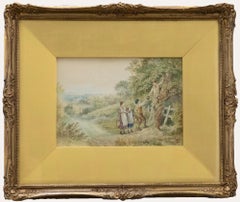
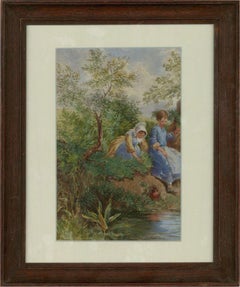
Style of Myles Birket Foster- Early 20th Century Watercolour, The Egg Snatchers

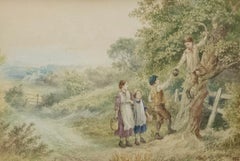
Style of Myles Birket Foster- Early 20th Century Watercolour, The Egg Snatchers

By Myles Birket Foster

Located in Corsham, GB

A charming watercolour study in the style of British artist Myles Birket Foster RWS. The scene depicts a group of children snatching eggs from a wild birds nest. The watercolour has ...

Category

20th Century Myles Birket Foster Art

Materials

Watercolor

Related Items
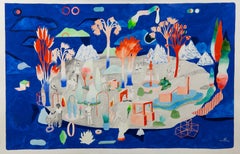
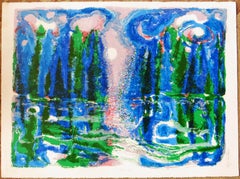
Demonstration #1 Hélène Duclos, 21st Century, Contemporary figurative art blue

Demonstration #1 Hélène Duclos, 21st Century, Contemporary figurative art blue

By Hélène Duclos

Located in Paris, FR

Gouache, coloured pencil and graphite on paper Signed lower right Unique work 1 / Hélène DUCLOS, 2016 – Artist Statement “Questioning the human condition and the position of being ...

Category

21st Century and Contemporary Contemporary Myles Birket Foster Art

Materials

Paper, Gouache
Edgar Degas, Dancer Standing in Profile, 1945 (after)

Edgar Degas, Dancer Standing in Profile, 1945 (after)

By Edgar Degas

Located in Southampton, NY

This exquisite lithograph after Edgar Degas (1834–1917), titled Danseur debout de profil (Dancer Standing in Profile), originates from the 1945 folio Degas, Ten Ballet Sketches. Published by The Studio Publications, Inc., New York, rendered and printed by Albert Carman, City Island, 1945, this work reflects Degas’s sensitive mastery of line, movement, and intimate observation, capturing the grace, poise, and psychological immediacy that define his iconic ballet imagery. In Danseur debout de profil (Dancer Standing in Profile), Degas reveals gesture and inner emotion through economical contour and lyrical nuance. Executed as a lithograph and pochoir on velin paper, this work measures 17 x 13 inches (43.18 x 33.02 cm). Signed in the plate and unnumbered as issued. Rendered and printed by Albert Carman, City Island, one of the notable American ateliers specializing in fine art lithography during the mid-20th century. Artwork Details: Artist: After Edgar Degas (1834–1917) Title: Danseur debout de profil (Dancer Standing in Profile), from Degas, Ten Ballet Sketches, 1945 Medium: Lithograph and pochoir on velin paper Dimensions: 17 x 13 inches (43.18 x 33.02 cm) Inscription: Signed in the plate and unnumbered as issued Date: 1945 Publisher: The Studio Publications, Inc., New York Printer: Albert Carman, City Island, 1945 Condition: Well preserved, consistent with age and medium Provenance: From the 1945 folio Degas, Ten Ballet Sketches, published by The Studio Publications, Inc., New York Notes: Excerpted from the album, Born in Paris in 1834, Edgar Degas lived, and surely loved the life of that city during most of his years. These continued somewhat sadly beyond those of most of his friends— into the debacle of the first World War, during which he died in 1917. Judging by the frequency with which he used them as models, he must have had an especial admiration for the ballet girls who followed a profession that at the time brought none of the glory and prosperity which attend it today. New aspects of the human body, revealed in movement, fascinated him. But his occupation with the simply anatomical side of his subjects never resulted in a cold interpretation. On the contrary there is a warmth and sympathy that pervades all of his work. The drawings here represent the painter in one important phase of his multi-sensitive view of life; and permit an insight which a more ambitious work might not do-into the operation of the creative process, the artist's transformation of reality as it passes through the mesh of his sensibilities. The Edition of this Portfolio is limited to MMMD examples. Rendered by Albert Carman. About the Publication: Degas, Ten Ballet Sketches, published in 1945 by The Studio Publications, Inc., New York, stands as one of the most elegant and scholarly mid-century American fine art folios devoted to the ballet imagery of Edgar Degas. Conceived as a high-quality interpretive portfolio, the album presents a series of lithograph-and-pochoir renderings based on Degas’s original drawings, executed with exceptional attention to tonal subtlety, contour fidelity, and the emotional interiority that defines the artist’s draftsmanship. Rendered and printed by Albert Carman on City Island, the publication embodies an American postwar effort to restore and celebrate European masterworks through meticulous handcraft and artisanal color application, honoring Degas’s distinctive line and the atmospheric delicacy of his studio-based studies. Produced in a substantial edition of MMMD examples, the portfolio offered audiences rare access to Degas’s private working drawings—images rarely seen outside institutional collections—while exemplifying the technical refinement and interpretive care characteristic of Carman’s workshop. Today, Degas, Ten Ballet Sketches remains a sought-after historical publication, valued for its craft, fidelity to Degas’s aesthetic, and its role in preserving and disseminating the artist’s intimate ballet imagery in a beautifully executed mid-century fine art format. About the Artist: Edgar Degas (1834–1917) was a French painter, draughtsman, printmaker, and sculptor whose groundbreaking fusion of classical draftsmanship, modern experimentation, and psychological depth helped define the trajectory of Western art, positioning him as one of the most influential figures of the nineteenth and early twentieth centuries; renowned for his depictions of ballet dancers, racehorses, theater scenes, cafe life, domestic interiors, milliners, laundresses, and women at their toilette, Degas reimagined observational realism through radical compositional innovation—employing extreme cropping, asymmetrical framing, oblique viewpoints, and dramatic lighting that anticipated photographic and cinematic language long before these technologies shaped visual culture, and although associated with Impressionism, he rejected plein-air spontaneity in favor of studio-based discipline rooted in the linear precision of Jean-Auguste-Dominique Ingres, the expressive chromaticism of Eugene Delacroix, and the modernity of Edouard Manet while also drawing inspiration from Japanese ukiyo-e prints, classical sculpture, and early photography; his independent artistic philosophy resonated with and helped shape the innovations of Pablo Picasso, Alexander Calder, Alberto Giacometti, Salvador Dali, Joan Miro, Wassily Kandinsky, Marcel Duchamp, and Man Ray, whose explorations of movement, form, dream logic, abstraction, and conceptualism all find antecedents in Degas’s investigations into seriality, temporality, and the fragmented figure, and his pioneering use of pastel, monotype, and wax sculpture fundamentally transformed each medium, influencing artists from Henri Matisse, Francis Bacon, Lucian Freud, and Giacomo Manzu to Paula Rego, contemporary realists, experimental photographers, and choreographers; his works are held in nearly every major museum collection worldwide—including the Musee dOrsay, the Louvre, the Metropolitan Museum of Art, the National Gallery of Art, the Art Institute of Chicago, the Courtauld Institute, and the National Gallery, London—affirming his central place in the history of art, and the highest auction record for Degas was achieved at Sothebys London on February 3, 2015, when Danseuses en Bleu sold for 37,033,000 GBP, cementing his status as one of the most sought-after and enduringly significant artists of the Western canon. Edgar Degas lithograph...

Category

1940s Impressionist Myles Birket Foster Art

Materials

Lithograph

Edgar Degas, Three Dancers, 1945 (after)

Edgar Degas, Three Dancers, 1945 (after)

By Edgar Degas

Located in Southampton, NY

This exquisite lithograph after Edgar Degas (1834–1917), titled Trois danseurs (Three Dancers), originates from the 1945 folio Degas, Ten Ballet Sketches. Published by The Studio Publications, Inc., New York, rendered and printed by Albert Carman, City Island, 1945, this work reflects Degas’s sensitive mastery of line, movement, and the intimate psychological nuances of the ballet studio. Executed as a lithograph and pochoir on velin paper, this work measures 13 x 17 inches (33.02 x 43.18 cm). Signed in the plate and unnumbered as issued. Rendered and printed by Albert Carman, City Island. Artwork Details: Artist: After Edgar Degas (1834–1917) Title: Trois danseurs (Three Dancers), from Degas, Ten Ballet Sketches, 1945 Medium: Lithograph and pochoir on velin paper Dimensions: 13 x 17 inches (33.02 x 43.18 cm) Inscription: Signed in the plate and unnumbered as issued Date: 1945 Publisher: The Studio Publications, Inc., New York Printer: Albert Carman, City Island Condition: Well preserved, consistent with age and medium Provenance: From the 1945 folio Degas, Ten Ballet Sketches, published by The Studio Publications, Inc., New York Notes: Excerpted from the album, Born in Paris in 1834, Edgar Degas lived, and surely loved the life of that city during most of his years. These continued somewhat sadly beyond those of most of his friends— into the debacle of the first World War, during which he died in 1917. Judging by the frequency with which he used them as models, he must have had an especial admiration for the ballet girls who followed a profession that at the time brought none of the glory and prosperity which attend it today. New aspects of the human body, revealed in movement, fascinated him. But his occupation with the simply anatomical side of his subjects never resulted in a cold interpretation. On the contrary there is a warmth and sympathy that pervades all of his work. The drawings here represent the painter in one important phase of his multi-sensitive view of life; and permit an insight which a more ambitious work might not do-into the operation of the creative process, the artist's transformation of reality as it passes through the mesh of his sensibilities. The Edition of this Portfolio is limited to MMMD examples. Rendered by Albert Carman. About the Publication: Degas, Ten Ballet Sketches (1945) is one of the earliest and most significant American postwar fine art portfolios devoted to Edgar Degas’s intimate works on paper. Published by The Studio Publications, Inc., New York, and rendered and printed by Albert Carman at City Island, the album sought to faithfully reproduce a group of Degas’s ballet-related drawings through a combination of lithography and hand-applied pochoir coloring. This hybrid technique allowed the edition to preserve the immediacy, tonal subtlety, and gestural delicacy central to Degas’s draftsmanship. Conceived as a fine art publication rather than a commercial book, the portfolio provided American audiences unprecedented access to Degas’s private, spontaneous studies—images that reveal the artist’s fascination with movement, anatomy, and the psychological atmosphere of the rehearsal studio. The album exemplifies the mid-20th-century revival of pochoir as a means of recreating the texture and coloristic nuance of original works on paper, and it remains an important document of how Degas’s legacy was translated into high-quality printed form for collectors, museums, and connoisseurs. About the Artist: Edgar Degas (1834–1917) was a French painter, draughtsman, printmaker, and sculptor whose groundbreaking fusion of classical draftsmanship, modern experimentation, and psychological depth helped define the trajectory of Western art, positioning him as one of the most influential figures of the nineteenth and early twentieth centuries; renowned for his depictions of ballet dancers, racehorses, theater scenes, cafe life, domestic interiors, milliners, laundresses, and women at their toilette, Degas reimagined observational realism through radical compositional innovation—employing extreme cropping, asymmetrical framing, oblique viewpoints, and dramatic lighting that anticipated photographic and cinematic language long before these technologies shaped visual culture, and although associated with Impressionism, he rejected plein-air spontaneity in favor of studio-based discipline rooted in the linear precision of Jean-Auguste-Dominique Ingres, the expressive chromaticism of Eugene Delacroix, and the modernity of Edouard Manet while also drawing inspiration from Japanese ukiyo-e prints, classical sculpture, and early photography; his independent artistic philosophy resonated with and helped shape the innovations of Pablo Picasso, Alexander Calder, Alberto Giacometti, Salvador Dali, Joan Miro, Wassily Kandinsky, Marcel Duchamp, and Man Ray, whose explorations of movement, form, dream logic, abstraction, and conceptualism all find antecedents in Degas’s investigations into seriality, temporality, and the fragmented figure, and his pioneering use of pastel, monotype, and wax sculpture fundamentally transformed each medium, influencing artists from Henri Matisse, Francis Bacon, Lucian Freud, and Giacomo Manzu to Paula Rego, contemporary realists, experimental photographers, and choreographers; his works are held in nearly every major museum collection worldwide—including the Musee dOrsay, the Louvre, the Metropolitan Museum of Art, the National Gallery of Art, the Art Institute of Chicago, the Courtauld Institute, and the National Gallery, London—affirming his central place in the history of art, and the highest auction record for Degas was achieved at Sothebys London on February 3, 2015, when Danseuses en Bleu sold for 37,033,000 GBP, cementing his status as one of the most sought-after and enduringly significant artists of the Western canon. Degas pochoir, Degas lithograph...

Category

1940s Impressionist Myles Birket Foster Art

Materials

Lithograph

Edgar Degas, Dancer Arranging Her Dress, 1945 (after)

Edgar Degas, Dancer Arranging Her Dress, 1945 (after)

By Edgar Degas

Located in Southampton, NY

This exquisite lithograph after Edgar Degas (1834–1917), titled Danseuse arrangeant sa robe (Dancer Arranging Her Dress), originates from the 1945 folio Degas, Ten Ballet Sketches. Published by The Studio Publications, Inc., New York, rendered and printed by Albert Carman, City Island, 1945, this work reflects Degas’s sensitive mastery of line, movement, and intimate observation, capturing the grace, poise, and psychological immediacy that define his iconic ballet imagery. In Danseuse arrangeant sa robe (Dancer Arranging Her Dress), Degas reveals gesture and inner emotion through economical contour and lyrical nuance. Executed as a lithograph and pochoir on velin paper, this work measures 17 x 13 inches (43.18 x 33.02 cm). Signed in the plate and unnumbered as issued. Rendered and printed by Albert Carman, City Island, one of the notable American ateliers specializing in fine art lithography during the mid-20th century. Artwork Details: Artist: After Edgar Degas (1834–1917) Title: Danseuse arrangeant sa robe (Dancer Arranging Her Dress), from Degas, Ten Ballet Sketches, 1945 Medium: Lithograph and pochoir on velin paper Dimensions: 17 x 13 inches (43.18 x 33.02 cm) Inscription: Signed in the plate and unnumbered as issued Date: 1945 Publisher: The Studio Publications, Inc., New York Printer: Albert Carman, City Island, 1945 Condition: Well preserved, consistent with age and medium Provenance: From the 1945 folio Degas, Ten Ballet Sketches, published by The Studio Publications, Inc., New York Notes: Excerpted from the album, Born in Paris in 1834, Edgar Degas lived, and surely loved the life of that city during most of his years. These continued somewhat sadly beyond those of most of his friends— into the debacle of the first World War, during which he died in 1917. Judging by the frequency with which he used them as models, he must have had an especial admiration for the ballet girls who followed a profession that at the time brought none of the glory and prosperity which attend it today. New aspects of the human body, revealed in movement, fascinated him. But his occupation with the simply anatomical side of his subjects never resulted in a cold interpretation. On the contrary there is a warmth and sympathy that pervades all of his work. The drawings here represent the painter in one important phase of his multi-sensitive view of life; and permit an insight which a more ambitious work might not do-into the operation of the creative process, the artist's transformation of reality as it passes through the mesh of his sensibilities. The Edition of this Portfolio is limited to MMMD examples. Rendered by Albert Carman. About the Publication: Degas, Ten Ballet Sketches, published in 1945 by The Studio Publications, Inc., New York, stands as one of the most elegant and scholarly mid-century American fine art folios devoted to the ballet imagery of Edgar Degas. Conceived as a high-quality interpretive portfolio, the album presents a series of lithograph-and-pochoir renderings based on Degas’s original drawings, executed with exceptional attention to tonal subtlety, contour fidelity, and the emotional interiority that defines the artist’s draftsmanship. Rendered and printed by Albert Carman on City Island, the publication embodies an American postwar effort to restore and celebrate European masterworks through meticulous handcraft and artisanal color application, honoring Degas’s distinctive line and the atmospheric delicacy of his studio-based studies. Produced in a substantial edition of MMMD examples, the portfolio offered audiences rare access to Degas’s private working drawings—images rarely seen outside institutional collections—while exemplifying the technical refinement and interpretive care characteristic of Carman’s workshop. Today, Degas, Ten Ballet Sketches remains a sought-after historical publication, valued for its craft, fidelity to Degas’s aesthetic, and its role in preserving and disseminating the artist’s intimate ballet imagery in a beautifully executed mid-century fine art format. About the Artist: Edgar Degas (1834–1917) was a French painter, draughtsman, printmaker, and sculptor whose groundbreaking fusion of classical draftsmanship, modern experimentation, and psychological depth helped define the trajectory of Western art, positioning him as one of the most influential figures of the nineteenth and early twentieth centuries; renowned for his depictions of ballet dancers, racehorses, theater scenes, cafe life, domestic interiors, milliners, laundresses, and women at their toilette, Degas reimagined observational realism through radical compositional innovation—employing extreme cropping, asymmetrical framing, oblique viewpoints, and dramatic lighting that anticipated photographic and cinematic language long before these technologies shaped visual culture, and although associated with Impressionism, he rejected plein-air spontaneity in favor of studio-based discipline rooted in the linear precision of Jean-Auguste-Dominique Ingres, the expressive chromaticism of Eugene Delacroix, and the modernity of Edouard Manet while also drawing inspiration from Japanese ukiyo-e prints, classical sculpture, and early photography; his independent artistic philosophy resonated with and helped shape the innovations of Pablo Picasso, Alexander Calder, Alberto Giacometti, Salvador Dali, Joan Miro, Wassily Kandinsky, Marcel Duchamp, and Man Ray, whose explorations of movement, form, dream logic, abstraction, and conceptualism all find antecedents in Degas’s investigations into seriality, temporality, and the fragmented figure, and his pioneering use of pastel, monotype, and wax sculpture fundamentally transformed each medium, influencing artists from Henri Matisse, Francis Bacon, Lucian Freud, and Giacomo Manzu to Paula Rego, contemporary realists, experimental photographers, and choreographers; his works are held in nearly every major museum collection worldwide—including the Musee dOrsay, the Louvre, the Metropolitan Museum of Art, the National Gallery of Art, the Art Institute of Chicago, the Courtauld Institute, and the National Gallery, London—affirming his central place in the history of art, and the highest auction record for Degas was achieved at Sothebys London on February 3, 2015, when Danseuses en Bleu sold for 37,033,000 GBP, cementing his status as one of the most sought-after and enduringly significant artists of the Western canon. Edgar Degas lithograph...

Category

1940s Impressionist Myles Birket Foster Art

Materials

Lithograph

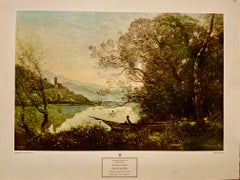
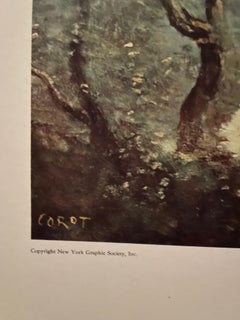
"The Lake of Terni"  by Jean Baptiste Camille Corot; lithograph

"The Lake of Terni" by Jean Baptiste Camille Corot; lithograph

By Jean-Baptiste-Camille Corot

Located in Chesterfield, MI

Jean Baptiste Camille Corot was a French landscape and portrait painter as well as a printmaker in etching. His prolific works simultaneously referenced the Neo-Classical tradition a...

Category

1860s Impressionist Myles Birket Foster Art

Materials

Lithograph

Fête du Jubilé de la Reine à Bedford Park, Londres

Fête du Jubilé de la Reine à Bedford Park, Londres

By Camille Pissarro

Located in New York, NY

A superb, dark and evenly-printed impression of this very scarce lithograph by Camille Pissarro and George W. Thornley. Printed in light brown on Chine appliqué. The deluxe edition o...

Category

1890s Impressionist Myles Birket Foster Art

Materials

Lithograph

“Windsor Castle, 1990” HM King Charles III Signed Lithograph, Edition of 295

“Windsor Castle, 1990” HM King Charles III Signed Lithograph, Edition of 295

Located in Yardley, PA

An excellent original signed lithograph depicting the legendary Windsor Castle by HM King Charles III (b. 1948). “The third lithograph to be produced was the very dramatic Windsor C...

Category

1990s Impressionist Myles Birket Foster Art

Materials

Paper, Lithograph

Edgar Degas, Sketch of Dancers, 1945 (after)

Edgar Degas, Sketch of Dancers, 1945 (after)

By Edgar Degas

Located in Southampton, NY

This exquisite lithograph after Edgar Degas (1834–1917), titled Croquis de danseurs (Sketch of Dancers), originates from the 1945 folio Degas, Ten Ballet Sketches. Published by The Studio Publications, Inc., New York, rendered and printed by Albert Carman, City Island, 1945, this work reflects Degas’s sensitive mastery of line, movement, and the intimate psychological nuances of the ballet studio. Executed as a lithograph and pochoir on velin paper, this work measures 13 x 17 inches (33.02 x 43.18 cm). Signed in the plate and unnumbered as issued. Rendered and printed by Albert Carman, City Island. Artwork Details: Artist: After Edgar Degas (1834–1917) Title: Croquis de danseurs (Sketch of Dancers), from Degas, Ten Ballet Sketches, 1945 Medium: Lithograph and pochoir on velin paper Dimensions: 13 x 17 inches (33.02 x 43.18 cm) Inscription: Signed in the plate and unnumbered as issued Date: 1945 Publisher: The Studio Publications, Inc., New York Printer: Albert Carman, City Island Condition: Well preserved, consistent with age and medium Provenance: From the 1945 folio Degas, Ten Ballet Sketches, published by The Studio Publications, Inc., New York Notes: Excerpted from the album, Born in Paris in 1834, Edgar Degas lived, and surely loved the life of that city during most of his years. These continued somewhat sadly beyond those of most of his friends— into the debacle of the first World War, during which he died in 1917. Judging by the frequency with which he used them as models, he must have had an especial admiration for the ballet girls who followed a profession that at the time brought none of the glory and prosperity which attend it today. New aspects of the human body, revealed in movement, fascinated him. But his occupation with the simply anatomical side of his subjects never resulted in a cold interpretation. On the contrary there is a warmth and sympathy that pervades all of his work. The drawings here represent the painter in one important phase of his multi-sensitive view of life; and permit an insight which a more ambitious work might not do-into the operation of the creative process, the artist's transformation of reality as it passes through the mesh of his sensibilities. The Edition of this Portfolio is limited to MMMD examples. Rendered by Albert Carman. About the Publication: Degas, Ten Ballet Sketches (1945) is one of the earliest and most significant American postwar fine art portfolios devoted to Edgar Degas’s intimate works on paper. Published by The Studio Publications, Inc., New York, and rendered and printed by Albert Carman at City Island, the album sought to faithfully reproduce a group of Degas’s ballet-related drawings through a combination of lithography and hand-applied pochoir coloring. This hybrid technique allowed the edition to preserve the immediacy, tonal subtlety, and gestural delicacy central to Degas’s draftsmanship. Conceived as a fine art publication rather than a commercial book, the portfolio provided American audiences unprecedented access to Degas’s private, spontaneous studies—images that reveal the artist’s fascination with movement, anatomy, and the psychological atmosphere of the rehearsal studio. The album exemplifies the mid-20th-century revival of pochoir as a means of recreating the texture and coloristic nuance of original works on paper, and it remains an important document of how Degas’s legacy was translated into high-quality printed form for collectors, museums, and connoisseurs. About the Artist: Edgar Degas (1834–1917) was a French painter, draughtsman, printmaker, and sculptor whose groundbreaking fusion of classical draftsmanship, modern experimentation, and psychological depth helped define the trajectory of Western art, positioning him as one of the most influential figures of the nineteenth and early twentieth centuries; renowned for his depictions of ballet dancers, racehorses, theater scenes, cafe life, domestic interiors, milliners, laundresses, and women at their toilette, Degas reimagined observational realism through radical compositional innovation—employing extreme cropping, asymmetrical framing, oblique viewpoints, and dramatic lighting that anticipated photographic and cinematic language long before these technologies shaped visual culture, and although associated with Impressionism, he rejected plein-air spontaneity in favor of studio-based discipline rooted in the linear precision of Jean-Auguste-Dominique Ingres, the expressive chromaticism of Eugene Delacroix, and the modernity of Edouard Manet while also drawing inspiration from Japanese ukiyo-e prints, classical sculpture, and early photography; his independent artistic philosophy resonated with and helped shape the innovations of Pablo Picasso, Alexander Calder, Alberto Giacometti, Salvador Dali, Joan Miro, Wassily Kandinsky, Marcel Duchamp, and Man Ray, whose explorations of movement, form, dream logic, abstraction, and conceptualism all find antecedents in Degas’s investigations into seriality, temporality, and the fragmented figure, and his pioneering use of pastel, monotype, and wax sculpture fundamentally transformed each medium, influencing artists from Henri Matisse, Francis Bacon, Lucian Freud, and Giacomo Manzu to Paula Rego, contemporary realists, experimental photographers, and choreographers; his works are held in nearly every major museum collection worldwide—including the Musee dOrsay, the Louvre, the Metropolitan Museum of Art, the National Gallery of Art, the Art Institute of Chicago, the Courtauld Institute, and the National Gallery, London—affirming his central place in the history of art, and the highest auction record for Degas was achieved at Sothebys London on February 3, 2015, when Danseuses en Bleu sold for 37,033,000 GBP, cementing his status as one of the most sought-after and enduringly significant artists of the Western canon. Degas pochoir, Degas lithograph...

Category

1940s Impressionist Myles Birket Foster Art

Materials

Lithograph

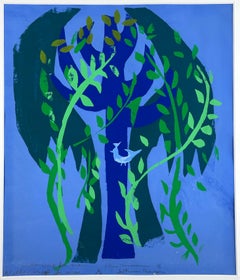
Corkscrew Willows with Stairs - Hand Colored Drypoint Etching California Adobe

Corkscrew Willows with Stairs - Hand Colored Drypoint Etching California Adobe

Located in Soquel, CA

Delicate and detailed etching by Orpha Klinker (American, 1891-1964). At the edge of an old Adobe building, a staircase leads to the second floor. The stucco on the walls of the building is cracked, revealing the stonework below. Next to the building is a garden with Corkscrew Willow trees. One of her first projects with which Orpha impressed the public was a notable series of her large color portraits of California pioneers in the L.A.TIMES under the heading of "Speaking Of Pioneers." This led to another series on landmarks and famous tales of early California including oil paintings of historic adobes, buildings, and trees of California. Signed in plate, lower left. Paper size: 8.5"H x 10.5"W Mat size: 10"H x 12"W Orpha Klinker (American, 1891-1964) graduated from Polytechnic High School, L.A. and later studied at U.C.L.A. Art School and at the Cannon Art School. Artists Paul Lauritz and Anna A. Hills of Laguna Beach were her first art teachers. She continued her study of art at the Julian and Colarossi Academies in Europe. Some of her earliest work was in designing. Many pages of her fine pen work drawings appeared in Los Angeles newspapers, illustrating the fashions of the day, not only in clothes but in furniture and other things. Then for a time she did her work in New York City and later with the Ladies Home Journal in Philadelphia. One of her first projects with which Orpha impressed the public was a notable series of her large color portraits of California pioneers in the L.A.TIMES under the heading of "Speaking Of Pioneers." This led to another series on landmarks and famous tales of early California including oil paintings of historic adobes, buildings, and trees of California. From the Mexican border to Death Valley she roamed, meeting and painting portraits of such characters as Death Valley Scotty, Shoshone Johnny, the ancient Indian who supposedly saw the first white man come to Death Valley, Emanuel A. Speegle, "The Last of the 49'ers" (over 90 years of age) and others. Orpha was active in keeping alive the memory of one historical event in particular, the signing of the Treaty of Cahuenga ending the Mexican War...

Category

1930s American Impressionist Myles Birket Foster Art

Materials

Paper, Watercolor, Drypoint

Reclining Female Nudes with Umbrella, Art Nouveau Watercolor

Reclining Female Nudes with Umbrella, Art Nouveau Watercolor

By Henri Lebasque

Located in Paris, Île-de-France

HENRI LEBASQUE (Champigné 1865 - 1937 Le Cannet) Reclining female nudes with an umbrella Pencil, stumping and heightened with watercolor on paper 27 x 24 cm Stamped signature lowe...

Category

19th Century Art Nouveau Myles Birket Foster Art

Materials

Paper, Pencil, Watercolor

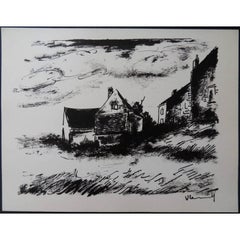
OASIS OF SEVEN PALMS CALIFORNIA

OASIS OF SEVEN PALMS CALIFORNIA

By George Elbert Burr

Located in Portland, ME

Burr, George Elbert. OASIS OF SEVEN PALMS CALIFORNIA. Gouache on paper, not dated, but before 1921. Titled in pencil, lower left, and signed in pencil, lower right, and with the numb...
Category

Early 20th Century Myles Birket Foster Art

Materials

Gouache
Previously Available Items
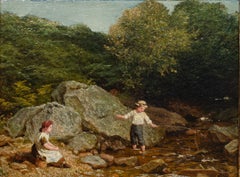
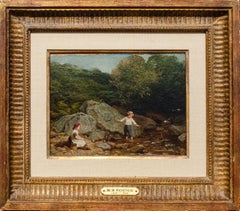
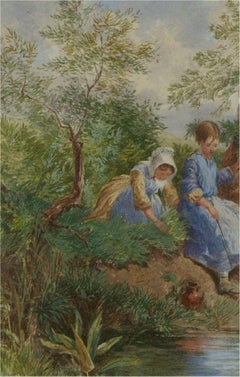
Original Myles Birket Foster RWS Painting of Children Fishing Creekside

Original Myles Birket Foster RWS Painting of Children Fishing Creekside

By Myles Birket Foster

Located in New York, NY

Myles Birket Foster RWS (British, 1825-1899) Untitled (Children Fishing), 19th Century Oil on board Sight: 7 3/4 x 10 5/8 Framed: 13 5/8 x 15 5/8 x 1 3/8 in. Myles Birket Foster (4 February 1825 - 27 March 1899) was a popular English illustrator, watercolour artist and engraver in the Victorian period. His name is also to be found as Myles Birkett Foster. Foster was born in North Shields, England of a primarily Quaker family, but his family moved south to London in 1830, where his father founded M. B. Foster & sons - a successful beer-bottling company. He was schooled at Hitchin, Hertfordshire, and on leaving initially went into his father's business. However, noticing his talent for art, his father secured an apprenticeship with the notable wood engraver, Ebenezer Landells, where he worked on illustrations for Punch magazine and the Illustrated London News. On leaving Landells' employ, he continued to produce work for the Illustrated London News and The Illustrated London Almanack. He also found work as a book illustrator and, during the 1850s, trained himself to paint in watercolours. His illustrations of Longfellow's Evangeline and books of poetry by other contemporaries were a great success, and he quickly became a successful artist in watercolours. Birket Foster became an Associate of the "Old" Watercolour Society (Later the Royal Watercolour Society) in 1860 and exhibited some 400 of his paintings at the Royal Academy over more than two decades. Birket Foster traveled widely, painting the countryside around Scotland, the Rhine Valley, the Swiss lakes and in Italy, especially Venice. In 1863 he moved to Witley, near Godalming in Surrey where he had a house ("The Hill") built. Being friendly with Edward Burne-Jones and William Morris, he had the house decorated and furnished in contemporary style, with tiles and paintings by Burne-Jones and Morris' firm, Morris and Company...

Category

19th Century Impressionist Myles Birket Foster Art

Materials

Oil, Board

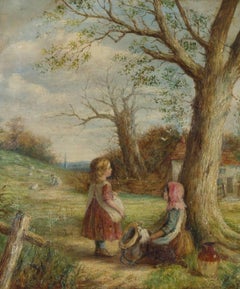
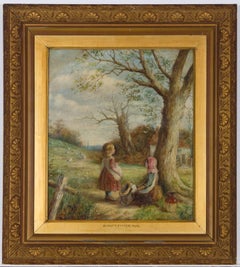
Attributed to Myles Birket Foster - 19th Century English Oil, Girls and a Dog

Attributed to Myles Birket Foster - 19th Century English Oil, Girls and a Dog

By Myles Birket Foster

Located in Corsham, GB

A charming late 19th Century framed oil painting attributed to Myles Birket Foster RWS (1825-1899) depicting two young girls and a dog resting under a tree. In an ornate gilt frame. ...

Category

Late 19th Century Victorian Myles Birket Foster Art

Materials

Canvas, Oil

Myles Birket Foster art for sale on 1stDibs.

Find a wide variety of authentic Myles Birket Foster art available for sale on 1stDibs. You can also browse by medium to find art by Myles Birket Foster in paint, watercolor, gouache and more. Much of the original work by this artist or collective was created during the 19th century and is mostly associated with the Impressionist style. Not every interior allows for large Myles Birket Foster art, so small editions measuring 11 inches across are available. Customers who are interested in this artist might also find the work of Paul Lecomte, Max Liebermann, and Albert de Belleroche. Myles Birket Foster art prices can differ depending upon medium, time period and other attributes. On 1stDibs, the price for these items starts at $340 and tops out at $11,279, while the average work can sell for $875.
Artists Similar to Myles Birket Foster