Sybil Andrews Art

British, 1898-1992

Sybil Andrews was an English-Canadian artist who specialized in printmaking and is best known for her reductionist linocuts. Born in 1898 in Bury St Edmunds, Andrews was unable to go straight to art school after her high school, as her family could not afford the tuition fees. Given the shortage of young men during the First World War, in 1916 she was apprenticed as a welder, working in the Bristol Welding Company’s airplane factory, helping in the development of the first all-metal airplane. During this period, she took an art correspondence course. After the war, Andrews returned to Bury St Edmunds, where she was employed as an art teacher at Portland House School. Between 1922–24, she attended the Heatherley School of Fine Art in London. Andrews continued to practice the art and met the architect Cyril Power, who became a mentor figure, and then her working partner until 1938. Between 1930–38, Andrews and Power shared a studio in Hammersmith. In 1933, Andrews and Cyril Power had an exhibition of their color monotypes and linocuts at the Redfern Gallery. Most of her monotypes were destroyed by a fire in an Ottawa gallery, in 1959 and they are therefore now seldom seen.

to
1
6
1
Overall Width
to
Overall Height
to
8
3
4
1
4
3
6
1
3
2
1
1
1
1
1
1
1
1
1
1
1
5
3
8
10,821
2,839
2,494
1,414
3
8
Artist: Sybil Andrews
'Hostellerie des Chiens du Guet' — British Impressionism

'Hostellerie des Chiens du Guet' — British Impressionism

By Sybil Andrews

Located in Myrtle Beach, SC

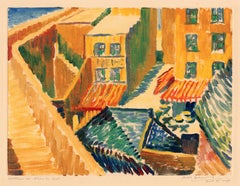
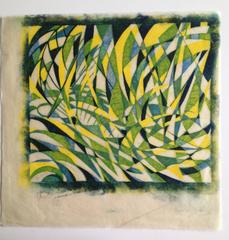
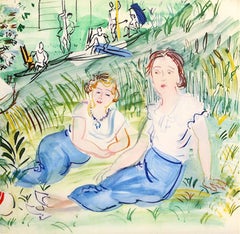
Sybil Andrews, 'Hostellerie des Chiens du Guet', color monotype, c. 1925; edition 2, proof 1. Signed 'Sybil Andrews pinx et imp' and titled in pencil. A superb, painterly impression, with fresh colors, on heavy cream wove paper; the full sheet with margins (5/8 to 1 3/4 inches). Printed by the artist. The artist’s original archival mounting tape remains in the four sheet corners, recto (well away from the image), in excellent condition. Matted to museum standards, unframed. A unique impression. Image size 8 15/16 x 11 15/16 inches (227 x 303 mm); sheet size 12 1/4 x 15 1/2 inches (311 x 394 mm). ABOUT THIS WORK In addition to her almost 80 celebrated modernist color linocuts, Sybil Andrews also worked in the monotype technique. She typically produced two or three impressions (or pulls) from each hand-painted plate, each proof unique in its qualities of color values and vibrancy. In 1933, Sybil Andrews and Cyril Power had an exhibition of their color monotypes and linocuts at the Redfern Gallery. Most of Andrews' monotypes were destroyed by a fire in an Ottawa gallery in 1959, and they now rarely come to the market. ABOUT THE IMAGE The Hostellerie des Chiens du Guet is a small hotel at the edge of...

Category

1920s Post-Impressionist Sybil Andrews Art

Materials

Monotype

The New Cable British Modern Mid 20th Century Vorticist European Vorticism Woman

The New Cable British Modern Mid 20th Century Vorticist European Vorticism Woman

By Sybil Andrews

Located in New York, NY

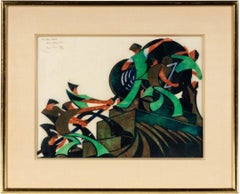
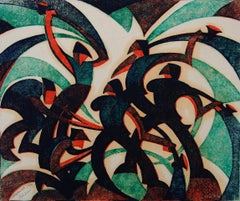
The New Cable British Modern Mid 20th Century Vorticist European Vorticism Woman Sybil Andrews CPE (British/Canadian, 1898-1992) "The New Cable," 1931 12 x 16 1/2 inches Color linocut Signed, titled, inscribed 'Second State', and numbered 13/60 in pencil Framed: 19 x 24 inches Literature: Coppel Sa17 Illustrated on page 10 of the catalog The proposed edition of the first state of the Giant Cable was 50, but only 30 impressions were pulled. Andrews removed the blue background for the second state, which was published under the title The New Cable in an edition of 60. BIO Sybil Andrews was a printmaker, painter, graphic artist and educator who was born in Bury St. Edmonds, Suffolk, England. She moved to London (England) in 1922. In 1947, she emigrated to Campbell River (Vancouver Island) British Columbia, Canada, where she worked, taught and lived for the rest of her life. She died at a hospital in Victoria (B.C.) Her mediums were the colour linocut (1) (most famous), etching, posters, pastels, ink, watercolour, monoprint and oil. Her subjects were human activity (at work, sports, travel, etc.), figures, animals, genre, allegory, architecture and landscape. Her style was Art Deco (see AskART styles), Futurism, Cubism and Vorticism (2). Her work is identified by a simple format, clean lines, distortion, vivid colours, drama and rhythm. Quote: "The colour linocut was just the medium for me, being interested in dynamics and ideas and patterns... It is impossible to be fussy with lines, you have to simplify, you are forced to simplify your idea to its fundamentals." Andrews produced 76 linocuts in her life, of which 43 were made from 1929 to 1939, which is considered to be her best period. John Hassall's art correspondence course (1918) was the beginning of her formal art education. She went from there to Heatherley's School of Fine Art (London/1922) where she studied under Henry Massey (see AskART) and met artistic partner Cyril Power (see AskART). At the same time, she studied independently with sculptor Henri Glicenstein (see AskART) who taught her drypoint etching and to draw from life. She also attended the Grosvenor School of Modern Art (1925). Iain McNab (1890-1967) was Principal and Claude Flight (3) (see AskART) an instructor who had a great influence on her choice of linocut as a primary medium. Some of his other students and her associates were Edith Lawrence (1890-1973), Lill Tschudi (1911-2001), Eileen Mayo (see AskART) and William Greengrass (1896-1970). After emigrating to Canada she taught art continuously until a month before her death. She was elected a member of the Canadian Painters - Etchers Society (after 1976 the Print and Drawing Council of Canada) in 1951. She began exhibiting her work in 1921.In 1929 she was included in "The First Exhibition of British Linocuts...

Category

1930s Modern Sybil Andrews Art
Materials

Linocut

"Rush Hour" British Modern Mid 20th Century Vorticist European Vorticism Woman

"Rush Hour" British Modern Mid 20th Century Vorticist European Vorticism Woman

By Sybil Andrews

Located in New York, NY

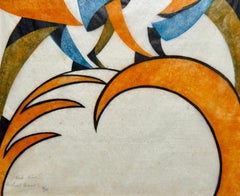
"Rush Hour" British Modern Mid 20th Century Vorticist European Vorticism Woman Sybil Andrews CPE (British/Canadian, 1898-1992) Rush Hour (Coppel SA 11) Linocut printed in Chinese orange, Chinese blue and black, 1930, on tissue thin oriental laid paper. Signed, titled and numbered 8/50 in pencil lower left, framed. Block 209 x 251mm (8 1/4 x 9 7/8in) Sheet 249 x 310mm (9 3/4 x 12 1/4in) Framed by Bark 14 1/2 x 16 inches BIO Sybil Andrews was a printmaker, painter, graphic artist and educator who was born in Bury St. Edmonds, Suffolk, England. She moved to London (England) in 1922. In 1947, she emigrated to Campbell River (Vancouver Island) British Columbia, Canada, where she worked, taught and lived for the rest of her life. She died at a hospital in Victoria (B.C.) Her mediums were the colour linocut (1) (most famous), etching, posters, pastels, ink, watercolour, monoprint and oil. Her subjects were human activity (at work, sports, travel, etc.), figures, animals, genre, allegory, architecture and landscape. Her style was Art Deco (see AskART styles), Futurism, Cubism and Vorticism (2). Her work is identified by a simple format, clean lines, distortion, vivid colours, drama and rhythm. Quote: "The colour linocut was just the medium for me, being interested in dynamics and ideas and patterns... It is impossible to be fussy with lines, you have to simplify, you are forced to simplify your idea to its fundamentals." Andrews produced 76 linocuts in her life, of which 43 were made from 1929 to 1939, which is considered to be her best period. John Hassall's art correspondence course (1918) was the beginning of her formal art education. She went from there to Heatherley's School of Fine Art (London/1922) where she studied under Henry Massey (see AskART) and met artistic partner Cyril Power (see AskART). At the same time, she studied independently with sculptor Henri Glicenstein (see AskART) who taught her drypoint etching and to draw from life. She also attended the Grosvenor School of Modern Art (1925). Iain McNab (1890-1967) was Principal and Claude Flight (3) (see AskART) an instructor who had a great influence on her choice of linocut as a primary medium. Some of his other students and her associates were Edith Lawrence (1890-1973), Lill Tschudi (1911-2001), Eileen Mayo (see AskART) and William Greengrass...

Category

1930s Modern Sybil Andrews Art
Materials

Linocut

SLEDGEHAMMERS

SLEDGEHAMMERS

By Sybil Andrews

Located in Portland, ME

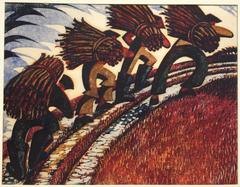
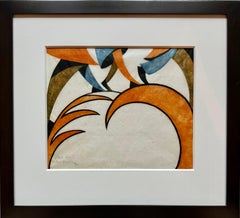
Andrews, Sybil (English/Canadian, 1898-1992), C. SA26. "SLEDGEHAMMERS", Color Linocut, 1933, ed. 60 plus 4 trial proofs, Ref. C. SA 26, 10-1/4 x 12-1/2, signed, titled and numbered 6...

Category

1930s Modern Sybil Andrews Art
Materials

Linocut

'Le Petit Bay, St. Malo' — 1920s British Impressionism

'Le Petit Bay, St. Malo' — 1920s British Impressionism

By Sybil Andrews

Located in Myrtle Beach, SC

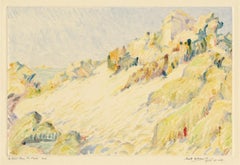
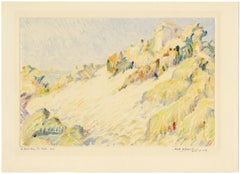
Sybil Andrews, 'Le Petit Bay, St. Malo', color monotype, c. 1925; edition 3, print 2. Signed 'Sybil Andrews pinx et imp' annotated 'No 2' and titled in pencil. A superb, luminous imp...

Category

1920s Post-Impressionist Sybil Andrews Art

Materials

Monotype

'Rue du Hallage - Rouen' — 1920s British Impressionism

'Rue du Hallage - Rouen' — 1920s British Impressionism

By Sybil Andrews

Located in Myrtle Beach, SC

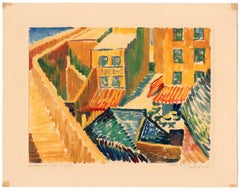
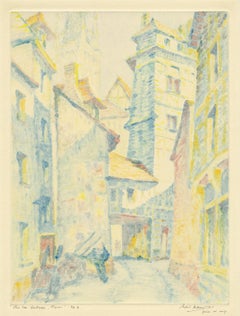
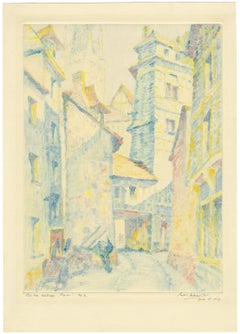
Sybil Andrews, 'Rue du Hallage - Rouen', color monotype, c. 1925, edition 3, proof 3. Signed 'Sybil Andrews pinx et imp' annotated 'No 3' and titled in pencil. Printed by the artist....

Category

1920s Post-Impressionist Sybil Andrews Art

Materials

Monotype

Sails
Sails

Sails

By Sybil Andrews

Located in New York, NY

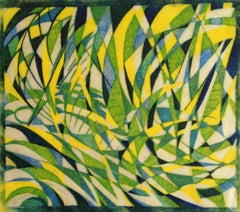
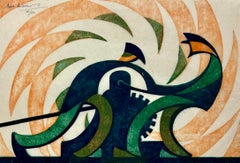
Sybil Andrews (1898-1992), Sails, linocut in colors, 1960, signed (twice), titled, and inscribed “TP” in pencil. Reference: White 50. In good condition, two sheets, each image 7 1/...

Category

1960s Futurist Sybil Andrews Art

Materials

Linocut

Related Items
Pasiphae Plate 17: J'irai à ce que j'ai voulu, sans fierté comme sans remords

Pasiphae Plate 17: J'irai à ce que j'ai voulu, sans fierté comme sans remords

By Henri Matisse

Located in Washington, DC

Artist: Henri Matisse Title: Plate 17: J'irai à ce que j'ai voulu, sans fierté comme sans remords (I go to what I wanted, as much without pride as without remorse) Portfolio: Pasipha...

Category

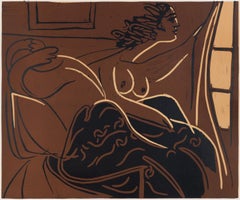
1940s Modern Sybil Andrews Art

Materials

Linocut

Kees van Dongen, Montmartre, from Views of Paris, 1963

Kees van Dongen, Montmartre, from Views of Paris, 1963

By Kees van Dongen

Located in Southampton, NY

This exquisite lithograph by Kees van Dongen (1877–1968), titled Montmartre (Montmartre), from Regards Sur Paris (Views of Paris), originates from the January 22, 1963 issue publishe...

Category

1960s Fauvist Sybil Andrews Art

Materials

Lithograph

'Sisters' — Renowned Black American, Harlem Renaissance Artist

'Sisters' — Renowned Black American, Harlem Renaissance Artist

Located in Myrtle Beach, SC

James Lesesne Wells, 'Sisters', linocut, edition not stated but small, 1928. Signed, titled, and annotated 'imp' in pencil. A fine impression on off-white wove Japan paper, with wide margins (1 7/8 to 3 3/4 inches), in excellent condition. Printed by the artist. Very scarce. Matted to museum standards, unframed. Image size 8 3/16 x 6 3/4 inches (208 x 171 mm); sheet size 13 1/2 x 10 3/4 inches (343 x 273 mm). Exhibition and Literature: 'Narratives of African American Art and Identity: The David C. Driskell Collection,' The Art Gallery at the University of Maryland, extensive touring exhibition, 1998-2000. Collections: Pennsylvania Academy of the Fine Arts, Smithsonian Institution (Anacostia Community Museum). ABOUT THE ARTIST “Wells is more than an artist with a deep concern for his fellow man. He carries many of his themes a step further into an apocalyptic world, a world of revelation and shifting lights. … He works on large blocks in a bold free style. … His work has a vigor, therefore, that is not often used in the medium today.” —Jacob Kainen (painter, critic, and collector) from Richard J. Powell’s 1986 essay Phoenix Ascending: The Art of James Lesesne Wells. James Lesesne Wells was an American painter, printmaker, educator, and pioneering figure of the Harlem Renaissance, whose work established a vital connection between African heritage, modernist form, and African American cultural identity. Known for his innovative use of linoleum and woodblock printing, Wells played a key role in shaping 20th-century African American art and inspired countless students throughout his lengthy career as a teacher at Howard University. Born in Atlanta, Georgia, Wells' early exposure to the arts came through church and community, where African American cultural traditions were central. He pursued formal artistic training at Lincoln University in Pennsylvania (earning a B.A. in 1924), followed by studies at the Pennsylvania Academy of the Fine Arts and the Barnes Foundation, where he encountered European modernists as well as traditional African sculpture, which profoundly influenced his style. Wells moved to New York in the late 1920s, swiftly immersing himself in the lively artistic and intellectual scene of Harlem. There, he became associated with artists, writers, and thinkers of the Harlem Renaissance, contributing to the growth of Black cultural identity. Considered a mentor to many famed artists of the Harlem Renaissance, Wells served as director of a summer art workshop in Harlem where his assistants included Charles Alston, Jacob Lawrence, and Palmer Hayden...

Category

1920s American Modern Sybil Andrews Art

Materials

Linocut

Inspiration, Modern Art Lithograph by Marc Chagall

Inspiration, Modern Art Lithograph by Marc Chagall

By Marc Chagall

Located in Long Island City, NY

"Inspiration" is an original lithograph by Marc Chagall published in the "Lithographs of Marc Chagall vol. II". The book was published in a limited edition of 6000. Size: 12.5 x 9.5...

Category

1960s Modern Sybil Andrews Art

Materials

Lithograph

GREETINGS FROM THE HOUSE OF WEYHE. Many Known Artists Inside the Gallery

GREETINGS FROM THE HOUSE OF WEYHE. Many Known Artists Inside the Gallery

Located in Santa Monica, CA

MAYBEL DWIGHT (1875 - 1955) GREETINGS FROM THE HOUSE OF WEYHE, 1928 Lithograph, signed in the plate. Image 7 1/8 x 8 3/8” + printed title. Sheet 8 ¼ x 9” as issued. Xmas card iss...

Category

1920s American Modern Sybil Andrews Art

Materials

Lithograph

Henri Matisse, Three Heads. To Friendship, from Apollinaire, 1952

Henri Matisse, Three Heads. To Friendship, from Apollinaire, 1952

By Henri Matisse

Located in Southampton, NY

This exquisite aquatint by Henri Matisse (1869–1954), titled Trois têtes. A l'amitié (Three Heads. To Friendship), from the album Apollinaire, Henri Matisse (Apollinaire, Henri Matisse), originates from the 1952 edition published by Editions Raisons d'etre, Paris, and printed by Mourlot Freres, Paris, April 24, 1952. The work captures Matisses lyrical line and expressive minimalism, paying tribute to the French poet Guillaume Apollinaire through a synthesis of portraiture and calligraphic grace. Executed as an aquatint on velin a la forme des papeteries d'Arches paper, this work measures 12.99 x 9.84 inches (33 x 25 cm). Unsigned and unnumbered, as issued. The edition exemplifies the superior craftsmanship of Mourlot Freres, Paris. Artwork Details: Artist: Henri Matisse (1869–1954) Title: Trois têtes. A l'amitié (Three Heads. To Friendship), from the album Apollinaire, Henri Matisse (Apollinaire, Henri Matisse) Medium: Aquatint on velin a la forme des papeteries d'Arches paper Dimensions: 12.99 x 9.84 inches (33 x 25 cm) Inscription: Unsigned and unnumbered, as issued Date: 1952 Publisher: Editions Raisons d'etre, Paris Printer: Mourlot Freres, Paris Catalogue Raisonne Reference: Duthuit, Claude. Henri Matisse: Catalogue raisonne des ouvrages illustres. Editions Claude Duthuit, Paris, 1988, illustration 31. Condition: Well preserved, consistent with age and medium Provenance: From the album Apollinaire, Henri Matisse (Apollinaire, Henri Matisse), published by Editions Raisons d'etre, Paris; printed by Mourlot Freres, Paris, 1952 Notes: Excerpted from the album (translated from French), Printing of this album was finished on April, Twenty-Four, M.CM.LII for the Editions Raisons d'etre, 2 rue des Beaux-Arts in Paris, was produced by Fernand Mourlot, based on the models of Henri Matisse. The eight original lithographs were shot on the presses of Mourlot Freres who also printed the cover and case composed by the artist. The stones were erased after drawing. The text and letrins engraved by Henri Matisse were drawn by Coulouma S.A., printer in Paris. Justification of the draw— XXX examples on large velin d'Arches a la forme, signed by the author and the artist, accompanied by a series of original lithographs numbered from I to XXX; CCC examples on velin d'Arches a la forme numbered from XXXI to CCCXXX; XX examples of non-commerce collaborators numbered from I to XX and in addition a few nominative examples on Grand Velin. About the Publication: Apollinaire, Henri Matisse (Apollinaire, Henri Matisse), published by Editions Raisons d'etre, Paris, in 1952, stands among Matisses most intimate artist’s albums, conceived as a visual homage to the poet Guillaume Apollinaire, whose friendship and creative influence had profoundly shaped the avant-garde in the early 20th century. The album unites Matisses mastery of line with his reverence for literature, pairing portraits, decorative initials, and typographic designs engraved in his own hand. Printed by the esteemed atelier Mourlot Freres, the volume exemplifies the peak of French postwar printmaking, merging literary refinement with visual purity. Each print reveals Matisses poetic sensibility—his ability to render emotion through the economy of contour and rhythm. About the Artist: Henri Matisse (1869–1954) was a French painter, sculptor, draughtsman, and printmaker whose revolutionary vision redefined modern art through his daring use of color, line, and form. Celebrated as one of the greatest artists of the 20th century, Matisse led the Fauvist movement and devoted his life to the pursuit of balance, beauty, and emotional expression in visual art. His early works burst with vibrant hues and liberated brushwork, while his later “cut-out” compositions achieved a poetic simplicity that transformed the relationship between color and space. Deeply influenced by the work of Paul Cezanne, Vincent van Gogh, and Georges Seurat, as well as by the rhythmic patterns of Islamic art, Byzantine mosaics, and Japanese prints, Matisse forged a new visual language that celebrated joy, movement, and serenity. He was part of an extraordinary generation of artists who shaped the evolution of modernism, maintaining lifelong dialogue and friendly rivalry with contemporaries such as Pablo Picasso, Georges Braque, Marc Chagall, Andre Derain, Albert Marquet, and Raoul Dufy—peers who, like him, sought to expand the expressive potential of color and composition. Matisses influence extended across generations, inspiring modern and contemporary masters including Alexander Calder, Alberto Giacometti, Salvador Dali, Joan Miro, Wassily Kandinsky, Marcel Duchamp, and Man Ray, each of whom drew upon his fearless experimentation and refined visual harmony. His paintings, sculptures, and works on paper are held in the most prestigious museums in the world, including the Museum of Modern Art, the Centre Pompidou, the Tate, and the Hermitage Museum, where his art continues to symbolize the essence of creativity and human emotion. The highest price ever paid for a Henri Matisse artwork is approximately 80.8 million USD, achieved in 2018 at Christies New York for Odalisque couchee aux magnolias (1923). Henri Matisse Trois têtes. A l'amitié (Three Heads. To Friendship) Apollinaire, Henri Matisse (Apollinaire, Henri Matisse) 1952, Matisse Editions Raisons d'etre, Matisse Mourlot Freres, Matisse aquatint...

Category

1950s Fauvist Sybil Andrews Art

Materials

Aquatint

Kerry James Marshall - Keeping the Culture, silkscreen and linocut, Signed/N

Kerry James Marshall - Keeping the Culture, silkscreen and linocut, Signed/N

By Kerry James Marshall

Located in New York, NY

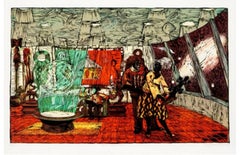
Kerry James Marshall Keeping the Culture, 2011 Silkscreen and linocut in colors with full margins and deckled edges on Arches paper with full margins and deckled edges 20-1/4 x 30-1/4 inches Hand signed, titled and numbered 79/100 by Kerry James Marshall in graphite pencil on the front Published by Africa House International, Chicago Unframed In September, 2025, "Kerry James Marshall: The Histories" opened at the Royal Academy of Arts in London. This major exhibition was the largest presentation of Marshall's work in the United Kingdom and Europe, and featured more than 70 works by the the artist, including a large number of paintings and a selection of prints, drawings and sculptures. Highlights of the show include a new series of paintings that explore the transatlantic slave trade, along with Knowledge and Wonder, a mural commissioned in 1995 by the Chicago Public Library that is the largest painting Marshall has produced. The exhibition at the Royal Academy will then travel to the Kunsthaus Zurich and the Musee d'Art Modern in Paris. Kerry James Marshall's 2011 "Keeping the Culture" is based upon the artist's eponymous painting done the year earlier, which is featured in the Royal Academy Exhibition. In 2013, an original painting, upon which this work is based, sold at Christie's auction. Below is the Christie's Lot Essay for that painting: ..." Set in a revolutionary apartment in the cosmos, Kerry James Marshall's Keeping the Culture optimistically anticipates a future that pays homage to the past. Ushering in a new stage of the artist's output, Keeping the Culture shifts focus from the failed utopia of urban renewal and the commemoration of civil rights era heroes in favor of a more technically refined meditation on the preservation of the traditional and spiritual values that shaped a culture. Placed in an ultramodern environment, two siblings marvel at a projection of the earth--in which Marshall has aptly positioned the African continent toward the viewer-while their affectionate parents dance in the foreground. Overlooking the milky way, Marshall's space-age flat is decorated with earthly relics-wooden tribal sculptures...

Category

2010s Contemporary Sybil Andrews Art

Materials

Mixed Media, Pencil, Linocut, Screen

Henri de Toulouse-Lautrec, Untitled, from Derriere le Miroir, 1966 (after)

Henri de Toulouse-Lautrec, Untitled, from Derriere le Miroir, 1966 (after)

By Henri de Toulouse-Lautrec

Located in Southampton, NY

This exquisite lithograph after Henri de Toulouse-Lautrec (1864–1901), titled Sans titre (Untitled), originates from the 1966 folio Derriere le Miroir, No. 158–159, published by Maeg...

Category

1960s Post-Impressionist Sybil Andrews Art

Materials

Lithograph

Chapel of the Agriculture School, Chapingo (Forces Under the Earth)

Chapel of the Agriculture School, Chapingo (Forces Under the Earth)

By (after) Diego Rivera

Located in Missouri, MO

(after) Diego Rivera "Chapel, Agriculture School, Chapingo" (Forces Under the Earth) 1933 from the portfolio "Frescoes of Diego Rivera" Published by the Museum of Modern Art, NY Approx. 18.5 x 13.5 with Matting Hand-Signed by the Artist Diego Rivera was born on December 13, 1886 in the mountain town of Guanajuato in Mexico. His mother was an ardent Catholic and his father was a rich and aristocratic revolutionary fighter and an atheist. Little Diego decided in favor of atheism. He swore his family had to leave Guanajuato when he was six because of his diatribes against the Church. When he was eleven he attended the San Carlos Academy of Fine Arts; his real teacher was Jose Posada...

Category

1930s Modern Sybil Andrews Art
Materials

Lithograph

Jean-Edouard Vuillard, The Footbridge, 1966 (after)

Jean-Edouard Vuillard, The Footbridge, 1966 (after)

By Edouard Vuillard

Located in Southampton, NY

This exquisite lithograph and pochoir after Jean-Edouard Vuillard (1868-1940), titled La Passerelle (The Footbridge), from the folio Vuillard, Douze Pastels (Vuillard, Twelve Pastels...

Category

1960s Post-Impressionist Sybil Andrews Art

Materials

Lithograph, Stencil

Kees van Dongen, Models, from Views of Paris, 1963

Kees van Dongen, Models, from Views of Paris, 1963

By Kees van Dongen

Located in Southampton, NY

This exquisite lithograph by Kees van Dongen (1877–1968), titled Mannequins (Models), from Regards Sur Paris (Views of Paris), originates from the January 22, 1963 issue published by...

Category

1960s Fauvist Sybil Andrews Art

Materials

Lithograph

II Cup of Joe
II Cup of Joe

Rickey Jewell HohimerII Cup of Joe, c.1990

$800

H 26.75 in W 30 in D 1 in

II Cup of Joe

Located in San Francisco, CA

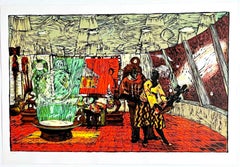
This artwork titled "II Cup of Joe" c.1990, is an original color serigraph by American artist Rickey Jewell Hohimer, 1946-2021. It is hand signed, titled and numbered 250/300 in pencil by the artist. The image size is 19.5 x 23.5 inches, framed size is 26.75 x 30 inches. The artwork is in excellent condition, the frame is slightly damaged at the top, and will be replaced by a new similar black frame when sold. This will bring the over all condition to excellent. About the artist: Although formally trained with a MFA in painting, Rickey Jewell Hohimer has used the styles of Van Gogh and Gaughin to reach for the spontaneity and simplicity of today's folk art. Hohimer creates figures which are not photos of reality; they are romantically stylized to encourage straightforward emotional responses both to the colorful images and to the situations in which they find themselves. Each of Hohimer's paintings lays out a basic story line to which viewers add their own details. "I want the viewer to become personally involved. My paintings offer a change from those which encourage extensive intellectualizing about what the artist is trying to convey. I want viewers to smile -- to enjoy the whimsical nature of what they are experiencing -- to feel it, not to analyze it!. His jazz paintings are stories on canvas of inspired musicians spontaneously making music of the moment. Life in the jazz age is clubs and nightlife beckoning to musicians to produce jazz art...

Category

Late 20th Century American Modern Sybil Andrews Art

Materials

Screen

Previously Available Items
BRINGING IN THE BOAT - Early Working Proof of One Block

BRINGING IN THE BOAT - Early Working Proof of One Block

By Sybil Andrews

Located in Santa Monica, CA

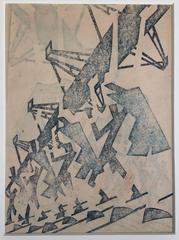
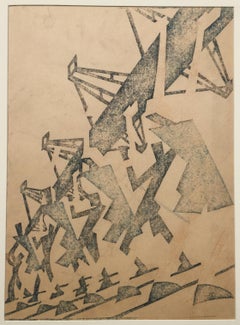
SYBIL ANDREWS (1898 – 1992) BRINGING IN THE BOAT, 1933 (Coppel SA 24) Linocut, A rare proof impression of indigo block on newsprint, unsigned. 13” x 9 ½”. She...

Category

1930s Modern Sybil Andrews Art
Materials

Linocut

Bringing in the Boat

Bringing in the Boat

By Sybil Andrews

Located in Santa Monica, CA

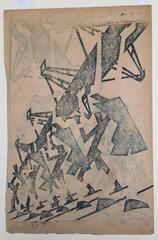
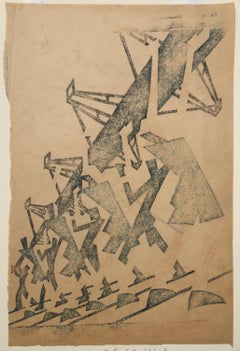
SYBIL ANDREWS (1898 – 1992) BRINGING IN THE BOAT, 1933 (Coppel SA 24) Linocut, A proof impression of indigo block on newsprint, unsigned. An image o...

Category

1930s Modern Sybil Andrews Art

Materials

Linocut

Gypsies
Gypsies

Sybil AndrewsGypsies, 1939

Sold

H 10.625 in W 14 in

Gypsies

By Sybil Andrews

Located in Santa Monica, CA

SYBIL ANDREWS (1898 – 1992) GYPSIES 1939 (C.SA 43) Color linocut. Signed titled and annotated “TP2” (trial proof) aside from the Edition of 60 (+...

Category

1930s Synthetic Cubist Sybil Andrews Art
Materials

Color

Sybil Andrews art for sale on 1stDibs.
Find a wide variety of authentic Sybil Andrews art available for sale on 1stDibs. If you’re browsing the collection of art to introduce a pop of color in a neutral corner of your living room or bedroom, you can find work that includes elements of green, orange and other colors. You can also browse by medium to find art by Sybil Andrews in linocut, monotype and more. Much of the original work by this artist or collective was created during the 20th century and is mostly associated with the modern style. Not every interior allows for large Sybil Andrews art, so small editions measuring 9 inches across are available. Customers who are interested in this artist might also find the work of Ernest Fiene, Achille-Émile Othon Friesz, and Paul Cézanne. Sybil Andrews art prices can differ depending upon medium, time period and other attributes. On 1stDibs, the price for these items starts at $2,800 and tops out at $59,000, while the average work can sell for $17,700.
Artists Similar to Sybil Andrews