Tomikichiro Tokuriki Art

1902-2000
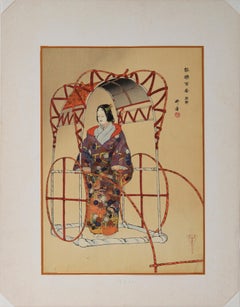
Print artist. Tokuriki was born in Kyoto, where he has always worked. The last of a long line of traditional-style painters, he turned early to woodblock prints and became a leader of the Kyoto 'Sosaku Hanga'. He graduated from the Kyoto City School of Fine Arts and Crafts and then from the Kyoto City Specialist School of Painting in 1924. In 1928 he studied 'Nihonga' painting under Tsuchida Bakusen (1887-1936) and Yamamoto Shunkyo (1871-1933) and exhibited with Kokuga Sosaku Kyokai, but about the same time in 1929 he changed to woodblock printing under the influence of Hiratsuka Un'ichi and began to contribute to the early print magazine 'Han'. He was a member of Nihon Hanga Kyokai from 1932, and active in promoting 'Sosaku Hanga' in Kyoto. He was a co-founder of the Kyoto magazine 'Taishu hanga' in 1932, which helped create the sense of a local school of the Creative Print Movement much encouraged by Hiratsuka. He produced many sets of prints before and during the Pacific War based on traditional subjects, such as 'Shin Kyoto fukei' ('New View of Kyoto', 1933-4), which also included designs by Asada Benji (q.v.) and Asano Takeji (b.1900), and 'Tokyo hakkei' ('Eight Views of Tokyo', 1942). Most of these were published by Uchida of Kyoto, but after the war Tokuriki set up his own publishing company called Matsukyu, which also began to teach block-carving to artisans and artists, in later years many of them foreigners. In 1948 he also set up a sub-company called Koryokusha consisting of artists who would produce their prints under the financial umbrella of Matsukyu. Later sets include 'Hanga Kyoto hyakkei' ('One Hundred Print Views of Kyoto', 1975). Tokuriki has continued to be active in teaching and writing, producing a long series of articles on print techniques in 'Hanga geijutsu' magazine during the 1970s.
to
2
Overall Width
to
Overall Height
to
2
2
2
2
2
1
1
1
1
2
2
10,634
2,826
2,495
1,410
2
Artist: Tomikichiro Tokuriki
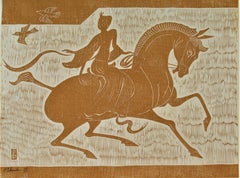
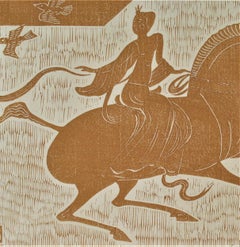
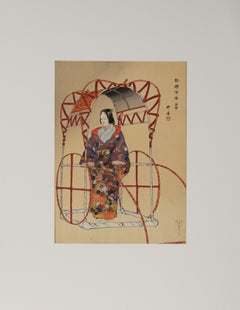
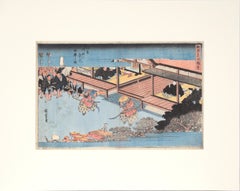
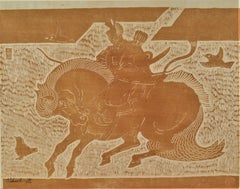
Untitled, Horsewoman

Untitled, Horsewoman

By Tomikichiro Tokuriki

Located in San Francisco, CA

This artwork "horsewoman" c.1960 is an original woodcut by noted Japanese artist, Tomikichiro Tokuriki, 1902-1999. It is hand signed and numbered 47/100 in pencil by the artist. The image (Block mark) size is 15.35 x 20.35 inches, sheet size is 15.35 x 20.5 inches. It is in very good condition, hanging tape remaining on the back. About the artist: Print artist. Tokuriki was born in Kyoto, where he has always worked. The last of a long line of traditional-style painters, he turned early to woodblock prints and became a leader of the Kyoto 'Sosaku Hanga'. He graduated from the Kyoto City School of Fine Arts and Crafts and then from the Kyoto City Specialist School of Painting in 1924. In 1928 he studied 'Nihonga' painting under Tsuchida Bakusen (1887-1936) and Yamamoto Shunkyo (1871-1933) and exhibited with Kokuga Sosaku Kyokai, but about the same time in 1929 he changed to woodblock printing under the influence of Hiratsuka Un'ichi and began to contribute to the early print magazine 'Han'. He was a member of Nihon Hanga Kyokai from 1932, and active in promoting 'Sosaku Hanga' in Kyoto. He was a co-founder of the Kyoto magazine 'Taishu hanga' in 1932, which helped create the sense of a local school of the Creative Print Movement much encouraged by Hiratsuka. He produced many sets of prints before and during the Pacific War based on traditional subjects, such as 'Shin Kyoto fukei' ('New View of Kyoto', 1933-4), which also included designs by Asada Benji (q.v.) and Asano Takeji (b.1900), and 'Tokyo hakkei' ('Eight Views of Tokyo', 1942). Most of these were published by Uchida of Kyoto, but after the war Tokuriki set up his own publishing company called Matsukyu, which also began to teach block-carving to artisans and artists, in later years many of them foreigners. In 1948 he also set up a sub-company called Koryokusha consisting of artists who would produce their prints under the financial umbrella of Matsukyu. Later sets include 'Hanga Kyoto hyakkei' ('One Hundred Print Views of Kyoto', 1975). Tokuriki has continued to be active in teaching and writing, producing a long series of articles on print techniques in 'Hanga geijutsu' magazine during the 1970s. Bibliography Smith, Lawrence, 'Modern Japanese Prints 1912-1989: Woodblocks and Stencils', BMP, London, 1994, p. 36 and no. 50.Statler, Oliver, 'Modern Japanese Prints: An Art Reborn', Turtle, Rutland, Vermont, and Tokyo, 1956, pp. 118-22.Tokuriki, Tomikichiro (trans. Arimatsu, Teruko), 'Woodblock Printing', Arimatsu Color Book Series no. 14, 8th English edn, Hoikusha, Osaka, 1977.Kanagawa Prefectural Museum of Modern Art, 'Kindai Nihon no mokuhanga-ten', exh. cat., 1990.Merritt, Helen, 'Modern Japanese Woodblock...

Category

Mid-20th Century Other Art Style Tomikichiro Tokuriki Art

Materials

Woodcut

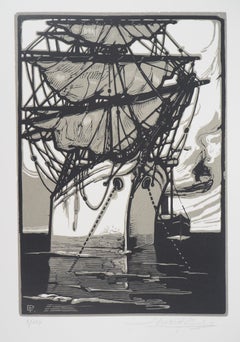
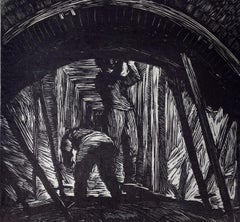
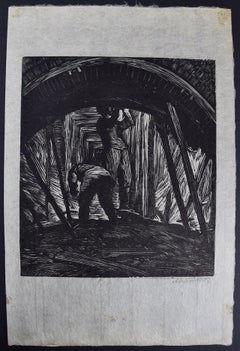
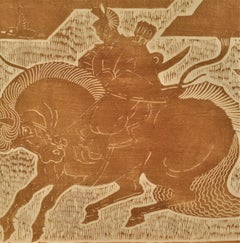
Untitled, Two Horsemen

Untitled, Two Horsemen

By Tomikichiro Tokuriki

Located in San Francisco, CA

This artwork "Two Horsemen" c.1960 is an original woodcut by noted Japanese artist, Tomikichiro Tokuriki, 1902-1999. It is hand signed and numbered 38/100 in pencil by the artist. The image (Block mark) size is 15.25 x 20.5 inches, sheet size is 16.5 x 21.15 inches. It is in very good condition, hanging tape remaining on the back. About the artist: Print artist. Tokuriki was born in Kyoto, where he has always worked. The last of a long line of traditional-style painters, he turned early to woodblock prints and became a leader of the Kyoto 'Sosaku Hanga'. He graduated from the Kyoto City School of Fine Arts and Crafts and then from the Kyoto City Specialist School of Painting in 1924. In 1928 he studied 'Nihonga' painting under Tsuchida Bakusen (1887-1936) and Yamamoto Shunkyo (1871-1933) and exhibited with Kokuga Sosaku Kyokai, but about the same time in 1929 he changed to woodblock printing under the influence of Hiratsuka Un'ichi and began to contribute to the early print magazine 'Han'. He was a member of Nihon Hanga Kyokai from 1932, and active in promoting 'Sosaku Hanga' in Kyoto. He was a co-founder of the Kyoto magazine 'Taishu hanga' in 1932, which helped create the sense of a local school of the Creative Print Movement much encouraged by Hiratsuka. He produced many sets of prints before and during the Pacific War based on traditional subjects, such as 'Shin Kyoto fukei' ('New View of Kyoto', 1933-4), which also included designs by Asada Benji (q.v.) and Asano Takeji (b.1900), and 'Tokyo hakkei' ('Eight Views of Tokyo', 1942). Most of these were published by Uchida of Kyoto, but after the war Tokuriki set up his own publishing company called Matsukyu, which also began to teach block-carving to artisans and artists, in later years many of them foreigners. In 1948 he also set up a sub-company called Koryokusha consisting of artists who would produce their prints under the financial umbrella of Matsukyu. Later sets include 'Hanga Kyoto hyakkei' ('One Hundred Print Views of Kyoto', 1975). Tokuriki has continued to be active in teaching and writing, producing a long series of articles on print techniques in 'Hanga geijutsu' magazine during the 1970s. Bibliography Smith, Lawrence, 'Modern Japanese Prints 1912-1989: Woodblocks and Stencils', BMP, London, 1994, p. 36 and no. 50.Statler, Oliver, 'Modern Japanese Prints: An Art Reborn', Turtle, Rutland, Vermont, and Tokyo, 1956, pp. 118-22.Tokuriki, Tomikichiro (trans. Arimatsu, Teruko), 'Woodblock Printing', Arimatsu Color Book Series no. 14, 8th English edn, Hoikusha, Osaka, 1977.Kanagawa Prefectural Museum of Modern Art, 'Kindai Nihon no mokuhanga-ten', exh. cat., 1990.Merritt, Helen, 'Modern Japanese Woodblock...

Category

Mid-20th Century Other Art Style Tomikichiro Tokuriki Art

Materials

Woodcut

Related Items
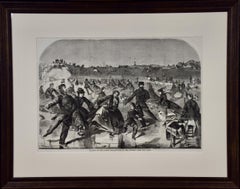
"Skating on Ladies' Pond Central Park": Winslow Homer 19th C. Woodcut Engraving

"Skating on Ladies' Pond Central Park": Winslow Homer 19th C. Woodcut Engraving

By Winslow Homer

Located in Alamo, CA

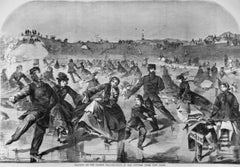
This Winslow Homer woodcut engraving entitled "Skating on the Ladies' Skating-Pond in Central Park, New York", was published in Harper's Weekly in the January 28, 1860 edition. It depicts a large number of men, women and children skating on a recently opened pond in Central Park. At the time of publication of this engraving, Central Park was in the early stages of construction. This engraving documents the very early appearance of Frederick Law Olmstead and Calvert Vaux's masterpiece of landscape design. According to Olmsted, the park was "of great importance as the first real Park made in this century – a democratic development of the highest significance". The people of New York were very proud of the plans for their park. It was stated at the time: "Our Park, which is progressing very satisfactorily under the management of the Commissioners, will undoubtedly be, one of these days, one of the finest place of the kind in the world...Those who saw the Park before the engineers went to work on it are amazed at the beautiful sites which have been contrived with such unpromising materials; all fair persons believe that the enterprise is managed with honesty and good taste." Skating was rapidly rising in national popularity in part due to the opening of Central Park’s lake to skaters on a Sunday in December 1858 with 300 participants. The following Sunday it attracted ten thousand skaters. By Christmas Day, a reported 50,000 people came to the park, most of them to skate. There were rules governing who could use the skating pond. “The Ladies’ Pond...

Category

1870s American Impressionist Tomikichiro Tokuriki Art

Materials

Engraving, Woodcut

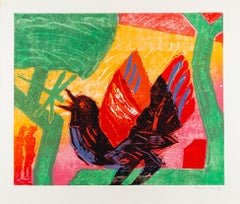
Mountain Man with Bird

Mountain Man with Bird

By Umetaro Azechi

Located in Austin, TX

UMETARO AZECHI Title: Mountain Man and Bird Medium: Woodblock Print Measurements: 5 x 7 inches Framing: Framed (12 x 13.44 inches)

Category

20th Century Tomikichiro Tokuriki Art

Materials

Woodcut

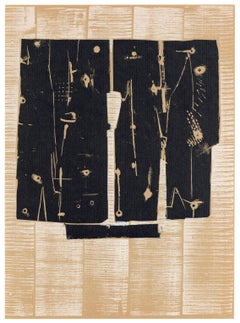
Female Figure and Skeletal Woodcut

Female Figure and Skeletal Woodcut

By Paul Koch

Located in Houston, TX

Woodcut of female figure and skeleton by English artist Paul Koch, 1964. Signed lower right. 23/200 Original artwork on paper displayed on a white mat with a gold border. Mat fits ...

Category

1970s Tomikichiro Tokuriki Art

Materials

Woodcut

Bronc by Lon Megargee, Woodblock Print ca. 1920s with Handmade Saguaro Rib Frame

Bronc by Lon Megargee, Woodblock Print ca. 1920s with Handmade Saguaro Rib Frame

Located in Phoenix, AZ

SHIPPING CHARGES INCLUDE SHIPPING, PACKAGING & **INSURANCE** Bronc by Lon Megargee, Woodblock Print ca. 1920s Handmade Saguaro Rib Frame, double linen mat, museum archival materials Bronc Woodblock Print, signed in print Image: 8 3/4 x 9 7/8 inches Frame: 21 x 20 inches SHIPPING CHARGES INCLUDES, SHIPPING, PACKAGING & INSURANCE FINE ART ESTATE OF LON MEGARGEE Megargee Custom Handmade Saguaro Frame We offer signed in print and original signature block prints. Custom, hand carved, signature frames, with archival standards and a speciality in hand dyed mats and french matting are provided for a beautiful and timeless presentation. Free shipping Continental US Biography Megargee explored different mediums; printmaking captivated him in particular. The contrast of the black and white block print method captured perfectly his interpretation of a bold American West. The first print was produced around 1921 and culminated with the creation of “The Cowboy Builds a Loop” in 1933 with 28 images and poetry by his friend, Roy George. Megargee continued producing prints throughout the 1940s and early 50s. Creator of the iconic logo for the Stetson Hat Company, " Last Drop From his Stetson", still in use today. Fine Art Estate of Lon Megargee At age 13, Lon Megargee came to Phoenix in 1896 following the death of his father in Philadelphia. For several years he resided with relatives while working at an uncle’s dairy farm and at odd jobs. He returned to Philadelphia in 1898 – 1899 in order to attend drawing classes at the Pennsylvania Academy of the Fine Arts. Back in Phoenix in 1899, he decided at the age of 16 to try to make his living as a cowboy. Lon moved to the cow country of Wickenburg where he was hired by Tex Singleton’s Bull Ranch. He later joined the Three Bar Ranch . . . and, after a few years, was offered a job by Billy Cook...

Category

Early 20th Century Tomikichiro Tokuriki Art

Materials

Woodcut

"Daikoku, Dieu de la Richesse" Japanese Style Woodblock Print

"Daikoku, Dieu de la Richesse" Japanese Style Woodblock Print

By Paul Jacoulet

Located in Austin, TX

A woodblock print of a Japanese geisha in elegant clothing against a yellow decorative background. By Paul Jacoulet 15.5" x 12" Woodblock print on paper Framed Size: 22.5" x 18.5" ...

Category

Mid-20th Century Tomikichiro Tokuriki Art

Materials

Paper, Woodcut

French Woodcut - La Mer et Les Fleuves

French Woodcut - La Mer et Les Fleuves

By Colette Pettier

Located in Houston, TX

Absorbing black and white woodcut of a nude female figure in the water surrounded by sea life and small figures by French artist Colette Pettier, 1936. Signed, dated and numbered 49 ...

Category

1930s Tomikichiro Tokuriki Art

Materials

Ink, Paper, Woodcut

Hopi by Lon Megargee, Original Signed Block Print ca. 1920s

Hopi by Lon Megargee, Original Signed Block Print ca. 1920s

Located in Phoenix, AZ

Title: Hopi ca. 1920s Artist: Lon Megargee Medium: Block Print Size: 11 x 11 inches (Sight Measurement) SHIPPING CHARGES INCLUDE SHIPPING, PACKAGING & INSURANCE Creator of Stetson's hat logo "Last Drop from his Hat" Image of Lon Megargee not included in purchase. Lon Megargee 1883 - 1960 At age 13, Lon Megargee came to Phoenix in 1896 following the death of his father in Philadelphia. For several years he resided with relatives while working at an uncle’s dairy farm and at odd jobs. He returned to Philadelphia in 1898 – 1899 in order to attend drawing classes at the Pennsylvania Academy of the Fine Arts. Back in Phoenix in 1899, he decided at the age of 16 to try to make his living as a cowboy. Lon moved to the cow country of Wickenburg, Arizona where he was hired by Tex Singleton’s Bull Ranch. He later joined the Three Bar R. . . and after a few years, was offered a job by Billy Cook of the T.T. Ranch near New River. By 1906, Megargee had learned his trade well enough to be made foreman of Cook’s outfit. Never shy about taking risks, Lon soon left Cook to try his own hand at ranching. He partnered with a cowpuncher buddy, Tom Cavness, to start the El Rancho Cinco Uno at New River. Unfortunately, the young partners could not foresee a three-year drought that would parch Arizona, costing them their stock and then their hard-earned ranch. Breaking with his romantic vision of cowboy life, Megargee finally turned to art full time. He again enrolled at the Pennsylvania Academy of Art and then the Los Angeles School of Art and Design during 1909 – 1910. The now well-trained student took his first trip to paint “en plein air” (outdoors) to the land of Hopi and Navajo peoples in northern Arizona. After entering paintings from this trip in the annual Territorial Fair at Phoenix, in 1911, he surprisingly sold his first oil painting to a major enterprise – the Santa Fe Railroad . . . Lon received $50 for “Navajos Watching the Santa Fe Train.” He soon sold the SFRR ten paintings over the next two years. For forty years the railroad was his most important client, purchasing its last painting from him in 1953. In a major stroke of good fortune during his early plein-air period, Megargee had the opportunity to paint with premier artist, William R. Leigh (1866 – 1955). Leigh furnished needed tutoring and counseling, and his bright, impressionistic palette served to enhance the junior artist’s sense of color and paint application. In a remarkable display of unabashed confidence and personable salesmanship, Lon Megargee, at age 30, forever linked his name with Arizona art history. Despite the possibility of competition from better known and more senior artists, he persuaded Governor George Hunt and the Legislature in 1913 to approve 15 large, historic and iconic murals for the State Capitol Building in Phoenix. After completing the murals in 1914, he was paid the then princely sum of roughly $4000. His Arizona statehood commission would launch Lon to considerable prominence at a very early point in his art career. Following a few years of art schooling in Los Angeles, and several stints as an art director with movie studios, including Paramount, Megargee turned in part to cover illustrations for popular Western story magazines in the 1920s. In the 1920s, as well, Lon began making black and white prints of Western types and of genre scenes from woodblocks. These prints he generally signed and sold singly. In 1933, he published a limited edition, signed and hard-cover book (about 250 copies and today rare)containing a group of 28 woodblock images. Titled “The Cowboy Builds a Loop,” the prints are noteworthy for strong design, excellent draftsmanship, humanistic and narrative content, and quality. Subjects include Southwest Indians and cowboys, Hispanic men and women, cattle, horses, burros, pioneers, trappers, sheepherders, horse traders, squaw men and ranch polo players. Megargee had a very advanced design sense for simplicity and boldness which he demonstrated in how he used line and form. His strengths included outstanding gestural (action) art and strong figurative work. He was superb in design, originality and drawing, as a study of his prints in the Hays collection reveals. In 1944, he published a second group of Western prints under the same title as the first. Reduced to 16 images from the original 28 subjects, and slightly smaller, Lon produced these prints in brown ink on a heavy, cream-colored stock. He designed a sturdy cardboard folio to hold each set. For the remainder of his life, Lon had success selling these portfolios to museum stores, art fairs and shows, and to the few galleries then selling Western art. Drawing on real working and life experiences, Lon Megargee had a comprehensive knowledge, understanding and sensitivity for Southwestern subject matter. Noted American modernist, Lew Davis...

Category

1920s American Impressionist Tomikichiro Tokuriki Art

Materials

Woodcut

The Sheepherder by Lon Megargee

The Sheepherder by Lon Megargee

Located in Phoenix, AZ

Lon Megargee 1883-1960 "The Sheepherder" Wood block print Signed in plate, lower right Image size: 10 x 10 inches Frame size 22 x 22 inches Creator of Stetson's hat logo "Last Drop from his Hat" Lon Megargee 1883 - 1960 At age 13, Lon Megargee came to Phoenix in 1896 following the death of his father in Philadelphia. For several years he resided with relatives while working at an uncle’s dairy farm and at odd jobs. He returned to Philadelphia in 1898 – 1899 in order to attend drawing classes at the Pennsylvania Academy of the Fine Arts. Back in Phoenix in 1899, he decided at the age of 16 to try to make his living as a cowboy. Lon moved to the cow country of Wickenburg, Arizona where he was hired by Tex Singleton’s Bull Ranch. He later joined the Three Bar R. . . and after a few years, was offered a job by Billy Cook of the T.T. Ranch near New River. By 1906, Megargee had learned his trade well enough to be made foreman of Cook’s outfit. Never shy about taking risks, Lon soon left Cook to try his own hand at ranching. He partnered with a cowpuncher buddy, Tom Cavness, to start the El Rancho Cinco Uno at New River. Unfortunately, the young partners could not foresee a three-year drought that would parch Arizona, costing them their stock and then their hard-earned ranch. Breaking with his romantic vision of cowboy life, Megargee finally turned to art full time. He again enrolled at the Pennsylvania Academy of Art and then the Los Angeles School of Art and Design during 1909 – 1910. The now well-trained student took his first trip to paint “en plein air” (outdoors) to the land of Hopi and Navajo peoples in northern Arizona. After entering paintings from this trip in the annual Territorial Fair at Phoenix, in 1911, he surprisingly sold his first oil painting to a major enterprise – the Santa Fe Railroad . . . Lon received $50 for “Navajos Watching the Santa Fe Train.” He soon sold the SFRR ten paintings over the next two years. For forty years the railroad was his most important client, purchasing its last painting from him in 1953. In a major stroke of good fortune during his early plein-air period, Megargee had the opportunity to paint with premier artist, William R. Leigh (1866 – 1955). Leigh furnished needed tutoring and counseling, and his bright, impressionistic palette served to enhance the junior artist’s sense of color and paint application. In a remarkable display of unabashed confidence and personable salesmanship, Lon Megargee, at age 30, forever linked his name with Arizona art history. Despite the possibility of competition from better known and more senior artists, he persuaded Governor George Hunt and the Legislature in 1913 to approve 15 large, historic and iconic murals for the State Capitol Building in Phoenix. After completing the murals in 1914, he was paid the then princely sum of roughly $4000. His Arizona statehood commission would launch Lon to considerable prominence at a very early point in his art career. Following a few years of art schooling in Los Angeles, and several stints as an art director with movie studios, including Paramount, Megargee turned in part to cover illustrations for popular Western story magazines in the 1920s. In the 1920s, as well, Lon began making black and white prints of Western types and of genre scenes from woodblocks. These prints he generally signed and sold singly. In 1933, he published a limited edition, signed and hard-cover book (about 250 copies and today rare)containing a group of 28 woodblock images. Titled “The Cowboy Builds a Loop,” the prints are noteworthy for strong design, excellent draftsmanship, humanistic and narrative content, and quality. Subjects include Southwest Indians and cowboys, Hispanic men and women, cattle, horses, burros, pioneers, trappers, sheepherders, horse traders, squaw men and ranch polo players. Megargee had a very advanced design sense for simplicity and boldness which he demonstrated in how he used line and form. His strengths included outstanding gestural (action) art and strong figurative work. He was superb in design, originality and drawing, as a study of his prints in the Hays collection reveals. In 1944, he published a second group of Western prints under the same title as the first. Reduced to 16 images from the original 28 subjects, and slightly smaller, Lon produced these prints in brown ink on a heavy, cream-colored stock. He designed a sturdy cardboard folio to hold each set. For the remainder of his life, Lon had success selling these portfolios to museum stores, art fairs and shows, and to the few galleries then selling Western art. Drawing on real working and life experiences, Lon Megargee had a comprehensive knowledge, understanding and sensitivity for Southwestern subject matter. Noted American modernist, Lew Davis...

Category

Early 20th Century American Impressionist Tomikichiro Tokuriki Art

Materials

Woodcut

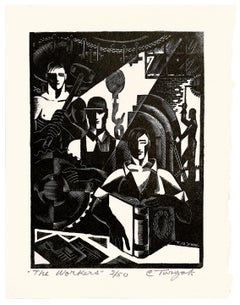
"Subway Construction, Moscow": An Early 20th C. Woodcut Engraving by Abramovitz

"Subway Construction, Moscow": An Early 20th C. Woodcut Engraving by Abramovitz

By Albert Abramovitz

Located in Alamo, CA

This is a signed woodcut engraving entitled "Subway Construction, Moscow" created by Albert Abramovitz in 1935, after a trip to the Soviet Union. It depicts many Russian workers acti...

Category

1930s Tomikichiro Tokuriki Art

Materials

Woodcut

Jacob Steinhardt Woodcut Print "Rachel Weeping For Her Children" Signed Numbered

Jacob Steinhardt Woodcut Print "Rachel Weeping For Her Children" Signed Numbered

By Jacob Steinhardt

Located in Detroit, MI

“A voice is heard in Ramah, mourning and great weeping, Rachel weeping for her children and refusing to be comforted, because they are no more.” This verse from Jeremiah 31:15 is the subject of this woodcut print by Jacob Steinhardt, depicting Rachel, who was the mother of the tribes of Joshua and Benjamin, and who was the wife of Jacob who was Israel, weeping for her children which is to be understood as after the destruction of the First Temple in Jerusalem, the Israelites were clustered into Ramah, the home of the Benjaminites, before being taken into the Babylonian captivity; Rachel is weeping for the destruction and expulsion of her descendants. This work is exemplary of the Jewish themes of Jacob Steinhardt, a German Jew...

Category

1960s Expressionist Tomikichiro Tokuriki Art

Materials

Woodcut

Grün VI (Green VI) - 21st Century, Georg Baselitz, Green, Portrait

Grün VI (Green VI) - 21st Century, Georg Baselitz, Green, Portrait

By Georg Baselitz

Located in Köln, DE

"Grün VI" is a motif from a range of woodcuts showing similar motifs in the same green colour. Baselitz is digesting his memories of the time shortly after the end of World War II in...

Category

1990s Neo-Expressionist Tomikichiro Tokuriki Art

Materials

Woodcut

Previously Available Items
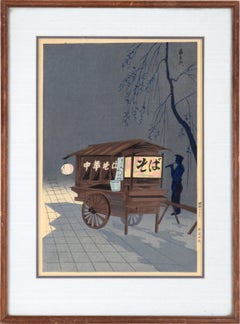
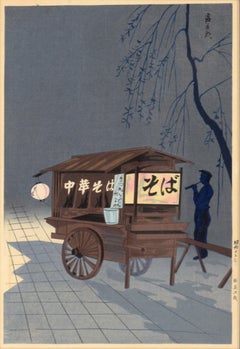
Soba Noodle Vendor Cart at Night - Japanese Woodblock in Ink on Paper

Soba Noodle Vendor Cart at Night - Japanese Woodblock in Ink on Paper

By Tomikichiro Tokuriki

Located in Soquel, CA

Soba Noodle Vendor Cart at Night - Japanese Woodblock in Ink on Paper Clean and balanced depiction of noodle cart by Tomikichiro Tokuriki (Japanese, 1902-1999). The noodle cart is front and center, in full color, with a faint glow emanating from the sign. The vendor is standing silhouetted to the right of the cart, under a wispy tree. Artist's signature along the right edge. Signature in the upper right corner. Presented in a wood frame with a light blue grey mat. Frame size: 19.75"H x 14.5"W Paper size" 15.38"H x 10.25"W Tomikichiro Tokuriki (Japanese, 1902-1999) was born March 22, 1902, in Kyoto, Japan. The first teacher of the young Tomikichiro was his grandfather. Later he entered the Kyoto School of Arts and Crafts with a two-year preparatory class and four years of regular training, and later a three year training at the Kyoto College of Art. He graduated from Kyoto Art College in 1923. While still at college, the young artist discovered his passion for sosaku hanga prints - a movement that had spread from Tokyo to Kyoto. With the assistance of an old carver and an Ukiyo-e printer, Tomikichiro Tokuriki learned everything to master the complete process of design, carving and printing himself. While the artist published his creative hanga-style prints himself, the artisan-prints were published by Uchida, Unsodo and other Kyoto publishers. Later he joined the Hanga Association and met other artists of the sosaku hanga movement like Hiratsuka, Masao Maeda, Kihachiro Shimozawa, Hide Kawanishi and Shiko Munakata. Like so many Japanese artists of the twentieth century, he went on extensive travels throughout Europe and the United States. In the sixties, he opened several exhibitions of his artworks in major US cities like Chicago, New York, Pittsburgh and Cleveland. And of course, he used his trips abroad to make sketches. Tokuriki Tomikichiro...

Category

1950s Edo Tomikichiro Tokuriki Art

Materials

Paper, Ink, Woodcut

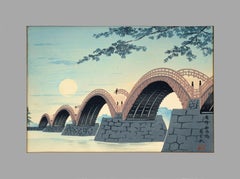
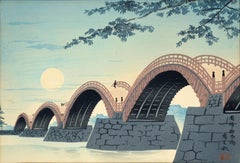
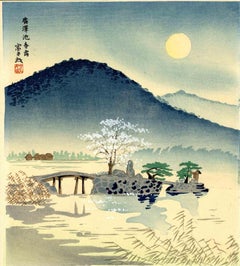
"Suwa Kintai Bridge at Iwakuni", Mid Century Japanese Landscape Woodblock Print

"Suwa Kintai Bridge at Iwakuni", Mid Century Japanese Landscape Woodblock Print

By Tomikichiro Tokuriki

Located in Soquel, CA

"Suwa Kintai Bridge at Iwakuni", a beautiful mid-century Japanese woodblock print by master modern printmaker Tomikichiro Tokuriki (Japanese, 1902-2000), c.1960s. This iconic bridge of five arches is depicted in the traditional clean and minimalist style, with tiny figures silhouetted under a full moon. From the series "Hanga Nihon Hakkei" (The Eight Views of Japan). Signed with the artist's chop lower right. Signed with chop of publisher, Uchida Bijutsu Shoten, lower right margin. "Suwa Kintai Bridge at Iwakuni / Hiroshima" noted on verso. Displayed in a new grey mat with acid free foam core backing. Unframed. Paper size: 11.25"H x 16"W. Tokuriki was born in Kyoto, where he has always worked. The last of a long line of traditional-style painters, he turned early to woodblock prints and became a leader of the Kyoto 'Sosaku Hanga'. He graduated from the Kyoto City School of Fine Arts and Crafts and then from the Kyoto City Specialist School of Painting in 1924. In 1928 he studied 'Nihonga' painting under Tsuchida Bakusen (1887-1936) and Yamamoto Shunkyo...

Category

Mid-20th Century Modern Tomikichiro Tokuriki Art

Materials

Paper, Woodcut

Fog at Hirosawa - Original Woodcut by Tomikichiro Tokuriki- 1950s

Fog at Hirosawa - Original Woodcut by Tomikichiro Tokuriki- 1950s

By Tomikichiro Tokuriki

Located in Roma, IT

Fog at Hirosawa Lake in spring is a Japanese multi-colored woodcut realized around the half of the 20thth Century by Tomikichiro Tokuriki (March 22, 1902, Kyoto - 1999). Original W...

Category

Mid-20th Century Modern Tomikichiro Tokuriki Art

Materials

Woodcut

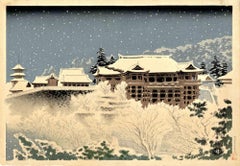
Kyomizu Temple in Kyoto - Woodcut by Tomikichiro Tokuriki - 1950s

Kyomizu Temple in Kyoto - Woodcut by Tomikichiro Tokuriki - 1950s

By Tomikichiro Tokuriki

Located in Roma, IT

Kyomizu Temple in Kyoto is an original artwork realized in the 1950s by Tomikichiro Tokuriki (March 22, 1902, Kyoto - 1999) Shinhanga Meishoe. Sheet dimensions: 28.5 x 41 cm. Sign...

Category

1950s Modern Tomikichiro Tokuriki Art

Materials

Paper, Woodcut

Tomikichiro Tokuriki art for sale on 1stDibs.

Find a wide variety of authentic Tomikichiro Tokuriki art available for sale on 1stDibs. You can also browse by medium to find art by Tomikichiro Tokuriki in woodcut print, paper and more. Much of the original work by this artist or collective was created during the 20th century and is mostly associated with the modern style. Not every interior allows for large Tomikichiro Tokuriki art, so small editions measuring 17 inches across are available. Customers who are interested in this artist might also find the work of Eugene Corneau, Francisco Dosamantes, and Frank Wootton. Tomikichiro Tokuriki art prices can differ depending upon medium, time period and other attributes. On 1stDibs, the price for these items starts at $154 and tops out at $500, while the average work can sell for $500.

Artists Similar to Tomikichiro Tokuriki