Want more images or videos?
Request additional images or videos from the seller
1 of 17
Swiss Gold and Enamel Zarf for the Turkish Market, circa 1840
$4,900List Price
About the Item
- Metal:
- Dimensions:Height: 2.5 in (63.5 mm)Diameter: 2 in (50.8 mm)
- Place of Origin:
- Period:
- Date of Manufacture:1840
- Condition:Wear consistent with age and use.
- Seller Location:Long Island City, NY
- Reference Number:1stDibs: LU149427983122
About the Seller
No Reviews Yet
Vetted Professional Seller
Every seller passes strict standards for authenticity and reliability
Established in 1980
1stDibs seller since 2019
7 sales on 1stDibs
Authenticity Guarantee
In the unlikely event there’s an issue with an item’s authenticity, contact us within 1 year for a full refund. DetailsMoney-Back Guarantee
If your item is not as described, is damaged in transit, or does not arrive, contact us within 7 days for a full refund. Details24-Hour Cancellation
You have a 24-hour grace period in which to reconsider your purchase, with no questions asked.Vetted Professional Sellers
Our world-class sellers must adhere to strict standards for service and quality, maintaining the integrity of our listings.Price-Match Guarantee
If you find that a seller listed the same item for a lower price elsewhere, we’ll match it.Trusted Global Delivery
Our best-in-class carrier network provides specialized shipping options worldwide, including custom delivery.You May Also Like
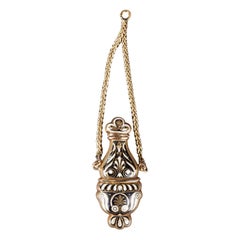
Gold and Enamel Perfum Bottle, Restauration Period, Circa 1830-1840
Located in Paris, FR
Small perfum bottle in gold and enamel. The flask is decorated with palmettes and foliage motifs in white and black enamel on black enamel background. Two gold chains permitted the s...
Category
Antique 1830s French Vanity Items
Materials
Gold, Enamel
$3,312
Free Shipping
H 1.58 in W 0.79 in D 0.28 in
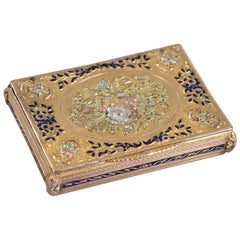
Early 19th Century Gold and Enamel Box, Swiss Work
Located in Paris, FR
Rectangular box with three tones of gold and royal blue enamel. The hinged lid is embellished with a multicolored gold medallion in relief featuring a bouquet of roses and tulips, se...
Category
Antique Early 19th Century Swiss Empire Boxes and Cases
Materials
Gold, Enamel
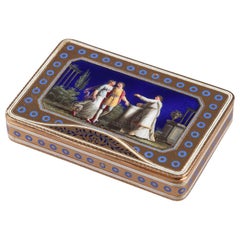
Enamelled gold Swiss box. Late 18th century.
Located in Paris, FR
Rectangular enamelled gold box. The hinged lid is decorated with a scene of young people dressed in neoclassical clothing and approaching near an altar where officiates a person dres...
Category
Antique 1780s Swiss Boxes and Cases
Materials
Gold, Enamel
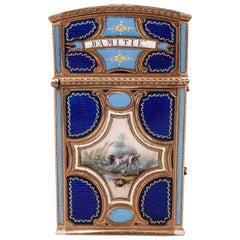
Gold, Enamel and Tablet Case
Located in Paris, FR
Flat trapezoidal shaped tablet case in enamelled gold. The upper part is hinged and opens with a push-button. The case is composed of four translucent blue...
Category
Antique 1790s Swiss Desk Accessories
Materials
Gold, Enamel
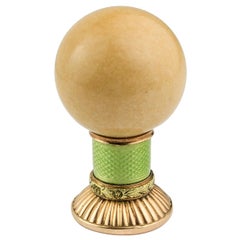
Faberge Gold, Enamel and Hardstone Desk Seal
By Fabergé
Located in London, GB
A Fabergé gold, enamel and hardstone desk seal, workmaster Henrik Wigström, St Petersburg, 1904-1908 the spherical handle carved of aventurine quartz, the co...
Category
Antique Early 1900s Russian Art Nouveau Desk Accessories
Materials
Carnelian, Quartz, Gold, Enamel
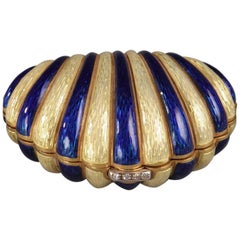
Gold and Enamel, Diamond Pills Box, Early 20th Century
Located in Paris, FR
Enamelled gold handbag box in the shape of a shell. The finely chased gold is adorned with geometric guilloché and enhanced with translucent opalescent white and royal blue enamels, ...
Category
Early 20th Century French Art Deco Boxes and Cases
Materials
Gold, Enamel
$7,808
Free Shipping
H 0.79 in W 1.97 in D 1.58 in
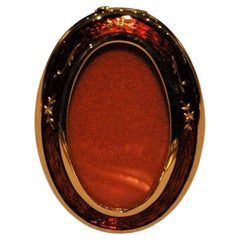
Fabergé 18 Kt Gold Frame with Red Enamel
By Fabergé
Located in BARI, IT
Small 18 kt gold frame with guilloche red enamel and small gold decorations inserted on the edge. Limited edition no. 21/300. It has its original certi...
Category
1990s European Enamel Frames and Objects
Materials
Gold, Enamel
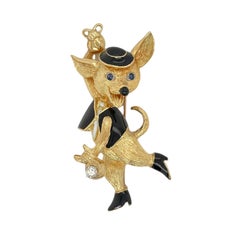
18K Yellow Gold & Black Enamel Chihuahua Dog Brooch
Located in New York, NY
Adorable 18k yellow gold and black enamel excited Chihuahua dog brooch.
Chihuahua brooch is accented by two round sapphire gemstones for the eyes and a ...
Category
Late 20th Century Retro Brooches
Materials
Diamond, Blue Sapphire, 18k Gold, Yellow Gold, Enamel
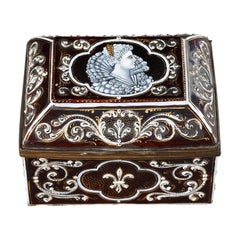
Limoges Enamel Keepsake Box. Second part of the 19th Century.
Located in Paris, FR
Small, rectangular, enamel keepsake box from Limoges. The lid is decorated with a central medallion featuring the profile of an upper-class woman, who was certainly the owner of this...
Category
Antique 1870s French Renaissance Revival Boxes and Cases
Materials
Enamel
$1,656
Free Shipping
H 3.55 in W 4.73 in D 3.55 in
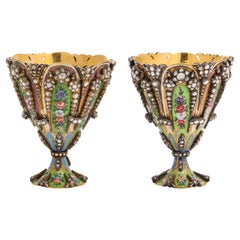
Highly Important Museum Quality Pair of Diamond and Enamel Zarfs
Located in New York, NY
A Highly Important Museum Quality Pair of Diamond and Enamel Zarfs.
Each Zarf with a scalloped rim and spreading foot, the sides set with colorful green ...
Category
Antique 1830s Desk Accessories
More From This Seller
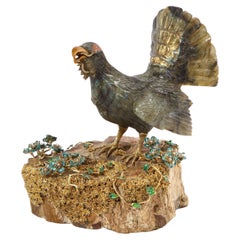
View AllRare 18K Gold, Enamel and Diamond Mounted Carved Labradorite Turkey Bird
Located in Long Island City, NY
A rare 18K gold, enamel and diamond mounted carved labradorite turkey bird sculpture on a petrified wood base, attributed to Manfred Wild, Idar-Oberstein, ...
Category
20th Century German Figurines and Sculptures
Materials
Diamond, Labradorite, 18k Gold, Enamel
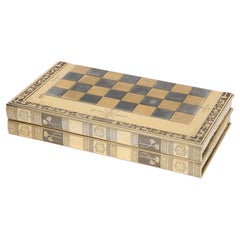
Rare English Silver-Gilt Book-Form Chess and Backgammon Game Board, circa 1976
Located in Long Island City, NY
Rare English silver-gilt book-form chess and backgammon game board, circa 1976.
This exceptional and rare solid silver chess board converts into a backgammon board and can also be placed in a bookshelf to add more opulence. (3 in 1).
This was most definitely a private commissioned piece by the House of Garrard...
Category
20th Century British More Objets d'Art and Vertu
Materials
Silver
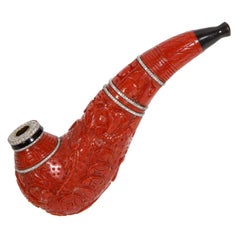
Contemporary Coral, 18k Gold, Diamonds, and Onyx Pipe
Located in Long Island City, NY
A Contemporary Coral, 18K Gold, Diamonds, and Onyx Pipe.
The carved coral pipe engraved with Chinese ornaments enhanced with brilliant-cut pave diam...
Category
20th Century Chinese More Objets d'Art and Vertu
Materials
Coral, Diamond, Onyx, 18k Gold
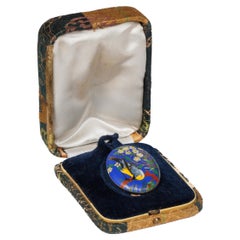
A Rare Alexis Falize Antique Gold and Cloisonné Enamel Locket, Circa 1867
By Falize
Located in Long Island City, NY
A Rare Alexis Falize Antique Gold and Cloisonné Enamel Locket, Circa 1867
This exquisite oval-shaped locket, crafted circa 1869, epitomizes the fusion of French artistry and Japanese aesthetic that characterized Alexis Falize's work during the late 19th century. The obverse features a meticulously rendered cloisonné enamel scene of a bird perched gracefully on a branch, while the reverse presents a serene landscape, showcasing Falize's mastery of the cloisonné technique and his deep appreciation for Japanese motifs.
The locket is housed in its original Japanese silk box, reflecting the authenticity and preservation of this remarkable piece. Falize, a distinguished Parisian jeweler (1811–1898), was profoundly influenced by Japanese and Chinese art, integrating Oriental motifs and palettes into his creations. This fascination was part of the broader Japonisme movement that swept through Europe following Japan's opening to Western trade in 1854, introducing Japanese decorative arts to a captivated Western audience.
Employing the cloisonné enamel technique—a method prevalent in traditional Japanese and Chinese metalwork—Falize delineated intricate designs using fine metal wires to create compartments (cloisons), which were then filled with vibrant enamels. This locket exemplifies such craftsmanship, with its vivid colors and precise detailing. Notably, Falize collaborated with esteemed enameller Antoine Tard, renowned for his Oriental-style cloisonné enamels. Tard's exceptional skill earned him accolades, including a gold collaborator’s medal at the 1867 Exposition Universelle in Paris. Their partnership produced some of the most celebrated cloisonné jewels of the era.
Comparable works by Falize are held in prestigious institutions worldwide. The British Museum houses a gold locket adorned with cloisonné enamel by Falize, highlighting the significance of his work in their collection. The Metropolitan Museum of Art features a reversible brooch attributed to Falize, further exemplifying his expertise in cloisonné enamel. Additionally, the Cleveland Museum of Art acquired a similar cloisonné locket marked by Falize, underscoring the widespread recognition of his craftsmanship. The Victoria and Albert Museum and the Schmuckmuseum in Pforzheim also include Falize's cloisonné enamelled lockets in their collections, attesting to the enduring legacy of his work.
In the realm of private collections, Wartski London has featured rare cloisonné...
Category
Antique 19th Century French Brooches
Materials
Gold, Enamel
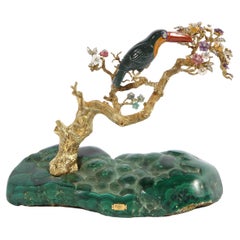
18K Gold, Diamonds, Amethyst, Tourmaline, Bloodstone, and Jasper Toucan Bird
By Gianfranco Frattini
Located in Long Island City, NY
An 18K gold, diamonds, amethyst, tourmaline, bloodstone, carved emerald, opal and jasper toucan bird resting on a gold tree branch, mounted on a carved malachite base.
A very rare and unique gold-mounted jeweled object...
Category
20th Century Italian Figurines and Sculptures
Materials
Amethyst, Diamond, Tourmaline, Jasper, 18k Gold
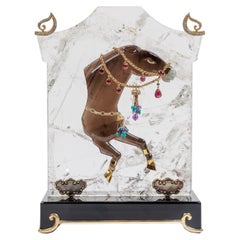
Mellerio Paris, a French Gold, Diamonds, Silver, and Smoky Quartz Carved Horse
By Mellerio dits Meller
Located in Long Island City, NY
Mellerio Paris, A French Gold, Diamonds, Silver-Gilt, Rock-Crystal, Jade, Mother-Of-Pearl and Smoky Quartz, Carved Horse Sculpture, Jeweled Mounted Object.
An extremely rare and unique, one of a kind French gold, diamonds, Silver-gilt, rock-crystal, jade, obsidian, mother-of-pearl, and smoky quartz carved jeweled sculpture "CHEVAUX DE LEGENDE", "A Legendary Horse" by Mellerio, Paris, circa 1991.
Sitting on black obsidian base, the solid rock-crystal slab is finely applied with a carved smoky -quartz and jade horse with a harness mounted in 18k gold, brilliant -cut diamonds, rubies, turquoise, and amethyst chains and pendants. The top columns adorned with 18k gold and brilliant cut diamond pendants, the bottom with gold and mother of pearl plaques. The obsidian base with a plaque engraved: CHEVAUX DE LEGENDE" / N° 05 / MELLERIO DITS MELLER / PARIS / 5003 D
The piece is in excellent condition and comes with a custom made wood case made for transport. It's very elegant and has French hallmarks throughout. A truly magnificent piece.
Measures 10.5" high x 8.5" wide x 4" deep
Founded in France in 1613 by the descendants of Italian immigrants from the Vigezzo Valley in the north of Italy, Mellerio is one of the oldest jewellery houses in Europe. The family business soon attracted the attention of the Royal Court and Marie Antoinette herself reportedly purchased a precious bracelet featuring 7 cameos surrounded by rubies in 1780. Later on, in the 19th century, Mellerio became the official supplier of the French Royal family and the Court of Netherland.
Mellerio creates many jewellery items, all set with rare gems such as peridots, amethysts, aquamarines, citrines and topaz, applying for a patent, the flexible stem, a very supple and light jewellery mechanism. Mellerio remains also well known for their spectacular series of Art Nouveau jewels, created at the beginning of the 20th century, as well as for the creation of trophies rewarding some of the greatest footfall and tennis players of history. In 1993, the jewellery house launched their first watch collection.
Today, Mellerio has stores in Paris, Japan and Hong Kong.
July 14, 1789: this date is known throughout the world as the beginning of the French Revolution. According to a ledger belonging to House of Mellerio, this was also the day that the jeweler sold a golden key to the Comte de Coutance for 10 livres. This ledger, as well as inventories dating as far back as 1768, are the jeweler’s oldest archives. These archives have continued to grow over the years, as the House, established on rue de la Paix in Paris, still lives on today, still in the hands of the same family from Craveggia, in the North of Italy.
The tumultuous history of the Mellerio family in France probably goes as far back as the Italian wars of the Renaissance, but the first official document proving their commercial activity in Paris dates back to 1613. This document is the famous royal warrant awarded by Marie de Medici to a number of Italian families established along the rue des Lombards, including the Mellerios, allowing them to sell “small jewelery items”, therefore granting them a small exception to the traditional monopoly enjoyed by Parisian jewelers. At that time, powerful corporations regulated the operations and customs of Parisian business, but thanks to this exceptional warrant, the Mellerios managed to escape the confines of this framework. Today, this wax-sealed document is kept at the city hall of Craveggia.
From 1613 to the Revolution, the Mellerios lived between France and Italy. The corporations tried many times to put an end to their trade privileges, but all in vain, as a dynasty of sovereigns renewed the warrant. Always marrying and often retiring in Craveggia, the Mellerios continued to maintain their jewelry business in Paris. At first, they did this without a shop. Wearing backpacks (wooden boxes divided into small compartments where jewels were kept), they would tour town fairs around Paris and royal castles.
This is how Jean-Baptiste Mellerio (1765-1850) is said to have sold a bracelet set with rubies and Antique cameos to Marie-Antoinette, which still exists today. Many elements seem to prove the veracity of this anecdote. The queen was particularly fond of cameos, which cover the entire background of her famous jewelry cabinet, and ruby was her favorite stone after diamond. The famous bracelet, reacquired a few years ago by the House of Mellerio, is indeed an 18th century jewel, set with antique cameos representing the profiles of Roman emperors. Two branches of the family were operating in Paris during this time, under the reign of Louis XVI: that of Jean-François (1746-1828), the paternal ancestor of the current Mellerios, and that of Jean-Baptiste (1765-1850).
The French Revolution forced them to return to Italy. However, both Jean-Baptiste and François Mellerio (1772-1843), who was the son of Jean-François, were eventually able to return to Paris after the founding of the Consulate. Jean-Baptiste opened a shop at the Iron Crown of rue Vivienne, and François opened his at the Palais des Tuileries, rue du Coq Saint-Honoré. His well-organized order books give an idea of his high-ranking clientele during the “Old Regime”, among which were the Comte and Comtesse Octave de Segur, the Marquise (later Duchess) de Tourzel, former governess of the royal children, and her daughter, the Comtesse de Bearn, the Craufurds -who organized the flight to Varennes, the Duc and Duchess de Gramont, the Comtesse de Boigne, and Madame de Souza, Talleyrand’s mistress.
We also see the names of the imperial family: Empress Josephine, the Queen of Holland, Princess Elisa, Caroline and Pauline. At that time, the House of Mellerio specialized, among other things, in the trade of antique cameos, a newly fashionable genre of jewel that captured the imagination of all the princesses and noble women of the time.
The years of the Restauration and July Monarchy were among the most glorious. The Bourbons were back on the throne, and the clientele of the House of Mellerio had regained its former wealth. Mellerio supplied Louis-Philippe, Duke of Orléans, as well as his mother, wife and sister, with sumptuous jewels, including a set of emeralds made piece by piece, while the Duke of Bourbon, last prince of the House of Condé, offered diamonds to his mistress, the scheming Baronne de Feucheres, and Monsieur de LaFayette also bought cameos for one of his granddaughters. For the first time, Mellerio ventured into the world of arts in 1815, when Carlotta Grisi, a famous dancer who created Giselle, as well as an actress named Rachel, bought jewels at the Mellerio store on rue de la Paix.
1848 marked a new turning point. France once again became a Republic. François Mellerio handed the company over to his son, Jean, and the latter decided to travel to Spain to build a new clientele. He later became one of the jewelers of the royal family, and met Eugénie de Montijo, who remained a faithful client when she became empress of the French people. The Imperial years were lavish. During the Second Empire, Paris was a pageant of crinoline dresses designed by Worth, while jewels by Mellerio, Worth’s neighbour on the rue de la Paix, adorned the noble women of the Tuileries court.
The Empress bought pearls. Mathilde Bonaparte...
Category
20th Century French Figurines and Sculptures
Materials
Amethyst, Diamond, Jade, Quartz, Rock Crystal, Ruby, Turquoise, Gold, Si...
Recently Viewed
View AllMore Ways To Browse
Antique Turkish Jewelry
Antique Turkish Vases
Antique Zarf
Enamel Zarf
Gold And Enamel Zarf
Swiss Enamel Zarf
Ottoman Zarf
Ferrari Key
Folding Knives
Gold Sewing Kit
Henry Dunay Buckle
Patek Philippe Hand Painted
Patek Philippe Tray
Porsche Ring
Rolex Ashtray
Russian Porcelain Eggs
Tequila Knife
Vintage Dubarry Jewelry