1 of 3

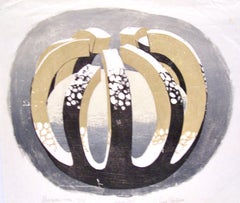
Helen Frankenthaler
Tales of Genji II

1998

You May Also Like

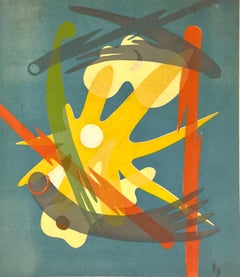
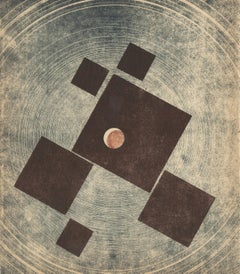
(Abstraction) by DD
Located in New York, NY
This image is an extravaganza of modernist motifs. The monogram 'D.D.' is at the lower right.
Category

Mid-20th Century American Modern Abstract Prints

Materials

Woodcut

(Abstraction) by DD
$750
H 15.25 in W 13.25 in
Underwater — Mid-century Modern
By Charles Quest
Located in Myrtle Beach, SC
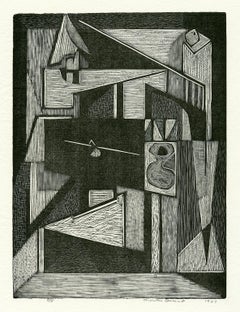
Charles Quest, 'Underwater', 1948, chiaroscuro wood engraving, edition 12. Signed, titled, dated and numbered '3/12' in pencil. A fine, richly-inked impression, in dark brown and warm black, on off-white wove paper, with full margins (5/8 to 1 1/2 inch), in excellent condition. Scarce. ABOUT THE ARTIST Charles Quest, painter, printmaker, and fine art instructor, worked in various mediums, including mosaic, stained glass, mural painting, and sculpture. Quest grew up in St. Louis, his talent evident as a teenager when he began copying the works of masters such as Michelangelo on his bedroom walls. He studied at the Washington University School of Fine Arts, where he later taught from 1944 to 1971. He traveled to Europe after his graduation in 1929 and studied at La Grande Chaumière and Academie Colarossi, Paris, continuing to draw inspiration from the works of the Old Masters. After returning to St. Louis, Quest received several commissions to paint murals in public buildings, schools, and churches, including one from Joseph Cardinal Ritter, to paint a replica of Velasquez's Crucifixion over the main altar of the Old Cathedral in St. Louis. Quest soon became interested in the woodcut medium, which he learned through his study of J. J. Lankes' A Woodcut Manual (1932) and Paul Landacre's articles in American Artist magazine ‘since no artists in St. Louis were working in wood’ at that time. Quest also revealed that for him, wood cutting and engraving were ‘more enjoyable than any other means of expression.’ In the late 1940s, his graphic works began attracting critical attention—several of his woodcuts won prizes and were acquired by major American and European museums. His wood engraving entitled ‘Lovers’ was included in the American Federation of Art's traveling print exhibition in 1947. Two years later, Quest's two prize-winning prints, ‘Still Life with Grindstone’ and ‘Break Forth into Singing’, were exhibited in major American museums in a traveling show organized by the Philadelphia Print Club. His work was included in the Chicago Art Institute's exhibition, ‘Woodcut Through Six Centuries’, and the print ‘Still Life with Vise’ was purchased by the Museum of Modern Art in New York. In 1951 he was invited by artist-Curator Jacob Kainen to exhibit thirty wood engravings and color woodcuts in a one-person show at the Smithsonian's National Museum (now known as the American History Museum). Kainen's press release praised the ‘technical refinement’ of Quest's work: ‘He obtains a great variety of textural effects through the use of the graver, and these dense or transparent grays are set off against whites or blacks to achieve sparkling results. His work has the handsome qualities characteristic of the craftsman and designer.’ At the time of the Smithsonian exhibition, Quest's work was represented by three New York galleries in addition to one in his home town. He had won 38 prizes, and his prints were in the collections of the Library of Congress, the Chicago Art Institute, the Metropolitan Museum, and the Philadelphia Museum of Art. In cooperation with the Art in Embassies program, his color woodcuts were displayed at the American Embassy in Paris in 1951. Recognition at home came in 1955 with his first solo exhibition in St. Louis. Press coverage of the show heralded the ‘growth of graphic arts toward rivaling painting and sculpture as a major independent medium’. An exhibition of his prints at the Bethesda Art Gallery in 1983 attracted Curator Emeritus Joseph A. Haller, S.J., who began purchasing his work for Georgetown University's collection. In 1990 Georgetown University Library's Special Collections Division was the recipient of a large body of Quest's work, including prints, drawings, paintings, sculpture, stained glass, and his archive of correspondence and professional memorabilia. These extensive holdings, including some 260 of his fine prints, provide a rich opportunity for further study and appreciation of this versatile and not-to-be-forgotten mid-Western American artist...
Category

1940s American Modern Abstract Prints

Materials

Woodcut

Still Life — Mid-century Modern
By Charles Quest
Located in Myrtle Beach, SC
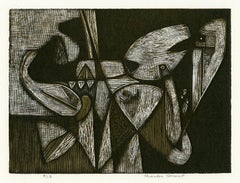
Charles Quest, 'Still Life', 1947, wood engraving, edition 8. Signed, dated, and numbered '3/8' in pencil. Titled and annotated 'wood engraving' in the bottom left margin. A fine impression, on off-white wove paper, with full margins (1 to 2 inches), in excellent condition. Scarce. Matted to museum standards, unframed. ABOUT THE ARTIST Charles Quest, painter, printmaker, and fine art instructor, worked in various mediums, including mosaic, stained glass, mural painting, and sculpture. Quest grew up in St. Louis, his talent evident as a teenager when he began copying the works of masters such as Michelangelo on his bedroom walls. He studied at the Washington University School of Fine Arts, where he later taught from 1944 to 1971. He traveled to Europe after his graduation in 1929 and studied at La Grande Chaumière and Academie Colarossi, Paris, continuing to draw inspiration from the works of the Old Masters. After returning to St. Louis, Quest received several commissions to paint murals in public buildings, schools, and churches, including one from Joseph Cardinal Ritter, to paint a replica of Velasquez's Crucifixion over the main altar of the Old Cathedral in St. Louis. Quest soon became interested in the woodcut medium, which he learned through his study of J. J. Lankes' A Woodcut Manual (1932) and Paul Landacre's articles in American Artist magazine ‘since no artists in St. Louis were working in wood’ at that time. Quest also revealed that for him, wood cutting and engraving were ‘more enjoyable than any other means of expression.’ In the late 1940s, his graphic works began attracting critical attention—several of his woodcuts won prizes and were acquired by major American and European museums. His wood engraving entitled ‘Lovers’ was included in the American Federation of Art's traveling print exhibition in 1947. Two years later, Quest's two prize-winning prints, ‘Still Life with Grindstone’ and ‘Break Forth into Singing’, were exhibited in major American museums in a traveling show organized by the Philadelphia Print Club. His work was included in the Chicago Art Institute's exhibition, ‘Woodcut Through Six Centuries’, and the print ‘Still Life with Vise’ was purchased by the Museum of Modern Art in New York. In 1951 he was invited by artist-Curator Jacob Kainen to exhibit thirty wood engravings and color woodcuts in a one-person show at the Smithsonian's National Museum (now known as the American History Museum). Kainen's press release praised the ‘technical refinement’ of Quest's work: ‘He obtains a great variety of textural effects through the use of the graver, and these dense or transparent grays are set off against whites or blacks to achieve sparkling results. His work has the handsome qualities characteristic of the craftsman and designer.’ At the time of the Smithsonian exhibition, Quest's work was represented by three New York galleries in addition to one in his home town. He had won 38 prizes, and his prints were in the collections of the Library of Congress, the Chicago Art Institute, the Metropolitan Museum, and the Philadelphia Museum of Art. In cooperation with the Art in Embassies program, his color woodcuts were displayed at the American Embassy in Paris in 1951. Recognition at home came in 1955 with his first solo exhibition in St. Louis. Press coverage of the show heralded the ‘growth of graphic arts toward rivaling painting and sculpture as a major independent medium’. An exhibition of his prints at the Bethesda Art Gallery in 1983 attracted Curator Emeritus Joseph A. Haller, S.J., who began purchasing his work for Georgetown University's collection. In 1990 Georgetown University Library's Special Collections Division was the recipient of a large body of Quest's work, including prints, drawings, paintings, sculpture, stained glass, and his archive of correspondence and professional memorabilia. These extensive holdings, including some 260 of his fine prints, provide a rich opportunity for further study and appreciation of this versatile and not-to-be-forgotten mid-Western American artist...
Category

1940s American Modern Abstract Prints

Materials

Woodcut

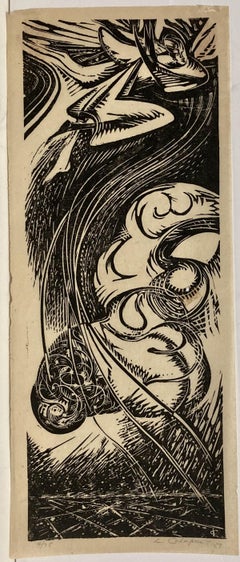
Letterio Calapai, (Sky Abstraction), 1957, mid-century wood engraving
By Letterio Calapai
Located in New York, NY
Letterio Calapai is widely recognized as a major American artist of the twentieth century. He is widely respected as a printmaker, especially for engravings and wood engravings, and ...
Category

1950s American Modern Abstract Prints

Materials

Woodcut

Untitled
By Charles William Smith
Located in Fairlawn, OH
Untitled Color woodcut, 1939 Unsigned as issued Signed and dedicated by the artist on the justification page (see photo) From: Abstractions By Charles Smith Forward by Carl O. Schnie...
Category

1930s American Modern Abstract Prints

Materials

Woodcut

Luke Gwilliam (1911-1989), Mnemonic Form, 1974, woodcut
Located in New York, NY
Luke Gilliam has an unusual woodcut technique that he pairs with a complex object of his own creation. He uses technique to create a technical tour-de-force with the intriguing title...
Category

1970s American Modern Abstract Prints

Materials

Woodcut

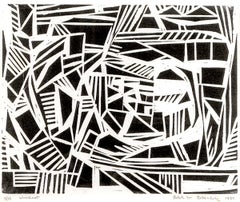
American Landscape: Houses, Gardens and Trees
By Ralph Rosenborg
Located in New York, NY
Signed (at lower right): Ralph M. Rosenborg 1939; ll: 3/15 Woodcut
Category

Mid-20th Century American Modern Abstract Prints

Materials

Woodcut

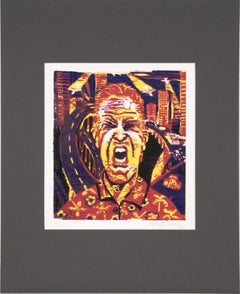
Portrait of Modern Man - Multilayer Woodblock in Ink on Paper
Located in Soquel, CA
Portrait of Anger - Multilayer Woodblock in Ink on Paper Bold and saturated woodblock print of a screaming man by Michael Dow (American, 20th Century). The man is centered in this m...
Category

1990s American Modern Figurative Prints

Materials

Paper, Ink, Woodcut

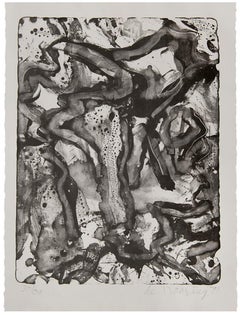
Landscape at Stanton Street
By Willem de Kooning
Located in London, GB
Lithograph, 1971, on paper, signed and dated in pencil, numbered from the edition of 60, published by Hollanders Workshop and Fourcade, New York, 75.7 x 56 cm. (30 x 2 2in.)
Category

1970s American Modern Abstract Prints

Materials

Lithograph

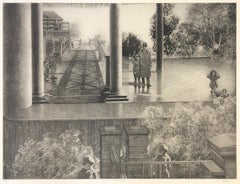
Mornings with Judd (Second state)
By Peter Milton
Located in Middletown, NY
Lift ground and hard ground etching and engraving on Murillo white wove paper, 18 x 24 inches (455 x 608 mm), full margins. Signed, dated, titled and numbered 60/100 in pencil, lower margin. Printed and published by the artist. In very good condition with minor age tone and scattered light surface soiling on the verso. Framed handsomely in an original Kulicke welded aluminum frame with the embossed maker's mark. [Milton 61]. Milton revisited this image in 1974 during an experiment to explore collage and the process of contact printing a high resolution photo-transparency directly onto a copper plate. He printed a small detail transparency of Mornings with Judd onto the existing plate, alongside it's larger self, and broke through to a new photo-resist approach, which Milton described as "piquant and irresistible," in his essays appearing in Robert Flynn...
Category

1970s American Modern Landscape Prints

Materials

Engraving, Etching, Archival Paper

Still Thinking About These?

All Recently Viewed