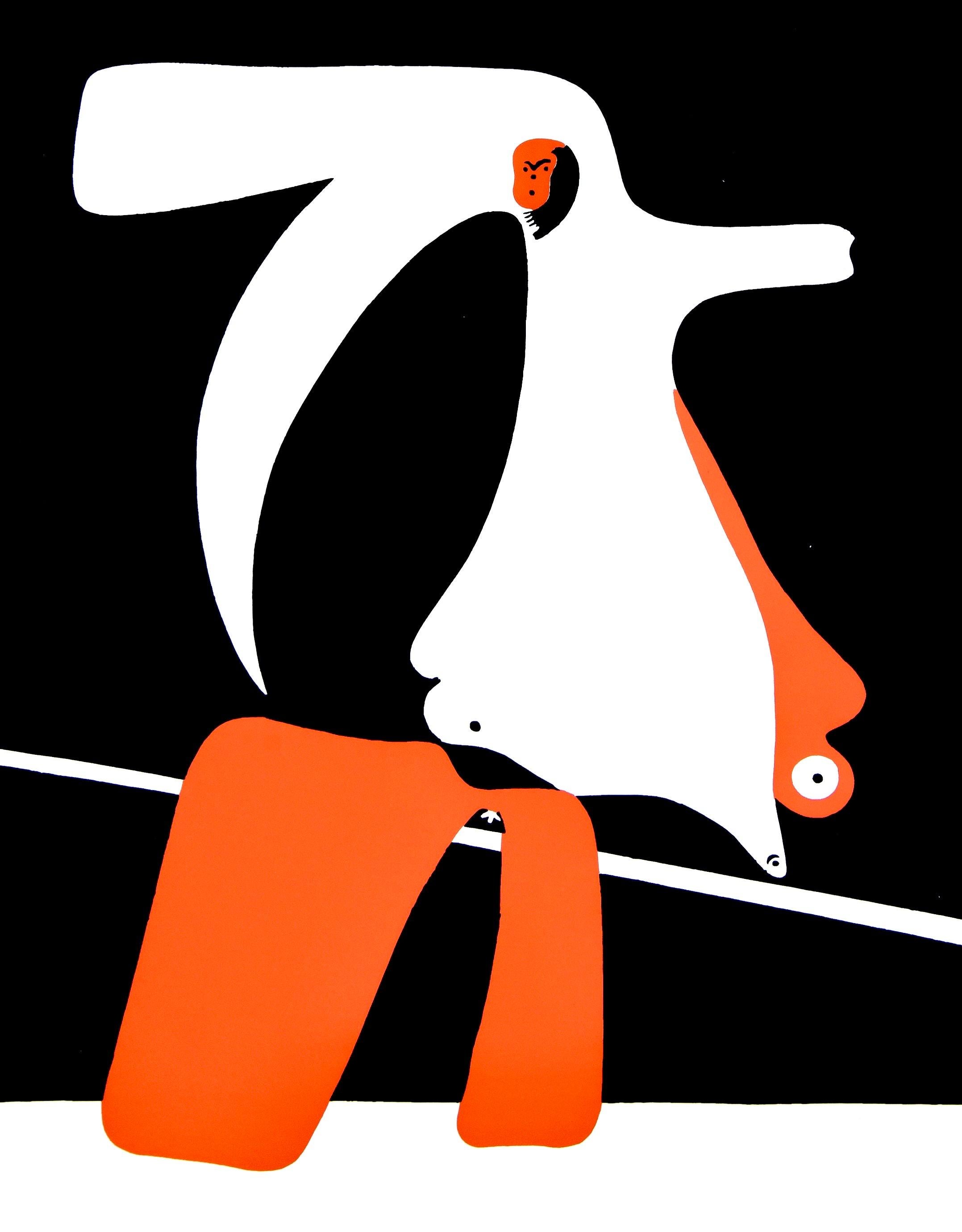
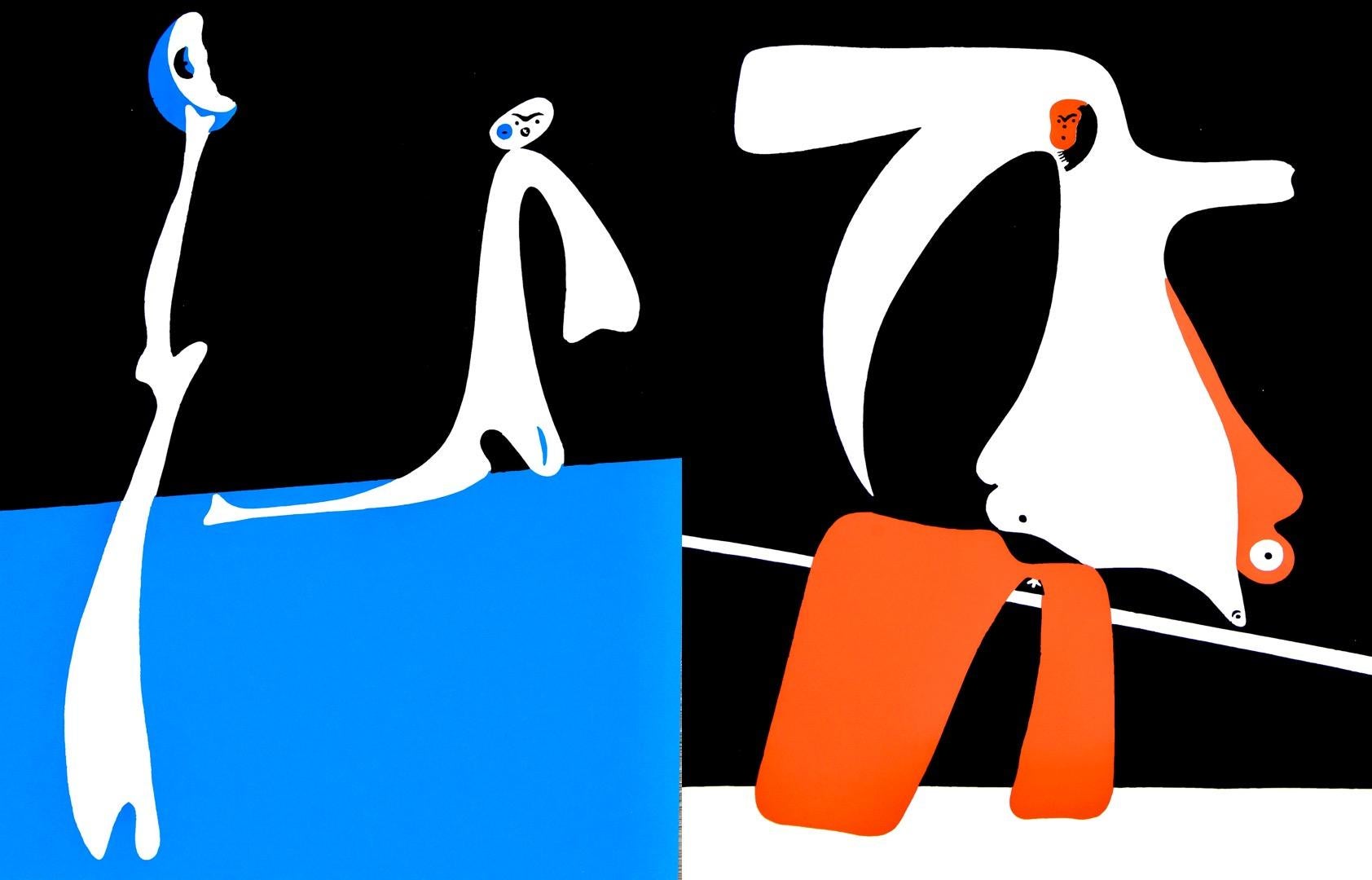
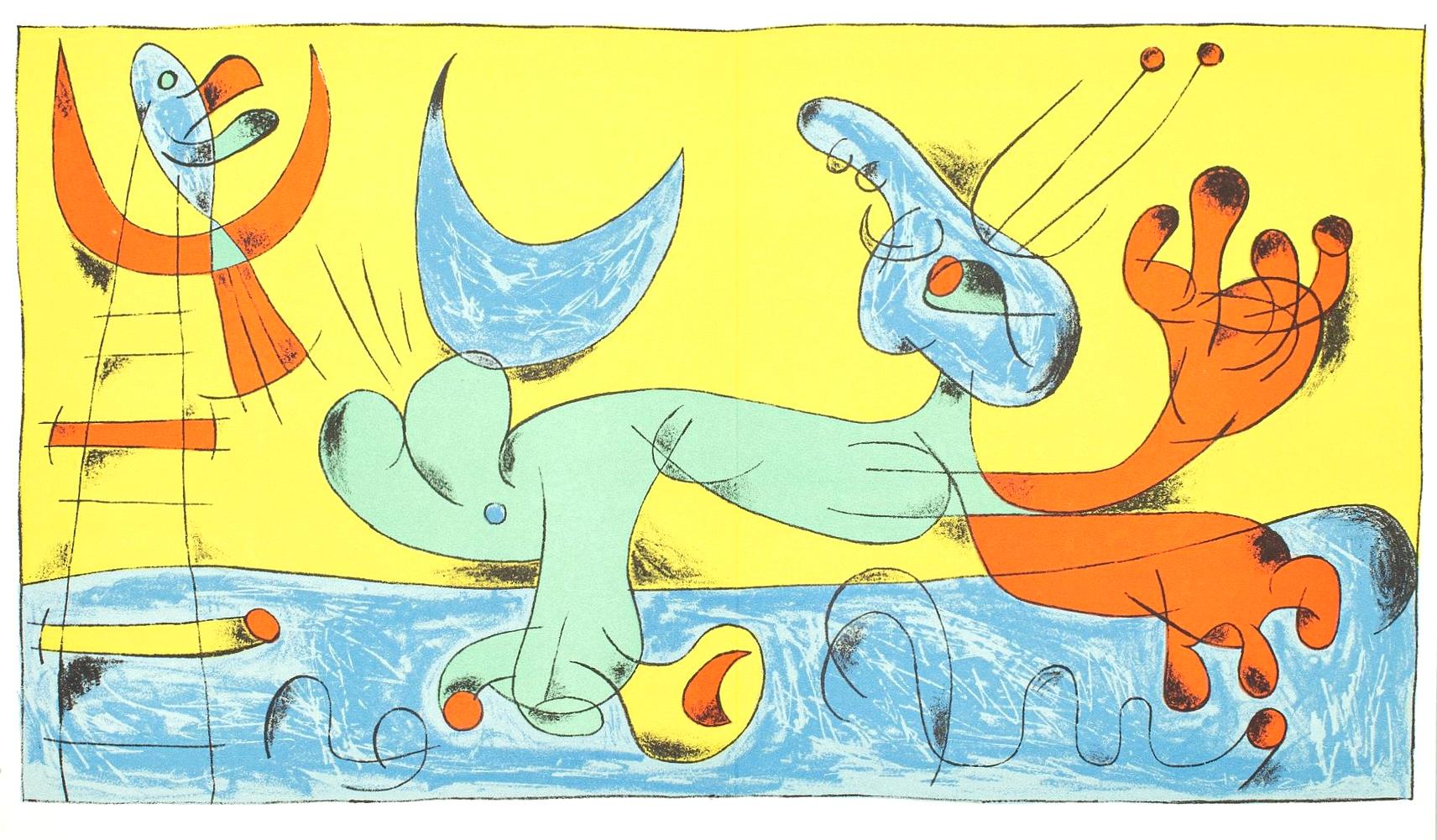
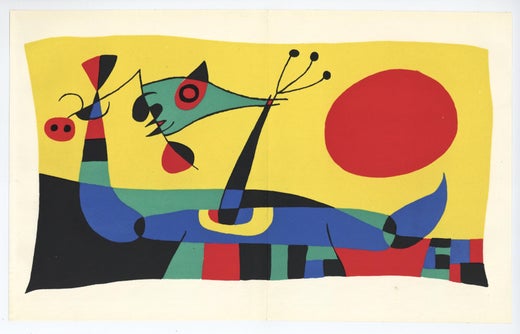
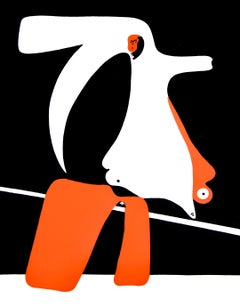
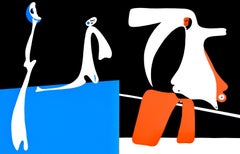
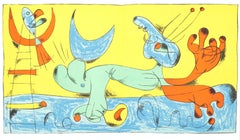
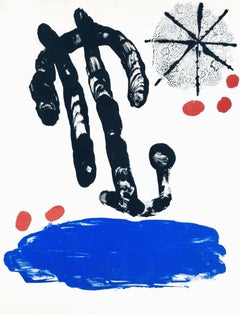
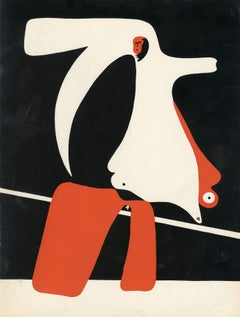
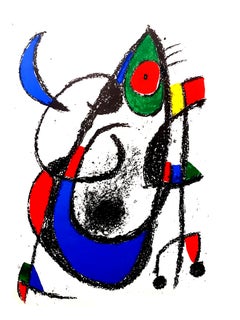
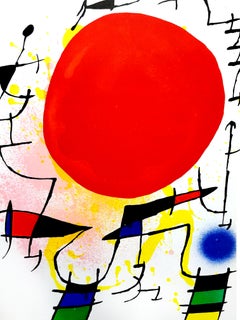
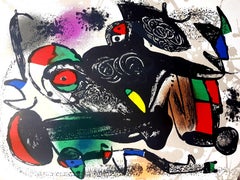
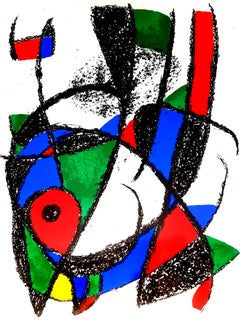
This exquisite lithograph and pochoir by Joan Miro (1893–1983), titled Sans titre (Untitled), originates from the landmark 1934 album Cahiers d'art, Nos. 1–4, 9e annee. Published by Editions des Cahiers d'Art, Paris, under the direction of Christian Zervos, Editeur, Paris, 1934, and printed by L'Imprimerie Crete, Paris, 1934, the work reflects Miros early Surrealist vocabulary, defined by biomorphic form, lyrical spontaneity, and a radiant chromatic sensibility uniquely suited to the pochoir technique.
Executed as a lithograph and pochoir on velin paper, this work measures 12.75 x 9.5 inches. Unsigned and unnumbered as issued. Printed by L'Imprimerie Crete, Paris.
Artwork Details:
Artist: Joan Miro (1893–1983)
Title: Sans titre (Untitled), from the album Cahiers d'art, Nos. 1–4, 9e annee, 1934
Medium: Lithograph and pochoir on velin paper
Dimensions: 12.75 x 9.5 inches (32.39 x 24.13 cm)
Inscription: Unsigned and unnumbered as issued
Date: 1934
Publisher: Editions des Cahiers d'Art, Paris; under the direction of Christian Zervos, Editeur
Printer: L'Imprimerie Crete, Paris
Catalogue raisonne reference: Dupin, Jacques, and Joan Miro. Miro Engraver 1928–1960. Rizzoli, 1984, illustration 14–15. Cramer, Patrick. Joan Miro: The Illustrated Books: Catalogue Raisonne. Patrick Cramer, 1989, illustration 3.
Condition: Well preserved, consistent with age and medium
Provenance: From the album Cahiers d'art, Nos. 1–4, 9e annee, 1934, published by Editions des Cahiers d'Art, Paris
About the Publication:
Cahiers d'art, Nos. 1–4, 9e annee, 1934, occupies an extraordinary place in the history of modern art publications, embodying the intellectual ambitions, editorial rigor, and avant-garde sensibility that defined Christian Zervos and his legendary journal Cahiers d'Art, founded in Paris in 1926 and widely regarded as one of the most influential engines of modernist thought in the twentieth century. The 1934 album brings together essays, critical writings, archaeological studies, photographic documentation, and original artworks with a level of scholarship, aesthetic refinement, and international perspective unmatched by any contemporary publication. Zervos conceived Cahiers d'Art not as a magazine but as a hybrid form—at once an academic review, a fine art album, a forum for emerging theory, and a platform through which the newest developments in painting, sculpture, architecture, ethnography, and ancient art could enter meaningful dialogue. The 1934 volume marks one of the most significant prewar issues due to its inclusion of original Joan Miro pochoirs produced with extraordinary precision by the ateliers of L'Imprimerie Crete, a technical process requiring multiple color stencils applied by hand to achieve vibrant, saturated hues faithful to Miros early Surrealist palette. These rare pochoirs are among the most important printed works Miro created before the war, capturing the explosive spontaneity, fantastical biomorphism, and dream-infused symbolism that defined his artistic language during the early 1930s. Beyond Miro, the 1934 album reflects the wide scope of Zervos's intellectual project—pairing archaeological studies of Cycladic and ancient Mediterranean sculpture with leading-edge modernism, presenting images and texts that collapsed the temporal divide between prehistoric form and avant-garde innovation. Cahiers d'Art was uniquely positioned within the cultural landscape of Paris, the epicenter of the global art world, and through Zervos's connections with Pablo Picasso, Henri Matisse, Georges Braque, Alexander Calder, Alberto Giacometti, and many others, the publication became a crucial bridge between artists, critics, historians, collectors, and museums. The 1934 issue exemplifies the journals hallmark qualities: luxurious paper, masterful printing, modern typography, intellectual breadth, and original artworks integrated directly into its pages, elevating each volume from a scholarly document to a collectible fine art object. Its impact remains profound—Cahiers d'Art shaped curatorial practice, influenced major museum acquisitions, helped define the discourse of Surrealism and modern abstraction, and contributed directly to the critical and historical frameworks through which twentieth century art continues to be understood. Today, volumes containing original Miro pochoirs from 1934 are among the most sought-after achievements of the prewar avant-garde, prized for their rarity, their aesthetic brilliance, and their central role in the printed history of modern art.
About the Artist:
Joan Miro (1893–1983) was a Catalan painter, sculptor, printmaker, and ceramicist whose visionary imagination and lyrical abstraction made him one of the most influential and beloved artists of the twentieth century. Born in Barcelona, Miro drew inspiration from Catalan folk art, Romanesque frescoes, and the luminous landscapes of Mont-roig del Camp, developing a deep connection to nature that infused his work with vitality and symbolism. After formal training at the Escola d'Art in Barcelona, he absorbed the lessons of Post-Impressionism and Cubism before moving to Paris in the early 1920s, where he became a leading figure in the Surrealist movement. There, Miro forged a personal visual language of biomorphic shapes, floating symbols, and radiant color harmonies that reflected both spontaneity and spiritual depth. In creative dialogue with peers such as Alexander Calder, Alberto Giacometti, Salvador Dali, Wassily Kandinsky, Marcel Duchamp, and Man Ray, he helped revolutionize modern art by dissolving the boundaries between abstraction and dream imagery. Miros inventive approach extended far beyond painting, embracing sculpture, ceramics, and monumental public commissions that redefined how art could interact with space and emotion. His expressive freedom and gestural abstraction profoundly influenced later artists including Jackson Pollock, Mark Rothko, Alexander Calder, Jean Dubuffet, Antoni Tapies, and Joan Mitchell, inspiring generations who sought to merge instinct, color, and imagination. Today, Miros work remains a cornerstone of modernism, prized by collectors and celebrated in major museums worldwide. His highest auction record was achieved by Peinture (Etoile Bleue) (1927), which sold for 23,561,250 GBP (approximately 37 million USD) at Sotheby's, London, on June 19, 2012.
Joan Miro Cahiers d'art 1934, Miro pochoir, Miro lithograph, Cahiers d'art 9e annee, Christian Zervos, L'Imprimerie Crete, Miro early Surrealism, Miro collectible print.