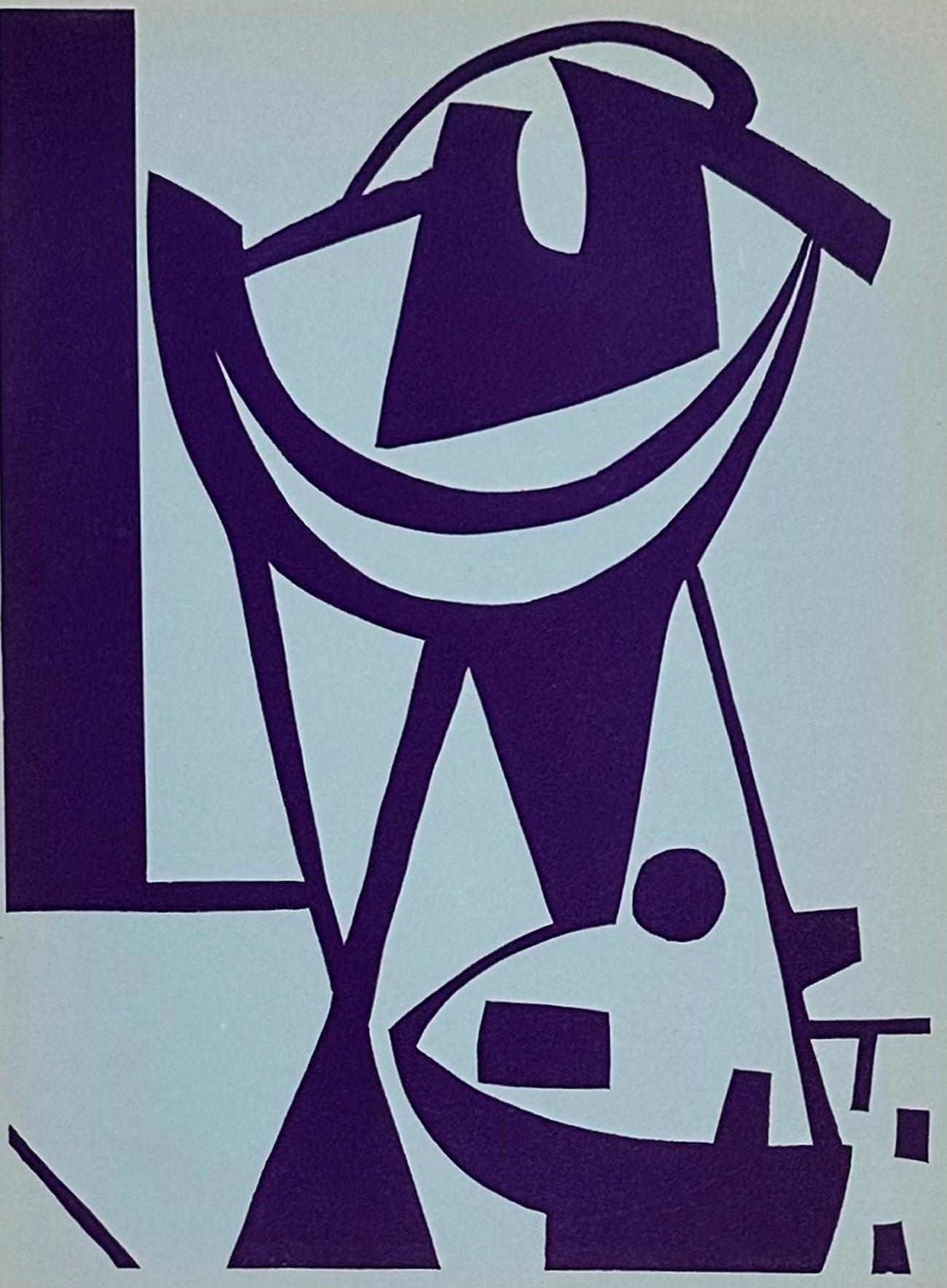
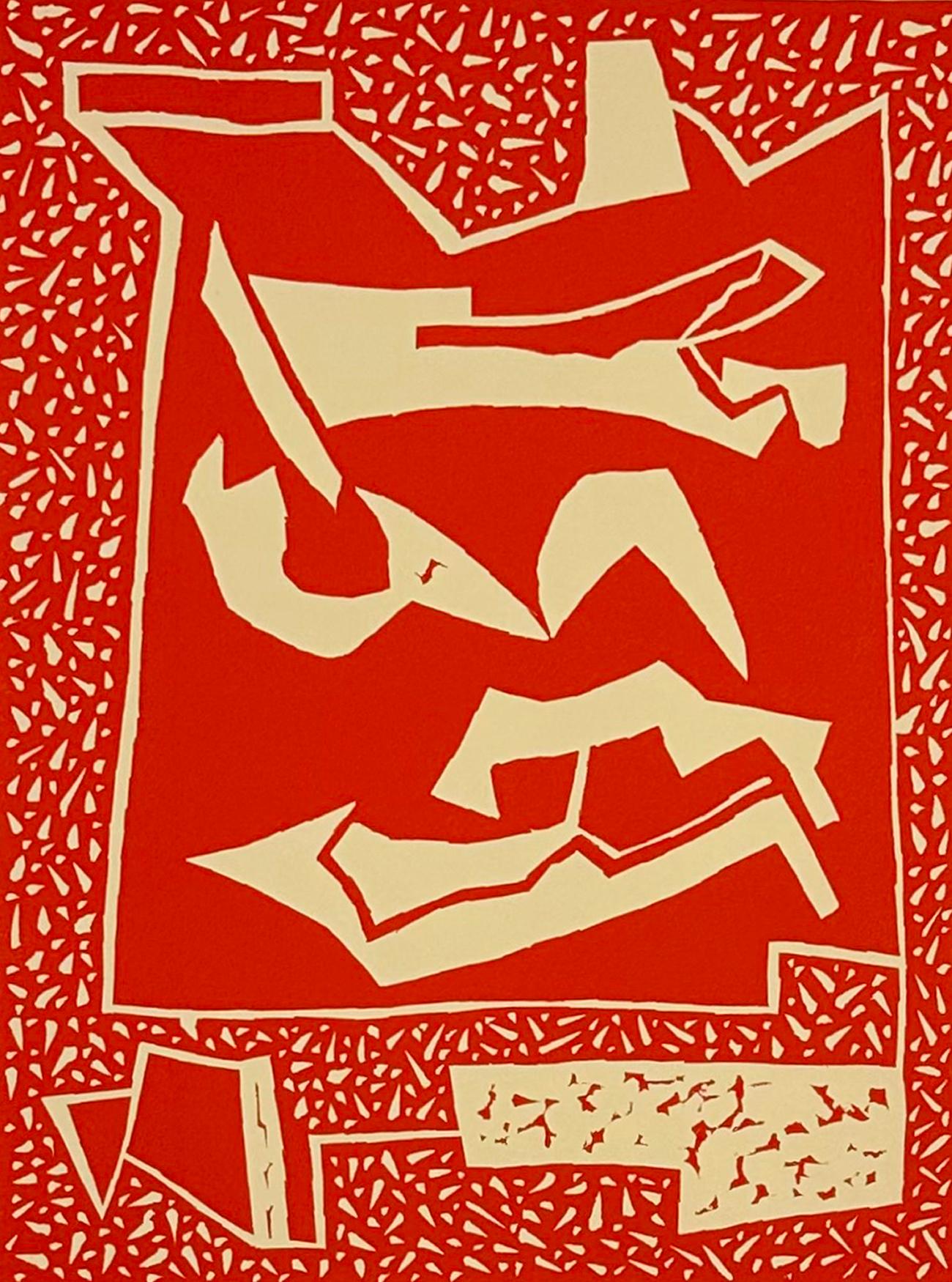
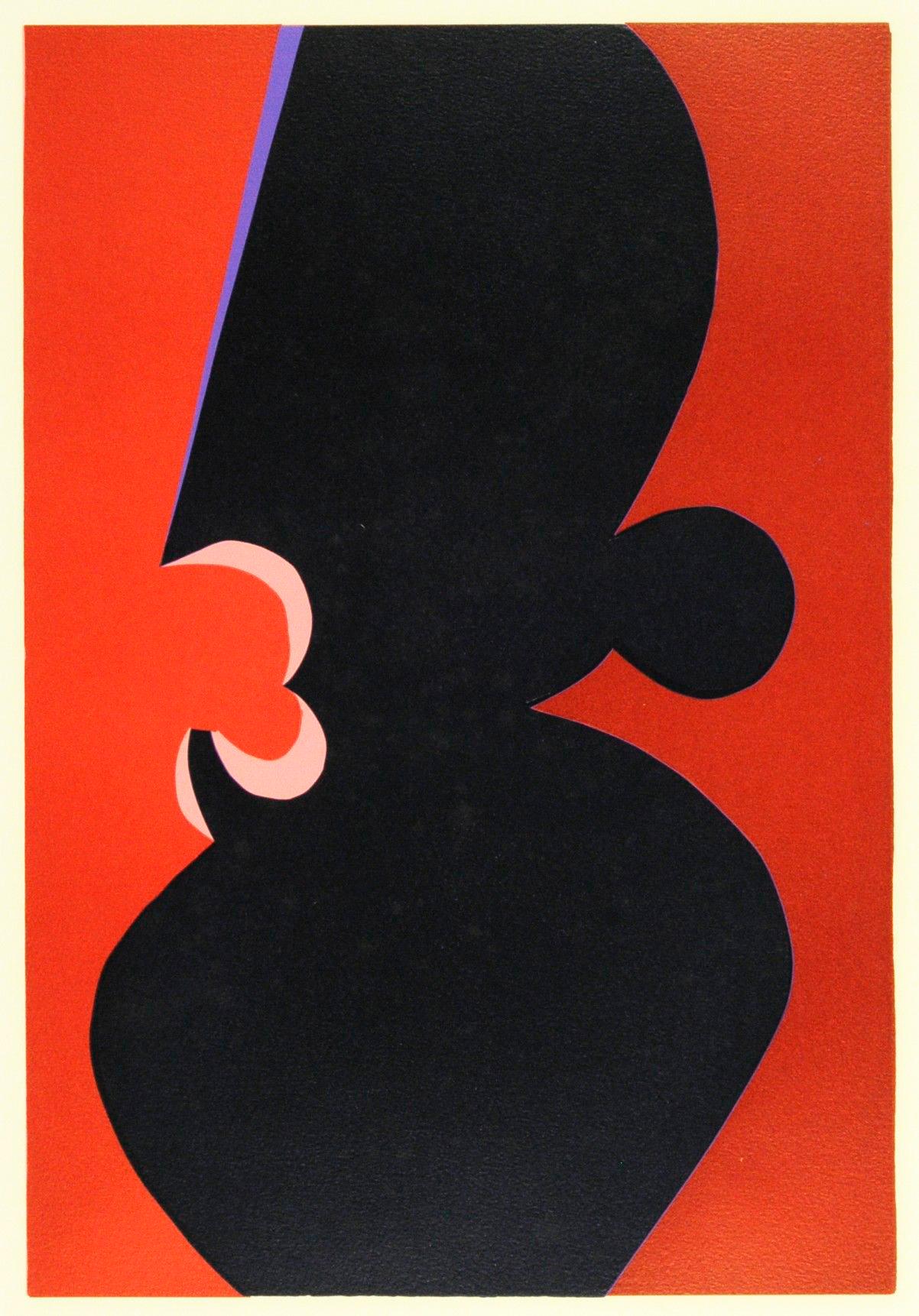
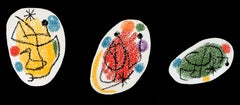
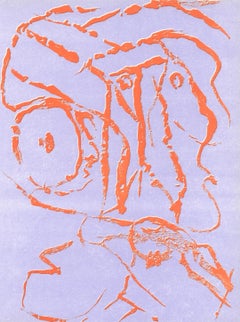
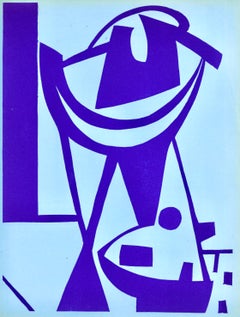
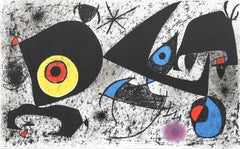
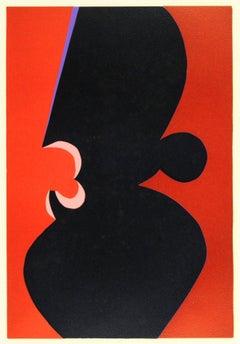
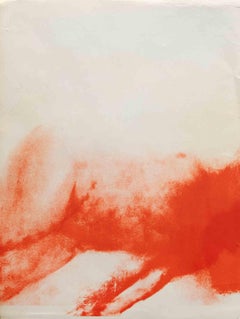
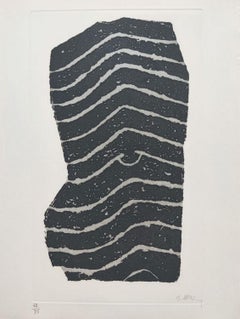
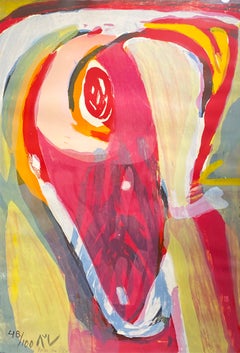
This exquisite linocut by Joan Miro (1893–1983), titled Femme (Woman), from the album XXe siecle, Chroniques du jour, 13 rue Valette (5e), Directeur G. di San Lazzaro, Sommaire du no. 4, Noel, 1938, originates from the 1938 edition published by Gualtieri di San Lazzaro, editeur, Paris, in collaboration with Societe Internationale d'Art XXe siecle, Paris, and printed by Mourlot Freres, Paris. Femme captures Miro's fascination with organic form, rhythm, and subconscious imagery, uniting playful abstraction and poetic symbolism in one of his early Surrealist compositions.
Executed as a linocut on velin paper, this work measures 12.5 × 9.75 inches (31.75 × 24.77 cm). Signed in the plate and unnumbered, as issued. The edition exemplifies the superb craftsmanship of Mourlot Freres, Paris.
Artwork Details:
Artist: Joan Miro (1893–1983)
Title: Femme (Woman), from the album XXe siecle, Chroniques du jour, 13 rue Valette (5e), Directeur G. di San Lazzaro, Sommaire du no. 4, Noel, 1938
Medium: Linocut on velin paper
Dimensions: 12.5 × 9.75 inches (31.75 × 24.77 cm)
Inscription: Signed in the plate and unnumbered, as issued
Date: 1938
Publisher: Gualtieri di San Lazzaro, editeur, Paris, in collaboration with Societe Internationale d'Art XXe siecle, Paris
Printer: Mourlot Freres, Paris
Catalogue raisonne references: Musee d'art moderne de la ville de Paris, et al. Miro: L'oeuvre Graphique: Exposition: Musee d'Art Moderne de La Ville de Paris. Le Musee, 1974, illustration 397; Cramer, Patrick, and Joan Miro. Joan Miro, Catalogue Raisonne Des Livres Illustres. P. Cramer, 1989, illustration 24; Miro, Joan, et al. Joan Miro, Lithographs. Maeght Editeur, 1972, illustration 6; Dupin, Jacques, et al. Miro Graveur, Vol. I, 1928-1960. D. Lelong, 1984, illustration 1312
Condition: Well preserved, consistent with age and medium
Provenance: From the album XXe siecle, Chroniques du jour, 13 rue Valette (5e), Directeur G. di San Lazzaro, Sommaire du no. 4, Noel, 1938, published by Gualtieri di San Lazzaro, editeur, Paris
About the Publication:
Gualtieri di San Lazzaro's XXe Siecle (Twentieth Century) was one of the most influential art journals of the modern era, founded in Paris in 1938 as a platform for the greatest painters, sculptors, and writers of the 20th century. San Lazzaro, a visionary editor, critic, and champion of modernism, believed that art and literature should coexist as expressions of a shared human imagination. Under his direction, XXe Siecle became a cultural bridge between Europe and the wider world, publishing special issues devoted to leading figures such as Picasso, Matisse, Chagall, Braque, Calder, Miro, Kandinsky, and Leger. Each edition combined essays by renowned critics and poets with original lithographs printed by the foremost ateliers of Paris, including Mourlot, Arte, and Bellini, creating a uniquely rich dialogue between text and image. Through XXe Siecle, San Lazzaro preserved the creative spirit of the avant-garde during and after World War II, championing freedom of expression and the evolution of abstraction, Surrealism, and modern thought. Over nearly four decades, the journal shaped international taste and defined the intellectual landscape of postwar art publishing. Today, XXe Siecle remains celebrated for its extraordinary synthesis of art, literature, and design, an enduring testament to Gualtieri di San Lazzaro's belief that the visual arts are the soul of the modern age.
About the Artist:
Joan Miro (1893–1983) was a Catalan painter, sculptor, printmaker, and ceramicist whose visionary imagination and lyrical abstraction made him one of the most influential and beloved artists of the 20th century. Born in Barcelona, Miro drew inspiration from Catalan folk art, Romanesque frescoes, and the luminous landscapes of Mont-roig del Camp, developing a deep connection to nature that infused his work with vitality and symbolism. After formal training at the Escola d'Art in Barcelona, he absorbed the lessons of Post-Impressionism and Cubism before moving to Paris in the early 1920s, where he became a leading figure in the Surrealist movement. There, Miro forged a personal visual language of biomorphic shapes, floating symbols, and radiant color harmonies that reflected both spontaneity and spiritual depth. In creative dialogue with peers such as Alexander Calder, Alberto Giacometti, Salvador Dali, Wassily Kandinsky, Marcel Duchamp, and Man Ray, he helped revolutionize modern art by dissolving the boundaries between abstraction and dream imagery. Miro's inventive approach extended far beyond painting, embracing sculpture, ceramics, and monumental public commissions that redefined how art could interact with space and emotion. His expressive freedom and gestural abstraction profoundly influenced later artists including Jackson Pollock, Mark Rothko, Alexander Calder, Jean Dubuffet, Antoni Tapies, and Joan Mitchell, inspiring generations who sought to merge instinct, color, and imagination. Today, Miro's work remains a cornerstone of modernism, prized by collectors and celebrated in major museums worldwide. His highest auction record was achieved by Peinture (Etoile Bleue) (1927), which sold for £23,561,250 (approximately $37 million) at Sotheby's, London, on June 19, 2012.
Joan Miro Femme, Miro XXe siecle, Miro 1938 linocut, Miro Mourlot, Miro velin paper, Miro abstraction, Miro collectible print.