1 of 1

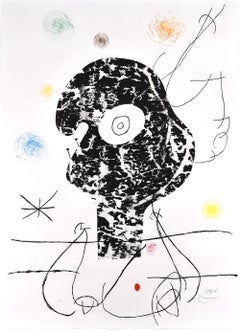
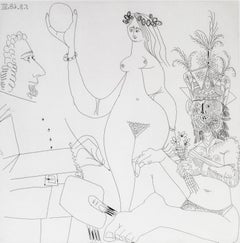
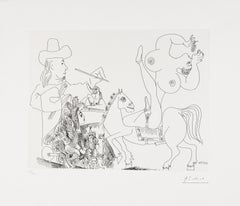
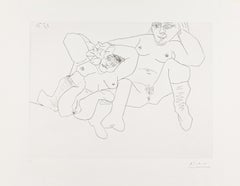
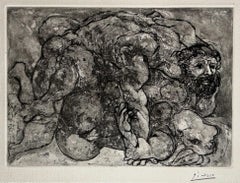
Pablo Picasso
Les Trois Femmes (Bloch 51)

1924-1925

$18,000List Price

You May Also Like

The Centenarian
By Edmund Blampied
Located in Storrs, CT
The Centenarian. 1930-31. Drypoint. Appleby 144. 10 5/16 x 10 3/8 (sheet 17 3/8 by 12 3/8). Edition 100. A rich impression on cream-colored 'Whatman' laid paper with full margins. Signed and numbered in ink. Edmund Blampied was a painter, etcher, lithographer and sculptor. Born in 1886 to a family of three boys in St. Martin, Jersey, Blampied became interested in drawing at an early age. After visiting the studio of John Helier Lander in 1899, Blampied decided to make a career as an artist. In 1903 he went to London to attend Lambeth Art School, where he studied etching under Walter Seymour. In 1905, he joined the Daily Chronicle as an artist. In that year he was awarded a scholarship to Bolt Court Scool of Photo-engraving and Lithography. In 1912 he left the Chronicle and established his own studio. He earned a living by illustrating novels and short stories. In 1913, he had his first exhibition at the Leicester Gallery in London. The following year he married Marianne Van Abbé. During the 1920's, he became a member of the Royal Society of Painter-Etchers and Engravers. During the 1920s Blampied became a member of the Royal Society of Painters-Etchers and Engravers and exhibited in London to critical acclaim. He produced a folio of comic drawings in the 1930s which was published in New York in 1934 and another that was published in London in 1936. The Keeper of Prints and Drawings at the British Museum published a mongraph on his work. His London exhibitions were highly successful. In 1938, he moved to Bulwarks, St.Aubin in Jersey, but at the onset of the Occupation, had to relocate to Route Orange, St. Brelade. remained there throughout World War II during the German Occupation, despite the fact that his wife was Jewish. During the Occupation he designed bank...
Category

1930s Modern Figurative Prints

Materials

Drypoint, Etching

Portrait of James McBey.
By Walter Tittle
Located in Storrs, CT
James McBey. 1931. Drypoint. 8 7/8 x 5 7/8 (sheet 11 1/2 x 9 ). An extremely rich impression with drypoint burr, printed by the artist on cream wove paper. Signed in the plate lower ...
Category

1930s American Modern Portrait Prints

Materials

Drypoint, Etching

Wheelbarrow Race
By Edmund Blampied
Located in Storrs, CT
1925-26. Drypoint. Appleby 114. 8 9/16 x 12 (sheet 12 x 17). Edition 100, #10. An excellent impression with burr, printed with plate tone on the full sheet of 'VGI' laid paper with ...
Category

1920s Modern Figurative Prints

Materials

Drypoint, Etching

France at her Furnaces
By James McBey
Located in Storrs, CT
1917. Etching. Hardie 175. 8 x 15 (sheet 10 1/8 x 16 15/16). Edition 76. Slight mat line; otherwise excellent condition. A rich impression printed on antique laid paper with full m...
Category

1910s Modern Interior Prints

Materials

Drypoint, Etching

San Marco [Venice].
By William Walcot R. E. Hon. R. I. B. A.
Located in Storrs, CT
William Walcot. R.E., R.I.B.A. San Marco. Etching with drypoint and aquatint. Dickins 66, Harvey-Lee 91. 3 7/8 x 5 7/8 (sheet 9 1/4 x 12 1/8). Venice set, # 2. Edition 415. A rich impression printed on cream wove paper. Fold in the margin, well outside the image; otherwise good condition. Signed in pencil. Housed in a 16 x 20-inch archival mat. Soon after Walcot's arrival in England, the Fine Art Society sponsored a trip sent to Italy. This scene is one of four small drypoints that resulted from the artist’s stay in Venice. When he was seventeen, he began to study architecture under Louis Benois at the Imperial Academy of Art in Saint Petersburg. He went to Paris where he continued his studies at the Ecole des Beaux-Arts and the Atelier Redon. He practiced as an architect briefly in Moscow, designing the Hotel Metropole...
Category

Early 20th Century Modern Landscape Prints

Materials

Drypoint, Etching, Aquatint

Chelsea Old Church, London
By William Walcot R. E. Hon. R. I. B. A.
Located in Storrs, CT
Chelsea Old Church. 1924. Etching, drypoint, and aquatint. Dickins 94. 5 3/8 x 8 (sheet 8 1/2 x 9 3/4). Edition 100 for The Print Collector's Club. A fine proof with tonal wiping, printed on cream wove paper. Signed and dedicated "W.R. Button from W. Walcot London 1930" in pencil. Chelsea Old Church, also known as All Saints, is an Anglican church, on Old Church Street, Chelsea, London SW3, England, near Albert Bridge. It is the church for a parish in the Diocese of London, part of the Church of England. Inside the Grade I listed building, there is seating for 400 people. There is a memorial plaque to the author Henry James (1843–1916) who lived nearby on Cheyne Walk. To the west of the church is a small public garden containing a sculpture by Sir Jacob Epstein. When he was seventeen,William Walcot began to study architecture under Louis Benois at the Imperial Academy of Art in Saint Petersburg. He went to Paris where he continued his studies at the Ecole des Beaux-Arts and the Atelier Redon. He practiced as an architect briefly in Moscow, designing the Hotel Metropole...
Category

Early 20th Century Modern Landscape Prints

Materials

Drypoint, Etching, Aquatint

Chelsea Old Church, London
$400 Sale Price
20% Off
H 5.38 in W 8 in D 0.5 in
Guardians of the Spire; Amiens Cathedral Number 2
By John Taylor Arms
Located in Middletown, NY
Guardians of the Spire; Amiens Cathedral Number 2 New York: 1937. Etching and drypoint on watermarked F.J. Head cream-colored, antique laid paper, 6 3/4 ...
Category

Mid-20th Century American Modern Figurative Prints

Materials

Drypoint, Etching

Palazzo dell'Angelo
By John Taylor Arms
Located in Middletown, NY
Palazzo dell'Angelo 1931 Etching and drypoint on cream-colored, handmade laid paper with deckle edges, 7 1/4 x 6 3/4 inches (185 x 171 mm), edition of 100, full margins. Signed, dated and numbered "Ed. 100" in pencil, lower margin, second state (of three). Printed by Henry Carling, New York. Extremely minor mat tone and some inky residue in the top right corner, all unobtrusive and well outside of image area. An exquisite impression of this intricate image, with astonishing detail, and all the fine lines printing clearly. The image represents the first print which Arms printed on his own handmade paper. Framed handsomely with archival materials and museum grade glass in a wood gilt frame with a flower and garland motif. Illustrated: Dorothy Noyes Arms, Hill Towns and Cities of Northern Italy, p. 180; Anderson, American Etchers Abroad 1880-1930; Eric Denker, Reflections & Undercurrents: Ernest Roth and Printmaking in Venice, 1900-1940, p. 116. [Fletcher 233] Born in 1887 in Washington DC, John Taylor Arms studied at Princeton University, and ultimately earned a degree in architecture at the Massachusetts Institute of Technology in 1912. With the outbreak of W.W.I, Arms served as an officer in the United States Navy, and it was during this time that he turned his focus to printmaking, having published his first etching in 1919. His first subjects were the Brooklyn Bridge, near the Navy Yard, and it was during his wartime travel that Arms created a series of extraordinarily detailed etchings based on Gothic cathedrals and churches he visited in France and Italy. He used what was available to him, namely sewing needles and a magnifying glass, to create the incredibly rich and fine detail that his etchings are known for. Upon his return to New York after the war, Arms enjoyed a successful career as a graphic artist, created a series of etchings of American cities, and published Handbook of Print Making and Print Makers (Macmillan, 1934). He served as President of the Society of American Graphic Artists, and in 1933, was made a full member of the National Academy of Design. In its most modern incarnation, Palazzo dell'Angelo was constructed in or around 1570. The building, which has a rich and storied history, was erected upon the ruins of an earlier structure which predates the Gothic period. Some remnants of the earliest features of the residence were most certainly still visible when Arms visited, as they are today. Having a background in architecture, there's no question that Arms was moved by the beauty, history and ingenuity represented in the physical structure. One thing specifically gives away Arms's passion for the architecture, and that is the fact that he focused on the building's Moorish entranceway, balustrade, and two mullioned windows, and not on the curious Gothic era bas-relief of an angel nestled into the facade of the building, after which the structure is named. The sculpture itself doesn't appear in Arms's composition at all, despite the fact that it is the feature of the building that is most famous in its folklore. Arms instead focuses on the oldest portion of the architecture, even documenting some of the remnants of a fresco, and a funerary stele for the freedman Tito Mestrio Logismo, and his wife Mestria Sperata (visible above the water level, to the left of the door, behind the gondola), which was first described in 1436. Among the many notable bits of history regarding the Palazzo, it has been documented that Tintoretto painted frescos of battle scenes on the facade of the building. The paintings have been lost to time and the elements, but not entirely to history. The empty frame...
Category

1930s American Modern Figurative Prints

Materials

Drypoint, Etching

Palazzo dell'Angelo
$2,800
H 7.25 in W 6.75 in
Ludgate Hill
By William Walcot R. E. Hon. R. I. B. A.
Located in Storrs, CT
Ludgate Hill. 1921. Etching, aquatint, and drypoint. Dickins 69. 5 5/8 x 5 1/8 (sheet 13 5/8 x 9 3/4). A fine proof with plate tone, printed on 'J Wha[tman] cream wove paper. Edition of 275 for the UK and 125 for the US. Signed in pencil. Ludgate Hill is a street that runs west from St. Paul's Churchyard to Ludgate Circus (built in 1864), and from there becomes Fleet Street. The Ludgate Hill railway station, between Water Lane and New Bridge Street, is a station of the London, Chatham, and Dover Railway. It was closed before World War II and the railway bridge and viaduct between Holborn Viaduct and Blackfriars stations was demolished in 1990 to enable the construction of the City Thameslink railway station in a tunnel. This also involved the regrading of the slope of Ludgate Hill at the junction. About halfway up Ludgate Hill is St Martin, Ludgate church. This was physically joined to the Ludgate. When he was seventeen, William Walcot began to study architecture under Louis Benois at the Imperial Academy of Art in Saint Petersburg. He went to Paris where he continued his studies at the Ecole des Beaux-Arts and the Atelier Redon. He practiced as an architect briefly in Moscow, designing the Hotel...
Category

Early 20th Century Modern Landscape Prints

Materials

Drypoint, Etching, Aquatint

Ludgate Hill
$400 Sale Price
20% Off
H 5.63 in W 5.13 in D 0.5 in
The Smithy
By Sir David Young Cameron, R.A.
Located in Middletown, NY
A warm composition, in theme and tone; the creaky timber interior of a 19th century Scottish blacksmith's shop. Etching and drypoint on cream laid Japan paper, 8 x 10 inches (202 x ...
Category

Late 20th Century Modern Interior Prints

Materials

Laid Paper, Drypoint, Etching

Still Thinking About These?

All Recently Viewed