Monoprint Interior Prints
to
1
Overall Width
to
Overall Height
to
3
2
1
1
1
1
1
1
1
1
1
1
1
1
1
1
1
1
Artist: Carol Summers
Medium: Monoprint
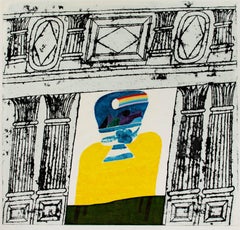
"Incredible String Band, " Original Color Woodcut, Serigraph, & Monotype
Located in Milwaukee, WI
"Incredible String Band" is an original color woodcut, serigraph, and monotype by Carol Summers. It depicts classical architecture surrounding Summer...
Category
1970s Monoprint Interior Prints
Materials
Monoprint, Monotype, Screen, Woodcut
Related Items
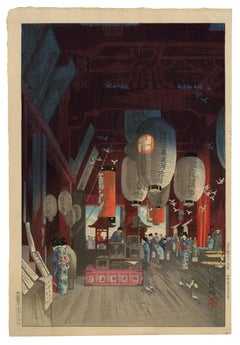
'Interior of the Kannon Temple at Asakusa' — Tokyo Landmark, Early Edition
Located in Myrtle Beach, SC
NARAZAKI EISHO (1864-1936), 'Asakusa Kannon-do no naido' (Interior of the Kannon Temple at Asakusa), color woodblock print, 1932. Signed Eisho lower right, with the artist’s red seal beneath. A fine impression with fresh colors; the full sheet with slight overall age toning, a drying tack...
Category
1930s Monoprint Interior Prints
Materials
Woodcut

$1,850
H 14.188 in W 9.563 in
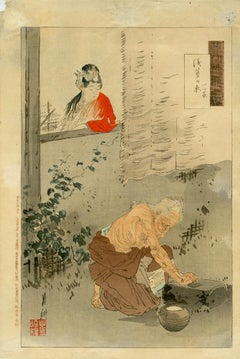
The Lonely House at Asajigahara.
Located in Middletown, NY
A scene from a series of ghost stories and spooky rural legends.
Tokyo: Matsuki Heikichi, 1896.
Woodcut in ink with embossing and hand-coloring in watercolor on handmade mulberry pa...
Category
Late 19th Century Edo Monoprint Interior Prints
Materials
Watercolor, Handmade Paper, Woodcut
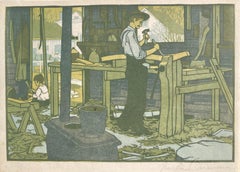
THE WAGON SHOP
Located in Santa Monica, CA
GUSTAVE BAUMANN (1881 – 1971)
THE WAGON SHOP, 1910 (Chamberlain 24)
Color woodcut signed in pencil. Unnumbed from an edition 100 as published in the Hills o’ Brown...
Category
1910s Modern Monoprint Interior Prints
Materials
Woodcut
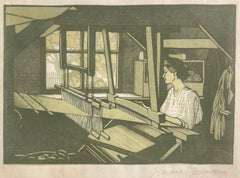
THE RUG WEAVER
Located in Santa Monica, CA
GUSTAVE BAUMANN (1881 – 1971)
THE RUG WEAVER, 1910 (Chamberlain 26)
Color woodcut signed in pencil. Unnumbed from an edition 100 as published in the Hills o’ Brown...
Category
1910s American Modern Monoprint Interior Prints
Materials
Woodcut
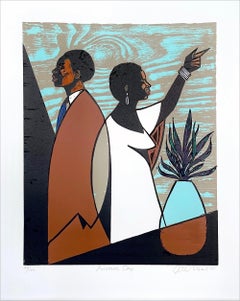
ANOTHER DAY Signed Woodcut, Modern Portrait, Black Couple, Brown, Blue, Beige
By Otto Neals
Located in Union City, NJ
ANOTHER DAY is an original limited edition woodcut by the American painter and sculptor, Otto Neals. The woodblock used to print ANOTHER DAY was hand carved by Otto Neals and printed...
Category
Early 2000s Contemporary Monoprint Interior Prints
Materials
Woodcut
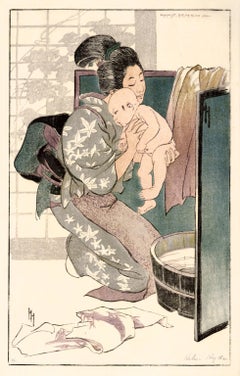
'The Bath' — Meji Era Cross-Cultural Woman Artist
By Helen Hyde
Located in Myrtle Beach, SC
Helen Hyde, 'The Bath', color woodblock print, edition not stated, 1905, Mason & Mason 59. Signed in pencil in the image, lower right. Numbered '96' in pencil in the image, lower left. The artist's monogram in the block, lower left, and 'Copyright, 1905, by Helen Hyde.' upper right. A superb impression with fresh colors on tissue-thin cream Japanese paper; the full sheet with margins (7/16 to 1 5/8 inches), in excellent condition. Matted to museum standards, unframed.
Image size 16 1⁄4 x 10 1⁄8 in. (413 x 260 mm); sheet size: 19 1⁄4 x 11 1⁄8 in. (489 x 283 mm).
Literature and Exhibition: Back cover illustration of the catalog of the artist’s prints, 'Helen Hyde', Smithsonian Institution Press, 1990; 'The International Block Print Renaissance, Then And Now, Block Prints In Wichita, Kansas, A Centennial Celebration — 1922-2022', Barbara J. Thompson, Wichita Art Museum, 2022 (back cover).
Impressions of this work are held in the following collections: Achenbach Foundation for Graphic Arts, Art Institute of Chicago, Fine Arts Museums of San Francisco (De Young), Harvard Art Museums, Library of Congress, Metropolitan Museum of Art, New York Public Library, Smithsonian American Art Museum, Terra Foundation for American Art, University of Oregon Museum of Art.
ABOUT THE ARTIST
Helen Hyde (1868-1919) was a pioneer American artist best known for advancing Japanese woodblock printmaking in the United States and for bridging Western and Japanese artistic traditions. Hyde was born in Lima, New York, but after her father died in 1872, her family relocated to Oakland, California, where she spent much of her youth.
Hyde pursued formal art education in the United States and Europe. She enrolled in the San Francisco School of Design, where she took classes from the Impressionist painter Emil Carlsen; two years later, she transferred to the Art Students League in New York, studying there with Kenyon Cox. Eager to expand her artistic repertoire, Hyde traveled to Europe, studying under Franz Skarbina in Berlin and Raphael Collin in Paris. While in Paris, she first encountered Japanese ukiyo-e prints, sparking a lifelong fascination with Japanese aesthetics. After ten years of study, Hyde returned to San Francisco, where she continued to paint and began to exhibit her work.
Hyde learned to etch from her friend Josephine Hyde in about 1885. Her first plates, which she etched herself but had professionally printed, represented children. On sketching expeditions, she sought out quaint subjects for her etchings and watercolors. In 1897, Hyde made her first color etchings—inked á la poupée (applying different ink colors to a single printing plate)—which became the basis for her early reputation. She also enjoyed success as a book illustrator, and her images sometimes depicted the children of Chinatown.
After her mother died in 1899, Hyde sailed to Japan, accompanied by her friend Josephine, where she would reside, with only brief interruptions, until 1914. For over three years, she studied classical Japanese ink painting with the ninth and last master of the great Kano school of painters, Kano Tomonobu. She also studied with Emil Orlik, an Austrian artist working in Tokyo. Orlik sought to renew the old ukiyo-e tradition in what became the shin hanga “new woodcut prints” art movement. She immersed herself in the study of traditional Japanese printmaking techniques, apprenticing with master printer Kanō Tomonobu. Hyde adopted Japanese tools, materials, and techniques, choosing to employ the traditional Japanese system of using craftsmen to cut the multiple blocks and execute the exacting color printing of the images she created. Her lyrical works often depicted scenes of family domesticity, particularly focusing on women and children, rendered in delicate lines and muted colors.
Through her distinctive fusion of East and West, Hyde’s contributions to Western printmaking were groundbreaking. At a time when few Western women ventured to Japan, she mastered its artistic traditions and emerged as a significant figure in the international art scene.
Suffering from poor health, she returned to the United States in 1914, moving to Chicago. Having found restored health and new inspiration during an extended trip to Mexico in 1911, Hyde continued to seek out warmer climates and new subject matter. During the winter of 1916, Hyde was a houseguest at Chicora Wood, the Georgetown, South Carolina, plantation illustrated by Alice Ravenel Huger Smith in Elizabeth Allston Pringle’s 1914 book A Woman Rice Planter. The Lowcountry was a revelation for Hyde. She temporarily put aside her woodcuts and began creating sketches and intaglio etchings of Southern genre scenes and African Americans at work. During her stay, Hyde encouraged Smith’s burgeoning interest in Japanese printmaking and later helped facilitate an exhibition of Smith’s prints at the Art Institute of Chicago.
During World War I, Hyde designed posters for the Red Cross and produced color prints extolling the virtues of home-front diligence.
In ill health, Hyde traveled to be near her sister in Pasadena a few weeks before her death on May 13, 1919. She was buried in the family plot near Oakland, California.
Throughout her career, Hyde enjoyed substantial support from galleries and collectors in the States and in London. She exhibited works at the St. Louis Exposition in 1897, the Pan-American Exhibition in Buffalo in 1901, the Tokyo Exhibition for Native Art (where she won first prize for an ink drawing) in 1901, the Alaska-Yukon-Pacific Exhibition in Seattle in 1909 (received a gold medal for a print), the Newark Museum in 1913, a solo show at the Chicago Art Institute in 1916, and a memorial exhibition in 1920, Detroit Institute of Arts, Color Woodcut Exhibition in 1919, New York Public Library, American Woodblock Prints...
Category
Early 1900s Showa Monoprint Interior Prints
Materials
Woodcut
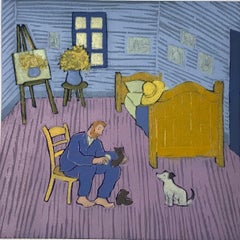
Once upon a time in London, Morning, Woodcut print, Vincent Van Gogh, Sunflowers
Located in Deddington, GB
A limited edition woodcut on paper print by Mychael Barratt of Vincent Van Gogh in his bedroom with his dog. Sunflowers appear in the background, brightening up a blue and purple room.
Additional information:
Mychael Barratt
Once upon a time in London, Morning
Woodcut on paper
Signed and titled in pencil
Numbered from the edition of 100
Image size
Height: 27.5 cm
Width: 27 cm
Complete size of sheet
Height: 39.6 cm
Width: 37.5 cm
Depth: 0.2 cm
ARTIST PROFILE: Mychael Barratt was born in Toronto, Canada, however, considers himself to be a Londoner since arriving for what was supposed to be a two-week stay thirty years ago. He is a narrative artist whose work is steeped in imagery relating to art history, literature, theatre and everything else that overfills his bookshelves. He was an artist in residence for Shakespeare’s Globe Theatre...
Category
2010s Contemporary Monoprint Interior Prints
Materials
Paper, Woodcut
$444
H 39.6 in W 37.5 in D 0.2 in
Two Women Playing Sugoroku from "Comparison of the Customs of Beauties."
Located in Middletown, NY
A scene from a vanishing Japan.
Two Women Playing Sugoroku from "Comparison of the Customs of Beauties."; The Customs and Manners of Women
Japan: Matsuki Heikichi, 1891.
Woodblock ...
Category
Late 19th Century Edo Monoprint Interior Prints
Materials
Watercolor, Handmade Paper, Woodcut
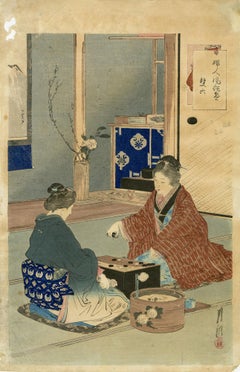
$450
H 12.75 in W 8.63 in
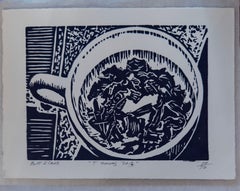
T leaves
Located in New York, NY
Edition 19/50
Category
2010s Monoprint Interior Prints
Materials
Woodcut
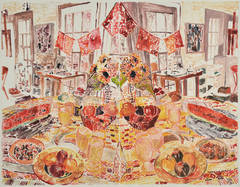
Lunch in the Studio
Located in Dallas, TX
Dallas artist Gail Norfleet is best known for her color monotypes, paintings, collages, and paintings on glass. Norfleet earned her BFA at The University of Texas, Austin, and her MFA at Southern Methodist University. Among others, she has had solo exhibitions in Dallas at The McKinney Avenue Contemporary and the former Delahunty and DW Galleries.
Gail’s studio and the studios where she teaches serve as the settings for her recent body of work titled "The Studio." The studio is a rich visual environment that has inspired artists for centuries. Gail’s studio is strung with brightly colored Mexican papel picado...
Category
21st Century and Contemporary Contemporary Monoprint Interior Prints
Materials
Monotype, Paper
Brave New World 1, dramatic, black & white Ashcan, Americana
By Tom Bennett
Located in Brooklyn, NY
Dramatic imagery from Tom Bennett’s series of black and white monotypes, blending surrealistic mindscapes with stark realism
About Tom Bennett:
With quick brushstrokes, Tom Bennett ...
Category
2010s American Realist Monoprint Interior Prints
Materials
Archival Paper, Monotype
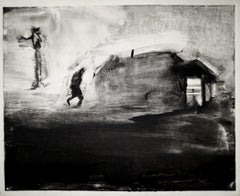
House by the River, dramatic, black & white, noir, mystery, genre
By Tom Bennett
Located in Brooklyn, NY
Dramatic imagery from Tom Bennett’s series of black and white monotypes, blending surrealistic mindscapes with stark realism
About Tom Bennett:
With quick brushstrokes, Tom Bennett ...
Category
2010s Surrealist Monoprint Interior Prints
Materials
Monotype
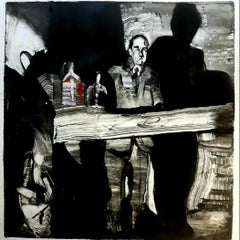
Monoprint interior prints for sale on 1stDibs.
Find a wide variety of authentic Monoprint interior prints available on 1stDibs. While artists have worked in this medium across a range of time periods, art made with this material during the 21st Century is especially popular. If you’re looking to add interior prints created with this material to introduce a provocative pop of color and texture to an otherwise neutral space in your home, the works available on 1stDibs include elements of blue, purple and other colors. There are many well-known artists whose body of work includes ceramic sculptures. Popular artists on 1stDibs associated with pieces like this include Jonathan Moss, Rosemary Farrer, Walter Bachinski, and Carol Summers. Frequently made by artists working in the Contemporary, Abstract, all of these pieces for sale are unique and many will draw the attention of guests in your home. Not every interior allows for large Monoprint interior prints, so small editions measuring 0.1 inches across are also available Prices for interior prints made by famous or emerging artists can differ depending on medium, time period and other attributes. On 1stDibs, the price for these items starts at $1 and tops out at $250,000, while the average work can sell for $796.