Arthur Kampf

German, 1864-1950

Arthur Kampf was a German history painter, associated with the Düsseldorf school of painting, began study under Peter Janssen, at the Kunstakademie Düsseldorf from 1879–81. After completing his education, he began the professor career and also became a member of the Prussian Academy of Arts, and gave drawing lessons, notably to Prince August Wilhelm, son of Wilhelm II. In 1944, Kampf was one of 24 artists, architects, authors, composers, actors, and singers added to the Special list of the Gottbegnadeten list, meaning he was considered indispensable.  Kampf's work is most strongly associated with the genre of traditional history painting though throughout his lifetime he explored styles influenced by Impressionism and Art Nouveau.

to
2
Overall Width
to
Overall Height
to
2
1
2
2
2
1
1
1
1
1
1
2
10,777
2,839
2,494
1,414
2
Artist: Arthur Kampf
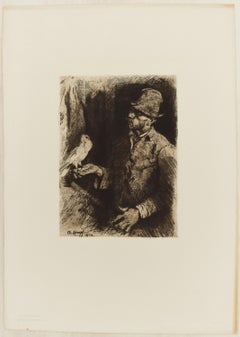
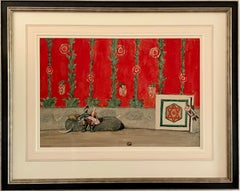
Taubenliebhaber (Pigeon Fanciers) - Original Etching by Arthur Kampf - 1904

Taubenliebhaber (Pigeon Fanciers) - Original Etching by Arthur Kampf - 1904

By Arthur Kampf

Located in Roma, IT

Taubenliebhaber is a black and white etching on ivory-colored paper, realized by the German artist, Arthur Kampf. Signed and dated on plate on lower left margin. From the portfolio “Deutscher Kunstverein zu Berlin “ published by Vereinsgabe, Berlin, in 1904-1905 and composed by a frontispiece, a index, and eleven etchings by Karl Koepping, Leopold Graf Kalckreuth, Hans Herrmann, Max Slevogt, Ludwig Hofmann, Reinhold Lepsius...

Category

Early 1900s Arthur Kampf

Materials

Etching

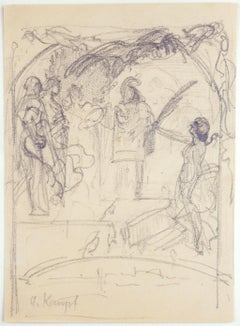
Study for an allegory of victory /  - A virtuoso victory -

Study for an allegory of victory / - A virtuoso victory -

By Arthur Kampf

Located in Berlin, DE

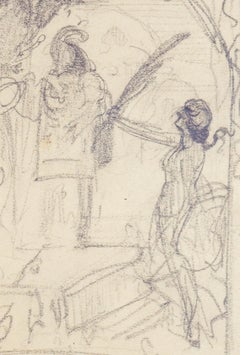
Arthur Kampf (1864 Aachen - 1950 Castorp-Rauxel), Study to an allegory of victory, around 1900. Pencil on paper, 21 cm x 18 cm, signed lower left "A. Kampf". - slightly darkened, otherwise in good condition - A virtuoso victory - About the artwork The vertical-format sketch illustrates a plateau to which a staircase leads up from the right. Arthur Kampf thus takes up a typical baroque disposition for the depiction of allegories. And indeed, a female figure climbs the steps to hand the palm of victory to a figure that is probably also female. Other persons standing on the plateau pay homage to her, whereby the figure on the left edge of the picture may represent a warrior. The scene is framed by an ornamentally decorated arch field, which additionally emphasizes the allegorical-historical content of the depiction. An arch can also be seen under the staircase, suggesting that this may be a design for a supraport. The sheet could have been created in the wake of Arthur Kampf's appointment in 1899 as head of the studio for history painting at the Berlin Art Academy. The drawing style, which only outlines the idea of the picture and yet is determined by concise lines, corresponds to the sketchiness of the Baroque and testifies to Arthur Kampfs intensive study of this heyday of history painting. About the artist Arthur Kampf was the son of the Aachen painter and imperial court photographer August Kampf. His older brother Eugen and his son Herbert were also painters. Arthur Kampf studied at the Düsseldorf Academy of Art from 1879 under Eduard von Gebhardt and Peter Janssen the Elder, whose master pupil he was from 1883 to 1891. Influenced by the naturalistic paintings of Jules Bastien-Lepage, which Kampf saw on a trip to Paris in 1885, he created the painting "The Last Statement" in 1886, which was based on a personal experience. It shows a man mortally wounded by knife wounds. The oppressive drasticness of the almost life-size depiction caused a sensation and controversial criticism. The first successes were achieved: At the Berlin Jubilee Exhibition of 1886, Kampf received an honorable mention, and at the Munich Annual Exhibition of 1890, he was awarded a gold medal. Between 1886 and 1936, Kampf participated in all the major German exhibitions. In 1887 the artist painted his first fresco, which was the beginning of a series of monumental compositions. With the highly successful painting "The Burial of the Corpse of Kaiser Wilhelm I in the Berlin Cathedral" (1888), Kampf established himself as a painter of contemporary history, following in the footsteps of Adolph von Menzel, whose oeuvre he immediately took up with the painting "Speech by Frederick the Great to His Generals in Koeben" (1893). The pictures of his Liberation War cycle were included in school textbooks and distributed in large editions as postcards. As for his academic career, Kampf became an assistant professor at the Düsseldorf Academy of Art in 1887, and in 1894 he was appointed professor of the class for antiquities and nature, and in 1897 he became head of the painting class. In 1899 Kampf was appointed director of the history painting studio at the Berlin Academy of Art. In 1901 he became a full member of the academy and was its president from 1907 to 1912. As Anton von Werner's successor, Kampf directed the Academy of Fine Arts in Charlottenburg from 1915 to 1925. Among his monumental works is the painting of the assembly hall of the Aachen town hall, done between 1898 and 1902. It focuses on the social welfare of the state and the work of the people. Important subsequent commissions include the painting of the reading room of the new Royal Library in Berlin and the new auditorium of the University of Berlin with "Fichte's Speech to the German Nation". During World War I, at the request of General Ewald von Lochow, Kampf traveled to the Western theaters of war, including Warsaw in 1916. In addition to painting, Kampf was also intensively involved in printmaking and, together with his brother Eugen and artist friends such as Alexander Frenz and Olof Jernberg, was considered an innovator of lithography in Düsseldorf. From 1913 on, he worked continuously as an illustrator of historical works and literary classics such as Shakespeare and Goethe. Kampf remained a recognized artist after 1933. On the occasion of the retrospective of his complete works at the "Great German Art Exhibition", he was awarded the "Eagle Shield of the German Reich". During the final phase of World War II, Kampf was placed on Hitler's "Gottbegnadetenliste," which protected him from military service. After World War II, Kampf, whose work was largely destroyed, fell into obscurity. Arthur Kampf belonged to numerous artists' associations. He was a member of the "Rheinisch-Westfälischer Künstlerbund", the "Society of German Watercolorists", the "Association of German Illustrators", the "Malkasten", the "Künstlerclub St. Lucas", the "Düsseldorfer Künstlerbund", the "Freie Vereinigung Düsseldorfer Künstler" and the "Berliner Künstlerbund". Arthur Kampf's sister was married to the painter Alexander Frenz. "Kampf's public recognition in the German Empire later led to his being one-sidedly labeled as a history painter and representative of the Wilhelmine era. This classification does not do justice to the artist's oeuvre as a whole. His early talent did not experience a rapid development later on, but it reached an ever greater mastery in the sense of an impressively relaxed realism and extended thematically beyond history. Kampf was also an excellent draughtsman, etcher and lithographer. Many of his works have been destroyed or lost, and some lead a shadowy existence in museum storerooms." - Otto Zirk "His importance as a Wilhelminian painter and cultural politician has been forgotten in favor of an exaggerated reception of his work during the Third Reich. - Andreas Schroyen Selection of public collections that own works by Arthur Kampf: Altonaer Museum Hamburg, Berlinische Galerie, Burg Frankenberg Aachen, Busch-Reisinger Museum Cambridge/Mass., Deutsches Historisches Museum Berlin, Government Art Collection London, Kulturhistorisches Museum Magdeburg, Kunsthalle Hamburg, Museum für Kunst- und Kulturgeschichte Dortmund, Museum Kunstpalast Düsseldorf, Neue Nationalgalerie Berlin, Suermondt-Ludwig-Museum Aachen, Van der Heydt-Museum Wuppertal. Selected Bibliography Hans W...

Category

Early 20th Century Realist Arthur Kampf

Materials

Paper

Related Items
Gun from Clue
Gun from Clue

A.J. FriesGun from Clue, 2016

$1,200

H 11 in W 14 in

Gun from Clue

By A.J. Fries

Located in Buffalo, NY

An original mixed media drawing by American artist A.J. Fries.

Category

21st Century and Contemporary Realist Arthur Kampf

Materials

Gouache, Graphite, Paper

Wassily Kandinsky - Horse Knight - Original Etching

Wassily Kandinsky - Horse Knight - Original Etching

By Wassily Kandinsky

Located in Collonge Bellerive, Geneve, CH

Wassily Kandinsky - Horse Knight - Original Etching 32 x 24 cm 1966 From the art review XXe siècle, San Lazzaro Unsigned and unumbered as issued

Category

1960s Abstract Geometric Arthur Kampf

Materials

Etching

Billingsgate
Billingsgate

Billingsgate

By James Abbott McNeill Whistler

Located in Middletown, NY

Etching printed in dark brownish black ink on cream laid paper, 6 x 8 7/8 inches (152 x 226 mm); full margins. Extremely minor and unobtrusive band of toning along the top sheet edg...

Category

Mid-19th Century Impressionist Arthur Kampf

Materials

Laid Paper, Drypoint, Etching

Temptation of St. Anthony

Temptation of St. Anthony

By Hendrik Goltzius

Located in North Clarendon, VT

Temptation of Saint Anthony an etching in the manner of Hendrik Goltzius. Goltzius was born near Viersen in Bracht or Millebrecht, a village then in the Duchy of Julich, now in the ...

Category

16th Century Baroque Arthur Kampf

Materials

Etching

Temple of Vesta
Temple of Vesta

Matthew DubourgTemple of Vesta, 1820

$350

H 11.42 in W 14.73 in

Temple of Vesta

By Matthew Dubourg

Located in Middletown, NY

London: J. Taylor, 1820. Etching with aquatint and engraving with hand coloring in watercolor on watermarked J Whatman Turkey Mill 1843 paper with a gilded edge, 11 1/2 x 14 3/4 inc...

Category

Mid-19th Century English School Arthur Kampf

Materials

Watercolor, Handmade Paper, Engraving, Etching, Aquatint

Serpentine (blue) - Contemporary, Abstract, Figure, Women, fragile

Serpentine (blue) - Contemporary, Abstract, Figure, Women, fragile

By Georg Baselitz

Located in Köln, DE

Aquatint in colours with sugar lift "Serpentine" (blue) by Georg Baselitz from 2022/23. The edition on Somerset White Satin comprises 50 copies in blue / 50 copies in green. The ...

Category

2010s Contemporary Arthur Kampf

Materials

Color, Etching, Aquatint

Untitled
Untitled

John ButtonUntitled, 1971

$1,500

H 13.5 in W 10.5 in

Untitled

By John Button

Located in New York, NY

Graphite on paper Dated in pencil, l.r. This artwork is offered by ClampArt, located in New York City. John Button (1929-1982) was a fine draftsman and drew from life models throug...

Category

1970s Realist Arthur Kampf

Materials

Paper, Graphite

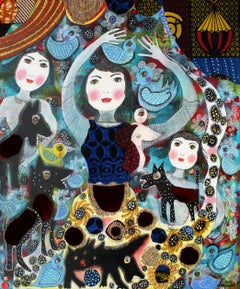
The Prince and the Siren, Watercolor & Gouache, Nocturne, Figural, Illustration

The Prince and the Siren, Watercolor & Gouache, Nocturne, Figural, Illustration

Located in Wiscasset, ME

John Richard Flanagan was born in Sydney, Australia. At the age of thirteen Flanagan left school to help support his family as an assistant to a lithographer producing advertising co...

Category

20th Century Realist Arthur Kampf
Materials

Paper, Watercolor, Gouache

Untitled #187

John ButtonUntitled #187, 1969

$1,500

H 11 in W 14 in

Untitled #187

By John Button

Located in New York, NY

Graphite on paper Dated in pencil, l.r. Numbered 187 in pencil, verso This artwork is offered by ClampArt, located in New York City. John Button (1929-1982) was a fine draftsman an...

Category

1960s Realist Arthur Kampf

Materials

Graphite, Paper

Untitled #238

Untitled #238

By John Button

Located in New York, NY

Graphite on paper Numbered 238 in pencil, verso This artwork is offered by ClampArt, located in New York City. John Button (1929-1982) was a fine draftsman and drew from life model...

Category

Late 20th Century Realist Arthur Kampf
Materials

Graphite, Paper

Untitled #257

John ButtonUntitled #257, 1974

$1,500

H 14 in W 10.75 in

Untitled #257

By John Button

Located in New York, NY

Graphite on paper Dated in pencil, l.r. Numbered 257 in pencil, verso This artwork is offered by ClampArt, located in New York City. John Button (1929-1982) was a fine draftsman an...

Category

1970s Realist Arthur Kampf

Materials

Graphite, Paper

Figure Study
Figure Study

Osmar SchindlerFigure Study, Unknown

$9,241

H 26.78 in W 18.9 in

Figure Study

Located in London, GB

Coloured and black chalk on paper Stamp ‘NACHLASS Osmar Schindler 1867-1927’. 58cm x 36cm, (68cm x 48cm framed) Osmar Schindler was a German painter ...

Category

Early 19th Century Realist Arthur Kampf
Materials

Paper, Chalk

Arthur Kampf art for sale on 1stDibs.
Find a wide variety of authentic Arthur Kampf available for sale on 1stDibs. You can also browse by medium to find art by Arthur Kampf in etching, paper and more. Not every interior allows for large Arthur Kampf, so small editions measuring 8 inches across are available. Customers who are interested in this artist might also find the work of Hans Juergen Diehl, Albert Decaris, and Georg Andreas Böckler. Arthur Kampf prices can differ depending upon medium, time period and other attributes. On 1stDibs, the price for these items starts at $515 and tops out at $1,058, while the average work can sell for $786.
Artists Similar to Arthur Kampf