Camille Bryen More Art
French, 1907-1977
Camille Bryen, pseudonym of Camille Briand, was born in Nantes on 17 September 1907.
He was a member of the Nouvelle École de Paris and belonged to the currents of lyrical abstraction and tachism. In the years 1925-1927, Camille Briand was part of the Nantes bohemian scene, using the pseudonym "Aristide", no doubt in allusion to his illustrious namesake, also of Nantes origin. He appeared on the cover of the Revue nantaise in April 1927, portrayed by Henri Bouyer, with the comment: "Type nantais, le Bohème Aristide".
In the years 1925-1927, Camille Briand was part of the Nantes bohemian scene, using the pseudonym "Aristide", no doubt in allusion to his illustrious namesake, also of Nantes origin. He appeared on the cover of the Revue nantaise in April 1927, portrayed by Henri Bouyer, with the comment: "Type nantais, le Bohème Aristide".In 1948, he organised the first exhibition of "lyrical abstraction" in which Hans Hartung, Wols, Gérard Schneider and Georges Mathieu took part. He then turned to engraving and, in 1949, oil painting. In 1950, he published Héréphile and then turned away from literature to devote himself entirely to painting and engraving.
From the 1950s onwards, Bryen regularly held solo exhibitions in France and abroad and took part in numerous salons, biennials and group exhibitions. In his work, always free of allusion, the discreet fields of colour, structured by fine sprays, create a poetic climate that ensures its originality.
He died in Paris on 8 May 1977.
As a tribute to Bryen, a stamp reproducing one of his works, Précambrien, was issued by the French Post Office on 14 September 1987 (value 5 francs).
Bryen was one of the painters included in the exhibition "L'envolée lyrique, Paris 1945-1956" presented in Paris at the Musée du Luxembourg in 2006.to
2
Overall Width
to
Overall Height
to
2
2
1
1
2
2
2
13
318
229
121
117
2
Artist: Camille Bryen
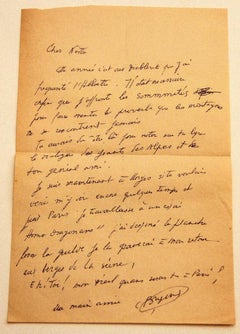
Letter by Camille Bryen to Nesto Jacometti - Mid-20th Century
By Camille Bryen
Located in Roma, IT
Letter written by Camille Bryen to Nesto Jacometti, with no date (most probably 1950s or early 1960s) and is written in French.
Category
1960s Modern Camille Bryen More Art
Materials
Paper, Ink
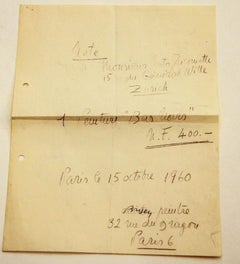
Letter by Camille Bryen to Nesto Iacometti - 1960
By Camille Bryen
Located in Roma, IT
The letter describes the note of a payment related to the sale of one of Bryen's paintings.
Category
1960s Contemporary Camille Bryen More Art
Materials
Paper, Ink
Related Items
Horse, Ink on Paper by Indian Modern Artist Sunil Das "In Stock"
By Sunil Das
Located in Kolkata, West Bengal
Sunil Das - Horse - 9 x 6 inches ( unframed size )
Ink on Paper, 2012
Inclusive of shipment in ready to hang condition.
Sunil Das ( 1939-2015) was a Master Modern Indian Artist fr...
Category
Early 2000s Modern Camille Bryen More Art
Materials
Paper, Ink
$1,169 Sale Price
58% Off
H 9 in W 6 in D 1 in
"No. 3080" Miniature Collage Currency by Michael Pauker
By Michael Pauker
Located in Soquel, CA
"No. 3080" Miniature Collage Currency by Michael Pauker
Miniature abstract paper collage by Bay Area artist Michael Pauker (American, b. 1957). This pie...
Category
Early 2000s Contemporary Camille Bryen More Art
Materials
Paper, Ink
$425
H 10 in W 8 in D 0.25 in
Homage To Chanel, 5"x5" Artwork, 10"x10" Frame, Black White Red, Christmas Gift
By Andrea Stajan-Ferkul
Located in Mississauga, Ontario
HOMAGE TO CHANEL - This original artwork on paper combines layered brushstrokes with textile collage elements. Surrounded by heavy texture, the focal point is a detailed Chanel logo ...
Category
2010s Contemporary Camille Bryen More Art
Materials
Mixed Media, Acrylic, Textile, Ink, Archival Paper
$487 Sale Price
25% Off
H 10 in W 10 in D 2 in
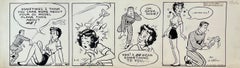
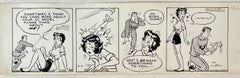
Rare 1950s Vintage Syndicated Ink Drawing Cartoon Strip Susie Q Smith Comic Art
Located in Surfside, FL
SUSIE Q. SMITH
Medium: Newspaper comics
Distributed by: King Features Syndicate
First Appeared: 1945
Creators: Linda and Jerry Walter
5.5 X 19.5
Dated August 13, 1954 in top right corner.
Like her contemporaries, Aggie Mack, Candy and Patsy Walker (before her conversion to a superhero), Susie Q. Smith was a female Archie-type — not exactly an imitator, because Archie, who had started only four years earlier, hadn't yet become popular enough to spawn imitators, but part of his genre. She attended high school, where her teachers often seemed unreasonable to her, interacted with the opposite gender in a typically adolescent way, and her parents didn't completely understand her. And she was cute and perky as only a teenage girl can be.
Susie was the star of a comic strip distributed by King Features, the biggest of the comic strip syndicates, whose other offerings have ranged from Jackys Diary to Prince Valiant. King launched the strip in both daily and Sunday form in 1945. Daily, she was only in a panel at first, but it expanded into a full, multi-panel strip on February 7, 1953. In a very odd turn of events, in 1953 the Walters chose to leave King Features behind and hitch their wagon at the McNaught Syndicate. The creators were Harold "Jerry" Walter and his wife, Linda. Jerry was also responsible for Jellybean Jones, who has nothing to do with Jughead Jones's young sister, a modern-day addition to the Archie cast of characters. Together, they did The Lively Ones during the 1960s. Though each was capable of doing both major jobs in comic strip production, their usual working method was for Jerry to dream up the ideas and write the dialog, while Linda did the artwork.
The Walters also collaborated on a series of Susie Q. Smith comic books for Dell Comics. Instead of reprinting newspaper strips, these ran new stories by the Walters. Between 1951 and '54, four issues were published as part of the Four Color Comics series, where many minor comic strips, including Dotty Dripple, Timmy and Rusty Riley had found a home. It had no other media spin-offs.
Susie Q. Smith had a respectable run in the newspapers, but it ended in 1959.
Jerry Walter (1915 - 2007) was an abstract expressionist artist whose output of energetic and colorful paintings were the products of the rich artistic milieu of post-war New York City. He was born Harold Frank Walter in Mount Pleasant, Iowa on November 25, 1915. After graduating from Colgate University in 1937, Walter moved to New York City, where he studied drawing and painting at the New School and the Art Students’ League. Before concentrating seriously on his art, he spent several years as a successful copywriter and idea man for the advertising agencies of J. Walter Thompson, McCann Ericson, and BBDO. During this time, he also worked as a syndicated cartoonist. Collaborating with his wife, Linda, his best-known series was Susie Q. Smith, which first appeared in 1945 and described as a “female Archie type.” Very popular, the cartoon was later the subject of a series of comic books published from 1951 to 1954. After serving in the United States Army for three years during World War II, Walter began to paint seriously. He ascribed his earliest artistic influence to Joan Miró, whose Dog Barking at the Moon (1926) he viewed when he was twelve, the year he published his first cartoon. Walter later wrote that jazz, “the first native expression of so-called modernism” was a strong influence on his work.
During the later 1940s, Walters spent time at the Research Studio in Maitland, Florida. Founded in 1937 by artist and architect J. André Smith and supported by the philanthropist Mary Curtis Bok, the Research Studio was a lively colony that hosted prominent artists, including Milton Avery, Ralston Crawford, and Doris Lee. While at the Studio, Walter’s work was purchased by Frank Crowninshield. A founding trustee of the Museum of Modern Art and editor of Vanity Fair, Crowinshield was a noted collector; his collection included important works by Pablo Picasso, Marc Chagall, Henri Matisse, Edgar Degas, George Bellows, and Pierre Bonnard. Returning to New York after his time at the Studio, Walter became an active member of the New York school of the abstract expressionist movement, and in the summer of 1956, Walter exhibited 13 paintings and a selection of drawings at New York’s Chase Gallery. The adroit manipulation of both color and composition evident in his work shows the influence of Abstract Expressionism, particularly Willem de Kooning, Arshile Gorky, and Hans Hofmann.
illustrator and female cartoonist Linda Walter was the talented female mind behind the beloved "Susie Q. Smith" comic strip. She played an instrumental role in shaping the cultural landscape through her vibrant illustrations. Known for the timeless charm of the "Susie Q. Smith" comic strip, Linda's artistry brought joy and laughter to countless readers during the 1950s and continues to resonate with fans across generations. She was part of the Woodstock artists community. from Women in Comics: Linda Walter was the artist of newspaper strip Susie Q. Smith, which was written by her husband, Jerry. It was syndicated by King Features Syndicate and ran from 1945 to 1959. The Walters also contributed original Susie Q. Smith stories to Dell's Four Color comic books from 1951 to 1954. From 1964-1965, they created a singled panel comic called The Lively Ones.
Vintage Golden Age of Comics era.
The Golden Age of Comic Books describes an era in the history of American comic books from 1938 to 1956. During this time, modern comic books were first published and rapidly increased in popularity. The superhero archetype was created. Between 1939 and 1941 Detective Comics (DC) and its sister company, All-American Publications, introduced popular superheroes such as Batman and Robin, Wonder Woman, the Flash, Green Lantern, Doctor Fate, the Atom, Hawkman, Green Arrow and Aquaman. Timely Comics, the 1940s predecessor of Marvel Comics, had million-selling titles featuring the Human Torch, the Sub-Mariner, and Captain America. Another notable series was The Spirit by Will Eisner.
Dell Comics' non-superhero characters (particularly the licensed Walt Disney animated-character comics) outsold the superhero comics of the day. The publisher featured licensed movie and literary characters such as Mickey Mouse, Donald Duck, Roy Rogers and Tarzan. Additionally, MLJ's introduction of Archie Andrews in Pep Comics #22 (December 1941) gave rise to teen humor comics, with the Archie Comics...
Category
1950s American Modern Camille Bryen More Art
Materials
Paper, Ink
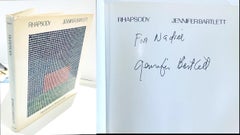
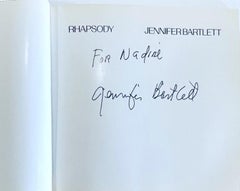
Rhapsody, hardback monograph (Hand signed and inscribed by Jennifer Bartlett)
By Jennifer Bartlett
Located in New York, NY
Jennifer Losch Bartlett
Rhapsody (hand signed and inscribed), 1985
Hardback monograph with dust jacket (hand signed and inscribed to Nadine)
Hand signed and inscribed in black marker "for Nadine" by Jennifer Bartlett on the half title page
12 × 12 × 1 inches
Provenance
signed for the present owner at Paula Cooper Gallery on January 21, 2016
This substantial, lavishly illustrated hardback monograph with dust jacket, was hand signed by Jennifer Bartlett for the present owner at Paula Cooper Gallery on January 21, 2016.
Makes an excellent gift
Book information:
Publisher: Harry N Abrams (November 1, 1985)
English; Hardcover; 108 pages with color illustrations
Editorial Review:
Rhapsody'' is Bartlett's multi-part, multi-theme epic, a statement of the coming of age of an artist. A portable mural extended over 987 one-foot steel plates requiring 153 running feet of wall space, it is an enormous and infrequently mastered challenge to install and exhibit. In 1985-86, however, it will be on view in Minneapolis, Kansas City, Brooklyn, La Jolla, and Pittsburgh, and well worth a trip. In book form it becomes more available, with Smith's guided tour through sections, with Bartlett's notes giving conceptual coherence, and the opportunity to move from close-up to long view by turning a page. Rhapsody'' and this book afford a glimpse of a mind and art in action, a discovering and ordering process, an exciting demonstration of ways of growing and expressing the self and the world. Highly recommended.
About Jennifer Bartlett:
By the mid-1970s, Jennifer Bartlett (1941-2022, b. Long Beach, California) had emerged as a leading American artist of her time—particularly following the landmark presentation at Paula Cooper Gallery of Rhapsody (1976), Bartlett’s magnum opus, now in the collection of the Museum of Modern Art, New York. Bartlett’s first survey exhibition was held in 1985 at the Walker Art Center, Minneapolis, and traveled to the Brooklyn Museum, New York, and the Carnegie Museum of Art, Philadelphia, among others. In 2006, the Addison Gallery of American Art surveyed Bartlett’s early enameled steel plate paintings in the period from 1968–76. In 2013-14, Klaus Ottmann curated her second traveling survey, which visited the Pennsylvania Academy of the Fine Arts and the Parrish Art Museum, New York. In 2014, the Cleveland Museum of Art united her three monumental plate...
Category
1980s Contemporary Camille Bryen More Art
Materials
Paper, Ink, Mixed Media, Lithograph, Offset
Jennifer BartlettRhapsody, hardback monograph (Hand signed and inscribed by Jennifer Bartlett), 1985
$800
H 12 in W 12 in D 1 in
Material Logo Poster
By Margaret Kilgallen
Located in Washington , DC, DC
After Margaret Kilgallen. Limited edition poster of 100 with stamp en verso.
Category
21st Century and Contemporary Contemporary Camille Bryen More Art
Materials
Paper, Ink
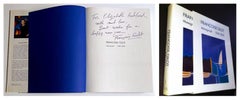
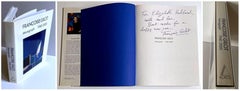
Francoise Gilot Monograph 1940-2000 (hand signed and inscribed to famed actress)
By Françoise Gilot
Located in New York, NY
Françoise Gilot
Francoise Gilot Monograph 1940-2000 (hand signed and warmly inscribed to renowned actress), 2000
Hardback monograph in a slipcase, hand signed and inscribed by Franco...
Category
Early 2000s Modern Camille Bryen More Art
Materials
Paper, Ink, Mixed Media, Lithograph, Offset
$1,500
H 5.1 in W 3.9 in D 0.8 in
Philip Treacy hardback book, hand signed by Philip Treacy, milliner to the stars
Located in New York, NY
Philip Treacy hardback book (hand signed by Philip Treacy), 2013
Hardback monograph with dust jacket (hand signed by legendary milliner Philip Treacy)
hand signed by Philip Treacy on the half title page
11 × 8 1/2 × 1 inches
Hand signed by Philip Treacy on the half title page.
Book information:
Publisher: Phaidon Press (February 5, 2013)
English; Hardcover; 200 pages with over 200 photographs
Review
"Lovely... All the most iconic designs are here."―The Observer
"How did one man change our minds on headgear? Philip Treacy by Kevin Davies celebrates [...] backroom moments of Treacy's career, no less striking than the headpieces he creates... The unseen stories behind all the 'moments'."―The Independent
"An usually revealing insight into the designer's work."―Harper's Bazaar
"Revealing [...] photos of Treacy at work. He looks determined and serious, but he has a kind face and he's never a poseur... In short, this is a cool book about a great guy."―VICE
"The head-topper extraordinaire gets a tip of the cap in the new book... Featuring over 200 images of the milliner's museum-quality lids, including head-turning snaps of mega-fierce singer and Bond villainess Grace Jones."―InStyle
"Inside the pages are 200 intimate pictures covering everything from Treacy's years at 69 Elizabeth Street to the scene backstage at fashion shows to the dignified funeral held for Treacy's beloved Jack Russell terrier, Mr. Pig."―The New York Times Style Magazine blog
More about Philip Tracey...
Category
2010s Contemporary Camille Bryen More Art
Materials
Paper, Ink, Mixed Media, Lithograph, Offset
$195
H 11 in W 8.5 in D 1 in
Lt Ed Hand SIGNED Book: Mario Testino Private View Bi-Lingual (Chinese-English)
By Mario Testino
Located in New York, NY
Mario Testino Private View Bi-Lingual (Chinese-English), hand signed and stamp numbered, 2012
Limited Collector's Edition Hardback Monograph with Lenticular Cover portrait of Lady Ga...
Category
2010s Contemporary Camille Bryen More Art
Materials
Plastic, Paper, Acrylic Polymer, Ink, Mixed Media, Lithograph, Offset
$1,200
H 22.75 in W 18.25 in
"No. 2710" Small Collage Currency by Michael Pauker
By Michael Pauker
Located in Soquel, CA
Small abstract paper collage in teal and white by Bay Area artist Michael Pauker (American, b. 1957). This piece is created from a few pieces of antique...
Category
Early 2000s Contemporary Camille Bryen More Art
Materials
Paper, Ink, Printer's Ink
$425
H 16 in W 12 in D 0.25 in
Monograph: GERHARD RICHTER PORTRAITS (official hand signed book - 1 of only 50)
By Gerhard Richter
Located in New York, NY
Gerhard Richter
GERHARD RICHTER PORTRAITS (official hand signed copy), 2009
Hardback monograph with dust jacket (official hand signed copy)
Hand signed by Gerhard Richter on the titl...
Category
Early 2000s Contemporary Camille Bryen More Art
Materials
Paper, Ink, Mixed Media, Lithograph, Offset
Gerhard RichterMonograph: GERHARD RICHTER PORTRAITS (official hand signed book - 1 of only 50), 2009
$4,000
H 13.75 in W 10.25 in D 2.5 in
Vintage Golden Age Syndicated Ink Drawing Cartoon Strip Susie Q Smith Comic Art
Located in Surfside, FL
SUSIE Q. SMITH
Medium: Newspaper comics
Distributed by: King Features Syndicate
First Appeared: 1945
Creators: Linda and Jerry Walter
6.5 X 19.5
Like her contemporaries, Aggie Mack, Candy and Patsy Walker (before her conversion to a superhero), Susie Q. Smith was a female Archie-type — not exactly an imitator, because Archie, who had started only four years earlier, hadn't yet become popular enough to spawn imitators, but part of his genre. She attended high school, where her teachers often seemed unreasonable to her, interacted with the opposite gender in a typically adolescent way, and her parents didn't completely understand her. And she was cute and perky as only a teenage girl can be.
Susie was the star of a comic strip distributed by King Features, the biggest of the comic strip syndicates, whose other offerings have ranged from Jackys Diary to Prince Valiant. King launched the strip in both daily and Sunday form in 1945. Daily, she was only in a panel at first, but it expanded into a full, multi-panel strip on February 7, 1953. In a very odd turn of events, in 1953 the Walters chose to leave King Features behind and hitch their wagon at the McNaught Syndicate. The creators were Harold "Jerry" Walter and his wife, Linda. Jerry was also responsible for Jellybean Jones, who has nothing to do with Jughead Jones's young sister, a modern-day addition to the Archie cast of characters. Together, they did The Lively Ones during the 1960s. Though each was capable of doing both major jobs in comic strip production, their usual working method was for Jerry to dream up the ideas and write the dialog, while Linda did the artwork.
The Walters also collaborated on a series of Susie Q. Smith comic books for Dell Comics. Instead of reprinting newspaper strips, these ran new stories by the Walters. Between 1951 and '54, four issues were published as part of the Four Color Comics series, where many minor comic strips, including Dotty Dripple, Timmy and Rusty Riley had found a home. It had no other media spin-offs.
Susie Q. Smith had a respectable run in the newspapers, but it ended in 1959.
Jerry Walter (1915 - 2007) was an abstract expressionist artist whose output of energetic and colorful paintings were the products of the rich artistic milieu of post-war New York City. He was born Harold Frank Walter in Mount Pleasant, Iowa on November 25, 1915. After graduating from Colgate University in 1937, Walter moved to New York City, where he studied drawing and painting at the New School and the Art Students’ League. Before concentrating seriously on his art, he spent several years as a successful copywriter and idea man for the advertising agencies of J. Walter Thompson, McCann Ericson, and BBDO. During this time, he also worked as a syndicated cartoonist. Collaborating with his wife, Linda, his best-known series was Susie Q. Smith, which first appeared in 1945 and described as a “female Archie type.” Very popular, the cartoon was later the subject of a series of comic books published from 1951 to 1954. After serving in the United States Army for three years during World War II, Walter began to paint seriously. He ascribed his earliest artistic influence to Joan Miró, whose Dog Barking at the Moon (1926) he viewed when he was twelve, the year he published his first cartoon. Walter later wrote that jazz, “the first native expression of so-called modernism” was a strong influence on his work.
During the later 1940s, Walters spent time at the Research Studio in Maitland, Florida. Founded in 1937 by artist and architect J. André Smith and supported by the philanthropist Mary Curtis Bok, the Research Studio was a lively colony that hosted prominent artists, including Milton Avery, Ralston Crawford, and Doris Lee. While at the Studio, Walter’s work was purchased by Frank Crowninshield. A founding trustee of the Museum of Modern Art and editor of Vanity Fair, Crowinshield was a noted collector; his collection included important works by Pablo Picasso, Marc Chagall, Henri Matisse, Edgar Degas, George Bellows, and Pierre Bonnard. Returning to New York after his time at the Studio, Walter became an active member of the New York school of the abstract expressionist movement, and in the summer of 1956, Walter exhibited 13 paintings and a selection of drawings at New York’s Chase Gallery. The adroit manipulation of both color and composition evident in his work shows the influence of Abstract Expressionism, particularly Willem de Kooning, Arshile Gorky, and Hans Hofmann.
illustrator and female cartoonist Linda Walter was the talented female mind behind the beloved "Susie Q. Smith" comic strip. She played an instrumental role in shaping the cultural landscape through her vibrant illustrations. Known for the timeless charm of the "Susie Q. Smith" comic strip, Linda's artistry brought joy and laughter to countless readers during the 1950s and continues to resonate with fans across generations. She was part of the Woodstock artists community. from Women in Comics: Linda Walter was the artist of newspaper strip Susie Q. Smith, which was written by her husband, Jerry. It was syndicated by King Features Syndicate and ran from 1945 to 1959. The Walters also contributed original Susie Q. Smith stories to Dell's Four Color comic books from 1951 to 1954. From 1964-1965, they created a singled panel comic called The Lively Ones.
Vintage Golden Age of Comics era.
The Golden Age of Comic Books describes an era in the history of American comic books from 1938 to 1956. During this time, modern comic books were first published and rapidly increased in popularity. The superhero archetype was created. Between 1939 and 1941 Detective Comics (DC) and its sister company, All-American Publications, introduced popular superheroes such as Batman and Robin, Wonder Woman, the Flash, Green Lantern, Doctor Fate, the Atom, Hawkman, Green Arrow and Aquaman. Timely Comics, the 1940s predecessor of Marvel Comics, had million-selling titles featuring the Human Torch, the Sub-Mariner, and Captain America. Another notable series was The Spirit by Will Eisner.
Dell Comics' non-superhero characters (particularly the licensed Walt Disney animated-character comics) outsold the superhero comics of the day. The publisher featured licensed movie and literary characters such as Mickey Mouse, Donald Duck, Roy Rogers and Tarzan. Additionally, MLJ's introduction of Archie Andrews in Pep Comics #22 (December 1941) gave rise to teen humor comics, with the Archie Comics...
Category
1950s American Modern Camille Bryen More Art
Materials
Paper, Ink
Camille Bryen more art for sale on 1stDibs.
Find a wide variety of authentic Camille Bryen more art available for sale on 1stDibs. If you’re browsing the collection of more art to introduce a pop of color in a neutral corner of your living room or bedroom, you can find work that includes elements of orange and other colors. You can also browse by medium to find art by Camille Bryen in ink, paper and more. Much of the original work by this artist or collective was created during the 1960s and is mostly associated with the modern style. Not every interior allows for large Camille Bryen more art, so small editions measuring 8 inches across are available. Customers who are interested in this artist might also find the work of Jean Dubuffet, André Breton, and Jean Cocteau. Camille Bryen more art prices can differ depending upon medium, time period and other attributes. On 1stDibs, the price for these items starts at $223 and tops out at $223, while the average work can sell for $223.