Felix Labisse Art

French, 1905-1982

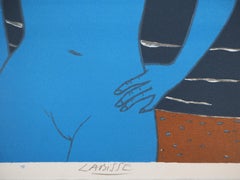
Félix Labisse was a self-taught painter, illustrator and theater designer born in Douai, a small commune in France close to the Belgian border. In Douai, Labisse studied at the Collège Saint Jean and later enrolled at the École de Pêche in Ostend, a city on the Belgian coast. Labisse was closely associated with the Expressionist painter James Ensor, whom he met on a visit to Ostend in 1922. Subsequently, Labisse’s early works are anchored in Flemish Expressionism under the influence of Ensor. In his later works, Labisse developed his own aesthetic, exploring the boundaries between fantasy, ritual, magic and eroticism. He experimented with perspective and used motifs such as naked women and hybrid beasts in fantastical settings. Labisse also met the filmmaker Henri Storck, and they founded the Club du Cinéma d’Ostende, which disseminated avant-garde films by Man Ray, Carl Dreyer and Fritz Lang.

Beginning in 1927, Labisse divided his time between Paris and Ostend, becoming a major French painter. His first exhibition, which gained him critical acclaim, took place at the Ostend Gallery of Modern Art in July 1928. In 1933, Labisse settled in Paris and produced the set and costumes for Autour d’une Mère at the Théâtre de l’Atelier. In Paris, he became part of the Surrealist milieu, meeting André Masson, Max Ernst, Raymond Queneau, René Magritte and Paul Delvaux. It was in 1938 that Labisse fully established his career as a painter after his exhibition at the Palais des Beaux-Arts in Brussels. In 1947, the French filmmaker Alain Resnaise created a short film starring Labisse in his studio titled Visite à Félix. Labisse was also a successful illustrator, producing drawings for the books Le Bain avec Andromède (1944) and Histoire Naturelle (1948) by Robert Desnos. His subjects included creatures such as the cyclops and the medieval French Guivre — a serpentine creature.

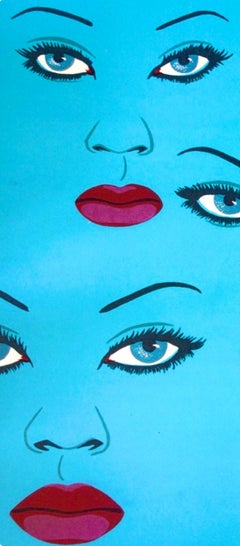
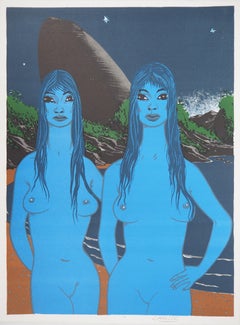
By 1951, Labisse moved to Neuilly-sur-Seine, where he would later die. Closely linked to Surrealism — a movement to which he never completely adhered too — Labisse is perhaps most recognized for his 1960s series of austere, blue goddess-like women. Interestingly, his political differences estranged him from the writer André Breton, a communist who was the founder of Surrealism and author of the Surrealist Manifesto. Remaining on the sidelines of Breton’s movement, Labisse continued to explore the limits of his imagination through painting. In 1957, Labisse published his Le Sorcier des Familles: Almanach Fatidique, featuring texts and illustrations in the layout of a calendar. He earned the respect of Breton, who wrote to him: "Beyond what may have sometimes divided us, let me tell you that I greatly appreciate your Sorcier des Familles […] This is a surrealist book, as I see it. My warmest compliments."

Labisse had his first retrospective in July 1960 at Knokke Casino in Belgium, where he exhibited 105 paintings. In 1966, he was elected a member of the Académie des Beaux-Arts in France, and in 1974, he became a member of the jury at the Cannes festival. Labisse maintained a lifelong friendship with Ensor that is immortalized in the painting Bonjour M. Ensor (1964).

(Biography provided by Stern Pissarro Gallery)

to
3
4
2
Overall Width
to
Overall Height
to
6
5
1
3
2
1
6
3
2
1
1
1
1
1
1
1
3
3
7
10,138
2,779
1,375
1,369
4
2
Artist: Felix Labisse
Fly - Original Serigraph by Félix Labisse - 1970s
By Felix Labisse
Located in Roma, IT
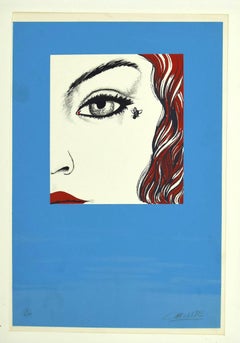
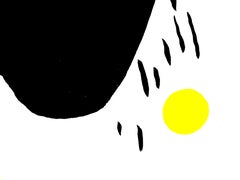
Fly is a colored serigraph on paper realized by the French artist Félix Labisse. Hand-signed in pencil on the lower right margin. Numbered in pencil on the lower left margin. Editio...
Category

1970s Modern Felix Labisse Art

Materials

Screen

Composition, Variations sur l'imaginaire, Félix Labisse
By Felix Labisse
Located in Southampton, NY
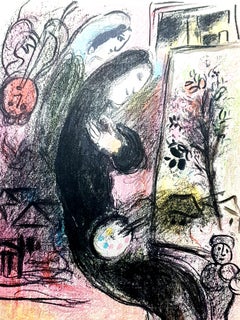
Lithograph on vélin de Rives paper. Inscription: hand signed and unnumbered, as issued. Good condition. Notes: From the folio, Variations sur l'imaginaire, 1972. Published by Philipp...
Category

1970s Surrealist Felix Labisse Art

Materials

Lithograph

Three Nudes - Original handsigned lithograph - 100 ex (Mourlot)
By Felix Labisse
Located in Paris, IDF
Felix LABISSE Three Nudes Original lithograph Handsigned Numbered / 100 ex On vellum 70 x 50 cm (c. 28 x 20 inch) Excellent condition
Category

1970s Modern Felix Labisse Art

Materials

Lithograph

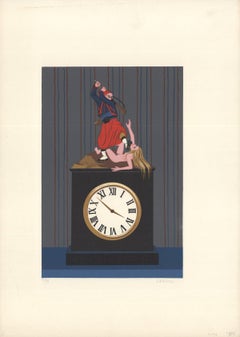
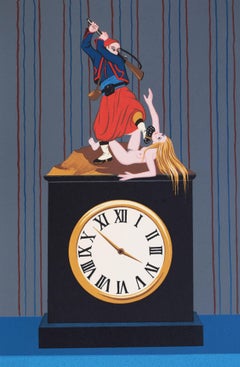
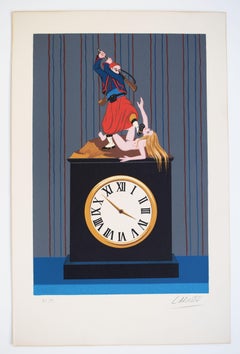
1980 Felix Labisse 'L'Horloge (The Clock)' Surrealism, France
By Felix Labisse
Located in Brooklyn, NY
Paper Size: 24.5 x 17.5 inches ( 62.23 x 44.45 cm ) Image Size: 15.25 x 10.25 inches ( 38.735 x 26.035 cm ) Framed: No Condition: B-: Good Condition, Signs of Handling and Age ...
Category

1980s Contemporary Felix Labisse Art

Materials

Lithograph

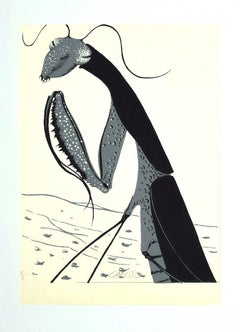
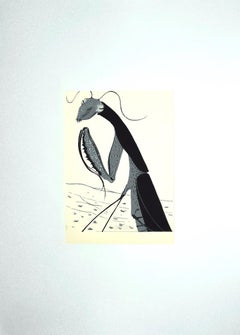
Mantis Religiosa - Original Screen Print by Félix Labisse - 1970s
By Felix Labisse
Located in Roma, IT
Mantis religiosa is a colored screen print on paper realized by the French artist Félix Labisse. Hand-signed in pencil on the lower right margin. Numbered in pencil on the lower le...
Category

1970s Contemporary Felix Labisse Art

Materials

Screen

Stellar Composition - Screen Print y Félix Labisse - 1970s
By Felix Labisse
Located in Roma, IT
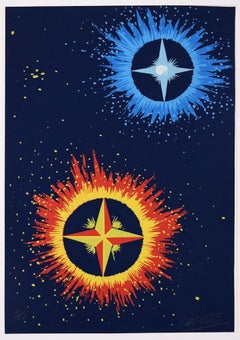
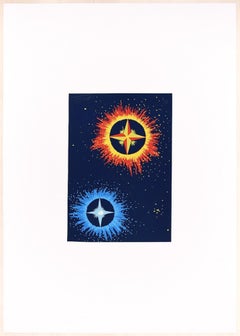
Stellar Composition is a colored serigraph on paper realized by the French artist Félix Labisse. Hand-signed in pencil on lower right margin. Numbered in pencil and in Roman numerals on lower left margin. This is an artist's proof on a edition of 16 prints, on a total edition of 100 pieces. In very good conditions, this original print is glued on a white cardboard passepartout, cm 69.6 x 50. Félix Labisse (Douai 1905 - Paris 1982) The French painter, illustrator and scenographer (especially for J.-L. Barrault), Fèlix Labisse settled in Paris in 1933, after a period spent in Ostend during which he was in close contact with J. Ensor and supported by R Desnos. His works, influenced by surrealism, show a dreamlike and fantastic atmosphere of magical metamorphosis. In June 1951 he created the sets for Jean-Paul Sartre's play "Il diavolo e il buon Dio", staged by Louis Jouvet. During this time he spends his time between Paris and Knokke Le Zoute...
Category

1970s Contemporary Felix Labisse Art

Materials

Screen

Related Items
Ben Shahn, Silkscreen with Old Testament Psalm 57 Signed/N + provenance letter
By Ben Shahn
Located in New York, NY
Ben Shahn Silkscreen inspired by Old Testament Psalm 57, 1967 Silkscreen on Japon paper Hand signed and numbered 255/300 by the artist on the front, with a copy of the provenance let...
Category

Mid-20th Century Modern Felix Labisse Art

Materials

Pencil, Screen

Spike, Affordable Contemporary Art, Silkscreen Prints, Colourful Abstract Prints
By Chris Keegan
Located in Deddington, GB
This handmade screen print depicts an imaginary spiked sphere shape in five colours including fluorescent Yellow, metallic Gold and Red. The Gold ink layer gives the abstract print an extra brilliance and shine showing off the multi layered liquid patterns on the surface of the object. Chris Keegan artist online and in Wychwood Art Gallery...
Category

21st Century and Contemporary Contemporary Felix Labisse Art

Materials

Paper, Screen

Tea for two – Tod
By Harry Bunce
Located in Deddington, GB
Tea for two – Tod by Harry Bunce [2017] limited_edition Screen Print Edition number 146 Image size: H:25 cm x W:31 cm Complete Size of Unframed Work: H:41 cm x W:49 cm x D:0.3cm Sol...
Category

2010s Contemporary Felix Labisse Art

Materials

Paper, Screen

Tea for two – Tod
$206
H 16.15 in W 19.3 in D 0.04 in
Young Hearts, Portland Gallery London offset lithograph
By Jack Vettriano
Located in Hillsborough, NC
Jack Vettriano (1951-) is renowned for his film noir oil paintings and 1930s glam style. Uniquely Vettriano, ‘Young Hearts’ is set by the seaside inviting narratives about the figures in his work: relationships, anticipation, power and suggestion. Vettriano grew up by the Fife Scottish coast. He began painting beach scenes as a young adult, later developing his particular recognizable style and thematic imagery. His work was embraced by celebrities such as Madonna and Jack Nicholson and he has become hugely successful. His most famous painting, ‘The Singing Butler...
Category

Early 2000s Contemporary Felix Labisse Art

Materials

Lithograph, Offset

I Am The Last Of My Kind
By Tracey Emin
Located in London, GB
Published by the Royal Academy
Category

2010s Contemporary Felix Labisse Art

Materials

Lithograph, Offset

Bad Boys
By Keith Haring
Located in New York, NY
A very good impression of this screenprint on BFK Rives wove paper. One of 7 numbered artist's proofs, aside from the edition of 30. Signed, dated, inscribed "AP" and numbered 5/7 in...
Category

1980s Contemporary Felix Labisse Art

Materials

Screen

Bad Boys
Bad Boys
$13,500
H 17 in W 22 in
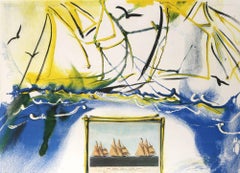
American Yachting Scene Salvador Dali Currier & Ives series lithograph 1971
By Salvador Dalí­
Located in Paonia, CO
American Yachting Scene is a vibrant explosion of ocean blue , whitecaps and strong yellow slashes to describe the ships sailing to their destination. There is an insert of a Currier and Ives print of sailing ships that Dali used as his inspiration. This original lithograph is from the series “The World Of Currier...
Category

1970s Surrealist Felix Labisse Art

Materials

Lithograph

Rodeo Queen by Luis Jimenez
Located in Phoenix, AZ
Rodeo Queen, 1981 Edition 36/50 Signed lower left, Inscribed: for the "Rose" 82. Provenance: Print was a gift to Rozanne Charington, companion and model for "Rodeo Queen", "Rose Tattoo" and "Jimenez at Adeliza's Candy Store". Lithograph on paper 42 ½ × 29 in. (107.3 × 73.7 cm) Luis Alfonso Jimenez Born, 1940, El Paso, Texas, died 2006, Hondo, New Mexico. Statement: Luis Jimenez, in his work, celebrates the vitality of life. . . . Jimenez es un hijo de la frontera; he knows its people and the landscape. It is the transformation of these people into art that is his most important contribution to the art of this vast region which stretches between Mexico and the United States. His subject matter utilizes the popular images of the cultura del norte, and a large part of it is depicted and transformed in the rough and tumble world of la frontera. He is also a son of el norte, and so he uses its materials and explores its emerging, popular myths. The tension and attraction of Jimnez’s work is that he always creates within the space of his two worlds, the Mexicano and the Americano. He constantly shows us the irony of the two forces which repel, while showing us glimpses of the synthesis he seeks. What a gift it has been to us for this talented artist to reflect on the soul of our region. He gives meaning to our existence and history. Rudolfo Anaya (passage chosen by the artist), A View from La Frontera, Man on Fire: Luis Jimenez, pp. 1, 3, 6Biography: Luis Jimenez was born in Texas to parents who had emigrated from Mexico to the United States; he would later dedicate his 1989 sculpture Border Crossing to his father, who had entered the country illegally. The elder Jimenez was a neon sign designer in El Paso, and Luis worked with him as a youth. His experience working in the neon shop and his fascination with U.S. car culture would both become major influences on his art career. Jimenez studied architecture at the University of Texas, Austin (UTA), and also took art courses in which he first created sculptures with wood, steel, and fiberglass, choosing the latter because of its association with U.S. popular culture. He subsequently became one of the artists who made fiberglass an acceptable medium in the 1960s. In 1964 Jimenez received his B.S. in art from UTA, and he continued his studies at the Universidad Nacional Autonoma de Mexico in Mexico City. In 1966 he moved to New York City and worked as an assistant to sculptor Seymour Lipton. Jimenez began to exhibit his art while in New York and in 1972 moved to New Mexico to focus on creating public sculptures, even as he maintained his diverse output of drawings, prints, and lithographs. Drawing on his early experiences, Jimenez creates works that come from a border perspective, one that draws upon the hybridity bred by culture clashes. Often socially and politically informed, his works speak not only in regional terms, those germane to the southwestern United States, but to broader, more global issues as well. They exhibit a profoundly Chicano aesthetic and sensibility, one that is informed by Mexican and Mexican American traditions, North American popular culture, Chicano cultural icons, and images and themes unique to the Southwest. Death, sexuality, and the struggle of the common people are frequent themes. Inspired by authors who write in an autobiographical style, Jimenez creates works that function as personal narrative yet are also able to make statements about culture in more global terms. His use of bold colors and lines, a legacy from his fathers work as a neon sign maker, lends a dynamic sensuality to his work, one that is particularly evident in his monumental fiberglass and acrylic urethane sculptural works Many of Jimenez's works correspond to scholar Toms Ybarra-Fraustos definition of the Chicano aesthetic of rasquachismo, a lowbrow sensibility that appeals to the working class in that it applies to objects that subvert expressions of the mainstream or dominant culture. Creating art that speaks to the people, Jimenez is able to transform regional and culturally specific myths and symbols into globally recognized and relevant icons. Exhibitions: In addition to his personal work, Jimenez has been commissioned for numerous public art projects. In 1999 his sculpture Southwest Piet was designated a National Treasure by First Lady Hillary Clinton. The many exhibitions featuring his work have included Human Concern/Personal Torment (Whitney Museum of American Art, New York, 1969). The First International Motorcycle Art Show (Phoenix Art Museum, Phoenix, AZ, 1973). Three Texas Artists (Centre Cultural Americaine, USIS, Paris, 1977), Recent Trends in Collecting (Smithsonian Institution, Washington, DC, 1982). Committed to Print (Museum of Modern Art, New York, 1989) Printmaking in Texas: The 1980s (Modern Art Museum, Fort Worth, TX. Laguna Gloria Art Museum, Austin, 1990. The Whitney Biennial (Whitney Museum of American Art, New York, 1991) Man On Fire: Luis Jimnez (Albuquerque Museum of Art, NM, 1994-95). 47th Annual Purchase Exhibition (American Academy of Arts and Letters, New York, 1995). Traveling solo exhibition, Working Class Heroes: Images from the Popular Culture (1997-2000). Jiménez Collier Gallery has been in continuous operation for over 40 years. Originally located just off Main Street in downtown Scottsdale, Arizona, we have moved to Phoenix to accommodate and showcase our large inventory including: • Original works by Maynard Dixon, Lon Megargee, Ed Mell, Fritz Scholder, Bill Schenck, Bill Lesch, Luis Jimenez, Greg Singley, Dan Budnik, and other 20th century Western, WPA and Contemporary Southwestern artists. • The Fine Art Estate of Lon Megargee • Vintage rodeo...
Category

1980s Contemporary Felix Labisse Art

Materials

Lithograph

Ebu, Pop Art Screenprint by Hunt Slonem, 1981
By Hunt Slonem
Located in Long Island City, NY
This serigraph was created by contemporary American artist Hunt Slonem. Slonem is best known for his Neo-Expressionist paintings and bright tropical palette, and his subject matter o...
Category

1980s Contemporary Felix Labisse Art

Materials

Screen

Hand of Africa - Mandela, Former South African President, Signed Artwork, Hand
By Nelson Mandela
Located in Knowle Lane, Cranleigh
Nelson Mandela, Hand of Africa, Signed Limited Edition Lithograph Many people are unaware that Nelson Mandela turned his hand to art in his 80's as a way of leaving a legacy for his ...
Category

Early 2000s Contemporary Felix Labisse Art

Materials

Lithograph

No One is Happier than Me
By David Shrigley
Located in London, GB
11 Colour Screenprint on Somerset Tub Sized 410gsm Paper
 hand-signed and numbered 76 x 56 cm Edition of 125
 published by Jealous Gallery and comes with publisher COA David Shrigle...
Category

2010s Contemporary Felix Labisse Art

Materials

Screen

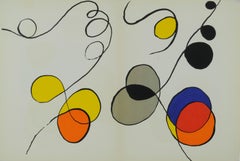
Convection, Braniff International Airways Flying Colors Collection
By Alexander Calder
Located in Fairfield, CT
Artist: Alexander Calder (1898-1976) Title: Convection, Braniff International Airways Flying Colors Collection Year: 1975 Medium: Lithograph on vélin d’Arches paper Size: 20 x 26 inc...
Category

1970s Surrealist Felix Labisse Art

Materials

Lithograph

Previously Available Items
The Blue Twins - Original handsigned lithograph
By Felix Labisse
Located in Paris, IDF
Felix LABISSE The Blue Twins, 1966 Original lithograph Handsigned in pencil On Rives vellum 37 x 28 cm (c. 15 x 11 inch) Excellent condition
Category

1960s Surrealist Felix Labisse Art
Materials

Lithograph

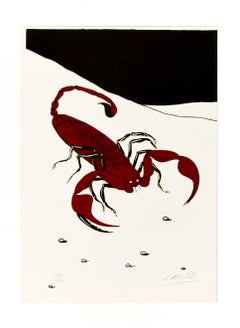
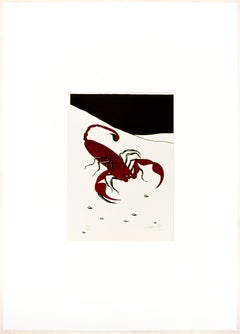
Scorpion - Original Screen Print y Félix Labisse - 1970s
By Felix Labisse
Located in Roma, IT
Scorpion is a colored serigraph on paper realized by the French artist Félix Labisse. Hand-signed in pencil on lower right margin. Numbered in pencil on lower left margin. Edition of 100 pieces. In very good conditions, this original print is glued on a white cardboard passepartout, cm 69.6 x 50. This is a beautiful original print with superb graphic elegance, to collect at home. Félix Labisse (Douai 1905 - Paris 1982) The French painter, illustrator and scenographer (especially for J.-L. Barrault), Fèlix Labisse settled in Paris in 1933, after a period spent in Ostend during which he was in close contact with J. Ensor and supported by R Desnos. His works, influenced by surrealism, show a dreamlike and fantastic atmosphere of magical metamorphosis. In June 1951 he created the sets for Jean-Paul Sartre's play "Il diavolo e il buon Dio", staged by Louis Jouvet. During this time he spends his time between Paris and Knokke Le Zoute...
Category

1970s Contemporary Felix Labisse Art
Materials

Screen

Felix Labisse art for sale on 1stDibs.
Find a wide variety of authentic Felix Labisse art available for sale on 1stDibs. If you’re browsing the collection of art to introduce a pop of color in a neutral corner of your living room or bedroom, you can find work that includes elements of blue and other colors. You can also browse by medium to find art by Felix Labisse in lithograph, screen print and more. Much of the original work by this artist or collective was created during the 20th century and is mostly associated with the modern style. Not every interior allows for large Felix Labisse art, so small editions measuring 9 inches across are available. Customers who are interested in this artist might also find the work of Jacques Beltrand, Pierre Quentin Chedel, and Charles Courtry. Felix Labisse art prices can differ depending upon medium, time period and other attributes. On 1stDibs, the price for these items starts at $77 and tops out at $334, while the average work can sell for $285.

Artists Similar to Felix Labisse

Still Thinking About These?

All Recently Viewed