Johannes Jansson Art
Dutch, 1729-1784
Jan Jansson or Johannes Janssonius (1588-1664) was born in Arnhem, Holland. His father was a printer and bookseller. In 1612 he married a Hondius daughter and became part of the prominent cartographic and publishing family business. He published his first map on his own in 1616. He partnered with his brother-in-law, the famous cartographer Henricus Hondius. They published their Atlas Major in eleven volumes. He also worked on newer editions of earlier Mercator/Hondius atlases. He published Jansson's English Country Maps in 1646. His brother-in-law continued the business following Jansson's death in 1664.
Abraham Goos (1590-1643) was a Dutch engraver of maps, sea charts, and globes, based initially in Antwerp and later in Amsterdam. The majority of his work was on maps created by Joannes Jansson, Jocodus Hondius, and John Speed.to
1
Overall Width
to
Overall Height
to
1
1
1
1
1
1
1
1
1
1
1
10,138
2,779
1,375
1,369
1
Artist: Johannes Jansson
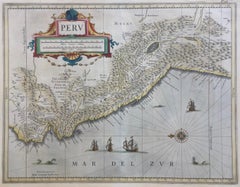
PERU
By Johannes Jansson
Located in Santa Monica, CA
JOHANNES JANSSON (1588 - 1664)
PERU, engraving with early coloring. Platemark 15 1/8 x 19 3/8 inches, sheet 17 x 20 1/2
A nice example of one of the earliest maps of Peru. From the ...
Category
1630s Old Masters Johannes Jansson Art
Materials
Engraving
Related Items
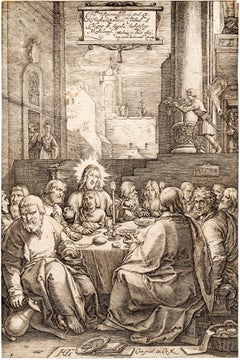
The Last Supper, from The Passion of Christ
By Hendrick Goltzius
Located in Middletown, NY
Engraving on cream laid paper, 8 x 5 3/8 inches (203 x 137 mm), trimmed at the platemark. A fine impression with a Coat of Arms watermark. Second state, after the addition of the Frederick de Witt...
Category
16th Century Old Masters Johannes Jansson Art
Materials
Laid Paper, Engraving

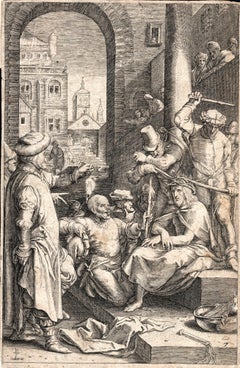
Christ Crowned with Thorns, from The Passion of Christ
By Hendrick Goltzius
Located in Middletown, NY
Engraving on cream wove paper, 8 x 5 3/8 inches (203 x 137 mm), narrow to thread margins. First state (of 2). A fine impression with archival paper adhered at left top and bottom cor...
Category
Early 17th Century Old Masters Johannes Jansson Art
Materials
Engraving
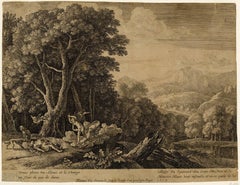
Venus Lamenting over the Death of Adonis
By Herman van Swanevelt
Located in Middletown, NY
c. 1654. Etching with engraving on thin laid paper with an early and large unidentified watermark with a sundial and a many-pointed star, and an unidentified collector's stamp in the...
Category
Mid-17th Century Old Masters Johannes Jansson Art
Materials
Handmade Paper, Engraving, Etching
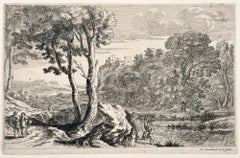
The Anglers
By Herman van Swanevelt
Located in Middletown, NY
Etching with engraving on cream laid paper with a large unidentified alphabetic watermark, 6 1/2 x 9 7/8 inches (165 x 251 mm), the full sheet. In good condition with handling wear a...
Category
Early 17th Century Old Masters Johannes Jansson Art
Materials
Laid Paper, Engraving, Etching
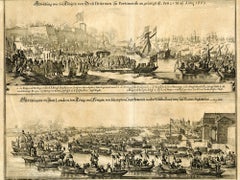
The Queen of Great Britain arriving in Portsmouth 25 May 1662 & The Arrival in L
By Matthäus Merian the Elder
Located in Middletown, NY
Two images of Queen Catharina of Braganza; one before her marriage to King Charles II, the other after, as Queen of Great Britian. Engraved by Matthiäus Merian, father of Maria Sybli...
Category
Mid-17th Century Old Masters Johannes Jansson Art
Materials
Laid Paper, Engraving
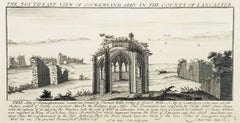
"Cockersand Abbey" from "Buck's Antiquities" /// British Old Master Engraving
By Samuel & Nathaniel Buck
Located in Saint Augustine, FL
Artist: Samuel and Nathaniel Buck (English, 1696-1779) and (?-1759/1774)
Title: "Cockersand Abbey" (Plate 148)
Portfolio: Buck's Antiquities or Venerable Remains of Above 400 Castles...
Category
1720s Old Masters Johannes Jansson Art
Materials
Laid Paper, Engraving, Intaglio
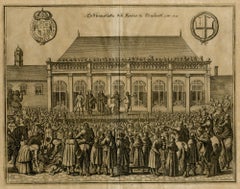
The Beheading of the King of England; Enthauptung des Königs in England
By Matthäus Merian the Elder
Located in Middletown, NY
The execution of Charles I (1600-1649) at Whitehall, January 30th 1649, in front of the Banqueting House. The executioner holding the head of Charles up to the crowd below.
Engravin...
Category
Mid-17th Century Old Masters Johannes Jansson Art
Materials
Laid Paper, Engraving
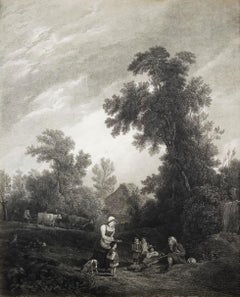
Benevolent Cottagers /// English Landscape Figurative Village Scene Engraving
Located in Saint Augustine, FL
Artist: (after) Sir Augustus Wall Callcott (English, 1779-1844)
Title: "Benevolent Cottagers"
Year: 1816
Medium: Original Etching and Engraving on laid paper
Limited edition: Unknown...
Category
1810s Old Masters Johannes Jansson Art
Materials
Engraving, Etching, Laid Paper, Intaglio
$600
H 20.75 in W 15.5 in
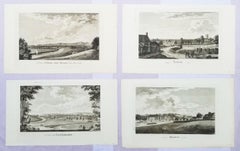
Set of Four Engravings from Nash's "History of Worcestershire" /// Landscape Art
By Treadway Russell Nash
Located in Saint Augustine, FL
Artist: Treadway Russell Nash (English, 1724-1811)
Title: "A View of Stourbridge", "A View of Upton upon Severn, from Ryal Hill", "Bewdley", and "Tenbury"
Portfolio: Collections for the History of Worcestershire
Year: 1781-1782 (First edition)
Medium: Set of Four Original Engravings on watermarked laid paper
Limited edition: Unknown
Printer: John Nichols, London, UK
Publisher: T. Payne and Son, J. Robson, B. White, Leigh and Sotheby, London, UK; Fletcher, Oxford, UK; and Lewis, Worcester, UK
Reference: Upcott III, page 1330
Sheet size (each): approx. 10" x 16.5"
Image size (each): approx. 6.88" x 11.75"
Condition: A few light handling creases. Have been professionally stored away for decades. They are all strong impressions in excellent condition
Notes:
Provenance: private collection - Aspen, CO. All four works were engraved by English artist Thomas Sanders (Active: Mid-Late 18th Century) after drawings by himself. Comes from Nash's two volume "Collections for the History of Worcestershire", (1781-1782) (First edition), which consists of 75 engravings. Each work is printed from one copper plate in one color: black. There was a (Second edition) "with Additions" bound in with Volume II of this portfolio published by John White in 1799. And, both the First and Second editions of "Collections for the History of Worcestershire" are based off Thomas Sanders' 1779-1781 "Perspective Views of the Market Towns within the County of Worcester". Both "A View of Stourbridge" and "A View of Upton upon Severn, from Ryal Hill" have unidentified fleur-de-lis watermarks in the center of their sheets. "Bewdley" has an unidentified watermark in the center of its sheet resembling "XV" and "Tenbury" has no watermark.
Biography:
Treadway Russell Nash (24 June 1724 – 26 January 1811) was an English clergyman, now known as an early historian of Worcestershire and the author of Collections for the History of Worcestershire, an important source document for Worcestershire county histories. He was a fellow of the Society of Antiquaries of London.
Treadway Russell Nash was born on 24 June 1724 born at Clerkenleap, in Kempsey, Worcestershire. His family were from Ombersley. They had lands there and at Claines, and had later bought lands in the Reformation around St Peter's, Droitwich. He was related to James Nash and John Nash, both MPs for Worcester. His father Richard, a grandson of Sir Rowland Berkeley, died in 1740, and Richard's eldest son in 1757. As a result, Treadway Russell Nash inherited the Russells' Strensham estates from his brother, as well as the Nash estates, and took both names.
He was educated from the age of twelve at King's School, Worcester, and became a scholar at Worcester College, Oxford aged fifteen. In March 1749, he accompanied his brother on a trip to the continent, to aid Richard's health. They visited Paris for about six weeks, before spending the summer "on the banks of the Loire". They then visited "Bourdeaux, Thoulouse, Montpelier, Marseilles, Leghorn, Florence, Rome, Naples, Bologna, Venice, Padua, Verona, Milan, Lyons, and again Paris"; such expeditions are often known as the Grand Tour.
On his return in late summer 1751, Nash took up a post as Vicar of Eynsham through his friend and future brother-in-law, John Martin. He also had an income as a tutor at Oxford. He took his Doctor of Divinity degree and left Oxford, having "gone out grand compounder", following the death of his brother. He also left his benefice at Eynsham in 1757. While at Oxford he had proposed a road from there to Witney (now the A40 and B4022), and also stood for Parliament. Nash married Margaret Martin...
Category
1780s Old Masters Johannes Jansson Art
Materials
Laid Paper, Engraving
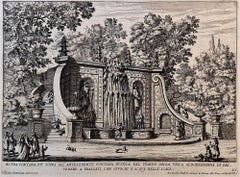
Fountains of Rome
By Giovan Battista Falda
Located in Middletown, NY
A charming scene with romping dogs and spectators watching the cascading water play a trick on an unsuspecting man who is sprayed as he descends the steps, ...
Category
Early 17th Century Old Masters Johannes Jansson Art
Materials
Laid Paper, Engraving, Etching
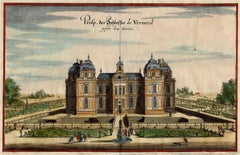
Chateau de Verneuil
By Matthäus Merian the Elder
Located in Middletown, NY
Engraving with hand coloring and heightening in watercolor on two leaves of expertly conjoined handmade laid paper, one leaf with a large watermark a feathered dragon, 7 1/4 x 11 1/4...
Category
Mid-17th Century Old Masters Johannes Jansson Art
Materials
Watercolor, Handmade Paper, Engraving
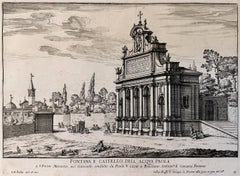
Fountains of Rome; Fontana e castello dell'Acqua
By Giovan Battista Falda
Located in Middletown, NY
Rome: Giovanni Giacomo De Rossi, 1625.
Etching and engraving on cream laid paper, 8 3/8 x 11 1/4 inches (222 x 286 mm), full margins. In good condition with some light yellow discoloration in the margins and on the verso, the image area remains clean and bright. The inscription in the lower margin reads Paulus Quintus Pont. Maxim ... anno DNI MDCXII Pontif.s sui Septimo' and in the margin 'Fontana e castello dell'acqua Paola a S.Pietro Montorio sul Gianicolo, condotta da Paolo V, vicino a Bracciano, Architett.a di Giovanni Fontana', and signed at left 'G.B.Falda del. et inc.' and at right 'G.Iac.Rossi le stampa in Roma alla pace co priv. del SP', and the number '11' in the lower right corner. Printed in 1691.
[Bartsch/Le Pientre graveur XXI.241.13]
Book I, plate 11: Fountain of San Pietro in Montorio, from "Le fontane delle ville di Frascati nel Tusculano con li loro prospetti" ("The fountains of the Villas of Frascati in Tusculano and their prospects"); a set of four books on fountains published by Giovanni Giacomo De Rossi (Italian, Rome 1627–1691), after Giovanni Francesco Venturini (active ca. 1650–1700) and Giovanni Battista Falda...
Category
Early 17th Century Old Masters Johannes Jansson Art
Materials
Laid Paper, Engraving, Etching
Previously Available Items
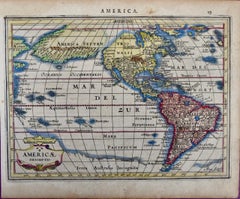
North & South America: A 17th Century Hand-colored Map by Jansson & Goos
By Johannes Jansson
Located in Alamo, CA
A 17th century hand-colored map of North & South America entitled "Americae Descriptio" by the cartographer Johannes Jansson, published in Jansson's Atlas Minor in Amsterdam in 1628....
Category
1620s Johannes Jansson Art
Materials
Engraving
Johannes Jansson art for sale on 1stDibs.
Find a wide variety of authentic Johannes Jansson art available for sale on 1stDibs. You can also browse by medium to find art by Johannes Jansson in engraving and more. Much of the original work by this artist or collective was created during the 18th century and earlier and is mostly associated with the Old Masters style. Not every interior allows for large Johannes Jansson art, so small editions measuring 9 inches across are available. Customers who are interested in this artist might also find the work of Gerard Mercator, Jacobus Houbraken, and Adriaen van Ostade. Johannes Jansson art prices can differ depending upon medium, time period and other attributes. On 1stDibs, the price for these items starts at $600 and tops out at $1,020, while the average work can sell for $810.