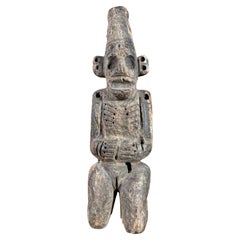
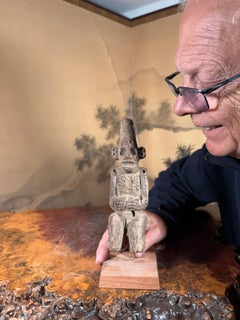
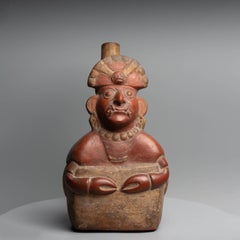
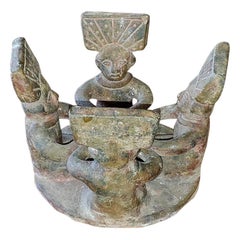
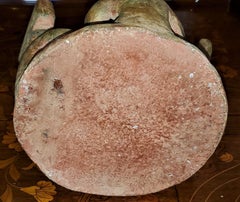
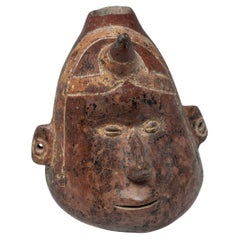
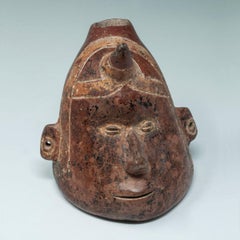
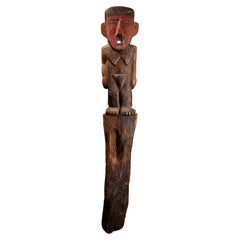
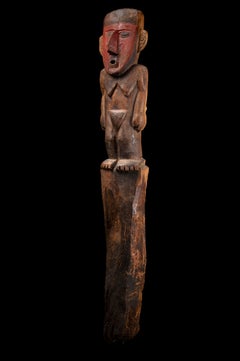
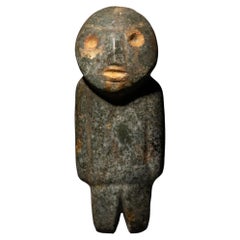
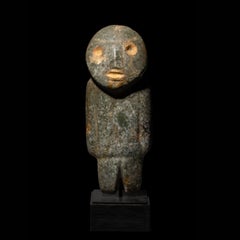
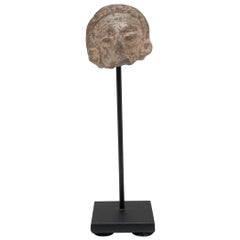
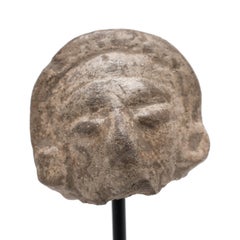
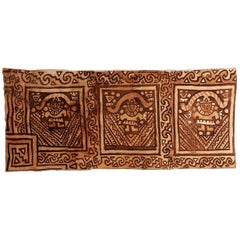
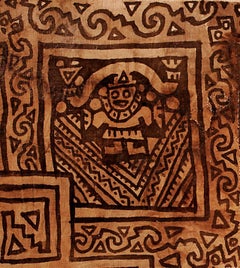
Funerary Post with female figure. Chimu, Peru, 1st Millennium AD. Wood. 106 cm.
Funerary Post with female figure
Chimu, Peru, 1st Millennium AD.
Wood
Height 106 cm
Provenance
- Jean Pierre Cottier and Fiorella Cottier-Angeli Collection, Geneva, Switzerland. Acquired by Yossef Maiman between 2000 and 2008.
- Private collection, Israel, until 2024.
Condition
Good state of preservation, no restorations.
Published
- ROSENZWIG, A.; WOLOSZYN, J. Z. Offerings for the Afterlife. Peruvian Pottery and Artifacts from the Maiman Collection. AMPAL/MERHAV Group of Companies. Israel. 2008. Fig. 102.
Description
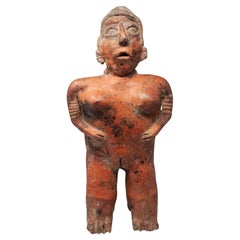
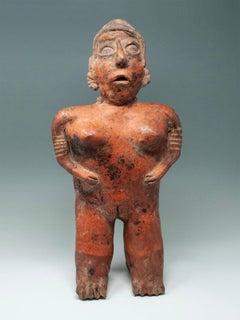
Funerary pole topped by a female figure in the round, both carved from a single piece of wood. This type of object was used as a grave marker and was especially important in the desert areas of pre-Columbian Peru, as it made it possible to easily locate the burial site during funeral rituals or ancestor worship. Figurative funerary poles are rare among Chimú wooden statuary, although they share formal characteristics with the more common freestanding sculpture.
The face is polychrome, predominantly a bright red pigment of cinnabar-colored resin. The figure is shown standing, with legs together and arms extended at both sides of the body, in a conventional, hieratic, and solemn posture. The figure is monolithic, although the main parts of the anatomy are perfectly differentiated, worked with a synthetic and geometric language. The obvious disproportion of the head, which is very large relative to the body, responds to a symbolic intention that probably alludes to the identity of the figure to whom the tomb belongs. The face is highly expressive in its synthesis, with almond-shaped eyes painted dark brown in contrast to the red of the face, framed by raised eyelids and nestled beneath eyebrows drawn with a fine beveled line. The nose is very prominent, completely flat, and with a curved profile, and the mouth stands out for its expression: open, deeply hollow, and framed by long nasolabial furrows worked in relief, which begin at the base of the nose and end at the chin, which protrudes slightly from the plane. The large ears, flat on the forehead and convex at the back, are decorated with an incised spiral design representing cartilage. The head ends in a gentle curve, probably representing a bonnet, which is painted in the same brown tone as the eyes. The body is depicted nude, with the breasts and pubis worked in flat relief, forming a formal interplay of inverted triangles. The joints of the arms and legs, as well as the fingers and toes, are clearly indicated, although without seeking naturalistic detail. A Chimú funerary pole is preserved in Princeton, also topped by a female figure, which displays significant similarities to the piece under study, both in posture, proportions, and overall composition, as well as in the polychromy and facial expression, with an open, hollow mouth.
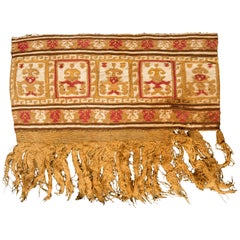
Wooden statuary is a little-known manifestation of Chimú art, given the few preserved examples due to Peru's climatic conditions. Although some have been found in the coastal deserts, thanks to their dry climate. In general, Chimú anthropomorphic sculptures follow a conventional model showing the figure standing frontally, with accentuated bilateral symmetry. These sculptures generally represent men, with female figures being much rarer, and they are rarely depicted clothed. In the few examples found with carved clothing, designs characteristic of the well-known Chimú textile art can be seen, as is the case with a funerary pole, also from Princeton, which includes animal figures on the sleeves of the tunic, and another auctioned in Paris in 2013, which displays a fringed profile and various geometric embroideries.
The Chimú culture was born on the northern coast of Peru after the fall of the Huari Empire, around 1100 AD, and developed until approximately 1400. Although it is considered the heir of the Moche culture, Chimú mythology places the origin of its people in the arrival on the Peruvian coast of the fleet of Taycanamo, the mythical founder and first ruler of the kingdom, who would have combined political and priestly functions. Their territory, which once covered some 1,300 km, was centered in the Moche River valley and their capital was the great city of Chan Chan. Most of the territory is a very arid coastal desert, although it is crisscrossed by numerous rivers that bring water from the Andes, creating fertile valleys in their wake. Thanks to the use of enormous aqueducts and an extensive network of irrigation canals, the Chimú reclaimed large tracts of agricultural land from the desert, where they grew cotton and all kinds of foodstuffs. The territory of the Chimú kingdom was also crisscrossed by trade routes, which had their caravan center in Chan Chan and transported subsistence goods as well as luxury items. Many Chimú cults and rituals were oriented toward promoting fertility in the fields, given the aridity of the territory, and closely linked religion and politics. The main propitiatory rites for agricultural fertility were based on the veneration of the mummies of the ancestors of the reigning dynasty.
Chimú artistic production includes featherwork, wood carving, textiles, and shell and hard stone work. Thanks to the influence of the neighboring Lambayeque people, who would eventually join the Chimú Empire, goldsmithing techniques were perfected for working with copper, silver, and gold. These techniques were used to create luxury objects such as vases, ear ornaments, and masks worn by the noble classes during ceremonial ceremonies. Chimú pottery...
Category
15th Century and Earlier Peruvian Antique Pre-Columbian Folk Art