17th Century Art

1,615 Results
to
372
643
276
223
200
334
Overall Width
to
Overall Height
to
7,662
21,551
166,345
236,928
2,157
2,346
4,711
6,597
6,008
15,832
21,200
26,524
19,311
14,129
5,469
694
113
9
3
3
1
1
1
1
1
886
723
20
1,278
655
486
354
335
182
145
122
114
92
90
87
86
82
80
47
39
36
33
27
890
859
389
366
362
66
32
28
21
20
882
342
1,293
374
Period: 17th Century
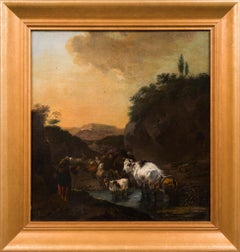
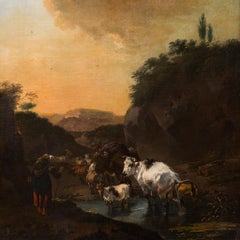
Golden Age Sheep and Goat in a Landscape - Dutch 17thC Old Master oil painting

Golden Age Sheep and Goat in a Landscape - Dutch 17thC Old Master oil painting

Located in Hagley, England

Abraham Begeyn, Dutch Golden Age painter and Prussian court painter painted this wonderful 17th century Old Master oil painting. Painted circa 1690 and signed lower right, the subject matter is sheep and a goat under a tree in the foreground, amongst beautiful flora and fauna. Through the trees one can see some classical ruins to the left and to the right some buildings with a shepherd and his flock in front of the buildings and mountains beyond. Above is a beautiful sky tinged with pink, suggestive of dawn. There is tremendous detail in the flora and fauna and also the sheep's woolly coat. Begeyn particularly favoured painting this sort of scene with the elements of landscape, ruins or buildings and animals and was a master at it and highly prized in the Netherlands. This is an excellent example of Begeyn's work and is good condition given its age as a 17th century Old Master oil painting. Signed lower right. Provenance: Collection of Mr P. Vienna (label on the reverse) Sale, Sotheby's, London, 18 October 1995, lot 70. Condition. Oil on canvas, 24 inches by 21 inches unframed and in good condition. Frame. Housed in a gilt swept frame, 31 inches by 28 inches framed and in good condition. Abraham Begeyn (c. 1637 Leiden - 11 June 1697 Berlin), was a Dutch Golden Age painter. Begeyn was born in Leiden. Though perhaps known mostly for his Italianate landscapes and cattle in the manner of Nicolaes Pietersz Berchem, Begyn was a highly skilled painter active in many genres, who travelled widely. According to the RKD, Begeyn's earliest known work is from 1653, though he was first accepted into the Guild of St. Luke in Leiden in 1655. He stopped paying dues in 1667, because he set off for a trip to Italy. He is registered in Rome and Naples from 1659–1660. In the rampjaar or disaster year, of 1672, he is registered in Amsterdam, and after that he lived in London, where he painted at Ham House, Surrey, together with Willem van de Velde the Younger (1633–1707) and Dirck van Bergen...

Category

Old Masters 17th Century Art

Materials

Oil

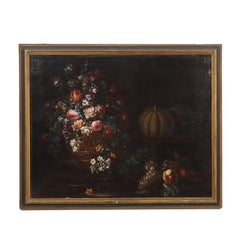
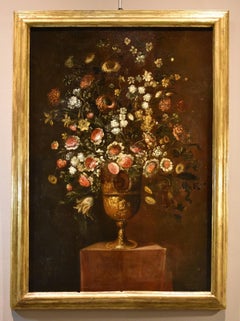
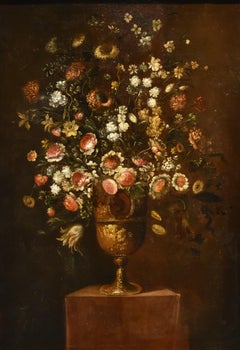
Still-life Flower Paint Oil on canvas Old master 17th Century Lombard school

Still-life Flower Paint Oil on canvas Old master 17th Century Lombard school

Located in Riva del Garda, IT

Francesca Volò Smiller, called Vincenzina (Milan, 1657 - 1700) - circle of Floral composition Oil on canvas (97 x 72 cm. - in octagonal frame 100 x 84 cm.) A rich floral compositio...

Category

Old Masters 17th Century Art

Materials

Oil

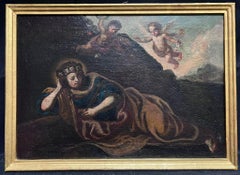
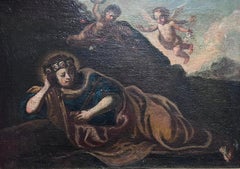
Cherubim Hovering Woman in Wilderness 17th Century Italian Old Master Oil

Cherubim Hovering Woman in Wilderness 17th Century Italian Old Master Oil

Located in Cirencester, Gloucestershire

Italian School, 17th century oil on canvas (laid on board), framed framed: 15 x 21 inches board: 14 x 20 inches provenance: private collection, France condition: very good and sound ...

Category

Baroque 17th Century Art

Materials

Oil

The Ring of Polycrates, Samos Tyrant, Circle Antonio Molinari, Unsigned, 17th C

The Ring of Polycrates, Samos Tyrant, Circle Antonio Molinari, Unsigned, 17th C

Located in brussel, BE

This ambitious composition illustrates the ancient episode of The Ring of Polycrates, drawn from Herodotus. In the story, the king of Samos, blessed with continuous success, is advis...

Category

Baroque 17th Century Art

Materials

Canvas, Oil

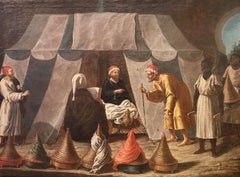
Venetian School, Ottoman Honey Merchant

Venetian School, Ottoman Honey Merchant

Located in London, GB

This incredibly rare early depiction of an Eastern Mediterranean or North African honey merchant is thought have been painted circa 1620. It predates th...

Category

17th Century Art

Materials

Canvas, Oil

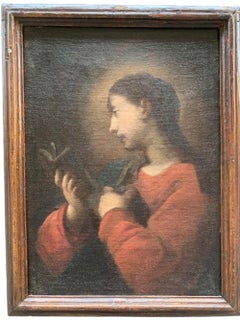
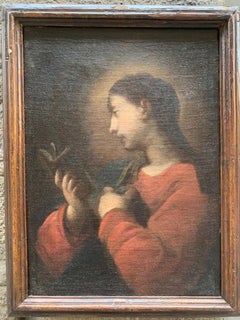
Madonna with the book. 17th century. L'école Génoise.

Madonna with the book. 17th century. L'école Génoise.

Located in Firenze, IT

17th Century Madonna With The Book. Genoese School. Follower Of Bernardo Strozzi. Artist: L'école Génoise Madonna with the book. 17th century. Oil painting on canvas. Width: 60cm H...

Category

Italian School 17th Century Art

Materials

Canvas, Oil

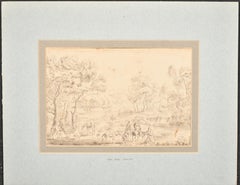
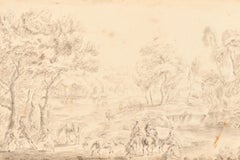
Fine 17th Century Dutch Old Master Drawing Hunting Party Landscape

Fine 17th Century Dutch Old Master Drawing Hunting Party Landscape

Located in Cirencester, Gloucestershire

The Hunting Party Attributed to Dirk Maes (1659-1717) Dutch. Figures in a Classical Landscape, Watercolour and wash on paper, Mounted, unframed image 6.75" x 9.75" (17.1 x 24.7cm)...

Category

Old Masters 17th Century Art

Materials

Watercolor, Pencil

Rinaldo and Armida in Armida's Enchanted Garden Baroque Italy 1700 Mythology

Rinaldo and Armida in Armida's Enchanted Garden Baroque Italy 1700 Mythology

Located in Eltville am Rhein, DE

Domenichino, actually Domenico Zampieri (after) Bologna 1581 – 1641 Naples Rinaldo and Armida in Armida's Enchanted Garden, circa 1700 Oil on canvas (doubled) Size: 80 x 138 cm ...

Category

Baroque 17th Century Art

Materials

Oil

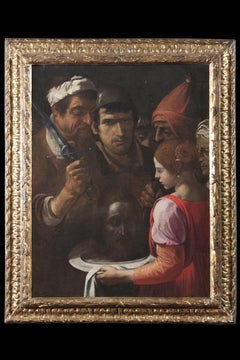
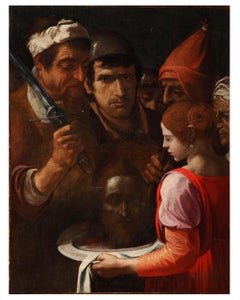
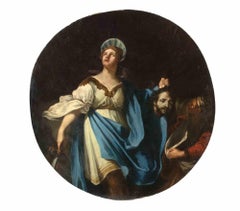
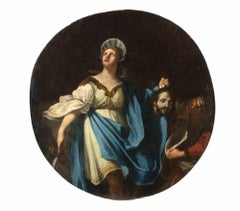
17th Century By Guidotti aka Cavalier Borghese Salomé and the Baptist Oil/canvas

17th Century By Guidotti aka Cavalier Borghese Salomé and the Baptist Oil/canvas

Located in Milano, Lombardia

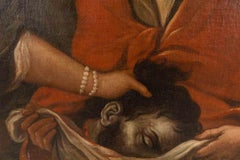
Cavaliere Paolo Guidotti, also known as il Cavalier Borghese (Lucca, Italy, 1559 - 1629) Title: Salomé and the Baptist Medium: Oil on canvas Dimensions: without frame 90 x 68.5 cm -...

Category

Old Masters 17th Century Art

Materials

Canvas, Oil

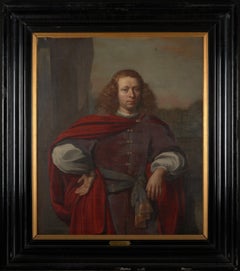
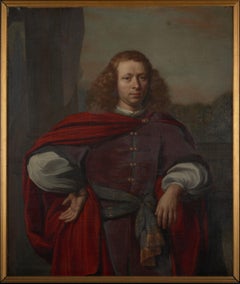
Portrait of a Gentleman in Three-Quarter-Length, attr. Nicolaes Maes

Portrait of a Gentleman in Three-Quarter-Length, attr. Nicolaes Maes

By Nicolaes Maes

Located in brussel, BE

The 39-year-old gentleman had himself portrayed as an aristocrat in an idyllic landscape. At the time, parks and forests were environments associated with the lands and pastimes of t...

Category

Dutch School 17th Century Art

Materials

Canvas, Oil

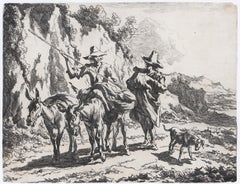
Shepherd talking to a young shepherd on a donkey

Shepherd talking to a young shepherd on a donkey

Located in Middletown, NY

Etching on handmade, cream laid paper. 5 13/16 x 7 5/8 inches (146 x 192 mm), thread margins. Scattered handling creases, light age tone, and minor paper inconsistoncies throughout....

Category

Old Masters 17th Century Art

Materials

Handmade Paper, Laid Paper, Etching

Portrait of Scottish Gentleman with Clay Pipe - 18th century art oil painting

Portrait of Scottish Gentleman with Clay Pipe - 18th century art oil painting

Located in Hagley, England

This atmospheric 18th century portrait oil painting is attributed to a Scottish artist. Painted circa 1790, The painting is a half length portrait of a seated gentleman. He is wearing a blue bonnet, the badge of a Scottish country gentleman and smoking a clay pipe. The way the light catches his hand and face and gleams on his buttons is lovely. The frame is super in that it echoes the button on his jacket. This is an excellent example of an 18th century Scottish portrait...

Category

Old Masters 17th Century Art

Materials

Oil

Guards Bugler Palamedesz Signed Dated Paint 17th Century Oil on table Old master

Guards Bugler Palamedesz Signed Dated Paint 17th Century Oil on table Old master

By Anthony Palamedesz (Delft 1601 - Amsterdam 1673)

Located in Riva del Garda, IT

Anthony Palamedesz (Delft 1601 - Amsterdam 1673) - signed and dated Guards with bugler Oil on panel (42 x 54 cm. - Framed 55 x 67 cm.) Signature: lower left “f Palamedes 163.....

Category

Old Masters 17th Century Art

Materials

Oil

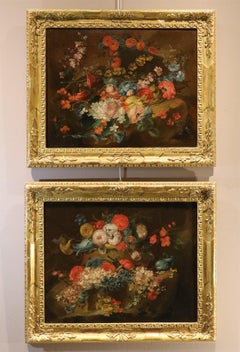
Pair Still-Lifes Flowers Monnoyer Paint 17/18th Century Oil on canvas

Pair Still-Lifes Flowers Monnoyer Paint 17/18th Century Oil on canvas

Located in Riva del Garda, IT

Antoine Monnoyer the Younger (Paris 1671 – Paris Saint-Germain-en-Laye 1747) attributed Pair of floral still lifes Oil on canvas 52 x 65 cm. - With carved and gilded wooden frames...

Category

Old Masters 17th Century Art

Materials

Oil

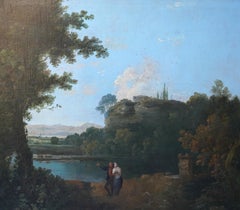
Lovers in Landscape - British 18th century Old Master pastoral art oil painting

Lovers in Landscape - British 18th century Old Master pastoral art oil painting

By Richard Wilson

Located in Hagley, England

This superb British 18th century Old Master oil painting is attributed to circle of noted landscape artist Richard Wilson. Painted circa 1750 it is a stunning lake landscape with a r...

Category

Old Masters 17th Century Art

Materials

Oil

Ambito di Jan Both ( Utrecht, 1618-1652) Paesaggio Laziale con ponte e pastori

Ambito di Jan Both ( Utrecht, 1618-1652) Paesaggio Laziale con ponte e pastori

By Jan Both

Located in Firenze, IT

Paesaggio italiano con un ponte, una torre, pastore ed animali. Ambito di Jan Both ( Utrecht, 1618-1652), arrivo a Roma e Venezia oltre al suo paese natale, Olanda. Il dipinto del X...

Category

Dutch School 17th Century Art

Materials

Canvas, Oil

Travellers near Ruins in a Landscape - Dutch Old Master art figural oil painting

Travellers near Ruins in a Landscape - Dutch Old Master art figural oil painting

By Pieter Wouwerman

Located in Hagley, England

This lovely Dutch Old Master oil painting is attributed to artist Pieter Wouwerman. Painted circa 1660 it is figurative landscape with horseback travellers and their dogs in the foreground approaching ruins on their left. Beyond is a river snakes through the landscape, beneath the fading light of approaching dusk. There are some superb details making this an excellent Dutch Golden Age oil painting...

Category

Old Masters 17th Century Art

Materials

Oil

17th Century by Pietro Della Vecchia The Alchemists Oil on canvas

17th Century by Pietro Della Vecchia The Alchemists Oil on canvas

By Pietro Della Vecchia 1

Located in Milano, Lombardia

Pietro Della Vecchia (Venice, Italy, 1603 - Vicenza, Italy, 1678) Title: The Alchemists Medium: Oil on canvas Dimensions: without frame 73 x 97 cm – with frame 90.4 x 114.3 x 6 cm N...

Category

Old Masters 17th Century Art

Materials

Canvas, Oil

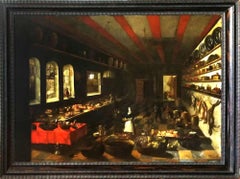
Pharmacist Valentino Signed Paint Oil on canvas Old master 17th Century Italy

Pharmacist Valentino Signed Paint Oil on canvas Old master 17th Century Italy

By Giovanni Domenico Valentino (Rome 1630 - Imola 1708)

Located in Riva del Garda, IT

Giovanni Domenico Valentino (Rome 1630 - Imola 1708) Signed with the monogram G.D.V in the center right, on a majolica vase The pharmacist in his laboratory Oil on canvas, 73 x 66 cm In gilded and lacquered frame cm. 86 x 80 This work, depicting a fascinating laboratory interior with a pharmacist busy in the preparation of medicines, is part of the typical production of the Roman Gian Domenico Valentini, also known as Giovanni Domenico Valentino (Rome 1630 - Imola 1708). The canvas, which is signed with the monogram G.D.V in the center right on a majolica vase, should have been painted in Rome, where the painter worked from 1662 until his death, except in 1680-1681, when he worked in Imola and Ravenna. The use of models by Flemish artists who populated the Eternal City appears essential in the development of Valentini's painting. The use of Nordic models in the development of this type of pictorial genre, with interior scenes and elements of still life, had gained great fortune with the Roman client, leading to an almost serial production, but always of great evocative charm. . Giovanni Domenico Valentini distinguished himself in the artistic panorama of the Italian seventeenth century precisely for the peculiarity of his favorite subjects: they are mainly kitchen interiors or as in our case of a laboratory, where countless objects are piled up arranged in picturesque disorder: here the tools of a pharmacy, in copper and terracotta, vases or pourers in metal and clay, jars and albarelli in majolica, bottles, flasks, glasses, cauldrons, basins and other containers in copper and terracotta, as well as an open oven. The large background wall is occupied by an angular hanging shelf for jars and apothecary jars all arranged in a row, in the foreground the still life featured various pharmaceutical tools such as apothecary bottles, mortar bowls, jars and jars with handles as well as pots and copper vessels. Particularly striking from a chromatic point of view, and a typical piece of furniture of the painter, is the painting above the door frame, which depicts a landscape. The interiors of the Valentini, of which our painting is a valuable example, which display large quantities of objects or furnishings, are arranged with a wisely studied organization: the whole represented is arranged according to the dictates of a pre-ordered exhibition and appears so to speak 'on display', exhibited and organized according to the very personal intent of a painter who aims to ennoble everyday life and make it the emblem of his art. The interior of our pharmacy is very similar to a monogrammed version kept in the Musée des Beaux-Arts, Palais Fesch, in Ajaccio (inv. 852-1-461) depicting a 'Young man visiting a pharmacy', in which the same elements, albeit varied: the half-open wardrobe...

Category

Old Masters 17th Century Art

Materials

Oil

Hercules and Omphale, Old Master Painting, Mannerism, Baroque, Mythology, Prague

Hercules and Omphale, Old Master Painting, Mannerism, Baroque, Mythology, Prague

Located in Greven, DE

Hercules and Omphale Oil on panel, 52 x 41 cm According to legend, Hercules had to make atonement and became a slave to the Lydian queen Omphale. When she found out who her slave was, she married him. Falling for his mistress and made effeminate by the luxury of court life, the former hero allowed himself to become the laughing stock of the court. He dressed in women's clothes, spun wool and did other women's work, whereas Omphale wore his lion's skin and carried a wooden club. When the time of punishment was over, the hero realised his delusion and left Omphale. So far, the painting could not be clearly assigned to an artist. Nevertheless, it impresses with its fluid and convincing painting, whose colourfulness and conception are reminiscent of the Prague School around Bartholomäus Spranger. This work follows an engraving and an etching made by Michel Dorigny in 1643 after a design by Simon Vouet. It shows the same scene but the print differs in minor details from the present painting (see e.g. the head of the lion) and the treatment of the faces seems to be painted more detailed and refined. So far there is no painting...

Category

Baroque 17th Century Art

Materials

Oil, Panel

Interior Scene with Kitchen - Oil on Canvas - 1659

Interior Scene with Kitchen - Oil on Canvas - 1659

Located in Roma, IT

Signed and dated lower left. Includes a beautiful later wooden frame cm. 137x8x182. Very Good conditions. Prov. Christie's London, February 15th 1974, n. 19. This artwork is shippe...

Category

Baroque 17th Century Art

Materials

Oil

The Duchess of St. Albans: A 17th C. Portrait After a Kneller Painting

The Duchess of St. Albans: A 17th C. Portrait After a Kneller Painting

By (After) Sir Godfrey Kneller

Located in Alamo, CA

This is a 17th century engraved mezzotint portrait of the Duchess of St. Albans by John Smith, after a painting by Sir Godfrey Kneller. It was published in London by John Boydell in 1694. The Duchess of St. Albans (1642-1712) was a woman named Diana de Vere. She was born in 1642, the daughter of Aubrey de Vere, the 20th Earl of Oxford. In 1662, she married Charles Beauclerk, the illegitimate son of King Charles II and his mistress, Nell Gwyn. As a result of her marriage, Diana became the Duchess of St. Albans, and she and Charles had several children together. Diana was known for her beauty and charm, and she was a prominent figure in the court of King Charles II. Despite her husband's illegitimate birth, Diana was highly respected in the royal court and was known for her intelligence and wit. She was a patron of the arts and supported many artists and writers of the time. Diana lived through a tumultuous period of English history, including the Great Fire of London and the Glorious Revolution, which saw King James II replaced by William of Orange. She died in 1712 at the age of 70 and was buried in Westminster Abbey. Descendants of Diana and her husband, who was an illegitimate son of King Charles II, include Diana, Princess of Wales and her son William, Duke of Cambridge. An author wrote of her: "The line of Vere, so long renown’d in arms, Concludes with luster in St. Albans’s charms; Her conquering eyes have made their race complete, It rose in valor, and in beauty set." This striking mezzotint engraving depicts Diana, Duchess of St Albans in a three-quarter length pose, standing, wearing loose flowing dress and a wrap. She has a very serene, calm appearance as she is looking straight at the viewer. There is a landscape of trees in the background. The print is adhered in the corners to an archival backing, which is itself adhered in the upper corners to a larger backing. The print is trimmed to just beyond the plate mark. There are areas of discoloration in the margins and in the inscription area, but the print is otherwise in very good condition. The sheet measures 14.5" high and 10" wide. This mezzotint is held by multiple museums and institutions, including The British Museum, The National Portrait Gallery London, The Fine Arts Museum of Boston, The Lewis Walpole Library at Yale, The Yale Center for British Art, The Fitzwilliam Museum at Cambridge and The National Galleries of Scotland. The original Kneller painting is part of the British Royal Collection Trust and hangs in the King's Private Dining Room at Hampton Court Palace. Sir Godfrey Kneller (1646-1723) was a leading portrait painter of his time, particularly renowned for his depictions of the British aristocracy and royalty. He was born in Lübeck, Germany, and trained in Amsterdam under the painter Ferdinand Bol...

Category

17th Century Art

Materials

Mezzotint

Still Life of Roses in a Glass Vase

Still Life of Roses in a Glass Vase

Located in London, GB

Gaspar Peeter Verbruggen 1664-1730 Still Life of Roses in a Glass Vase Oil on oak panel Image size: 8 ¾ x 7 ½ inches (22.25 x 19 cm) Contemporary Dutch ebonised style frame This int...

Category

17th Century Art

Materials

Oil, Panel, Oak

Pasquariello Truonno, Meo Squaquara

Pasquariello Truonno, Meo Squaquara

By Jacques Callot

Located in San Francisco, CA

Artist: Jacques Callot (French, 1592-1635) Title: Pasquariello Truonno, Meo Squaquara Year: 1622 Medium: Etching Paper: Laid paper Size of paper: 2.35 x 3.95 inches Condition: Very g...

Category

Realist 17th Century Art

Materials

Etching

Roman Ruins -  Painting attr. to Francis Harding - 17th Century

Roman Ruins - Painting attr. to Francis Harding - 17th Century

Located in Roma, IT

Roman ruins is an original old master artwork realized realized by a follower of the artist Giovanni Paolo Panini and attributed to Francis Harding (1730-1766). Mixed colored oil on canvas. Includes frame. The work is a replica of Panini's canvas made around 1740, made known by Ferdinando Arisi in his 1986 monograph (Cat.456) as belonging to the Galleria Taccani in Milan and recently reappeared on the London market...

Category

Modern 17th Century Art

Materials

Paint, Oil

Saint Francis Xavier Evangelisation scene. Genovese School 17th century

Saint Francis Xavier Evangelisation scene. Genovese School 17th century

Located in GB

San Francesco Saverio (Saint Francis Xavier), one of the most influential Christian missionaries in history. He was born into a noble Basque family in the Kingdom of Navarre, now par...

Category

17th Century Art

Materials

Canvas, Oil

Sneezewort, Poppy, Strawflower: 17th C. Besler Hand-colored Botanical Engraving

Sneezewort, Poppy, Strawflower: 17th C. Besler Hand-colored Botanical Engraving

By Basilius Besler 1

Located in Alamo, CA

This is a hand-colored copper plate engraving entitled "Ptarmica Vulgaris (Sneezewort), Papaver Spinosum (Mexican Poppy), Chrysocame Peregrina (Seaside Strawflower)", depicting flowering Sneezewort, Mexican Poppy and Seaside Strawberry plants respectively from Basilius Besler's landmark work, Hortus Eystettensis (Garden at Eichstatt), first published in 1613 in Eichstatt, Germany near Nuremberg and later in 1640 and 1713. This beautiful colorful engraving is printed on thin laid chain-linked paper. The left margin is thinner than the others and the left edge is somewhat irregular where the engraving was previously bound in the original publication. The print is otherwise in excellent condition with striking hand-coloring. The sheet measures 20" high and 16.38" wide. Basilius Besler (1561–1629) was an apothecary and botanist. He was curator of the Willibaldsburg Castle garden of Johann Konrad von Gemmingen, prince bishop...

Category

Academic 17th Century Art

Materials

Engraving

Religious Subject Oil on Canvas Italy XVII Century

Religious Subject Oil on Canvas Italy XVII Century

Located in Milan, IT

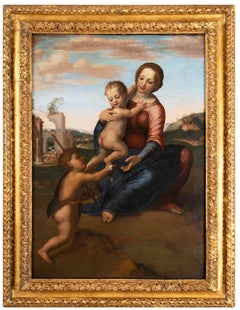
Oil painting on canvas. Venetian school of the seventeenth century. Entirely in the foreground, this scene of a group of sacred figures, which presents the faces of Mary and the Chil...

Category

Other Art Style 17th Century Art

Materials

Oil

Mid-17th-Century Spanish School Oil Painting, Portrait Of A Theologian

Mid-17th-Century Spanish School Oil Painting, Portrait Of A Theologian

Located in Cheltenham, GB

This mid-17th-century Spanish oil on canvas depicts a dignified man of learning - a theologian, or perhaps a cathedral canon. Dressed in a black cassock, marked by a vertical row of...

Category

Baroque 17th Century Art

Materials

Canvas, Oil

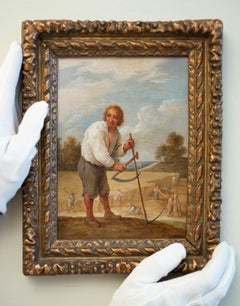
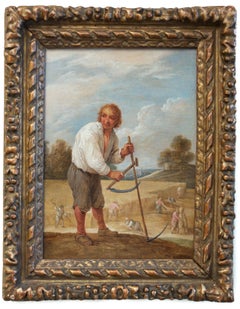
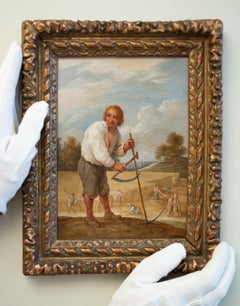
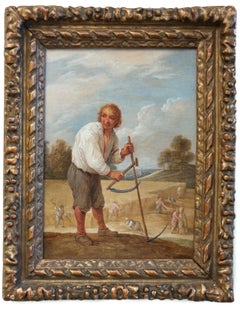
Peasants in a Cornfield (Boer in het veld) by David Teniers the Younger

Peasants in a Cornfield (Boer in het veld) by David Teniers the Younger

By David Teniers the Younger

Located in Stockholm, SE

Remembering the magic of everyday life moments in the art of David Teniers: The art of David Teniers the Younger (1610–1690) coincided with the heyday of the Flemish Baroque and captured a great variety of motifs of his time. In this painting of a seemingly simple peasant scene lies keys to understanding both the imaginative mind of Teniers as well as why this time period produced some of the most iconic works in all of art history.  As indicated by the name, Teniers was more or less born into his profession. As the son of David Teniers the elder, himself a painter who studied under Rubens, the younger David received training in art from a very young age and had no less than three brothers who also became painters. Because of his father’s frequent financial failures that even at times saw him imprisoned, David the younger helped to rescue the family from ruin through painting copies of old masters. Essentially, the young Teniers was confronted with painting as both a passion and creative expression as well as a necessity during difficult times, an experience that would shape much of his capacity and sensitivity in his coming life. Despite the hardships, the talent and determination of Teniers was recognized and quickly expanded his possibilities. He had already spent time in France and possibly also England when he was hired by his father’s former teacher Rubens to help with a prestigious commission with mythological paintings, now considered lost, for Philip IV the king Spain. In 1644–54 Teniers was appointed dean of the Antwerp Guild of Saint Luke, manifesting his esteemed position within the artistic community. A few years afterwards he took an important step when relocating to Brussels, where Teniers yet again found new career opportunities that would prove to be very successful. As the keeper of the collections of Archduke Leopold Wilhelm, a role similar to what we now refer to as an art advisor, Teniers purchased hundreds of important artworks that manifested the prominent status of the Archduke’s collection while at the same time providing an unusual access to inspiration and knowledge for Teniers himself. Since he kept on painting during the same time, his creative scope must have seemed almost bewildering in the great variety of images and stories that he surrounded himself with.  Regardless of how glamorous and culturally stimulating the career of Teniers was, he was as open to the charm and existential importance of everyday life as he was to works of great masters and luxurious collectibles. In his impressive repertoire of genres with everything from exquisite royal portraits, interiors, landscapes and history paintings he always added something new and inventive, highlighting the possibilities of art and importance of an experimental and intuitive mind. It is difficult to single out one aspect or genre to summarize his legacy, since it lies much more in the broad virtuosity across many motifs, although he is particularly remembered for farm scenes and meticulously depicted interiors where other paintings and artworks are captured with an astonishing precision. However, the fact that he is still today one of the most known and celebrated names of the Dutch Golden Age is a proof to the magic of his work, which continues to spark dialogue and wonder in the contemporary viewer of his works. The farm boy in the field in this painting, which likely dates to the mature part of his career, is a wonderful entry into the mind of Teniers. In the tightly cropped motif, we see him standing right in the middle of the busy harvest when men, women and everyone capable were sent out in the field to collect the crop that formed the very core of their diet and survival. In the background we see a fresh blue sky interspersed with skillfully painted clouds, some trees reaching their autumnal colours and in the far distance the glimpse of a small church and village. The presence of a church in a landscape, so typical of Dutch art, served both a symbolic and visual function as a representation of faith while at the same time defining scale and distance. In the field, the work is in full action with the farmers spread out in various positions, all in the midst of hard and sweaty labour. While they are portrayed as having nothing else than the work on their mind, our farm boy seems to have his attention directed elsewhere. Standing there with his white, half open shirt, flowy curls and strong, sturdy body; his gaze is directed away, out of the picture and the scythes in his hands. He looks almost smirking, expressed with tremendous subtlety in the slight smile of his lips and big eyes, being just in the middle of losing focus on the work. What is it that steals his attention? What has he seen, or realized, or felt – to break him free of the arduous task of harvesting, if but for a moment? Here starts the wondering and the questions that are the hallmark of a great piece of art. Instead of explicitly locking in the motif in overly clear symbolism Teniers has chosen an open ended, subtle yet striking moment for us to consider. While it of course can be related to numerous other farm scene depictions of this time, and clever usages of gazes and real-life scenes to underscore various moral or symbolic meanings, the painting can be much more of a contemplation than an explanation or illustration. The ordinary nature and understated yet emotionally textured composition of the motif gives greater space for our own reactions and thoughts. Has he seen a pretty farm girl just passing by? Is he fed up with the farm life, joyously dreaming away for a minute, imagining another future? Or is he simply in need of distraction, looking away and ready for anything that can steal his attention? One quality that never seem to have escaped Teniers was that of curiosity. During all of his career he constantly investigated, expanded and experimented with not only the style and technique of painting, but with the vision of art itself. Being credited with more or less introducing farm motifs for a broader audience not only tells us of his ability to understand the demand for different motifs, but the sensitivity to transform seemingly ordinary parts of life into deep aesthetic experiences, far beyond their expected reach. The farm boy in this painting is, of course, exactly that. But with the help of one smirk the entire picture is charged with a different energy, awakening many contrasts and relationships between the calm landscape, the hard work and his own breach of effectivity, holding sharp scythes while thinking or seeing something else. It is no wonder Teniers chose to work with farm scenes as a way of investigating these intricate and delicate plays on expectations and surprises, clarity and ambivalence. It invites us to an appreciation of human everyday life that connects us with the people of 17th century...

Category

Old Masters 17th Century Art
Materials

Canvas, Oil

"Chancay" (Pre-Columbian) Mummy Mask wood face peruvian folk red human folk art

"Chancay" (Pre-Columbian) Mummy Mask wood face peruvian folk red human folk art

Located in Milwaukee, WI

The Peruvian Chancay (pre-Columbian) Mummy Bundle mask, from around 1600 is made of painted wood, textiles, and human hair. According to the Walters Art Museum: Andean cultures are ...

Category

Folk Art 17th Century Art

Materials

Textile, Wood

Still Life with Flowers, Fruit and Goldfinch, 17th century

Still Life with Flowers, Fruit and Goldfinch, 17th century

Located in Milan, IT

Oil painting on canvas. In the beautiful composition you can see, resting on an inlaid wooden sideboard, a basket full of cherries, some of which are scattered on the top, and a plat...

Category

Other Art Style 17th Century Art

Materials

Oil

Group Of Musicians Caravaggesque Painter 17th Century Paint OIl on canvas

Group Of Musicians Caravaggesque Painter 17th Century Paint OIl on canvas

Located in Riva del Garda, IT

Caravaggesque painter active in Rome in the 17th century A group of musicians in an inn Oil on canvas 74 x 99 cm. - Framed 93 x 121 cm. The scene depicted belongs to a subjec...

Category

Old Masters 17th Century Art
Materials

Oil

Seascape Ships Landscape Porcellis 17th Century Paint Oil on table Old master

Seascape Ships Landscape Porcellis 17th Century Paint Oil on table Old master

Located in Riva del Garda, IT

Julius Porcellis (Rotterdam 1610 – 1645 Leiden) attributable Seascape with ships Oil on wood panel (oak) 52 x 84 cm In gilded wood frame 77 x 108 cm The painting on display d...

Category

Old Masters 17th Century Art
Materials

Oil

European Portrait of a Priest

European Portrait of a Priest

Located in Milford, NH

A fine European portrait of a priest, oil on canvas, probably dating to the 17th or 18th century, unsigned, with original stretcher, minor surface losses and damage, craquelure, edge...

Category

17th Century Art

Materials

Canvas, Oil

17th Century by Giovanni Domenico Ferrucci The Death of Cleopatra Oil on canvas

17th Century by Giovanni Domenico Ferrucci The Death of Cleopatra Oil on canvas

Located in Milano, Lombardia

Giovanni Domenico Ferrucci (Fiesole, Italy, 1619 – Lucca, Italy, post 1669) Title: The Death of Cleopatra Medium: Oil on canvas Dimensions: without frame 85 x 70.7 cm – with frame 10...

Category

Old Masters 17th Century Art
Materials

Canvas, Oil

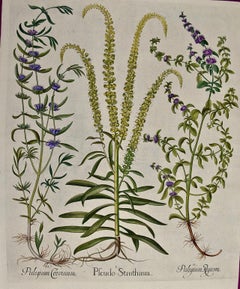
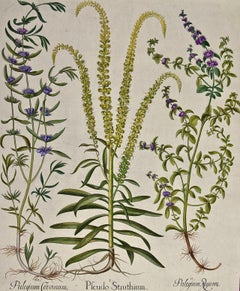
Flowering Peppermint Plants: A 17th C. Besler Hand-colored Botanical Engraving

Flowering Peppermint Plants: A 17th C. Besler Hand-colored Botanical Engraving

By Basilius Besler 1

Located in Alamo, CA

This is a hand-colored copper plate engraving entitled "Pulegium Cervinum, Pseudo Pulegium Struthium, Pulegium Regium", depicting flowering Peppermint, Weld and Pennyroyal plants respectively from Basilius Besler's landmark work, Hortus Eystettensis (Garden at Eichstatt), first published in 1613 in Eichstatt, Germany near Nuremberg and later in 1640 and 1713. This beautiful colorful engraving is printed on thin laid chain-linked paper. There are subtle creases in the right upper corner, very common with Besler's relating to the drying of the paper during its production. The right margin is thinner than the others. The print is otherwise in excellent condition with striking hand-coloring. Basilius Besler (1561–1629) was an apothecary and botanist. He was curator of the Willibaldsburg Castle garden of Johann Konrad von Gemmingen, prince bishop...

Category

Academic 17th Century Art

Materials

Engraving

Piedmontese painter - 18th century capriccio painting - Ruins and figures

Piedmontese painter - 18th century capriccio painting - Ruins and figures

Located in Varmo, IT

Piedmontese painter (18th century) - Landscape with ruins and figures. 97 x 138 cm (without frame) - 114 x 156 cm (with frame). Oil on canvas, unframed (not signed). The painting ...

Category

Rococo 17th Century Art

Materials

Canvas, Oil

Smoker Leaning on the Back of a Chair

Smoker Leaning on the Back of a Chair

By Adriaen van Ostade

Located in San Francisco, CA

Artist: Adriaen Van Ostade (Dutch, 1610-1685) Title: Smoker Leaning on the Back of a Chair Year: 1672 Medium: Etching Paper: Laid paper Image size: 4.1 x 3.55 inches Signature: Si...

Category

Old Masters 17th Century Art
Materials

Etching