1840s Art

to
75
659
384
66
19
17
Overall Width
to
Overall Height
to
7,697
21,641
163,846
227,234
2,015
2,275
4,943
6,544
5,870
15,053
20,647
25,822
18,677
14,101
5,498
745
10
7
1
1
1
663
469
4
776
323
291
229
145
134
106
98
95
91
66
53
49
47
40
40
34
30
28
27
823
138
127
114
78
143
40
25
18
12
125
833
862
197
Period: 1840s
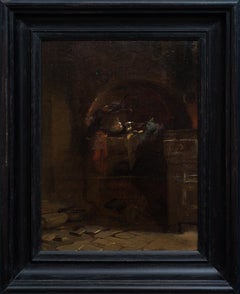
Interior of a Kitchen, c. 1840

Interior of a Kitchen, c. 1840

Located in Stockholm, SE

Egron Sellif Lundgren (1815–1875) Sweden Interior of a Kitchen, c. 1840 oil on paper laid on cardboard, inscribed “Lundgren Nr. 15” on the reverse. unframed 27.5 x 20.5 cm (10 ¾ x ...

Category

Old Masters 1840s Art

Materials

Paper, Oil, Board

Romantic Portrait of a Woman in Oriental Dress among Greek Ruins, ca. 1840

Romantic Portrait of a Woman in Oriental Dress among Greek Ruins, ca. 1840

Located in Firenze, IT

Female Figure in Oriental Dress among the Ruins of Romantic Greece Oil on canvas, 61 × 46 cm (without frame), 74 × 57 cm (with frame) Early to mid-19th century Not signed A youn...

Category

Romantic 1840s Art

Materials

Canvas, Oil

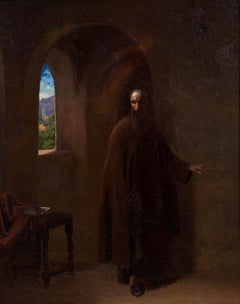
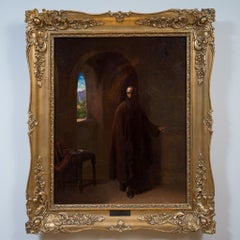
Monk in a Monastic Cell, Roma, Italy

Monk in a Monastic Cell, Roma, Italy

Located in Stockholm, SE

Egron Lundgren (1815–1875) Monk in a Monastic Cell signed and dated Egron Lundgren Rom 1848 oil on relined canvas unframed 62 x 50 cm (24 ½ x 19 ¾ in.) framed 79 x 68 cm (31 x 26 ¾...

Category

Old Masters 1840s Art

Materials

Canvas, Oil

Romantic French painting Italy Como lake monks Mid 19th

Romantic French painting Italy Como lake monks Mid 19th

Located in PARIS, FR

Jules SANSON Active in the 1830s and 1840s The arrival of the young girl at the monastery on the shores of Lake Como Oil on canvas 27 x 35.5 cm (31.5 x 39.5 cm with the frame) Signed...

Category

Romantic 1840s Art

Materials

Oil

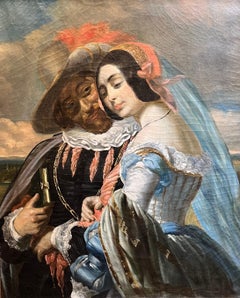
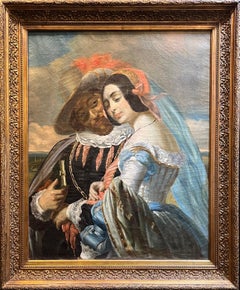
"Galantes Paar" by Henri Druard - Oil on Canvas - 100x81 cm

"Galantes Paar" by Henri Druard - Oil on Canvas - 100x81 cm

Located in Geneva, CH

Artwork sold with frame (100 x 120 x 7.5 cm) Henri Druard (1821–1877) was a French painter known for his genre scenes and depictions of everyday life in 19th-century France. Born in...

Category

Realist 1840s Art

Materials

Canvas, Oil

White Eye-browed Partridges: Hand-colored Folio-sized Bird Lithograph by Gould

White Eye-browed Partridges: Hand-colored Folio-sized Bird Lithograph by Gould

By John Gould

Located in Alamo, CA

This is a 19th century hand-colored folio-sized lithograph entitled "Dendrortyx Leucophrys" (White Eye-browed Partridges) by John Gould, published in his monograph 'A Monograph of the Odontophorinae, or Partridges of America' in London between 1844-1850. Reportedly only 250 copies were printed. The print depicts two partridges, one standing and the other lying apparently on sand, surrounded by high grass. A landscape of plants and possibly water is seen in the background. This beautiful hand-colored lithograph is presented in a double cream-colored mat. There is one tiny spot in the left lower corner, faint spots in the right upper print and mild toning about the periphery which is covered by the mat. It is otherwise in excellent condition. It is accompanied by the original text page. John Gould (1841-1881) was an English contemporary of the American John James Audubon. Gould published his first illustrated book on birds in 1831 entitled "A Century of Birds from the Himalaya Mountains", followed by "Ramphastidae" and "Birds of Europe". He then extended the scope of his travels and research to include Australia, New Zealand and New Guinea, drawing birds in their natural habitat. Artists, such as his wife Elizabeth Gould, Henry Richter and Edward Lear, transferred his drawings to hand printed and hand colored stone lithographs, which are known for their beauty, detail and accuracy. As well as an exceptional and prolific artist, Gould was an outstanding scientific naturalist. In approximately 50 years he created approximately 3,000 lithographs of birds...

Category

Naturalistic 1840s Art

Materials

Lithograph

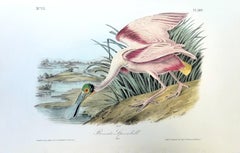
Roseate Spoonbill /// John James Audubon Natural History Ornithology Water Bird

Roseate Spoonbill /// John James Audubon Natural History Ornithology Water Bird

By John James Audubon

Located in Saint Augustine, FL

Artist: John James Audubon (American, 1785-1851) Title: "Roseate Spoonbill" (Plate 362, No. 73) Portfolio: The Birds of America, First Royal Octavo Edition Year: 1840-1844 Medium: Original Hand-Colored Lithograph on wove paper Limited edition: approx. 1,200 Printer: John T. Bowen, Philadelphia, PA Publisher: John James Audubon and J.B. Chevalier, New York, NY and Philadelphia, PA Sheet size: 6.75" x 10.44" Image size: 5" x 7.63" Condition: In excellent condition Very rare The "Roseate Spoonbill" is one of the very top, absolute most desirable birds from Audubon's famous "Birds of America" series Notes: Provenance: private collection - Fleming Island, FL. Lithography and hand-coloring by American artist John T. Bowen (1801-c.1856). Comes from Audubon's famous seven volume portfolio "The Birds of America", First Royal Octavo Edition (1840-1844), which consists of 500 hand-colored lithographs. Based on a composition painted in Florida in 1831 or 1832. "This beautiful and singular bird" was prized for its wings and tail feathers which were made into fans in St. Augustine. The roseate spoonbill is a gregarious wading bird of the ibis and spoonbill family, Threskiornithidae. It is a resident breeder in both South and North America. The roseate spoonbill's pink color is diet-derived, consisting of the carotenoid pigment canthaxanthin, like the American flamingo. To make 'The Birds of America' more affordable and widely available, in 1839 John James Audubon began the first octavo edition, a smaller version of the folio which was printed and hand-colored by J. T. Bowen in Philadelphia. Employing a new invention, the camera lucida, the images were reduced in size, rendered in intermediate drawings by John James Audubon and his son John Woodhouse, and then drawn onto lithographic stones. These miniatures exhibit a remarkable amount of attention to quality and detail, as well as a meticulous fidelity to the larger works. Some compositional changes were made in order to accommodate the smaller format. Like the Havell edition, John James Audubon’s first...

Category

Victorian 1840s Art

Materials

Watercolor, Lithograph
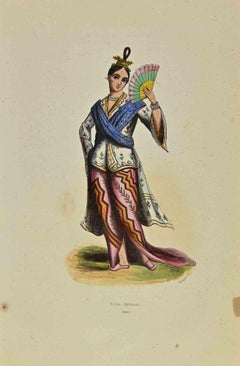
Danseuse Javanaise - Lithograph by Auguste Wahlen - 1844

Danseuse Javanaise - Lithograph by Auguste Wahlen - 1844

Located in Roma, IT

Danseuse Javanaise is a hand colored lithographs realized by Auguste Wahlen in 1844. Good condition. The artwork belongs to the Suite Moeurs, usages et costumes de tous les peuples...

Category

Modern 1840s Art

Materials

Lithograph

Herault de Timor - Lithograph by Auguste Wahlen - 1844

Herault de Timor - Lithograph by Auguste Wahlen - 1844

Located in Roma, IT

Herault de Timor is a hand colored lithograph realized by Auguste Wahlen in 1844. Good condition. The artwork belongs to the Suite Moeurs, usages et costumes de tous les peuples du...

Category

Modern 1840s Art

Materials

Lithograph

Attilla, Chestnut Horse in Stable, Oil on Canvas, Signed J Herring Snr 1842

Attilla, Chestnut Horse in Stable, Oil on Canvas, Signed J Herring Snr 1842

By John Frederick Herring Sr.

Located in St. Albans, GB

Canvas Size: 28 x 36" (71 x 91cm) Outside Frame Size 36 x 44" (91 x 111cm) It is signed on the middle right on the wooden window. This is a stunning painting of a racehorse signed and dated J F Herring Sen 1842. The horse is named above the water trough as Attilla. As Herring was a renowned painter of racehorses it is likely that this was done for a wealthy patron who owned several. Although he painted many of the winners of the St. Ledger Cup Attilla was not one of these. Free carriage worldwide John Frederick HERRING Snr 1795 – 1865 A sporting painter, born in Surrey of American/Dutch extraction. At first he was a sign and coach painter. He then worked as a stable boy and coachman in Yorkshire until with the help of patrons he was able to study with Abraham Cooper RA, the only art education he appears to have had. He specialised in racing subjects and his few hunting scenes are rare. Herring painted the start of the 1844 Derby, which became known as ‘the dirtiest Derby in history’. He sometimes collaborated with his three sons, J.F.Jnr, Benjamin Jnr and Charles. He also collaborated with James Pollard on a number of racing scenes inc. ‘The Doncaster Gold Cup’, 1838, ‘The Emperor of Russia’s Cup at Ascot’ 1845 and ‘The Dead Heat for the Doncaster Great St. Ledger’ 1849 Herring painted 33 successive winners of the St. Ledger and not surprisingly lived a large part of his life in the Doncaster area before settling in Newmarket in 1830 and then in London in 1835. He suffered serious financial difficulties after his move to London which, thanks to a great friend and patron William Taylor Copeland (1797 – 1868) head of the Spode Porcelain factory at Stoke on Trent, was resolved. He painted many pictures of the Copeland family, some of which were adapted and used as designs on the Spode china...

Category

Victorian 1840s Art

Materials

Oil

Fabbriche di Careggine - 19th Century Oil Painting Ancient Ruins Tuscany Italy

Fabbriche di Careggine - 19th Century Oil Painting Ancient Ruins Tuscany Italy

By Edmund John Niemann

Located in Gerrards Cross, GB

‘Fabbriche di Careggine’ by Edmund John Niemann (1813-1876). Fabbriche di Careggine is the name of a Italian ghost village that today lies beneath Vagli di Sotto, a man-made lake in Tuscany. Prior to its flooding in 1953 the village was home to a community of subsistence farmers who raised sheep and Garfagnana goats. We only offer original antique artwork for sale in the finest condition it can be for its age having been professionally cleaned, conserved, and re-varnished. Clients should also note that tracked and signed for international tariff-free shipping is always complimentary. It is not uncommon for paintings by one member of famous family of artists to be mistakenly attributed to a relative; a picture by “the Elder” is erroneously credited as being by “the Younger” and the work of one brother is confused with another, and so on. In 19th century British art...

Category

English School 1840s Art

Materials

Oil

Le Diable Boiteux - Rare Book Illustrated by Tony Johannot - 1840

Le Diable Boiteux - Rare Book Illustrated by Tony Johannot - 1840

By Tony Johannot

Located in Roma, IT

Le Diable Boiteux is an original modern rare book written by René Le Sage (Sarzeau, 1668 – Boulogne-sur-Mer, 1747) and illustrated by Tony Johannot (9 November 1803 – 4 August 1852) in 1840. Original First Edition. Published by Bourdin éditeur, Paris. Format: large 8°. The book includes 380 pages with several in text and full page illustrations. Mint conditions. Tony Johannot (9 November 1803 – 4 August 1852). Johannot was a French engraver, illustrator and painter. His historical paintings were exhibited at the Paris Salon for the first time in 1831. He became an illustrator much prized for his elegance, his diversity, and the lively character of his drawings, which were converted to engravings either by himself or by such artists as Jacques Adrien Lavieille, Émile Montigneul, and Alfred Revel. He was praised by Théophile Gautier.

Category

Modern 1840s Art

Materials

Paper, Lithograph

Danseuse a Java - Lithograph by Auguste Wahlen - 1844

Danseuse a Java - Lithograph by Auguste Wahlen - 1844

Located in Roma, IT

Danseuse a Java is a hand colored lithographs realized by Auguste Wahlen in 1844. Good condition. The artwork belongs to the Suite Moeurs, usages et costumes de tous les peuples du...

Category

Modern 1840s Art

Materials

Lithograph

Eglantine - Les Fleurs Animées Vol.I - Litho by J.J. Grandville - 1847

Eglantine - Les Fleurs Animées Vol.I - Litho by J.J. Grandville - 1847

By J. J. Grandville

Located in Roma, IT

Image dimensions: 24.3 x 17.5 cm. Single sheet with passepartout. "...The unhappy man had approached that mysterious spot where, amid a thousand aquatic plants, the Water-arrow grows." T. Delord. Les Fleurs animées...

Category

Modern 1840s Art

Materials

Lithograph

Estampas Del Popol Vuh

Estampas Del Popol Vuh

By Carlos Mérida

Located in San Francisco, CA

Artist: Carlos Merida (Guatemalan, 1891-1984) Title: Estampas Del Popol Vuh Year: 1943 Medium: Color lithograph Edition: Unumbered of 1000 Paper: Wove ...

Category

Abstract Impressionist 1840s Art

Materials

Lithograph

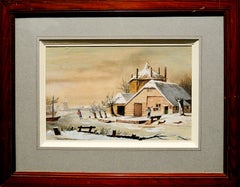
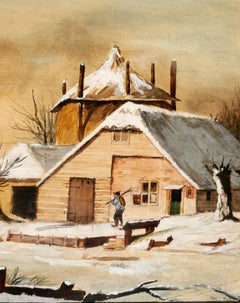
19e century Holland school Winter scene Oil painting Signed

19e century Holland school Winter scene Oil painting Signed

Located in Zofingen, AG

➡️Winter scene⬅️ Watercolor from Johannes Franciscus HOPPENBROUWERS (1819-1866) (see wikipedia) ⭐Structural Analysis⭐ This painting depicts a winter scene in a rural village, possibly in the Netherlands or a similar European setting. The composition is well-balanced, featuring: A central building with a distinctive thatched roof covered in snow, creating a focal point. A frozen river or canal, with a person ice skating in the middle ground, adding movement and human presence. A windmill and houses in the background, reinforcing a Dutch setting. Figures engaged in daily life, such as the man near the building carrying a walking stick and a bag, adding a narrative element. The overall scene is tranquil yet lively, capturing a nostalgic winter atmosphere. ⭐Color and Light⭐ The palette consists of muted earth tones, including warm browns, ochres, and soft grays, giving a rustic and aged appearance. The sky has an orange-yellow hue, possibly representing a sunrise or sunset, casting a gentle glow over the cold landscape...

Category

Romantic 1840s Art

Materials

Gesso, Watercolor

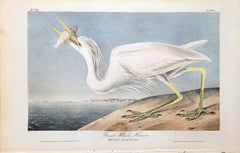
Great White Heron /// John James Audubon Ornithology Shorebird Key West Florida

Great White Heron /// John James Audubon Ornithology Shorebird Key West Florida

By John James Audubon

Located in Saint Augustine, FL

Artist: John James Audubon (American, 1785-1851) Title: "Great White Heron" (Plate 368, No. 74) Portfolio: The Birds of America, First Royal Octavo Edition Year: 1840-1844 Medium: Or...

Category

Victorian 1840s Art

Materials

Watercolor, Lithograph
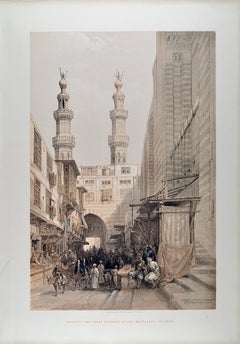
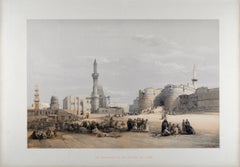
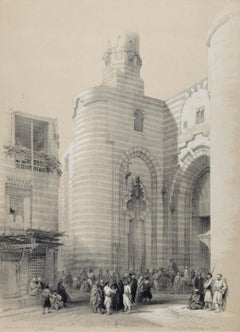
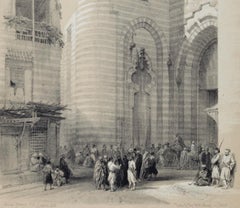
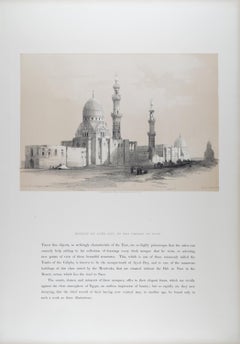
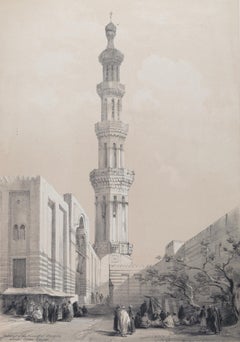
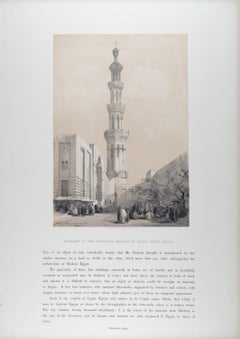
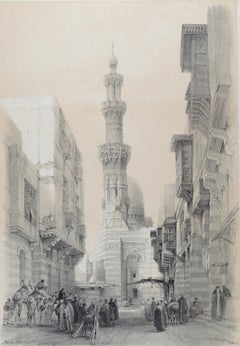
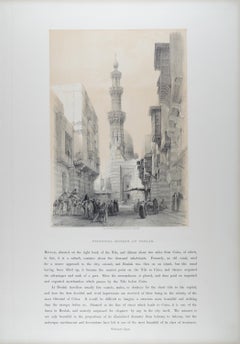
Minaret of a Mosque in Siout, Egypt: Original 19th C. Lithograph by D. Roberts
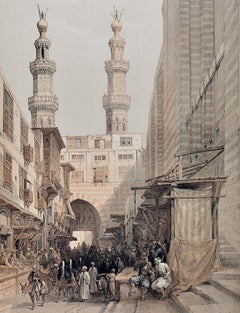
Minaret of a Mosque in Siout, Egypt: Original 19th C. Lithograph by D. Roberts
By David Roberts

Located in Alamo, CA

This is an original 19th century duotone lithograph entitled "Minaret of the Principal Mosque in Siout, Upper Egypt" by David Roberts, from his Egypt and Nubia volumes of the large folio edition, published in London by F. G. Moon in 1849. The lithographs were prepared by Louis Haghe (1806-1885) from drawings and paintings by Roberts. The resultant large folio editions of 'The Holy Land' and 'Egypt & Nubia' are considered the greatest lithographically illustrated works issued in the 19th century. This lithograph depicts an imposing minaret in the background, a large mosque on the left and both sitting and standing groups of Egyptian men in conversation in the foreground. Roberts thought this minaret was the most beautiful he had encountered and was a prime example of the architecture of modern Egypt. It has four balconies with enriched balustrades supported by brackets and corbels...
Category

Realist 1840s Art

Materials

Lithograph
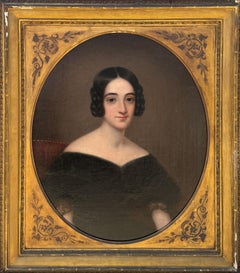
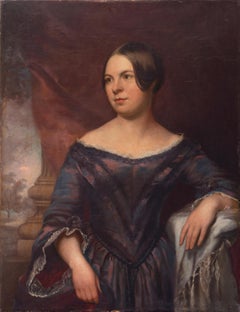
"Portrait of Rebecca" Harriet Peale, Early American Female Portrait

"Portrait of Rebecca" Harriet Peale, Early American Female Portrait

By Harriet Cany Peale

Located in New York, NY

Harriet Peale Portrait of Rebecca, 1840 Inscribed verso, “Portrait of Rebecca Greenwood (?)/ Aged 25 years/ Painted by Harriet C. Cany/ May 1840” Oil on canvas 28 3/4 x 23 3/4 inches...

Category

Academic 1840s Art

Materials

Canvas, Oil

Running fallow deer
Running fallow deer

Running fallow deer

Located in PARIS, FR

Running fallow deer by Pierre-Jules MENE (1810-1879) A rare bronze sculpture with a nuanced dark brown patina Signed on the base "P.J. Mêne" With the foundry mark "fondu par Eugène...
Category

French School 1840s Art

Materials

Bronze

"Portrait of an Italian Fencer, " John Frederick Kensett, Hudson River School

"Portrait of an Italian Fencer, " John Frederick Kensett, Hudson River School

By John Frederick Kensett

Located in New York, NY

John Frederick Kensett (1816 - 1872) Portrait of an Italian Fencer, circa 1845-47 Watercolor on wove paper 13 1/8 x 8 1/8 inches Signed with initials and inscribed lower right "J.F.K. Rome" From October 1845 through the spring of 1847, Kensett lived in Rome. He attended classes where he sketched from live models, and he sketched in the countryside outside Rome and around Florence, Perugia, and Venice, places he visited with his artist friends. He fulfilled commissions for paintings from Americans in Italy, and by 1847 his career was well established. Son of an English immigrant engraver, John Kensett lacked enthusiasm for that medium and became one of the most accomplished painters of the second generation of Hudson River School painters. His reputation is for Luminism, careful depiction of light, weather, and atmosphere as they affect color and texture of natural forms. He was particularly influenced by the painting of Asher Durand in that he focused on realism and detail rather than the highly dramatic views associated with Thomas Cole. Going to the western United States in the mid 1850s and the 1860s, he was the first of the Hudson River School painters to explore and paint the West. Kensett was born and raised in Cheshire, Connecticut, and learned his engraving from his father, Thomas Kensett with whom he worked in New Haven, Connecticut until 1829. He continued working until 1840 as an engraver of labels, banknotes and maps and was employed part of that time by the American Bank Note Company in New York City. There he met Thomas Rossiter, John Casilear, and other artists who urged him to pursue painting. In 1840, he and Rossiter, Asher Durand, and Casilear went to Europe where Kensett stayed for seven years and supported himself by doing engraving but became accomplished in landscape painting. Having sent canvases of Italian landscapes back to New York, he had a reputation for skillful painting that preceded him. When he returned to New York City in 1847, he was an "instant success" and very sought after by collectors. Two of his Italian landscapes had already been purchased by the American Art Union. By 1849, he was a full member of the National Academy of Design and was generally popular among his peers. His studio was a gathering place with travelers stopping by to see his canvases and to identify "precise locations in the Catskills or Newport or New England in the oil sketches and drawings that covered his walls." (Zellman 170). For the women, he was a popular bachelor, "romantic looking with high forehead and sensitive expression." (Samuels 262) He was also sought after by many organizations. Among his activities were serving on the committee to oversee the decoration of the United States Capitol in Washington DC, and becoming one of the founders of the Metropolitan Museum in New York. An inveterate traveler, Kensett spent summers on painting excursions away from New York City. One of these trips was a special painting excursion with fifteen other artists sponsored by the B & O Railroad from Baltimore, Maryland to Wheeling, West Virginia. Unlike many of the Hudson River painters...

Category

Hudson River School 1840s Art

Materials

Paper, Watercolor