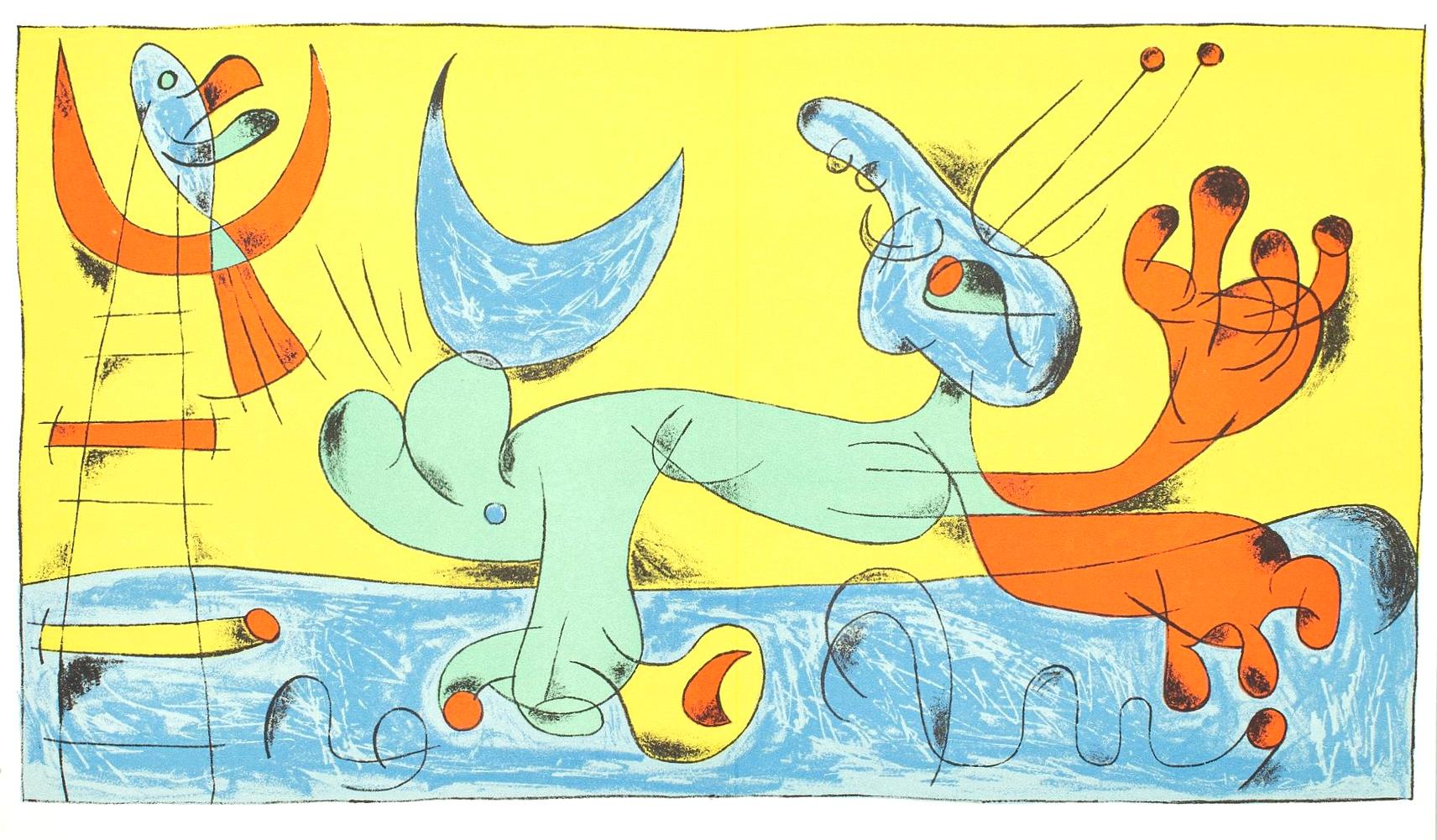
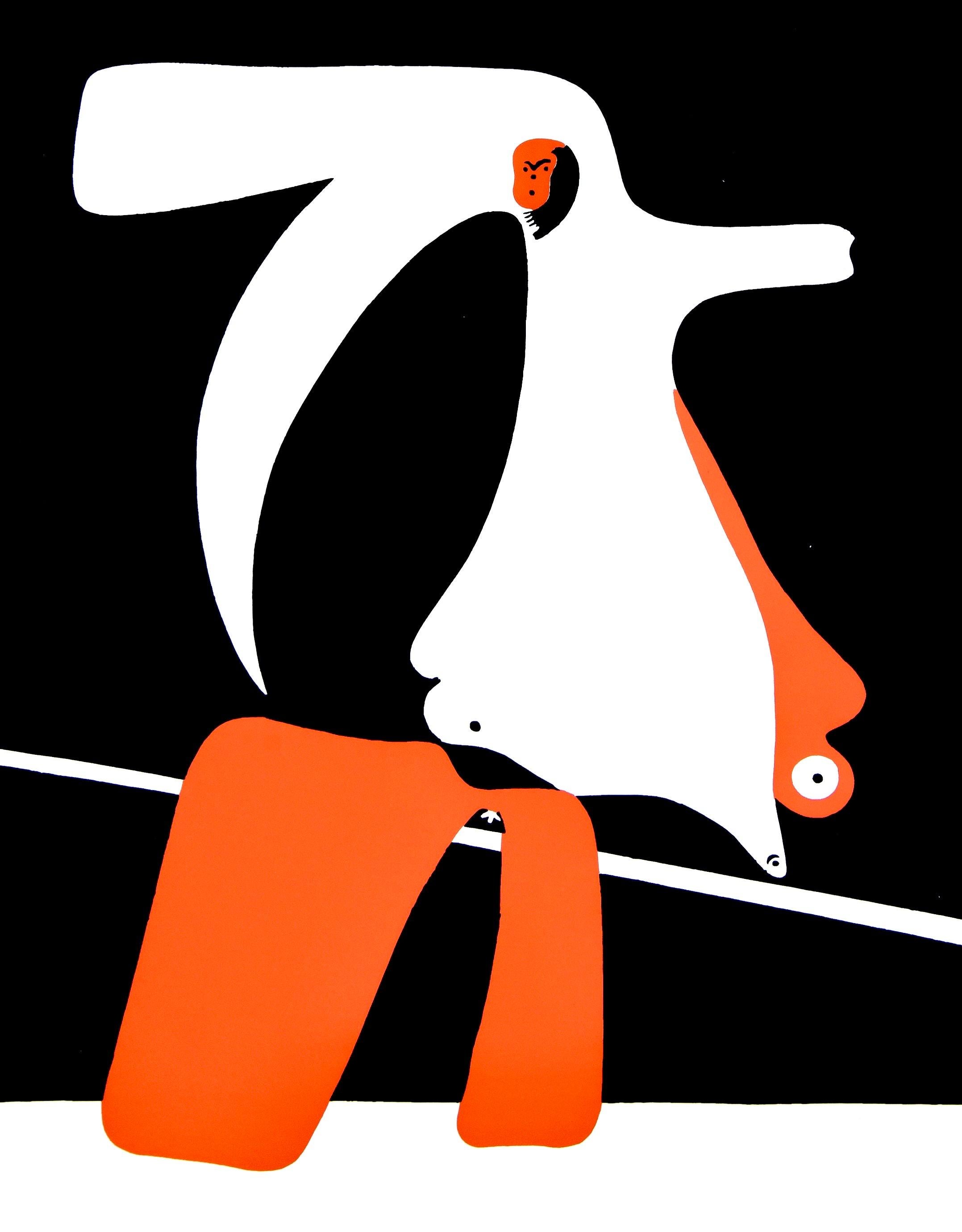
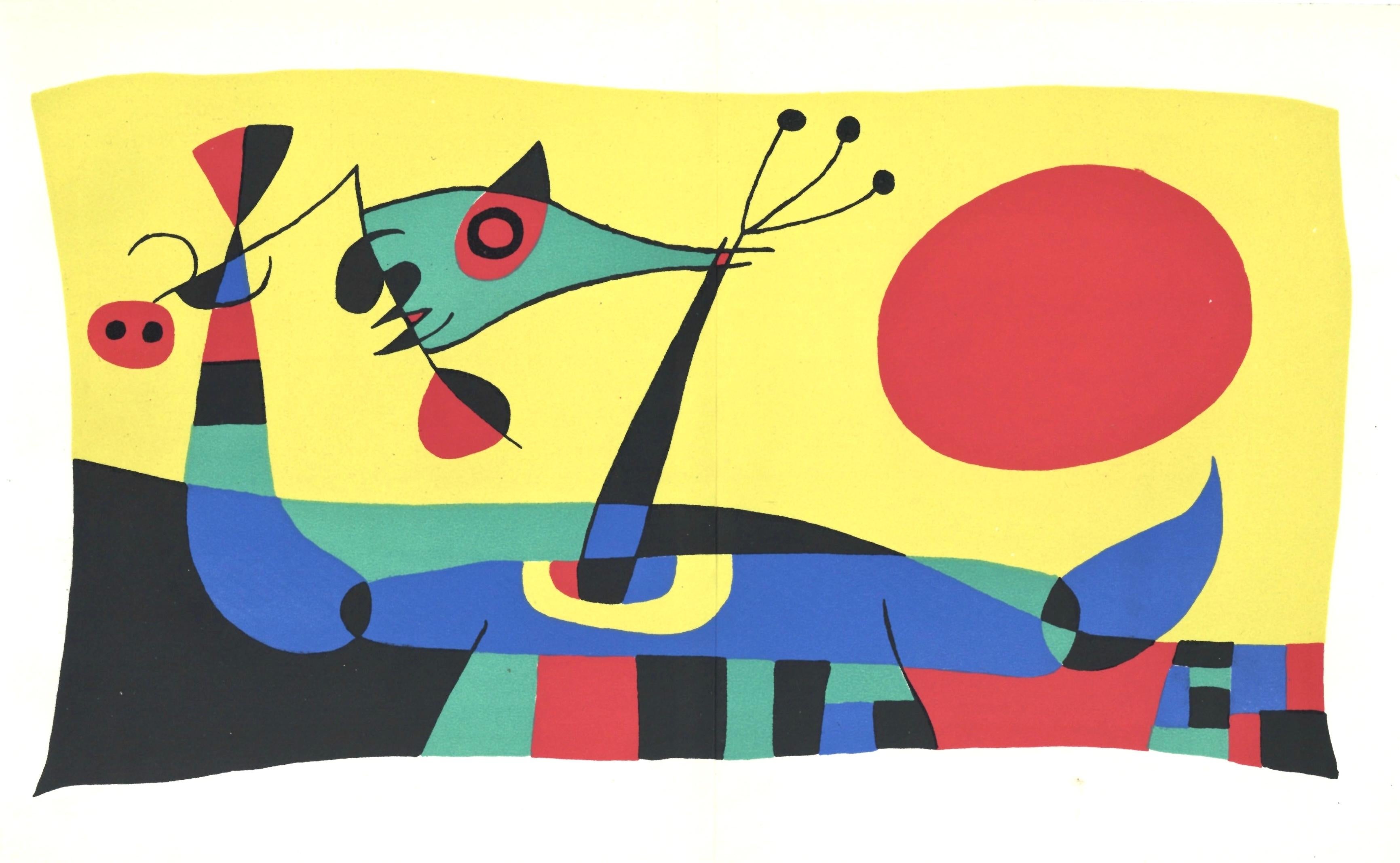
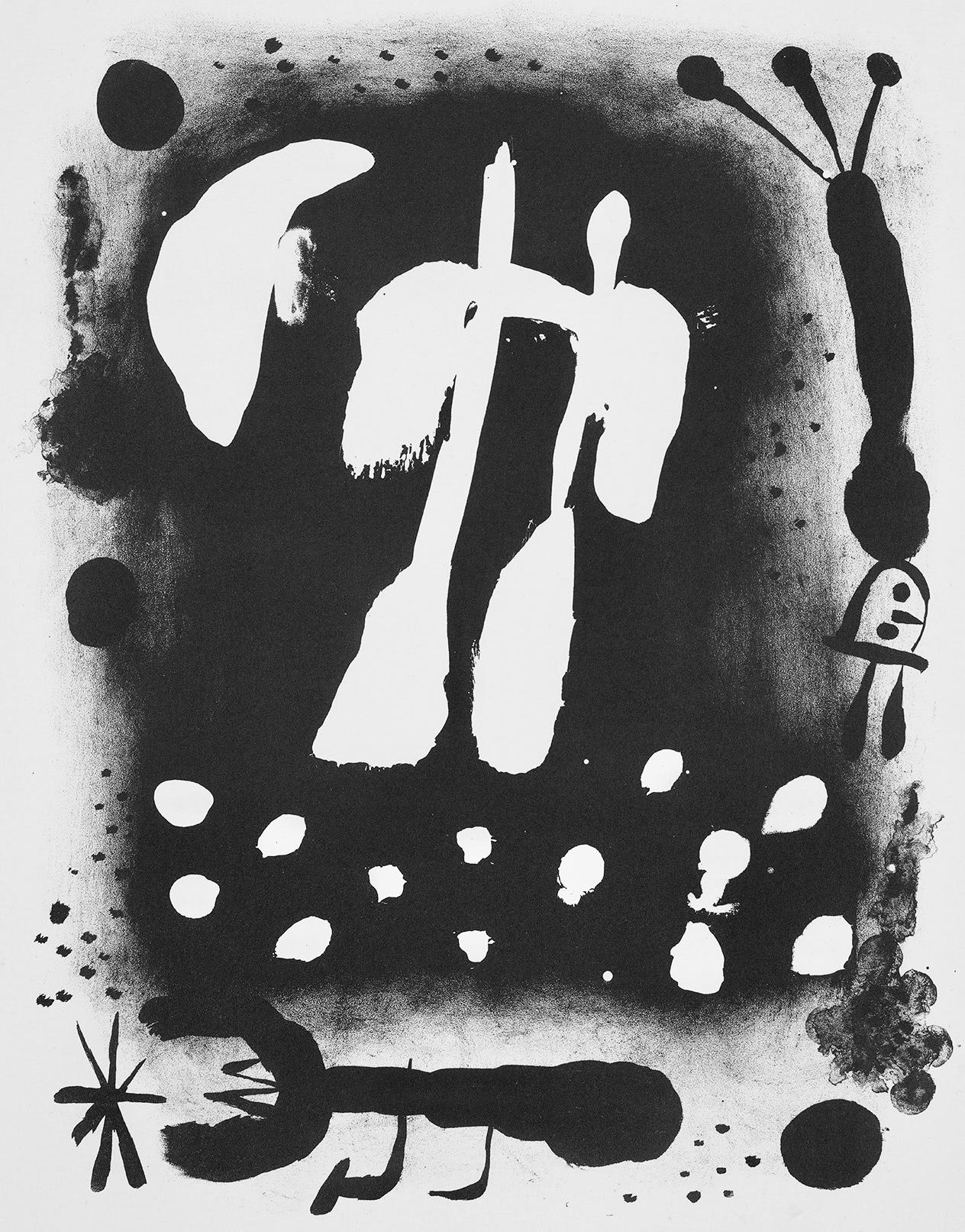
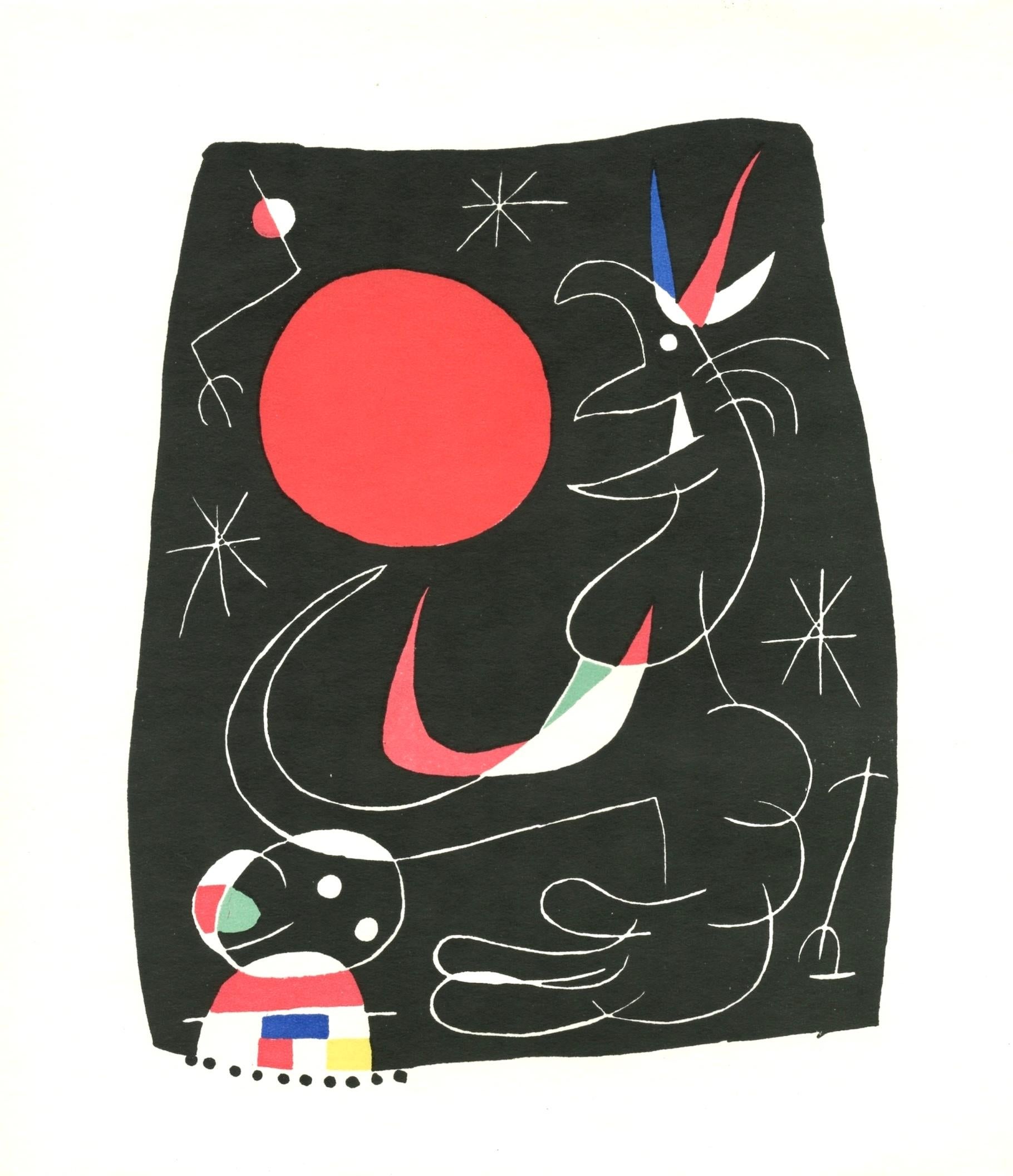
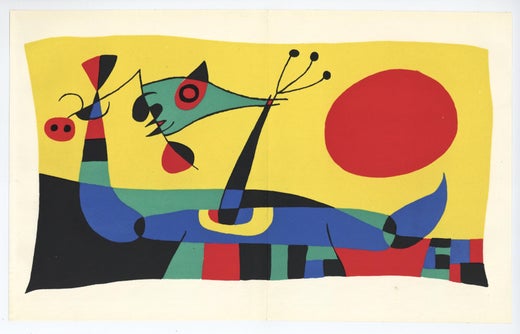
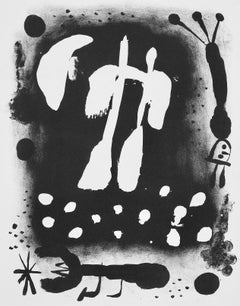
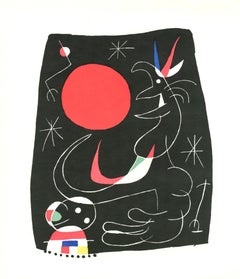
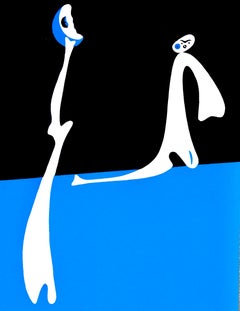
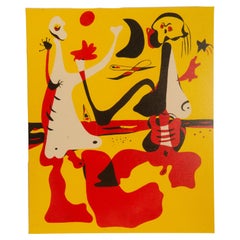
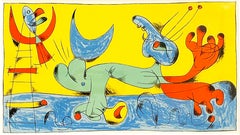
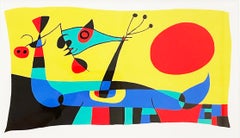
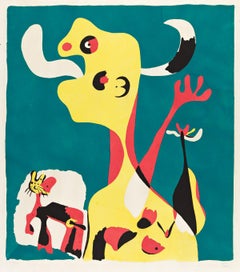
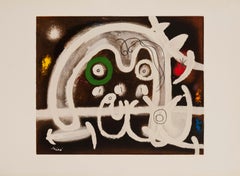
This exquisite lithograph and pochoir by Joan Miro (1893–1983), titled Figures davant el mar (Figures Before the Sea), originates from the historic 1934 album D'Aci i d’Alla, Numero Extraordinari de Nadal dedicat a l’art del segle XX. Published by Llibreria Catalonia, Barcelona, under the direction of Antonio Lopez Llausas, Editeur, Barcelona, 1934, and under the supervision of Joan Prats, Barcelona, and Josep Lluis Sert, Barcelona; printed by Pochoir Publicity Art, Barcelona, under the direction of J. Mateu, Barcelona, 1934, the work reflects Miros early mastery of Surrealist biomorphism and his exceptional sensitivity to the pochoir technique, whose saturated, hand-applied colors were ideally suited to his luminous Mediterranean palette.
Executed as a lithograph and pochoir on velin paper, this work measures 13 x 11.1875 inches (33.02 x 28.42 cm). Unsigned and unnumbered as issued. Printed by Pochoir Publicity Art, Barcelona, under the direction of J. Mateu.
Artwork Details:
Artist: Joan Miro (1893–1983)
Title: Figures davant el mar (Figures Before the Sea), from the album D'Aci i d’Alla, Numero Extraordinari de Nadal dedicat a l’art del segle XX, 1934
Medium: Lithograph and pochoir on velin paper
Dimensions: 13 x 11.1875 inches (33.02 x 28.42 cm)
Inscription: Unsigned and unnumbered as issued
Date: 1934
Publisher: Llibreria Catalonia, Barcelona; under the direction of Antonio Lopez Llausas, Editeur, Barcelona, with the supervision of Joan Prats and Josep Lluis Sert
Printer: Pochoir Publicity Art, Barcelona; under the direction of J. Mateu
Catalogue raisonne reference: Dupin, Jacques, and Joan Miro. Miro Engraver 1928–1960. Rizzoli, 1984, illustration 13. Cramer, Patrick. Joan Miro: The Illustrated Books: Catalogue Raisonne. Patrick Cramer, 1989, illustration 11.
Condition: Well preserved, consistent with age and medium
Provenance: From the album D'Aci i d’Alla, Numero Extraordinari de Nadal dedicat a l’art del segle XX, 1934, published by Llibreria Catalonia, Barcelona
About the Publication:
The 1934 album D'Aci i d’Alla, Numero Extraordinari de Nadal dedicat a l’art del segle XX, stands as one of the most ambitious, sophisticated, and culturally significant Catalan art publications of the interwar period, conceived at a moment when Barcelona was a thriving hub of artistic modernity. Produced by Llibreria Catalonia under the direction of Antonio Lopez Llausas, with the close involvement of Joan Prats and Josep Lluis Sert—two of the most influential Catalan cultural figures of the twentieth century—the album embodied a vision of Catalonia as an active, forward-looking center of international avant-garde thought, connected intellectually and aesthetically to Paris, yet deeply rooted in Mediterranean identity. Unlike standard periodicals, D'Aci i d’Alla functioned as a hybrid fine art album, design object, and critical journal, integrating essays, photography, architecture, poetry, and original artworks in a unified modernist aesthetic. The 1934 Numero Extraordinari, devoted to twentieth-century art, was particularly ambitious in scope: it surveyed the newest movements in modernism while highlighting Catalonia’s unique contributions to the international avant-garde. Its inclusion of an original Joan Miro pochoir—executed in Barcelona rather than Paris—was a powerful assertion of Catalan artistic autonomy, demonstrating that local ateliers such as Pochoir Publicity Art, under J. Mateu, could achieve the same chromatic brilliance and technical refinement as their Parisian counterparts. Pochoir, a labor-intensive method involving hand-applied color through meticulously cut stencils, allowed Miro’s biomorphic forms, floating constellations, and radiant hues to appear with a vibrancy unmatched by conventional printing techniques. Figures davant el mar is one of the most celebrated works associated with this extraordinary issue, capturing Miro at a pivotal phase when he was synthesizing Surrealism, Catalan folk imagery, and the luminous atmosphere of the Mediterranean into a distinctly personal visual language. The publication itself remains an essential artifact of pre–Spanish Civil War Catalan modernism—an avant-garde manifesto in printed form, reflecting an era of cultural optimism, intellectual experimentation, and international engagement that would soon be disrupted by political turmoil. Today, surviving examples of the 1934 D'Aci i d’Alla album, especially those retaining the Miro pochoir, are prized for their rarity, historical resonance, and their central role in documenting the flowering of Catalan artistic identity during one of its most visionary periods.
About the Artist:
Joan Miro (1893–1983) was a Catalan painter, sculptor, printmaker, and ceramicist whose visionary imagination and lyrical abstraction made him one of the most influential and beloved artists of the 20th century. Born in Barcelona, Miro drew inspiration from Catalan folk art, Romanesque frescoes, and the luminous landscapes of Mont-roig del Camp, developing a deep connection to nature that infused his work with vitality and symbolism. After formal training at the Escola d'Art in Barcelona, he absorbed the lessons of Post-Impressionism and Cubism before moving to Paris in the early 1920s, where he became a leading figure in the Surrealist movement. There, Miro forged a personal visual language of biomorphic shapes, floating symbols, and radiant color harmonies that reflected both spontaneity and spiritual depth. In creative dialogue with peers such as Alexander Calder, Alberto Giacometti, Salvador Dali, Wassily Kandinsky, Marcel Duchamp, and Man Ray, he helped revolutionize modern art by dissolving the boundaries between abstraction and dream imagery. Miros inventive approach extended far beyond painting, embracing sculpture, ceramics, and monumental public commissions that redefined how art could interact with space and emotion. His expressive freedom and gestural abstraction profoundly influenced later artists including Jackson Pollock, Mark Rothko, Alexander Calder, Jean Dubuffet, Antoni Tapies, and Joan Mitchell, inspiring generations who sought to merge instinct, color, and imagination. Today, Miros work remains a cornerstone of modernism, prized by collectors and celebrated in major museums worldwide. His highest auction record was achieved by Peinture (Etoile Bleue) (1927), which sold for 23,561,250 GBP (approximately 37 million USD) at Sotheby's, London, on June 19, 2012.
Joan Miro Figures davant el mar 1934, Miro D’aci i d’alla 1934, Miro pochoir, Llibreria Catalonia 1934, J. Mateu pochoir Barcelona, Miro Surrealist print, Miro Catalan modernism, Miro collectible print.