Drawing Landscape Prints

to
1,476
2,320
606
323
39
26
Overall Width
to
Overall Height
to
1,312
417
313
160
146
122
85
32
26
14
5
1
131
115
79
49
46
248
384
2,575
145
24
26
401
170
274
411
273
428
170
53
176
1,708
1,570
33
6,817
3,352
2,606
2,330
1,833
1,663
1,504
1,373
1,217
1,044
1,025
989
867
848
830
718
579
527
520
514
1,409
1,317
340
273
260
125
934
2,021
1,124
Art Subject: Drawing
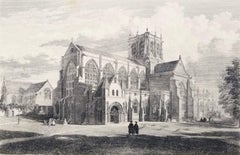
Southwest View of Sherborne Abbey Church /// History of Dorset English Engraving
Located in Saint Augustine, FL
Artist: John Hutchins (English, 1698-1773) Title: "Southwest View of Sherborne Abbey Church" (Plate 15) Portfolio: The History and Antiquities of the County of Dorset Year: 1861-1870...
Category

1860s Victorian Landscape Prints

Materials

Engraving

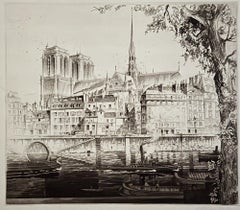
Notre-Dame Cathedral from the Seine
Located in Middletown, NY
Etching with drypoint on cream wove paper, 7 x 8 3/4 inches (177 x 223 mm); sheet 10 1/2 x 11 3/4 inches (267 x 300 mm), full margins. Signed V. E. Chapel and numbered 62/250 in penc...
Category

Early 20th Century French School Landscape Prints

Materials

Etching, Drypoint

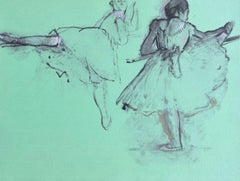
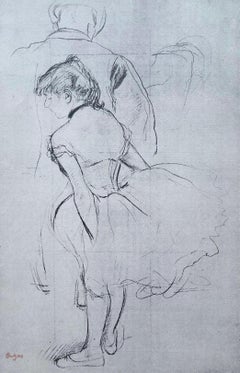
Edgar Degas, Dancer at the Barre, 1945 (after)
Located in Southampton, NY
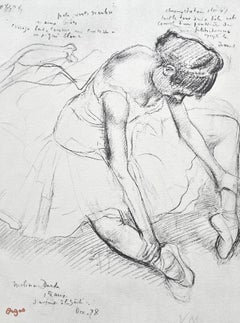
This exquisite lithograph after Edgar Degas (1834–1917), titled Danseur au bar (Dancer at the Barre), originates from the 1945 folio Degas, Ten Ballet Sketches. Published by The Studio Publications, Inc., New York, rendered and printed by Albert Carman, City Island, 1945, this work reflects Degas’s sensitive mastery of line, movement, and the intimate psychological nuances of the ballet studio. Executed as a lithograph and pochoir on velin paper, this work measures 13 x 17 inches (33.02 x 43.18 cm). Signed in the plate and unnumbered as issued. Rendered and printed by Albert Carman, City Island. Artwork Details: Artist: After Edgar Degas (1834–1917) Title: Danseur au bar (Dancer at the Barre), from Degas, Ten Ballet Sketches, 1945 Medium: Lithograph and pochoir on velin paper Dimensions: 13 x 17 inches (33.02 x 43.18 cm) Inscription: Signed in the plate and unnumbered as issued Date: 1945 Publisher: The Studio Publications, Inc., New York Printer: Albert Carman, City Island Condition: Well preserved, consistent with age and medium Provenance: From the 1945 folio Degas, Ten Ballet Sketches, published by The Studio Publications, Inc., New York Notes: Excerpted from the album, Born in Paris in 1834, Edgar Degas lived, and surely loved the life of that city during most of his years. These continued somewhat sadly beyond those of most of his friends— into the debacle of the first World War, during which he died in 1917. Judging by the frequency with which he used them as models, he must have had an especial admiration for the ballet girls who followed a profession that at the time brought none of the glory and prosperity which attend it today. New aspects of the human body, revealed in movement, fascinated him. But his occupation with the simply anatomical side of his subjects never resulted in a cold interpretation. On the contrary there is a warmth and sympathy that pervades all of his work. The drawings here represent the painter in one important phase of his multi-sensitive view of life; and permit an insight which a more ambitious work might not do-into the operation of the creative process, the artist's transformation of reality as it passes through the mesh of his sensibilities. The Edition of this Portfolio is limited to MMMD examples. Rendered by Albert Carman. About the Publication: Degas, Ten Ballet Sketches (1945) is one of the earliest and most significant American postwar fine art portfolios devoted to Edgar Degas’s intimate works on paper. Published by The Studio Publications, Inc., New York, and rendered and printed by Albert Carman at City Island, the album sought to faithfully reproduce a group of Degas’s ballet-related drawings through a combination of lithography and hand-applied pochoir coloring. This hybrid technique allowed the edition to preserve the immediacy, tonal subtlety, and gestural delicacy central to Degas’s draftsmanship. Conceived as a fine art publication rather than a commercial book, the portfolio provided American audiences unprecedented access to Degas’s private, spontaneous studies—images that reveal the artist’s fascination with movement, anatomy, and the psychological atmosphere of the rehearsal studio. The album exemplifies the mid-20th-century revival of pochoir as a means of recreating the texture and coloristic nuance of original works on paper, and it remains an important document of how Degas’s legacy was translated into high-quality printed form for collectors, museums, and connoisseurs. About the Artist: Edgar Degas (1834–1917) was a French painter, draughtsman, printmaker, and sculptor whose groundbreaking fusion of classical draftsmanship, modern experimentation, and psychological depth helped define the trajectory of Western art, positioning him as one of the most influential figures of the nineteenth and early twentieth centuries; renowned for his depictions of ballet dancers, racehorses, theater scenes, cafe life, domestic interiors, milliners, laundresses, and women at their toilette, Degas reimagined observational realism through radical compositional innovation—employing extreme cropping, asymmetrical framing, oblique viewpoints, and dramatic lighting that anticipated photographic and cinematic language long before these technologies shaped visual culture, and although associated with Impressionism, he rejected plein-air spontaneity in favor of studio-based discipline rooted in the linear precision of Jean-Auguste-Dominique Ingres, the expressive chromaticism of Eugene Delacroix, and the modernity of Edouard Manet while also drawing inspiration from Japanese ukiyo-e prints, classical sculpture, and early photography; his independent artistic philosophy resonated with and helped shape the innovations of Pablo Picasso, Alexander Calder, Alberto Giacometti, Salvador Dali, Joan Miro, Wassily Kandinsky, Marcel Duchamp, and Man Ray, whose explorations of movement, form, dream logic, abstraction, and conceptualism all find antecedents in Degas’s investigations into seriality, temporality, and the fragmented figure, and his pioneering use of pastel, monotype, and wax sculpture fundamentally transformed each medium, influencing artists from Henri Matisse, Francis Bacon, Lucian Freud, and Giacomo Manzu to Paula Rego, contemporary realists, experimental photographers, and choreographers; his works are held in nearly every major museum collection worldwide—including the Musee dOrsay, the Louvre, the Metropolitan Museum of Art, the National Gallery of Art, the Art Institute of Chicago, the Courtauld Institute, and the National Gallery, London—affirming his central place in the history of art, and the highest auction record for Degas was achieved at Sothebys London on February 3, 2015, when Danseuses en Bleu sold for 37,033,000 GBP, cementing his status as one of the most sought-after and enduringly significant artists of the Western canon. Degas pochoir, Degas lithograph...
Category

1940s Impressionist Figurative Prints

Materials

Lithograph

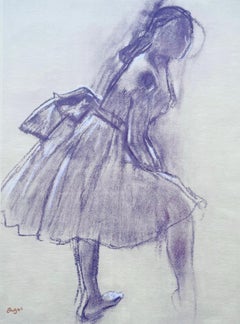
Edgar Degas, Dancer Standing in Profile, 1945 (after)
Located in Southampton, NY
This exquisite lithograph after Edgar Degas (1834–1917), titled Danseur debout de profil (Dancer Standing in Profile), originates from the 1945 folio Degas, Ten Ballet Sketches. Published by The Studio Publications, Inc., New York, rendered and printed by Albert Carman, City Island, 1945, this work reflects Degas’s sensitive mastery of line, movement, and intimate observation, capturing the grace, poise, and psychological immediacy that define his iconic ballet imagery. In Danseur debout de profil (Dancer Standing in Profile), Degas reveals gesture and inner emotion through economical contour and lyrical nuance. Executed as a lithograph and pochoir on velin paper, this work measures 17 x 13 inches (43.18 x 33.02 cm). Signed in the plate and unnumbered as issued. Rendered and printed by Albert Carman, City Island, one of the notable American ateliers specializing in fine art lithography during the mid-20th century. Artwork Details: Artist: After Edgar Degas (1834–1917) Title: Danseur debout de profil (Dancer Standing in Profile), from Degas, Ten Ballet Sketches, 1945 Medium: Lithograph and pochoir on velin paper Dimensions: 17 x 13 inches (43.18 x 33.02 cm) Inscription: Signed in the plate and unnumbered as issued Date: 1945 Publisher: The Studio Publications, Inc., New York Printer: Albert Carman, City Island, 1945 Condition: Well preserved, consistent with age and medium Provenance: From the 1945 folio Degas, Ten Ballet Sketches, published by The Studio Publications, Inc., New York Notes: Excerpted from the album, Born in Paris in 1834, Edgar Degas lived, and surely loved the life of that city during most of his years. These continued somewhat sadly beyond those of most of his friends— into the debacle of the first World War, during which he died in 1917. Judging by the frequency with which he used them as models, he must have had an especial admiration for the ballet girls who followed a profession that at the time brought none of the glory and prosperity which attend it today. New aspects of the human body, revealed in movement, fascinated him. But his occupation with the simply anatomical side of his subjects never resulted in a cold interpretation. On the contrary there is a warmth and sympathy that pervades all of his work. The drawings here represent the painter in one important phase of his multi-sensitive view of life; and permit an insight which a more ambitious work might not do-into the operation of the creative process, the artist's transformation of reality as it passes through the mesh of his sensibilities. The Edition of this Portfolio is limited to MMMD examples. Rendered by Albert Carman. About the Publication: Degas, Ten Ballet Sketches, published in 1945 by The Studio Publications, Inc., New York, stands as one of the most elegant and scholarly mid-century American fine art folios devoted to the ballet imagery of Edgar Degas. Conceived as a high-quality interpretive portfolio, the album presents a series of lithograph-and-pochoir renderings based on Degas’s original drawings, executed with exceptional attention to tonal subtlety, contour fidelity, and the emotional interiority that defines the artist’s draftsmanship. Rendered and printed by Albert Carman on City Island, the publication embodies an American postwar effort to restore and celebrate European masterworks through meticulous handcraft and artisanal color application, honoring Degas’s distinctive line and the atmospheric delicacy of his studio-based studies. Produced in a substantial edition of MMMD examples, the portfolio offered audiences rare access to Degas’s private working drawings—images rarely seen outside institutional collections—while exemplifying the technical refinement and interpretive care characteristic of Carman’s workshop. Today, Degas, Ten Ballet Sketches remains a sought-after historical publication, valued for its craft, fidelity to Degas’s aesthetic, and its role in preserving and disseminating the artist’s intimate ballet imagery in a beautifully executed mid-century fine art format. About the Artist: Edgar Degas (1834–1917) was a French painter, draughtsman, printmaker, and sculptor whose groundbreaking fusion of classical draftsmanship, modern experimentation, and psychological depth helped define the trajectory of Western art, positioning him as one of the most influential figures of the nineteenth and early twentieth centuries; renowned for his depictions of ballet dancers, racehorses, theater scenes, cafe life, domestic interiors, milliners, laundresses, and women at their toilette, Degas reimagined observational realism through radical compositional innovation—employing extreme cropping, asymmetrical framing, oblique viewpoints, and dramatic lighting that anticipated photographic and cinematic language long before these technologies shaped visual culture, and although associated with Impressionism, he rejected plein-air spontaneity in favor of studio-based discipline rooted in the linear precision of Jean-Auguste-Dominique Ingres, the expressive chromaticism of Eugene Delacroix, and the modernity of Edouard Manet while also drawing inspiration from Japanese ukiyo-e prints, classical sculpture, and early photography; his independent artistic philosophy resonated with and helped shape the innovations of Pablo Picasso, Alexander Calder, Alberto Giacometti, Salvador Dali, Joan Miro, Wassily Kandinsky, Marcel Duchamp, and Man Ray, whose explorations of movement, form, dream logic, abstraction, and conceptualism all find antecedents in Degas’s investigations into seriality, temporality, and the fragmented figure, and his pioneering use of pastel, monotype, and wax sculpture fundamentally transformed each medium, influencing artists from Henri Matisse, Francis Bacon, Lucian Freud, and Giacomo Manzu to Paula Rego, contemporary realists, experimental photographers, and choreographers; his works are held in nearly every major museum collection worldwide—including the Musee dOrsay, the Louvre, the Metropolitan Museum of Art, the National Gallery of Art, the Art Institute of Chicago, the Courtauld Institute, and the National Gallery, London—affirming his central place in the history of art, and the highest auction record for Degas was achieved at Sothebys London on February 3, 2015, when Danseuses en Bleu sold for 37,033,000 GBP, cementing his status as one of the most sought-after and enduringly significant artists of the Western canon. Edgar Degas lithograph...
Category

1940s Impressionist Figurative Prints

Materials

Lithograph

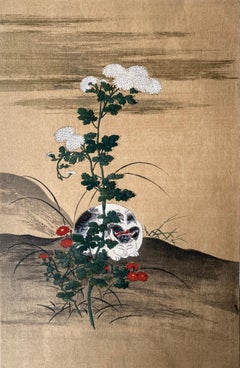
Authentic Japanese Woodblock Print-White Cat-Hanabusa Itchō-Edo-Re-carved 1920s
Located in London, GB
This rare Original 1920s authentic print is a Taisho Period Woodblock print published from the Japan 1920's The Nippon Mokuhan Gasui, Masterpieces Series.; it is authentically hand ...
Category

1920s Edo Landscape Paintings

Materials

Ink, Handmade Paper

Elwood W. Bartlett, Wisconsin Farm, about 1945, mid-century wood engraving
Located in New York, NY
Elwood Warren Bartlett is a Wisconsin native who also worked in Indiana. Largely self taught as a printmaker, Bartlett worked in a style that once identified as his, immediately t...
Category

1940s American Modern Landscape Prints

Materials

Woodcut

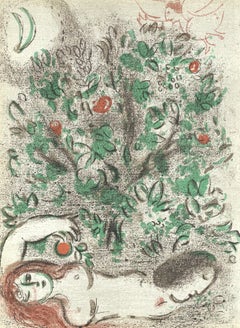
Marc Chagall, Paradise I, from Drawings for the Bible, 1956
Located in Southampton, NY
This exquisite lithograph by Marc Chagall (1887–1985), titled Paradis I (Paradise I), from Marc Chagall, Dessins Pour La Bible (Drawings for the Bible), Verve: Revue Artistique et Litteraire, Vol. VIII, No. 33–34, originates from the September 1956 issue published by Editions de la revue Verve, Paris, under the direction of Teriade, Editeur, Paris, and printed by Mourlot Freres, Paris, 1956. This radiant and dreamlike composition envisions the Garden of Eden as a symbol of divine harmony and innocence, where life, color, and spirit coexist in perfect unity. Through lyrical forms and glowing tonal contrasts, Chagall expresses a vision of creation that transcends narrative, merging spiritual wonder with emotional warmth. Paradis I embodies the artist’s enduring fascination with the sacred origins of life and the poetic balance between the earthly and the eternal. The piece forms part of Chagall’s celebrated series of lithographs and drawings created for Dessins Pour La Bible, a monumental project uniting art, scripture, and mysticism in one of the artist’s most important achievements. Executed as a lithograph on velin du Marais paper, this work measures 14 x 10.5 inches (35.56 x 26.67 cm). Unsigned and unnumbered as issued. The edition exemplifies the superb craftsmanship of the Mourlot Freres atelier, renowned for its collaborations with the greatest modern masters of the 20th century. Artwork Details: Artist: Marc Chagall (1887–1985) Title: Paradis I (Paradise I), from Marc Chagall, Dessins Pour La Bible (Drawings for the Bible), Verve: Revue Artistique et Litteraire, Vol. VIII, No. 33–34, September 1956 Medium: Lithograph on velin du Marais paper Dimensions: 14 x 10.5 inches (35.56 x 26.67 cm) Inscription: Unsigned and unnumbered as issued Date: 1956 Publisher: Editions de la revue Verve, Paris, under the direction of Teriade, Editeur, Paris Printer: Mourlot Freres, Paris Catalogue raisonne references: Cain, Julien, and Fernand Mourlot. Chagall Lithographe. Andre Sauret, Editeur, 1960, illustrations 117–46. Cramer, Patrick, and Meret Meyer. Marc Chagall: Catalogue Raisonne Des Livres Illustrés. P. Cramer ed., 1995, illustration 25. Condition: Well preserved, consistent with age and medium Provenance: From Marc Chagall, Dessins Pour La Bible (Drawings for the Bible), Verve: Revue Artistique et Litteraire, Vol. VIII, No. 33–34, published by Editions de la revue Verve, Paris, 1956 Notes: Excerpted from the album (translated from French), This double issue of Verve is dedicated to the full reproduction in heliogravure of the one hundred-five plates etched by Marc Chagall, between 1930 and 1955, for the illustration of the Bible. The artist composed especially for the present work, sixteen lithographs in color and twelve in black, as well as the cover and the title page. This volume was completed and printed on September 10, 1956, by the Master Printers Draeger Freres for heliogravure, and by Mourlot Freres for lithography. About the Publication: Marc Chagall, Dessins Pour La Bible (Drawings for the Bible), published as Verve Vol. VIII, No. 33–34 in September 1956, represents one of the crowning achievements of Chagall’s lifelong dialogue with the sacred. Conceived and directed by the visionary publisher Teriade and printed by the master lithographers Mourlot Freres, the issue features thirty-four color lithographs and numerous black-and-white drawings inspired by biblical figures and stories. Chagall’s works for this edition unite text and image in a luminous meditation on divine creation, moral struggle, and spiritual renewal, imbued with his signature dreamlike symbolism and radiant color. Produced in postwar Paris, this landmark publication reaffirmed the enduring union of art and faith, establishing Dessins Pour La Bible as one of the most important illustrated works of the 20th century. About the Artist: Marc Chagall (1887–1985) was a Belarus-born French painter, printmaker, and designer whose visionary imagination, radiant color, and deeply poetic symbolism made him one of the most beloved and influential artists of the 20th century. Rooted in the imagery of his Jewish heritage and the memories of his childhood in Vitebsk, Chagall’s art wove together themes of faith, love, folklore, and fantasy with a dreamlike modern sensibility. His unique style—merging elements of Cubism, Fauvism, Expressionism, and Surrealism—defied categorization, transforming ordinary scenes into lyrical meditations on memory and emotion. Influenced by Russian icon painting, medieval religious art, and the modern innovations of artists such as Pablo Picasso, Henri Matisse, and Georges Braque, Chagall developed a profoundly personal visual language filled with floating figures, vibrant animals, musicians, and lovers that symbolized the transcendent power of imagination and love. During his early years in Paris, he became an integral part of the Ecole de Paris circle, forming friendships with Amedeo Modigliani, Fernand Leger, and Sonia Delaunay, and his creative spirit resonated with that of his peers and successors—Alexander Calder, Alberto Giacometti, Salvador Dali, Joan Miro, Wassily Kandinsky, Marcel Duchamp, and Man Ray—artists who, like Chagall, sought to push the boundaries of perception, emotion, and form. Over a prolific career that spanned painting, printmaking, stained glass, ceramics, and stage design, Chagall brought an unparalleled poetic sensibility to modern art, infusing even the most abstract subjects with human warmth and spiritual depth. His works are held in the most prestigious museums around the world, including the Museum of Modern Art, the Centre Pompidou, the Tate, and the Guggenheim, where they continue to inspire generations of artists and collectors. The highest price ever paid for a Marc Chagall artwork is approximately $28.5 million USD, achieved in 2017 at Sotheby’s New York for Les Amoureux (1928). Marc Chagall Paradis...
Category

1950s Expressionist Figurative Prints

Materials

Lithograph

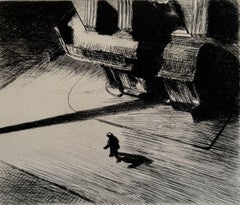
Night Shadows
By Edward Hopper
Located in Storrs, CT
Night Shadows. 1921. Etching. Levin 82. 7 x 8 3/8 (sheet 10 x 13 7 1/16).s Series: Six American Etchings: The New Republic Portfolio, 1924. Edition approximately 500-600. Illustrate...
Category

1920s American Modern Landscape Prints

Materials

Etching

Night Shadows
Night Shadows
$48,000 Sale Price
20% Off
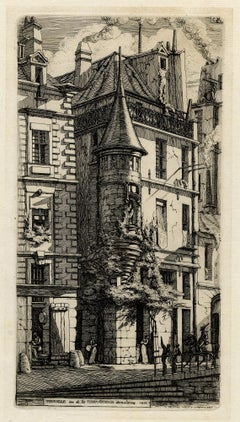
Tourelle, Rue de la Tixéranderie démolie en 1851
Located in Middletown, NY
Etching and drypoint on watermarked Hudelist laid paper, 9 5/8 x 5 inches (245 x 129mm) full margins. Second state (of five) after lettering. A superb condition with a pencil inscrip...
Category

Mid-19th Century French School Landscape Prints

Materials

Laid Paper, Etching, Drypoint

Victor Rebuffo (1903-1983) - Mid 20th Century Woodcut, Riachuelo
Located in Corsham, GB
An original woodcut print by the listed Italian-Argentinian artist Victor Luciano Rebuffo (1903-1983). Entitled 'Riachuelo'. The print depicts a stylised waterfront scene with buildi...
Category

20th Century Landscape Prints

Materials

Woodcut

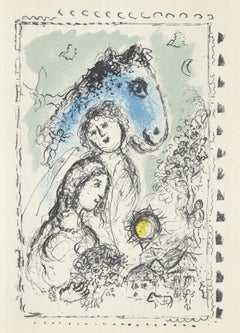
Marc Chagall, Blue Horse with Couple, from Derriere le Miroir, 1982
Located in Southampton, NY
This exquisite lithograph by Marc Chagall (1887–1985), titled Cheval bleu au couple (Blue Horse with Couple), originates from the historic 1982 folio Derriere le Miroir, No. 250, Hommage a Aime et Marguerite Maeght (Tribute to Aime and Marguerite Maeght). Published by Maeght Editeur, Paris, under the direction of Aime Maeght, and printed by Imprimerie Moderne du Lion, Paris, this vibrant composition reflects Chagall’s lyrical fusion of color, dream, and devotion. In Cheval bleu au couple, ethereal figures and a radiant blue horse float within a luminous space of poetic imagination, evoking love, memory, and transcendence. The image captures the artist’s timeless ability to unite fantasy and emotion within the expressive language of modernism. Executed on velin paper, this lithograph measures 15 x 11 inches (38.1 x 27.9 cm). As issued, it is unsigned and unnumbered, consistent with the authorized publication format. The edition exemplifies Chagall’s mastery of color lithography and his lifelong exploration of faith, folklore, and the human spirit. Artwork Details: Artist: Marc Chagall (1887–1985) Title: Cheval bleu au couple (Blue Horse with Couple), from Derriere le Miroir, No. 250, Hommage a Aime et Marguerite Maeght (Tribute to Aime and Marguerite Maeght), 1982 Medium: Lithograph on velin paper Dimensions: 15 x 11 inches (38.1 x 27.9 cm) Inscription: Unsigned and unnumbered, as issued Date: 1982 Publisher: Maeght Editeur, Paris Printer: Imprimerie Moderne du Lion, Paris Catalogue raisonne references: Chagall, Marc, et al. Chagall Lithographe VI, 1980–1985. Andre Sauret, Editeur, 1986, illustration 993. Cramer, Patrick, and Meret Meyer. Marc Chagall: Catalogue Raisonne Des Livres Illustres. P. Cramer ed., 1995, illustration 113. Condition: Well preserved, consistent with age and medium Provenance: From the 1982 folio Derriere le Miroir, No. 250, published by Maeght Editeur, Paris Notes: Excerpted from the folio (translated from French), This special issue of Derriere le Miroir was designed and defined by Aime Maeght in the fall of 1980. He envisioned its publication as a celebration with which artists and writers published since 1946 were to be associated. He also chose Francois Chapon, president of the Reverdy Committee, to write the presentation. This Derriere le Miroir number 250 took the form, after its disappearance on September 5, 1981, of a tribute to Aime Maeght and his wife Marguerite Maeght who died four years earlier. 24 artists agreed to create an original graphic work for this issue which includes the general table of all issues as well as excerpts from texts by 32 writers. Finished printing on June 2, 1982 on the presses of the l'Imprimerie moderne du Lion in Paris. CL examples were printed on velin d'Arches, numbered from I to CL, and some non-commercial examples constituting the original edition. About the Publication: Derriere le Miroir (translated as "Behind the Mirror") was an iconic French art periodical published from 1946 to 1982 by Maeght Editeur, one of the most influential art publishers of the 20th century. Founded by Aime Maeght in Paris, the publication was conceived as a visual and literary collaboration between leading modern artists, poets, and critics. Each issue functioned as both an exhibition catalogue and a work of art in itself—featuring original lithographs printed directly from the artists' stones or plates, alongside essays, poems, and critical commentary. Over the course of 36 years, Derriere le Miroir produced more than 250 issues and showcased an extraordinary roster of artists including Henri Matisse, Marc Chagall, Joan Miro, Georges Braque, Alexander Calder, Fernand Leger, Pierre Bonnard, Alberto Giacometti, Eduardo Chillida, Ellsworth Kelly, Francis Bacon, Paul Rebeyrolle, Claude Garache, Antoni Tapies, Bram van Velde, Pierre Alechinsky, Pol Bury, Shusaku Arakawa, and Gerard Titus-Carmel. Printed in the ateliers of Mourlot, Arte, and Imprimerie Moderne du Lion, the periodical set new standards for quality in color lithography, combining fine art printing with elegant typography and poetic text. Beyond its visual brilliance, Derriere le Miroir also became a cultural chronicle of postwar European modernism. Each issue coincided with exhibitions held at Galerie Maeght, providing a collectible and widely accessible record of groundbreaking shows. Its integration of image, text, and philosophy created a dialogue between art and literature that elevated the modern art book to new aesthetic heights. Today, Derriere le Miroir remains one of the most sought-after and historically significant art publications, prized by collectors and scholars alike for its craftsmanship, influence, and its role in defining the visual language of 20th-century modernism. The Maeght Foundation in Saint-Paul-de-Vence continues to honor this legacy through exhibitions and archival preservation of the series, affirming Derriere le Miroir's enduring place in the history of modern art and fine art publishing. About the Artist: Marc Chagall (1887–1985) was a Belarus-born French painter, printmaker, and designer whose visionary use of color and poetic symbolism made him one of the most beloved and influential artists of the 20th century. Rooted in the rich imagery of his Jewish heritage and childhood in Vitebsk, Chagall’s dreamlike compositions fused memory, folklore, faith, and romance with the expressive innovations of modern art. His work evolved alongside and in dialogue with the great modern masters—Pablo Picasso, Henri Matisse, Alexander Calder, Salvador Dali, Joan Miro, Georges Braque, Wassily Kandinsky, Marcel Duchamp, and Man Ray—artists who, like Chagall, redefined artistic language for a new century. Spanning painting, printmaking, stained glass, ceramics, stage design, and illustration, Chagall’s career reflected both his deep spirituality and his boundless imagination. His works are held in major museum collections worldwide, including the Museum of Modern Art, the Guggenheim, the Tate, and the Centre Pompidou. The highest price ever paid for a Marc Chagall artwork is approximately $28.5 million USD, achieved in 2017 at Sotheby’s New York for Les Amoureux (1928). Marc Chagall Cheval bleu au couple, Marc Chagall lithograph, Chagall Derriere le Miroir, Chagall Maeght...
Category

1980s Expressionist Figurative Prints

Materials

Lithograph

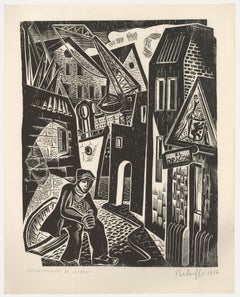
Victor Rebuffo (1903-1983) - 1956 Woodcut, Encantamiento De La Ribera
Located in Corsham, GB
An original woodcut print by the listed Italian-Argentinian artist Victor Luciano Rebuffo (1903-1983). Entitled 'Encantamiento De La Ribera' Riverside Enchantment. Pencil signed, tit...
Category

Mid-20th Century Landscape Prints

Materials

Woodcut

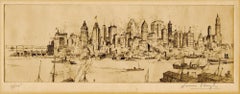
New York Skyline
By Louis H. Ruyl
Located in Middletown, NY
Etching with drypoint on cream wove paper with deckle edges, 4 3/8 x 12 3/4 inches (233 x 323 mm); sheet 9 1/2 x 15 3/4 inches (240 x 338 mm), full margins. Signed and numbered 4/75 ...
Category

Early 20th Century American Modern Landscape Prints

Materials

Handmade Paper, Etching, Drypoint

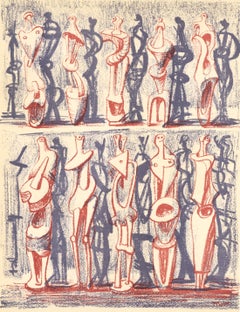
Henry Moore, Red and Blue Standing Figures, from XXe Siecle, 1951
Located in Southampton, NY
This exquisite lithograph by Henry Moore (1898–1986), titled Red and Blue Standing Figures, from the album XXe Siecle, Nouvelle serie, No. 1, 1951, originates from the 1951 edition p...
Category

1950s Modern Landscape Prints

Materials

Lithograph

Clemente Untitled B: surreal mythical landscape, voyage with ocean, Venus, snake
Located in New York, NY
A black and white, large-scale surreal mythical landscape of an ocean voyage, with a snake wrapped around a clock, a ship, Venus sculpture, greek urns, and snakes, printed in black o...
Category

1980s Contemporary Figurative Prints

Materials

Lithograph

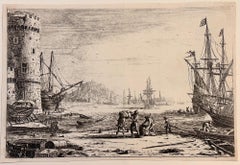
Harbour with a Round Tower
Located in Middletown, NY
1641. Etching on cream wove paper, 5 1/16 x 7 11/16 inches (128 x 195 mm), narrow margins. Printed 19th century on a remainder which has a partially trimmed, printed image of a Virgi...
Category

Mid-17th Century French School Figurative Prints

Materials

Handmade Paper, Etching

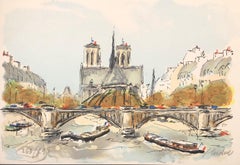
Paris, Notre Dame de Paris and Seine River - Original Lithograph Handsigned & N°
Located in Paris, IDF
Urbain HUCHET Notre Dame de Paris Original lithograph, 1960 Handsigned in pencil by the artist Numbered / 295 copies On velllum 19 x 28 cm (c. 8 x 11 inch) Excellent condition
Category

1960s Modern Landscape Prints

Materials

Lithograph

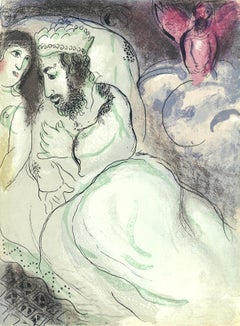
Marc Chagall, Sarah and Abimelech, from Drawings for the Bible, 1956
Located in Southampton, NY
This exquisite lithograph by Marc Chagall (1887–1985), titled Sara et Abimelech (Sarah and Abimelech), from Marc Chagall, Dessins Pour La Bible (Drawings for the Bible), Verve: Revue...
Category

1950s Expressionist Figurative Prints

Materials

Lithograph

Andrew Wyeth, New Leaves, from The Four Seasons (after)
Located in Southampton, NY
This exquisite lithograph after Andrew Wyeth (1917–2009), titled New Leaves, originates from the distinguished 1962 folio The Four Seasons: Paintings and Drawings by Andrew Wyeth. Published and printed by Art in America Company, Inc., New York, the edition exemplifies Wyeth’s quiet observation of nature and the passage of time. New Leaves captures the delicate stir of spring renewal—the subtle emergence of life in the landscape—rendered with Wyeth’s hallmark balance of precision, restraint, and emotional depth. Executed on velin paper, this lithograph measures 17 x 13 inches (43.2 x 33 cm). As issued, it is unsigned and unnumbered, representing the folio’s authentic format. The Four Seasons series was conceived by the editors of Art in America in collaboration with Andrew and Betsy Wyeth, who selected drawings from the artist’s studio and personal archive to embody the poetic rhythm of the changing seasons. Each composition reveals Wyeth’s mastery of atmosphere, mood, and the quiet intensity of natural experience. Artwork Details: Artist: After Andrew Wyeth (1917–2009) Title: New Leaves, from The Four Seasons, Paintings and Drawings by Andrew Wyeth, 1962 Medium: Lithograph on velin paper Dimensions: 17 x 13 inches (43.2 x 33 cm) Inscription: Unsigned and unnumbered, as issued Date: 1962 Publisher: Art in America Company, Inc., New York Printer: Art in America Company, Inc., New York Condition: Well preserved, consistent with age and medium Provenance: From the 1962 folio The Four Seasons, Paintings and Drawings by Andrew Wyeth, published and printed by Art in America Company, Inc., New York Notes: Excerpted from the 1962 folio: "In 1962 the editors of Art in America proposed to Wyeth a portfolio of images of his recent dry-brush drawings. The artist and his wife suggested the theme, 'The Four Seasons,' because of the essential role played in his work by the cycle of the seasons. The drawings were selected by Andrew and Betsy Wyeth from works in the house and studio at Chadds Ford, supplemented by some owned by friends. With a few exceptions they had never been exhibited or reproduced. The plates were made directly from the originals. In these drawings Wyeth's loving concentration on the object is fully revealed. But as always in his work, this concern with the tangible is balanced by sensibility to mood, to the emotion arising from the actual. They are pervaded with a sense of the season—the exact time of year, the hour of the day, the quality of the light. To the truth and subtlety with which he captures these intangible factors, these drawings owe their poignant poetry." About the Artist: Andrew Wyeth (1917–2009) was an American visual artist and one of the best-known painters of the mid-20th century. Although he considered himself an abstractionist, Wyeth’s work is characterized by a meticulous realism imbued with psychological depth and atmosphere. He often painted the landscapes and people surrounding his homes in Chadds Ford, Pennsylvania, and Cushing, Maine, creating an intimate record of American rural life. The son of the celebrated illustrator N. C. Wyeth, Andrew trained under his father before developing his own deeply personal visual language inspired by Winslow Homer, Henry David Thoreau, and King Vidor. His wife, Betsy Wyeth, was both his muse and career manager, while his son Jamie Wyeth continued the family’s artistic legacy. Among Wyeth’s best-known works is Christina’s World (1948), housed in the Museum of Modern Art, New York—a quintessential image of 20th-century American art. His other notable series include The Helga Pictures and his window studies, each reflecting a profound meditation on solitude, memory, and perception. Wyeth was the first painter to receive both the Presidential Medal of Freedom and the Congressional Gold Medal, and was elected to the French Académie des Beaux-Arts in 1980. In 2022, Andrew Wyeth's painting Day Dream sold for USD 23.29 million at Christie’s New York, setting a world record for the artist. Andrew Wyeth lithograph...
Category

1960s American Realist Landscape Prints

Materials

Lithograph

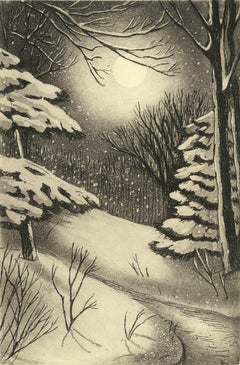
Silent Snow (Poetical imagery and Christmas memories in New England)
By Mary Teichman
Located in New Orleans, LA
This image is from an exclusive edition published by Stone + Press in 1994 in an edition of 100. This impression is #98. It brings to mind the Robert Frost poem, Stopping by Woods on a Snowy Evening. The woods are lovely, dark and deep, But I have promises to keep, And miles to go before I sleep, And miles to go before I sleep. Mary Teichman...
Category

1990s American Modern Landscape Prints

Materials

Etching

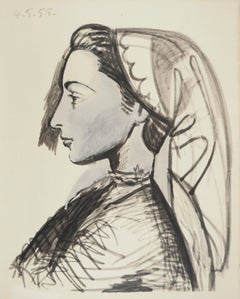
Pablo Picasso, Portrait of Jacqueline, from The Double Flute, 1967 (after)
Located in Southampton, NY
This exquisite lithograph and pochoir after Pablo Picasso (1881–1973), titled Portrait de Jacqueline (Portrait of Jacqueline), from the folio Picasso, La flute double, 16 Dessins, Aq...
Category

1960s Cubist Figurative Prints

Materials

Lithograph, Stencil

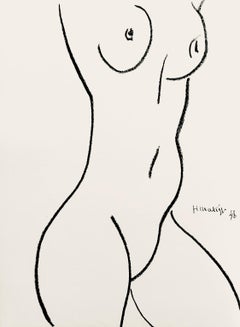
Henri Matisse, Nude, Second Study, from Verve, Revue Artistique, 1953 (after)
Located in Southampton, NY
This exquisite lithograph after Henri Matisse (1869–1954), titled Nu, deuxieme etude (Nude, Second Study), from Verve, Revue Artistique et Litteraire, Vol. VII, No. 27–28, originates...
Category

1950s Fauvist Landscape Prints

Materials

Lithograph

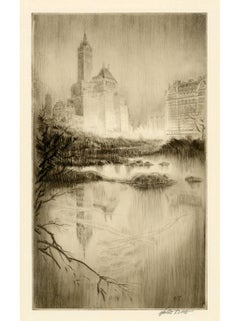
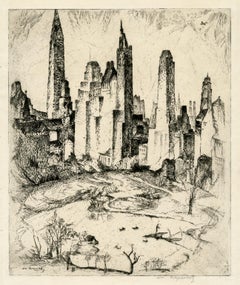
The Plaza, Sunset Glow
Located in Myrtle Beach, SC
'The Plaza, Sunset Glow', drypoint, c. 1920s, edition not stated. Signed in pencil and initialed in the plate, lower right. Titled 'The Plaza, Sunset' and annotated 'no. 165' in ink, in the bottom left sheet corner. A superb, luminous impression in dark brown ink, with selectively wiped plate tone; on cream wove paper; the full sheet with margins (1 to 2 1/4 inches). Pale tape stains on the top sheet edge, recto, well away from the image, otherwise in excellent condition. Matted to museum standards, unframed. A view across 'The Pond' in New York City's Central Park, toward Grand Army Plaza...
Category

1920s American Impressionist Landscape Prints

Materials

Drypoint

'Financial District', New York City — American Modernism
Located in Myrtle Beach, SC
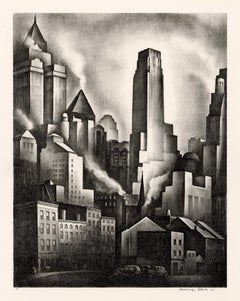
Howard Cook, 'Financial District', lithograph, 1931, edition 75, Duffy 155. A fine, richly-inked impression, on cream wove paper, the full sheet with wide margins (2 3/4 to 5 5/8 inches), in excellent condition. Image size 13 5/16 x 10 3/8 inches (338 x 264 mm); sheet size 23 x 16 inches (584 x 406 mm). Matted to museum standards, unframed. Literature: 'American Master Prints from the Betty and Douglas Duffy Collection', the Trust for Museum Exhibitions, Washington, D.C., 1987. Collections: Crystal Bridges Museum of American Art, Library of Congress, Metropolitan Museum of Art, Philadelphia Museum of Art, Smithsonian American Art Museum. ABOUT THE ARTIST Howard Norton Cook (1901-1980) was one of the best-known of the second generation of artists who moved to Taos. A native of Massachusetts, he studied at the Art Students League in New York City and at the Woodstock Art Colony. Beginning his association with Taos in 1926, he became a resident of the community in the 1930s. During his career, he received two Guggenheim Fellowships and was elected an Academician in the National Academy of Design. He earned a national reputation as a painter, muralist, and printmaker. Cook’s work in the print mediums received acclaim early in his career with one-person exhibitions at the Denver Art Museum (1927) and the Museum of New Mexico (1928). He received numerous honors and awards over the years, including selection in best-of-the-year exhibitions sponsored by the American Institute of Graphics Arts, the Brooklyn Museum, the Society of American Etchers, and the Philadelphia Print Club. His first Guggenheim Fellowship took him to Taxco, Mexico in 1932 and 1933; his second in the following year enabled him to travel through the American South and Southwest. Cook painted murals for the Public Works of Art Project in 1933 and the Treasury Departments Art Program in 1935. The latter project, completed in Pittsburgh, received a Gold Medal from the Architectural League of New York. One of his most acclaimed commissions was a mural in the San Antonio Post Office in 1937. He and Barbara Latham settled in Talpa, south of Taos, in 1938 and remained there for over three decades. Cook volunteered in World War II as an Artist War Correspondent for the US Navy, where he was deployed in the Pacific. In 1943 he was appointed Leader of a War Art Unit...
Category

1930s American Modern Figurative Prints

Materials

Lithograph

Thames Warehouses
Located in Santa Monica, CA
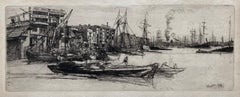
JAMES McNEILL WHISTLER (American 1834–1903 London) THAMES WAREHOUSES, 1859 (K 38 ii/ii; Glascow 46 iv/v; Mansfield 37) Etching and drypoint on fine thin laid paper. Plate: 3 × 8 i...
Category

1850s Impressionist Landscape Prints

Materials

Drypoint, Etching

Paris : On the Way to Montmartre - Original Lithograph, Handsigned
Located in Paris, IDF
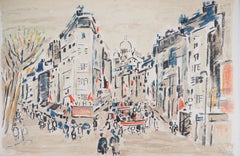
Robert SAVARY Paris : On the Way to Montmartre, 1969 Original lithograph (Mourlot workshop) Handsigned in pencil On Japan paper 37 x 58 cm (c. 16 x 23 in) Excellent condition
Category

1960s Modern Landscape Prints

Materials

Lithograph

Kollwitz, Mother and Child (after)
Located in Southampton, NY
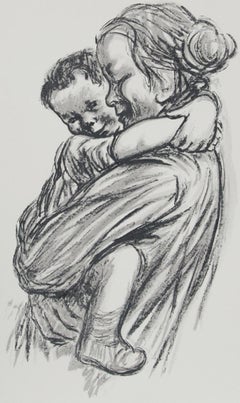
Lithograph on vélin paper. Inscription: Unsigned and unnumbered, as issued. Good condition. Notes: From the folio, Kathe Kollwitz, Ten Lithographs. Published by Henry C. Kleemann and...
Category

1940s Modern Landscape Prints

Materials

Lithograph

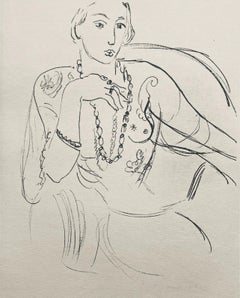
Henri Matisse, Crayon, from Drawings by Henri Matisse, 1925 (after)
Located in Southampton, NY
This exquisite lithograph after Henri Matisse (1869–1954), titled Crayon (Crayon), from the album Dessins de Henri-Matisse (Drawings by Henri Matisse), originates from the 1925 edition published by Editions des Quatre Chemins, Paris, rendered by Daniel Jacomet, Paris, and printed by Atelier Daniel Jacomet et Cie, Paris, December 15, 1925. The work exemplifies Matisses mastery of pure line and the expressive economy of form that defined his graphic art of the 1920s, transforming simplicity into lyrical harmony. Executed as a lithograph on velin Lafuma Navarre paper, this work measures 10 x 8 inches (25.4 x 20.32 cm). Unsigned and unnumbered, as issued. The edition exemplifies the refined craftsmanship of the Daniel Jacomet et Cie workshops, Paris. Artwork Details: Artist: After Henri Matisse (1869–1954) Title: Crayon (Crayon), from the album Dessins de Henri-Matisse (Drawings by Henri Matisse) Medium: Lithograph on velin Lafuma Navarre paper Dimensions: 10 x 8 inches (25.4 x 20.32 cm) Inscription: Unsigned and unnumbered, as issued Date: 1925 Publisher: Editions des Quatre Chemins, Paris Printer: Atelier Daniel Jacomet et Cie, Paris Catalogue Raisonne Reference: Duthuit, Claude. Henri Matisse: Catalogue raisonne des ouvrages illustres. Editions Claude Duthuit, Paris, 1988, illustration 3. Condition: Well preserved, consistent with age and medium Provenance: From the album Dessins de Henri-Matisse (Drawings by Henri Matisse), published by Editions des Quatre Chemins, Paris; rendered by Daniel Jacomet, Paris; printed by Atelier Daniel Jacomet et Cie, Paris, December 15, 1925 Notes: Excerpted from the album (translated from French), This album was printed in C examples on velin d'Arches with an original example by Henri-Matisse, numbered from I to C, and M examples on velin Lafuma. Printing was completed on December Fifteenth, One Thousand, Nine Hundred and Twenty-Five by F. Dutal et Cie, in Paris; the boards having been executed by the Daniel Jacomet et Cie workshops in Paris. About the Publication: Dessins de Henri-Matisse (Drawings by Henri Matisse), published by Editions des Quatre Chemins, Paris, in 1925, is a landmark early graphic portfolio that captures the artist’s mastery of contour and proportion through a series of delicately rendered lithographs. Realized under the direction of the Daniel Jacomet et Cie workshops—renowned for their exceptional skill in fine art printmaking—the album showcases Matisse’s fascination with the purity of line and the human form. Issued in a limited printing of examples on both velin d’Arches and velin Lafuma papers, it reflects the refined aesthetics and technical excellence that characterized the interwar Parisian print ateliers. The publication represents a pivotal stage in Matisse’s evolution as a draughtsman, bridging the intimate immediacy of his drawings with the permanence of fine print. About the Artist: Henri Matisse (1869–1954) was a French painter, sculptor, draughtsman, and printmaker whose revolutionary vision redefined modern art through his daring use of color, line, and form. Celebrated as one of the greatest artists of the 20th century, Matisse led the Fauvist movement and devoted his life to the pursuit of balance, beauty, and emotional expression in visual art. His early works burst with vibrant hues and liberated brushwork, while his later “cut-out” compositions achieved a poetic simplicity that transformed the relationship between color and space. Deeply influenced by the work of Paul Cezanne, Vincent van Gogh, and Georges Seurat, as well as by the rhythmic patterns of Islamic art, Byzantine mosaics, and Japanese prints, Matisse forged a new visual language that celebrated joy, movement, and serenity. He was part of an extraordinary generation of artists who shaped the evolution of modernism, maintaining lifelong dialogue and friendly rivalry with contemporaries such as Pablo Picasso, Georges Braque, Marc Chagall, Andre Derain, Albert Marquet, and Raoul Dufy—peers who, like him, sought to expand the expressive potential of color and composition. Matisses influence extended across generations, inspiring modern and contemporary masters including Alexander Calder, Alberto Giacometti, Salvador Dali, Joan Miro, Wassily Kandinsky, Marcel Duchamp, and Man Ray, each of whom drew upon his fearless experimentation and refined visual harmony. His paintings, sculptures, and works on paper are held in the most prestigious museums in the world, including the Museum of Modern Art, the Centre Pompidou, the Tate, and the Hermitage Museum, where his art continues to symbolize the essence of creativity and human emotion. The highest price ever paid for a Henri Matisse artwork is approximately 80.8 million USD, achieved in 2018 at Christies New York for Odalisque couchee aux magnolias (1923). Henri Matisse Crayon...
Category

1920s Modern Landscape Prints

Materials

Lithograph

Notre Dame de Paris
Located in Middletown, NY
A superb, dark impression of a well known scene by Arms. Etching with aquatint on watermarked handmade F.J. Head & Co. laid paper, 12 3/8 x 13 15/16 inches (315 x 354 mm), full marg...
Category

1920s American Modern Landscape Prints

Materials

Handmade Paper, Laid Paper, Etching, Aquatint
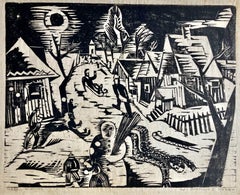
Werner Drewes, Winter, 1933, modernist woodcut
Located in New York, NY
A modernist fantasy winter scene created by Werner Drewes, this print brings key aspects of the period together. His cubist-inspired woodcut technique is utilized here to bring the s...
Category

1930s American Modern Landscape Prints

Materials

Woodcut

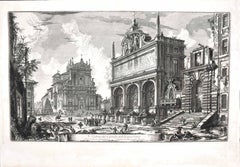
View of Castello dell'Acqua Felice - Etching by G. B. Piranesi - 1751
Located in Roma, IT
View of Castel of Acqua Felice is an original etching realized by the italian artist Giovanni Battista Piranesi in 1751. Very precoius and rare lifetime impression. Roman edition. I...
Category

1750s Old Masters Figurative Prints

Materials

Etching

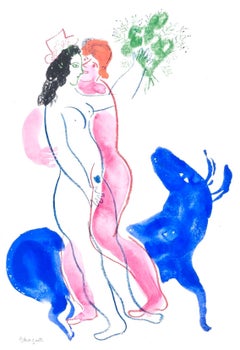
Marc Chagall, The Blue Beast, from Color of Love, 1958 (after)
Located in Southampton, NY
This exquisite lithograph and pochoir after Marc Chagall (1887–1985), titled La Bete Bleu (The Blue Beast), from the folio Couleur amour, 13 Aquarelles, Gouaches, Lavis (Color of Lov...
Category

1950s Modern Figurative Prints

Materials

Lithograph, Stencil

Edgar Degas, Dancer Arranging Her Dress, 1945 (after)
Located in Southampton, NY
This exquisite lithograph after Edgar Degas (1834–1917), titled Danseuse arrangeant sa robe (Dancer Arranging Her Dress), originates from the 1945 folio Degas, Ten Ballet Sketches. Published by The Studio Publications, Inc., New York, rendered and printed by Albert Carman, City Island, 1945, this work reflects Degas’s sensitive mastery of line, movement, and intimate observation, capturing the grace, poise, and psychological immediacy that define his iconic ballet imagery. In Danseuse arrangeant sa robe (Dancer Arranging Her Dress), Degas reveals gesture and inner emotion through economical contour and lyrical nuance. Executed as a lithograph and pochoir on velin paper, this work measures 17 x 13 inches (43.18 x 33.02 cm). Signed in the plate and unnumbered as issued. Rendered and printed by Albert Carman, City Island, one of the notable American ateliers specializing in fine art lithography during the mid-20th century. Artwork Details: Artist: After Edgar Degas (1834–1917) Title: Danseuse arrangeant sa robe (Dancer Arranging Her Dress), from Degas, Ten Ballet Sketches, 1945 Medium: Lithograph and pochoir on velin paper Dimensions: 17 x 13 inches (43.18 x 33.02 cm) Inscription: Signed in the plate and unnumbered as issued Date: 1945 Publisher: The Studio Publications, Inc., New York Printer: Albert Carman, City Island, 1945 Condition: Well preserved, consistent with age and medium Provenance: From the 1945 folio Degas, Ten Ballet Sketches, published by The Studio Publications, Inc., New York Notes: Excerpted from the album, Born in Paris in 1834, Edgar Degas lived, and surely loved the life of that city during most of his years. These continued somewhat sadly beyond those of most of his friends— into the debacle of the first World War, during which he died in 1917. Judging by the frequency with which he used them as models, he must have had an especial admiration for the ballet girls who followed a profession that at the time brought none of the glory and prosperity which attend it today. New aspects of the human body, revealed in movement, fascinated him. But his occupation with the simply anatomical side of his subjects never resulted in a cold interpretation. On the contrary there is a warmth and sympathy that pervades all of his work. The drawings here represent the painter in one important phase of his multi-sensitive view of life; and permit an insight which a more ambitious work might not do-into the operation of the creative process, the artist's transformation of reality as it passes through the mesh of his sensibilities. The Edition of this Portfolio is limited to MMMD examples. Rendered by Albert Carman. About the Publication: Degas, Ten Ballet Sketches, published in 1945 by The Studio Publications, Inc., New York, stands as one of the most elegant and scholarly mid-century American fine art folios devoted to the ballet imagery of Edgar Degas. Conceived as a high-quality interpretive portfolio, the album presents a series of lithograph-and-pochoir renderings based on Degas’s original drawings, executed with exceptional attention to tonal subtlety, contour fidelity, and the emotional interiority that defines the artist’s draftsmanship. Rendered and printed by Albert Carman on City Island, the publication embodies an American postwar effort to restore and celebrate European masterworks through meticulous handcraft and artisanal color application, honoring Degas’s distinctive line and the atmospheric delicacy of his studio-based studies. Produced in a substantial edition of MMMD examples, the portfolio offered audiences rare access to Degas’s private working drawings—images rarely seen outside institutional collections—while exemplifying the technical refinement and interpretive care characteristic of Carman’s workshop. Today, Degas, Ten Ballet Sketches remains a sought-after historical publication, valued for its craft, fidelity to Degas’s aesthetic, and its role in preserving and disseminating the artist’s intimate ballet imagery in a beautifully executed mid-century fine art format. About the Artist: Edgar Degas (1834–1917) was a French painter, draughtsman, printmaker, and sculptor whose groundbreaking fusion of classical draftsmanship, modern experimentation, and psychological depth helped define the trajectory of Western art, positioning him as one of the most influential figures of the nineteenth and early twentieth centuries; renowned for his depictions of ballet dancers, racehorses, theater scenes, cafe life, domestic interiors, milliners, laundresses, and women at their toilette, Degas reimagined observational realism through radical compositional innovation—employing extreme cropping, asymmetrical framing, oblique viewpoints, and dramatic lighting that anticipated photographic and cinematic language long before these technologies shaped visual culture, and although associated with Impressionism, he rejected plein-air spontaneity in favor of studio-based discipline rooted in the linear precision of Jean-Auguste-Dominique Ingres, the expressive chromaticism of Eugene Delacroix, and the modernity of Edouard Manet while also drawing inspiration from Japanese ukiyo-e prints, classical sculpture, and early photography; his independent artistic philosophy resonated with and helped shape the innovations of Pablo Picasso, Alexander Calder, Alberto Giacometti, Salvador Dali, Joan Miro, Wassily Kandinsky, Marcel Duchamp, and Man Ray, whose explorations of movement, form, dream logic, abstraction, and conceptualism all find antecedents in Degas’s investigations into seriality, temporality, and the fragmented figure, and his pioneering use of pastel, monotype, and wax sculpture fundamentally transformed each medium, influencing artists from Henri Matisse, Francis Bacon, Lucian Freud, and Giacomo Manzu to Paula Rego, contemporary realists, experimental photographers, and choreographers; his works are held in nearly every major museum collection worldwide—including the Musee dOrsay, the Louvre, the Metropolitan Museum of Art, the National Gallery of Art, the Art Institute of Chicago, the Courtauld Institute, and the National Gallery, London—affirming his central place in the history of art, and the highest auction record for Degas was achieved at Sothebys London on February 3, 2015, when Danseuses en Bleu sold for 37,033,000 GBP, cementing his status as one of the most sought-after and enduringly significant artists of the Western canon. Edgar Degas lithograph...
Category

1940s Impressionist Figurative Prints

Materials

Lithograph

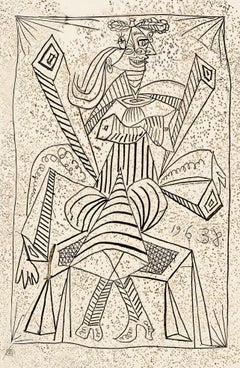
Picasso, Composition (Cramer 30; Horodisch D14; Bloch 307; Matarasso 28) (after)
Located in Southampton, NY
Lithograph on vélin paper. Unsigned and unnumbered, as issued. Good condition. Notes: From the volume, L'indicatif présent ou l'infirme del qu'il est, 1938. Published by Éditions Sou...
Category

1930s Cubist Figurative Prints

Materials

Lithograph

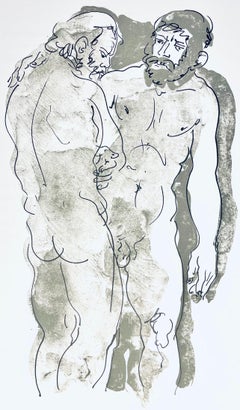
Composition, Réflexions Simples Sur Le Corps, Hans Erni
Located in Southampton, NY
Lithograph on vélin chiffon de Rives paper. Unsigned and unnumbered, as issued. Good condition. Notes: From the folio, Réflexions Simples Sur Le Corps, Ayant Inspiré Des Lithographie...
Category

1960s Modern Figurative Prints

Materials

Lithograph

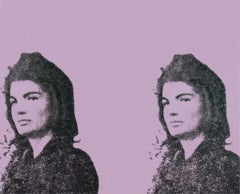
Jacqueline Kennedy (Jackie II) (Feldman/Schellmann II.14), Andy Warhol
Located in Fairfield, CT
Artist: Andy Warhol (1928-1987) Title: Jacqueline Kennedy (Jackie II) Year: 1966 Medium: Silkscreen in colors on wove paper Size: 24 x 30 inches Condition: Excellent Inscription: Sig...
Category

1960s Pop Art Figurative Prints

Materials

Screen

Landscape - Etching on Paper by Mario Logli - 20th Century
Located in Roma, IT
Landscape is an original etching on paper realized by Maro Logli. Hand-signed at the bottom of the image. numbered on the lower right, edition, IX/XXX. very good condition. Sheet...
Category

20th Century Modern Figurative Prints

Materials

Etching

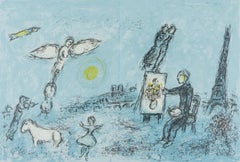
Marc Chagall, The Artist and the City, from Derriere le miroir, 1981
Located in Southampton, NY
This exquisite lithograph by Marc Chagall (1887–1985), titled L’Artiste et la Ville (The Artist and the City), from the folio Derriere le miroir, No. 246, originates from the 1981 ed...
Category

1970s Expressionist Figurative Prints

Materials

Lithograph

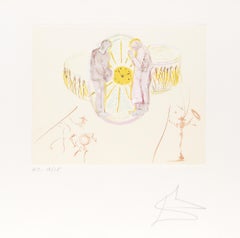
One’s Identity, Signed Surrealist Lithograph and Etching by Salvador Dali
Located in Long Island City, NY
A lithograph and etching on Arches paper after Salvador Dali The Cycles of Life portfolio, made in 1977. This was printed by Forte and published by Duall Graphics for DALART. It is r...
Category

1970s Landscape Prints

Materials

Etching, Lithograph

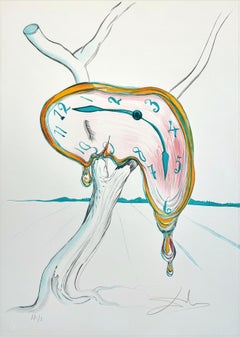
TEAR OF TIME (Melting Clock)Signed Lithograph on Arches Paper, Surrealism
Located in Union City, NJ
TEAR OF TIME (Melting Clock) is a limited edition color lithograph by the Modern master Salvador Dali, after an original Salvador Dali gouache pa...
Category

20th Century Surrealist Portrait Prints

Materials

Lithograph

Tugs on the Hudson
Located in Middletown, NY
Drypoint etching with engraving printed in black ink on Japanese mulberry paper, 4 1/2 x 3 3/8 inches (113 x 84 mm), full margins. In superb condition. A beautiful New York City river...
Category

Early 20th Century American Modern Landscape Prints

Materials

Handmade Paper, Drypoint, Etching

Degas, Melina Darde, Ten Ballet Sketches (after)
Located in Fairfield, CT
Medium: Lithograph and stencil on vélin paper Year: 1945 Paper Size: 17 x 13 inches Inscription: Signed in the plate and unnumbered, as issued Notes: From the folio, Degas, Ten Balle...
Category

1940s Impressionist Figurative Prints

Materials

Lithograph

Ten of views of Manhattan (10).
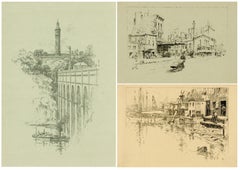
Located in Middletown, NY
The Society of Iconophiles (New York, 1894–1936), 1898. Each a lithograph printed on grayish-green, or white wove paper each sheet 10 3/4 x 7 1/2 inches (274 x 190 mm), each with ful...
Category

Early 20th Century American Modern Landscape Prints

Materials

Handmade Paper, Lithograph

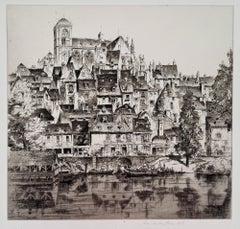
Cathedral de Saint Julien le Mans
Located in Middletown, NY
Etching on antique cream laid paper with a deckle edge, 9 1/8 x 9 3/4 inches (232 x 248 mm); sheet 12 1/8 x 12 3/4 inches (307 x 323 mm), full margins. Signed and dated in pencil in ...
Category

Early 20th Century American Modern Landscape Prints

Materials

Handmade Paper, Laid Paper, Etching

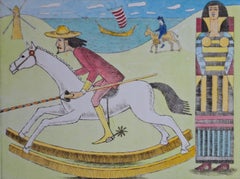
Dulcinea and Don Quixote - Figurative Drypoint Print, Colorful, Polish Art
Located in Warsaw, PL
Colorful figurative drypoint print by Polish artist Czeslaw Tumielewicz. Subject for this artwork comes from Miguel de Cervantes' book. The print is signed, it comes from edition lim...
Category

2010s Contemporary Landscape Prints

Materials

Paper, Drypoint, Watercolor

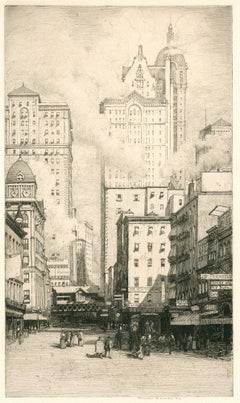
Cortland Street
Located in Middletown, NY
Etching with drypoint on antique handmade laid Japon paper, 12 7/8 x 7 1/2 (327 x 191 mm); sheet 15 5/16 x 10 7/16 (389 x 265 mm), full margins. Signed in pencil in the lower margin....
Category

Early 20th Century American Modern Landscape Prints

Materials

Drypoint, Etching

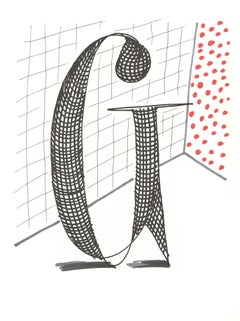
David Hockney, Letter G, from Hockney's Alphabet, 1991
Located in Southampton, NY
This exquisite lithograph by David Hockney (born 1937), titled Letter G, from the folio Hockney's Alphabet, Drawings by David Hockney, originates from the 1991 edition published by A...
Category

1990s Contemporary Figurative Prints

Materials

Lithograph

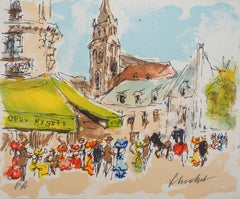
Paris : Saint Germain des Pres - Original Lithograph Handsigned and Numbered
Located in Paris, IDF
Urbain HUCHET Paris : Saint Germain des Pres, c. 1980 Original lithograph Handsigned in pencil by the artist Numbered / 350 copies On Arches velllum 15 x 18 cm (c. 6 x 7 in) Excell...
Category

Late 20th Century Post-Impressionist Landscape Prints

Materials

Lithograph

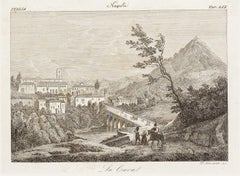
La Cava (The Cave) - Etching by Francesco Mochetti - 1843
Located in Roma, IT
Image dimensions: 14.7 x 19.8 cm. La Cava is an original black and white etching on paper, printed in 1843 as a plate of the print suite "90 Views of the citi...
Category

1840s Modern Figurative Prints

Materials

Etching

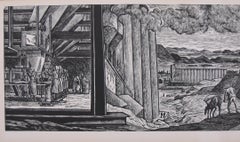
THE MAKING OF TORTILLAS - Mural Size 47 1/2 inches Long
Located in Santa Monica, CA
LEOPOLDO MENDEZ (1902 – 1969) THE MAKING OF TORTILLAS 1954 Linocut. Edition unknown. This example signed in pencil and dated 1957. 14” x 47 3/8” ...
Category

1950s Modern Figurative Prints

Materials

Linocut

Leonor Fini, Untitled, from The Story of O, 1962
Located in Southampton, NY
This exquisite lithograph, titled Sans titre, after Leonor Fini, from the folio L'Histoire d'O (The Story of O), 1962, was published and printed by La Compagnie des Vibliophiles, au ...
Category

1960s Modern Figurative Prints

Materials

Lithograph

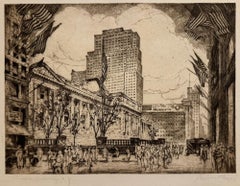
A view of the New York Public Library, looking uptown along 5th Avenue.
Located in Middletown, NY
New York: c 1920. Etching with aquatint printed in brownish black ink on cream wove paper, 8 3/4 x 12 inches (220 x 304 mm), full margins. Signed and titled in pencil in the lower ma...
Category

1920s American Modern Landscape Prints

Materials

Archival Paper, Etching, Aquatint

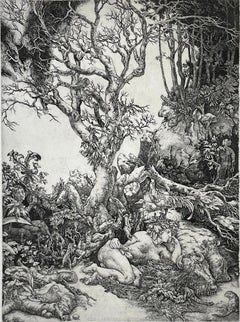
It Seemed To Me, by Stan Washburn
Located in Palm Springs, CA
Signed, titled and numbered etching from the edition of 90. An idyllic setting for Adam and Eve before "the expulsion". In individual prints, and his illustrated books, Washburn clev...
Category

1970s Contemporary Landscape Prints

Materials

Etching

'New York, Central Park' — 1930s American Modernism
Located in Myrtle Beach, SC
'New York, Central Park', etching, edition 40, c. 1930. Signed in pencil. Titled and numbered '14/40' on the bottom sheet edge, in pencil. Signed in the plate, lower left. A superb, ...
Category

1930s American Modern Landscape Prints

Materials

Etching

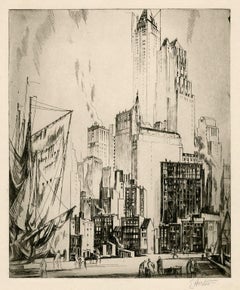
'Woolworth Building Under Construction' — Early 20th Century Modernism
Located in Myrtle Beach, SC
Earl Horter, 'The Woolworth Building Under Construction', etching, c. 1912, edition not stated. Signed in pencil. A fine, richly-inked impression, in warm black ink, with selectively...
Category

1910s American Modern Landscape Prints

Materials

Etching

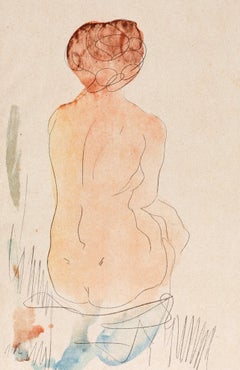
Francois Auguste Rene Rodin, Untitled, from Twelve Watercolors, 1920 (after)
Located in Southampton, NY
This exquisite lithograph after Francois Auguste Rene Rodin (1840–1917), titled Sans titre (Untitled), from the folio Douze aquarelles de Auguste Rodin (Twelve Watercolors by Auguste...
Category

1920s Modern Figurative Prints

Materials

Lithograph, Stencil

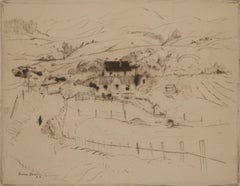
Early 20th Century Signed Etching By Armin Carl Hansen -- Valley Farm
Located in Soquel, CA
Signed 1926 Armin Carl Hansen Etching and Drypoint of Central Coast California Valley Farm Wonderful etching and drypoint of Valley Farm signed and titled by Armin Carl Hansen (Amer...
Category

1920s American Impressionist Landscape Prints

Materials

Laid Paper, Etching

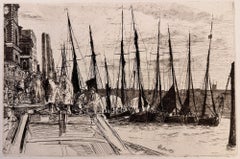
Billingsgate
Located in Middletown, NY
Etching printed in dark brownish black ink on cream laid paper, 6 x 8 7/8 inches (152 x 226 mm); full margins. Extremely minor and unobtrusive band of toning along the top sheet edg...
Category

Mid-19th Century Impressionist Landscape Prints

Materials

Laid Paper, Drypoint, Etching

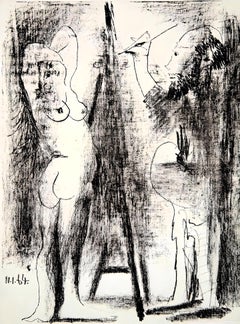
Picasso, Le peintre et son modèle (Cramer 128; Bloch 1848) (after)
Located in Southampton, NY
Lithograph on Arches paper. Inscription: Unsigned and unnumbered, as issued. Good condition; unframed. Notes: Published by Atelier Mourlot, Paris, 1964. PABLO PICASSO (1881-1973) Spanish painter and sculptor is one of the most recognized figures of twentieth century art. During his artistic career, which lasted more than 75 years, he created thousands of works using all kinds of mediums. He changed art more profoundly than any other artist of his time. First famous for pioneering cubism, Picasso continued to develop his art with a pace...
Category

1960s Cubist Figurative Prints

Materials

Lithograph

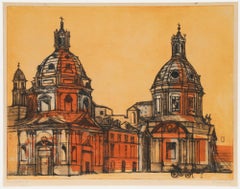
Richard Beer (1928-2017) - 20th Century Etching, Two Churches
Located in Corsham, GB
An original 20th century etching by artist Richard Beer, signed and titled in graphite below the plate lines. On paper laid to card.
Category

20th Century Landscape Prints

Materials

Etching

Still Thinking About These?

All Recently Viewed