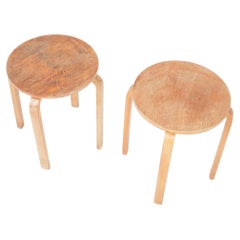
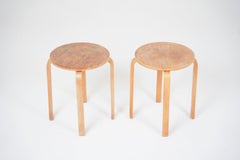
IKEA FROSTA Chair Set Of Two
$390 / set
IKEA FROSTA Chair Set Of Two
By IKEA
Located in Čelinac, BA
IKEA FROSTA Chair Set of Two Sweden 1980s
Category
Vintage 1980s Swedish Mid-Century Modern Chairs
Materials
Wood
$390 / set
IKEA FROSTA Chair Set Of Two
By IKEA
Located in Čelinac, BA
IKEA FROSTA Chair Set of Two Sweden 1980s
Wood
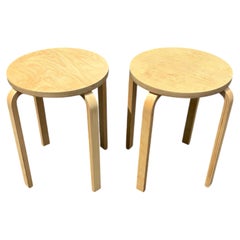
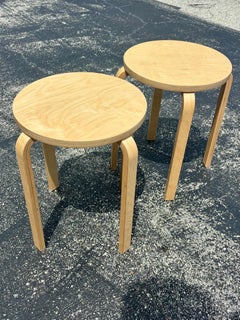
1990s Vintage IKEA Frosta Birch Plywood Stacking Stools, Pair
By IKEA, Alvar Aalto
Located in Delray Beach, FL
Pair of vintage 1990s IKEA Frosta stools crafted from laminated birch plywood with sculptural bentwood legs.
Birch
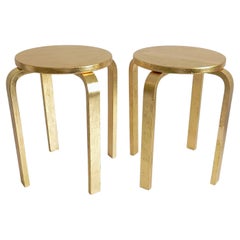
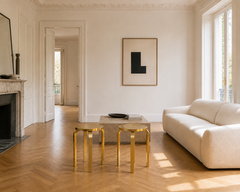
1990s IKEA Frosta Stools in the Style of Alvar Aalto, Gold Leaf Covered
By IKEA, Alvar Aalto
Located in Valencia, VC
Pair of 1990s IKEA Frosta stools in birch plywood, inspired by Alvar Aalto’s iconic Model 60.
Wood, Birch, Bentwood, Plywood
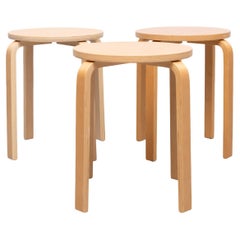
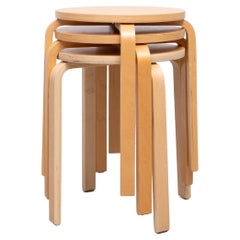
IKEA Frosta Stools Set of 3, Beech Wood, Mid-Century Modern
By IKEA
Located in Den Haag, NL
Frosta Beech Stools .by Ikea 1980s Good condition .
Beech
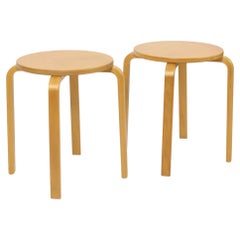
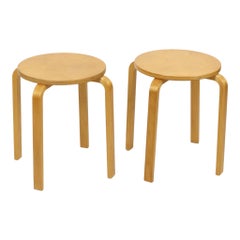
Set of 2 Vintage IKEA Frosta Stools, Beech Wood, 1990s
Located in Poperinge, BE
A lovely set of two vintage IKEA stools—the 'Frosta' model—crafted from bent beech plywood.
Beech
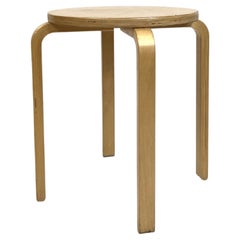
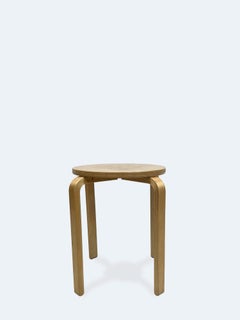
Set of Two Stackable Stools, Model "Frosta" by IKEA, 1990s
By IKEA
Located in Reichenschwand, DE
This pair of stackable stools from the 1990s—model "Frosta" by IKEA—embodies the clarity and practicality that define Scandinavian design.
Wood, Birch, Plywood
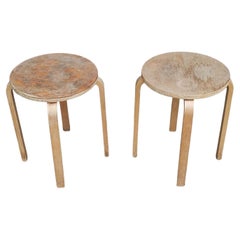
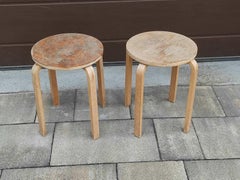
Set of Two IKEA Frosta Bentwood Stool 1990s
By IKEA
Located in Čelinac, BA
Set of Two IKEA Stool 1990s
Bentwood
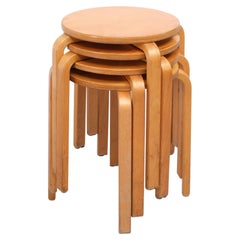
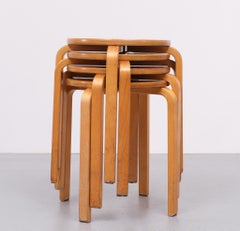
Vintage Frosta Bentwood Stacking Stools for Ikea, 1990s
By IKEA, Alvar Aalto
Located in Den Haag, NL
Very nice set of Frosta Bend wood stools. 4 Pieces original designed by Alvar Aalto manufactured by Ikea.
Bentwood
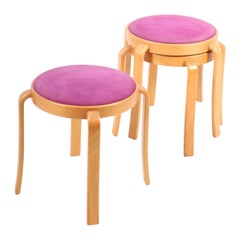
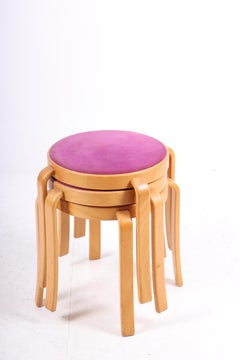
Set of Three Stools, Designed by Rud Thygesen, 1980
By Rud Thygesen and Johnny Sorensen
Located in Lejre, DK
Set of three stools in beech frame and wool. Designed by Danish architects Johnny Sørensen and Rud Thygesen.
Beech, Fabric
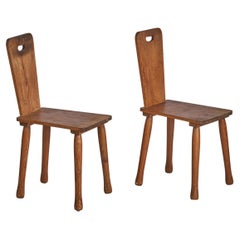
Swedish Designer, Side Chairs, Pine, Sweden, 1940s
Located in High Point, NC
A pair of pine side chairs designed and produced in Sweden, 1940s. Seat height: 18”
Pine
$2,102
H 17.33 in W 16.15 in D 16.15 in
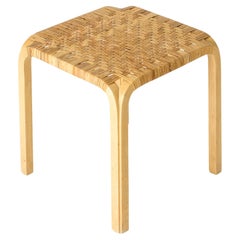
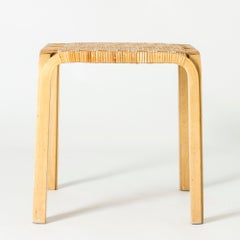
Vintage Midcentury Alvar Aalto stool, model "Y61", Finland, 1950s
By Artek, Alvar Aalto
Located in Östermalm, Stockholms län
Lovely stool by Alvar Aalto, model “Y 61”. Made from birch with flowing lines, wreathed rattan seat.
Rattan, Birch
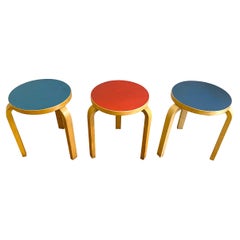
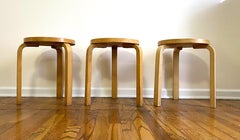
Set of 3 Alvar Alto Stool 60 by Artek, Finland
By Artek, Alvar Aalto
Located in New York, NY
Set of 3 vintage original vintage Alvar Alto 60 stools from early 1960s. From a private home with one owner who purchased them in the late 1950s. Two with blue linoleum tops and one ...
Bentwood, Birch
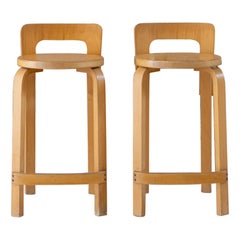
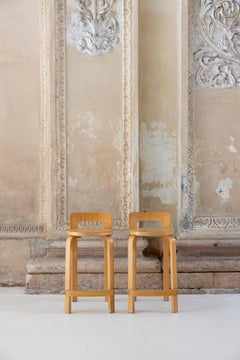
$2,610Sale Price / set|20% Off
H 28.15 in W 15.36 in D 14.77 in
Midcentury pair of stools mod. K65 by Alvar Aalto for Artek
By Alvar Aalto
Located in Piacenza, Italy
Model K65 Stool by Alvar Aalto for Artek Finland, 1970s Designed by Alvar Aalto between 1933 and 1935, the K65 stool exemplifies his pioneering approach to bent birch construction an...
Wood
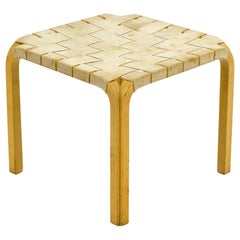
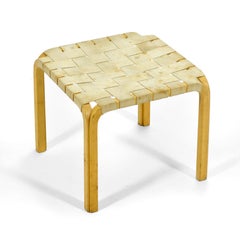
Alvar Aalto Y61 Stool
By Alvar Aalto, Artek
Located in Highland, IN
Designed in 1947, Alvar Aalto's Y61 stool required a special technique to create the unique Y-leg. This vintage example was sold in the US by ICF and has a rich patina attesting to y...
Canvas, Birch
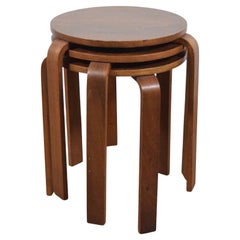
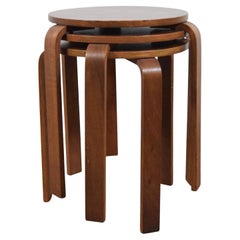
Set of 3 mid century danish teak stacking stools or tables
Located in Brooklyn, NY
Set of 3 mid century danish teak stacking stools or tables. Each table has 3 legs. Flat head screws labeled made in Denmark. Set of 3 matching stools. Original vintage condition. All...
Bentwood, Teak
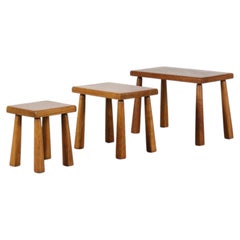
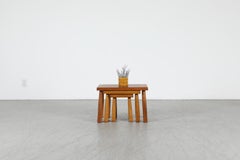
Pierre Chapo Inspired Oak Nesting Tables, Set of 3
By Pierre Chapo
Located in Los Angeles, CA
Set of three graduated oak nesting tables in the manner of Pierre Chapo. Each table features a thick solid oak top with softly rounded edges and four chunky, slightly splayed legs. T...
Oak
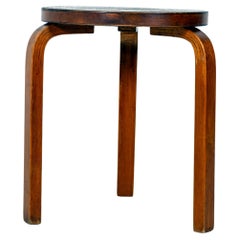
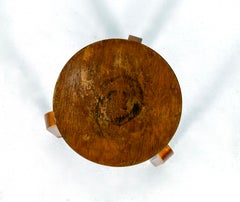
Alvar Aalto Stool 60
By Alvar Aalto
Located in Miami, FL
Stool 60 designed by Alvar Aalto, strong patina with some chips. Please see picture 3 for accurate color.
Bentwood
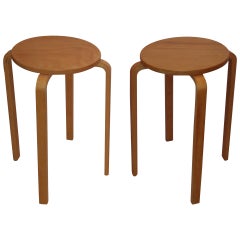
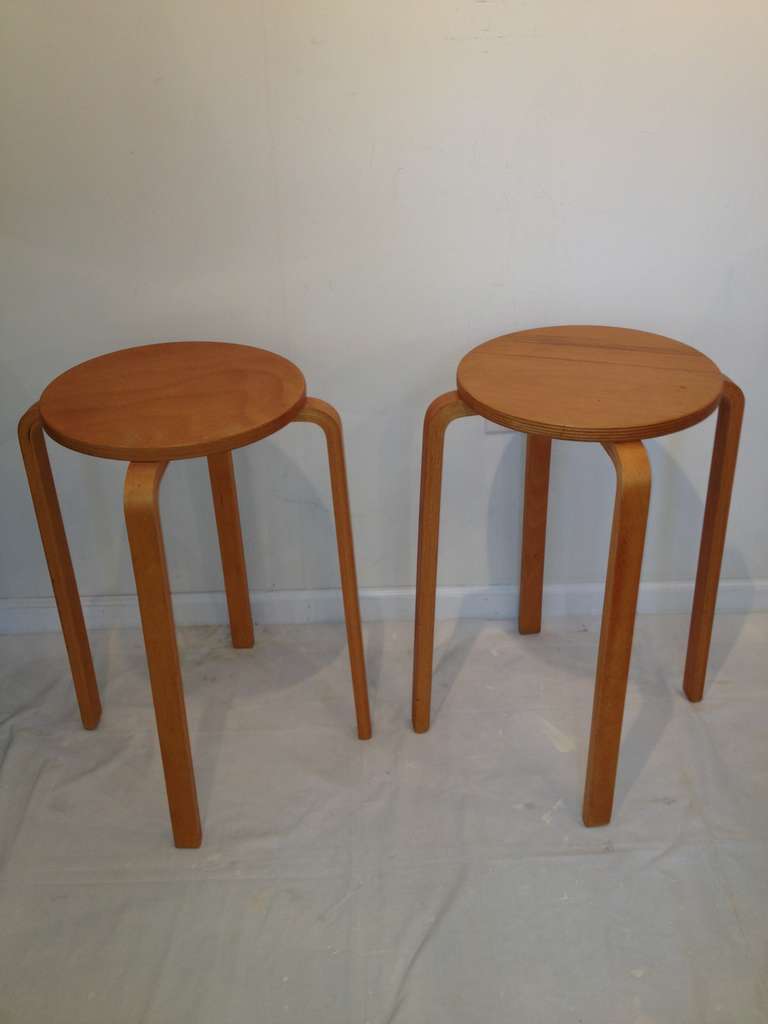
Alvar Aalto style Stool /Tables 63 Bentwood
By Alvar Aalto
Located in Westport, CT
Alvar Aalto Style Stool /Tables design no 63 bentwood birch finish /could be used as tables or pedestals,vintage in very good condition,unusual height.
Wood
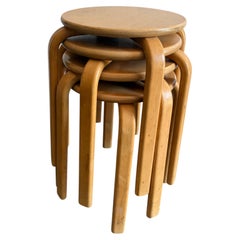
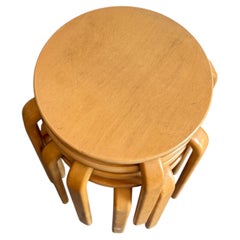
Set of 4 mid century danish Bentwood Birch stacking stools or tables
By Alvar Aalto
Located in Brooklyn, NY
Set of 4 mid century danish Birch stacking stools or tables. Each table has 4 legs. Flat head screws labeled made in Denmark. Set of 4 matching stools. Original vintage condition. Al...
Bentwood, Birch, Plywood
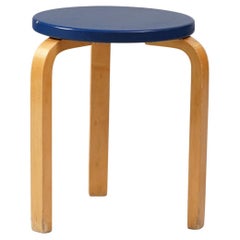
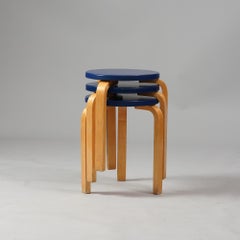
Model 60 Stools, Alvar Aalto, Artek, 1950s/1960s
By Artek, Alvar Aalto
Located in Helsinki, Uusimaa
Three model 60 stools by Alvar Aalto for Artek from the 1950s/1960s. Birch and imitation leather. Good vintage condition, minor patina and wear consistent with age and use. Iconic Al...
Faux Leather, Birch
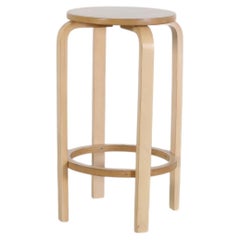
Alvar Aalto Inspired Bent Birch Bar Stool, Scandinavian Design
By Alvar Aalto
Located in Los Angeles, CA
Inspired by the work of Alvar Aalto, this bar stool is constructed entirely in bent birch, carrying forward the material vocabulary Aalto pioneered in Finnish modernism. Four bentwoo...
Birch, Bentwood
$4,000 / set
H 17.5 in W 17 in D 17 in
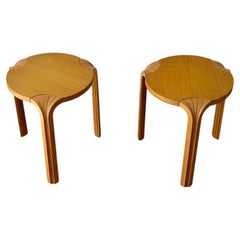
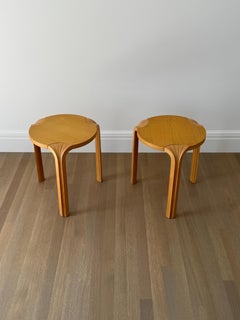
Pair of Alvar Aalto Vintage Birch X600 Fan Leg Stools - Mid-Century Modern 1960s
By ICF New York, Alvar Aalto, Artek
Located in St. Louis, MO
Matching pair of authentic 1960s Alvar Aalto "Fan Leg" stools (Model X600) represents one of the most elegant and structurally brilliant iterations in the history of mid-century Scan...
Birch
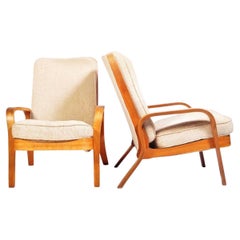
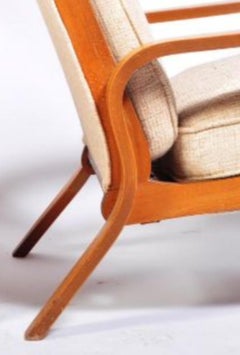
Pair of Chairs for the Modern Home
Located in Greenwich, CT
Pair of easy chairs having a sleek, streamlined design of beautifully clever simplicity made for the modern British home, circa 1960. In bent plywood featuring continuous one piece a...
Plywood
$2,240 / set
H 17.72 in W 13.78 in D 13.78 in
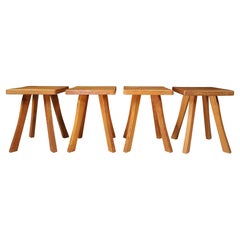
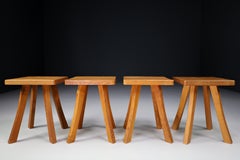
Set/4 Midcentury Elm French Stools in the Style of Charlotte Perriand France, 50s
By Pierre Chapo, Charlotte Perriand
Located in Almelo, NL
Set/4 of four-legged French stools in the style of Charlotte Perriand for the Les Arcs Ski resort and Pierre Chapo France 1950s. These solid elm stools shows an incredible patina and...
Elm
IKEA is the world's largest furniture retailer, but its origins were far humbler than its global footprint suggests. Founded in 1943 by 17-year-old Ingvar Kamprad in the Swedish village of Älmhult, the company began as a mail-order business selling pens, wallets and picture frames. It wasn't until 1948 that the IKEA catalog started featuring furniture, altering the course of modern domestic design.
IKEA is rooted in democratic design, or the belief that well-made, beautiful objects should be accessible to everyone. This philosophy took shape in the 1950s when IKEA began working with independent designers to develop its own furniture lines. The pivotal innovation came in 1956, when IKEA introduced flat-pack furniture, a practical solution born out of necessity when designer Gillis Lundgren removed a table's legs to fit it into a car. This single insight reshaped how the world thinks about manufacturing, shipping and the relationship between consumer and object.
The 1970s and 1980s are now widely considered the golden age of IKEA design, a period when the company regularly collaborated with outside designers before transitioning to entirely in-house production. These decades produced some of the brand's most collectible pieces, and vintage examples are today actively sought after by collectors worldwide. Karen Mobring's safari-influenced seating — including the Diana, Natura and Amiral chairs — captures the organic, relaxed spirit of the era, while Noboru Nakamura's Bore chair and Lundgren's Pixi lounge chair round out the most coveted 1970s offerings. The 1980s brought a sharper, more industrial sensibility through Niels Gammelgaard's work in wire and tubular steel, among them the Enetri shelf, the wire Jarpen chairs and the foldable Ted chair, as well as Tord Björklund's Skye chaise and Klinte armchair.
Beyond these core collaborators, IKEA has worked with some of the most significant names in 20th-century design. Kai Kristiansen, Ettore Sottsass, Verner Panton and Mats Theselius all produced pieces for the brand, and rare examples of their IKEA work are among the most prized finds for collectors today. More recently, collaborations with designers such as Ilse Crawford, Tom Dixon and Hella Jongerius through its IKEA PS (“post scriptum”) collections have continued to push the brand into more expressive territory.
IKEA has also shaped retail culture itself. Its sprawling, maze-like store format — introduced in Älmhult in 1958 — transformed shopping into an experience, complete with room vignettes, a Swedish café and a one-way path designed to inspire. The brand has since expanded to more than 60 countries, while its annual catalog, once one of the most widely distributed publications in the world, became a cultural artifact in its own right.
IKEA continues to balance its founding tension: mass production in the service of good design. As Kamprad once put it, "to design a desk which may cost $1,000 is easy for a furniture designer, but to design a functional and good desk which shall cost $50 can only be done by the very best."
Find a range of vintage and collectible IKEA chairs, shelving and furniture on 1stDibs.
With entire areas of our homes reserved for “sitting rooms,” the value of quality antique and vintage seating cannot be overstated.
Fortunately, the design of side chairs, armchairs and other lounge furniture — since what were, quite literally, the early perches of our ancestors — has evolved considerably.
Among the earliest standard seating furniture were stools. Egyptian stools, for example, designed for one person with no seat back, were x-shaped and typically folded to be tucked away. These rudimentary chairs informed the design of Greek and Roman stools, all of which were a long way from Sori Yanagi's Butterfly stool or Alvar Aalto's Stool 60. In the 18th century and earlier, seats with backs and armrests were largely reserved for high nobility.
The seating of today is more inclusive but the style and placement of chairs can still make a statement. Antique desk chairs and armchairs designed in the style of Louis XV, which eventually included painted furniture and were often made of rare woods, feature prominently curved legs as well as Chinese themes and varied ornaments. Much like the thrones of fairy tales and the regency, elegant lounges crafted in the Louis XV style convey wealth and prestige. In the kitchen, the dining chair placed at the head of the table is typically reserved for the head of the household or a revered guest.
Of course, with luxurious vintage or antique furnishings, every chair can seem like the best seat in the house. Whether your preference is stretching out on a plush sofa, such as the Serpentine, designed by Vladimir Kagan, or cozying up in a vintage wingback chair, there is likely to be a comfy classic or contemporary gem for you on 1stDibs.
With respect to the latest obsessions in design, cane seating has been cropping up everywhere, from sleek armchairs to lounge chairs, while bouclé fabric, a staple of modern furniture design, can be seen in mid-century modern, Scandinavian modern and Hollywood Regency furniture styles.
Admirers of the sophisticated craftsmanship and dark woods frequently associated with mid-century modern seating can find timeless furnishings in our expansive collection of lounge chairs, dining chairs and other items — whether they’re vintage editions or alluring official reproductions of iconic designs from the likes of Hans Wegner or from Charles and Ray Eames. Shop our inventory of Egg chairs, designed in 1958 by Arne Jacobsen, the Florence Knoll lounge chair and more.
No matter your style, the collection of unique chairs, sofas and other seating on 1stDibs is surely worthy of a standing ovation.