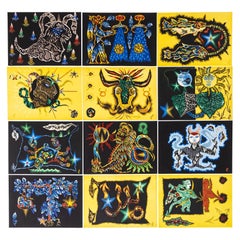
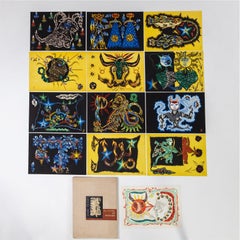
Credited with helping revive the design and production of tapestries during the 20th century, French artist Jean Lurçat rubbed shoulders with some of the greatest painters in the world while weaving his own artistic narrative into the fabric of history.
Lurçat met artists Henri Matisse, Paul Cézanne and Pierre-Auguste Renoir in Paris in his early twenties — when the Bruyères native found himself fully immersed in the French art world. He had studied at Académie Colarossi and worked in the studio of sculptor Victor Prouvé, and later made paintings inspired by Fauvism. Lurçat first exhibited his tapestries in 1917.
Lurçat’s inaugural textiles were constructed with weaver Marthe Hennebert and were marked by Cubism and avant-garde–inspired art styles before he embarked on extensive travels that would enrich his work. Lurçat’s travels exposed him to other movements and styles that ranged from German Expressionism to Spanish and African influences that inspired his later works.
Lurçat’s tapestries found a regular home in 1925 at Jeanne Bucher’s gallery, which featured the work of other artists including Pablo Picasso, Hans Arp, Jacques Lipchitz, Georges Braque and Max Ernst. Between 1930 and 1936, Lurçat had solo exhibitions at the Flechtheim Gallery in Berlin and the Pierre Matisse Gallery in New York. In 1939 — when the popularity of tapestries had long been on the decline — Lurçat opened a factory with other artists in Aubusson, the home of a centuries-old tapestry production industry, in order to create modernist tapestries.
Over the course of his life, Lurçat designed more than 1,000 tapestries. One of his most notable, Apocalypse Tapestry (1948), is on display in the Church of Notre-Dame de Toute-Grâce and complements the original which dates back to the 14th century. His other highly acclaimed works include Song of the World (1957–64) and Four Seasons (1940).
While Lurçat’s best known works are his tapestries, he also produced engravings, book illustrations and ceramics. The Museum of Modern Art in New York City holds some of these book illustrations as well as a few other works in its permanent collection. Other works by Lurçat are held in the collections of the Detroit Museum of Fine Arts, the Musée Nationale d’Art Moderne, the Museum of Chicago, the Philadelphia Museum of Art and the National Gallery in Washington DC.
On 1stDibs, find a collection of Jean Lurçat wall decorations, decorative objects and ceramics.
Organically shaped, clean-lined and elegantly simple are three terms that well describe vintage mid-century modern furniture. The style, which emerged primarily in the years following World War II, is characterized by pieces that were conceived and made in an energetic, optimistic spirit by creators who believed that good design was an essential part of good living.
ORIGINS OF MID-CENTURY MODERN FURNITURE DESIGN
CHARACTERISTICS OF MID-CENTURY MODERN FURNITURE DESIGN
MID-CENTURY MODERN FURNITURE DESIGNERS TO KNOW
ICONIC MID-CENTURY MODERN FURNITURE DESIGNS
VINTAGE MID-CENTURY MODERN FURNITURE ON 1STDIBS
The mid-century modern era saw leagues of postwar American architects and designers animated by new ideas and new technology. The lean, functionalist International-style architecture of Le Corbusier and Bauhaus eminences Ludwig Mies van der Rohe and Walter Gropius had been promoted in the United States during the 1930s by Philip Johnson and others. New building techniques, such as “post-and-beam” construction, allowed the International-style schemes to be realized on a small scale in open-plan houses with long walls of glass.
Materials developed for wartime use became available for domestic goods and were incorporated into mid-century modern furniture designs. Charles and Ray Eames and Eero Saarinen, who had experimented extensively with molded plywood, eagerly embraced fiberglass for pieces such as the La Chaise and the Womb chair, respectively.
Architect, writer and designer George Nelson created with his team shades for the Bubble lamp using a new translucent polymer skin and, as design director at Herman Miller, recruited the Eameses, Alexander Girard and others for projects at the legendary Michigan furniture manufacturer.
Harry Bertoia and Isamu Noguchi devised chairs and tables built of wire mesh and wire struts. Materials were repurposed too: The Danish-born designer Jens Risom created a line of chairs using surplus parachute straps for webbed seats and backrests.
The Risom lounge chair was among the first pieces of furniture commissioned and produced by celebrated manufacturer Knoll, a chief influencer in the rise of modern design in the United States, thanks to the work of Florence Knoll, the pioneering architect and designer who made the firm a leader in its field. The seating that Knoll created for office spaces — as well as pieces designed by Florence initially for commercial clients — soon became desirable for the home.
As the demand for casual, uncluttered furnishings grew, more mid-century furniture designers caught the spirit.
Classically oriented creators such as Edward Wormley, house designer for Dunbar Inc., offered such pieces as the sinuous Listen to Me chaise; the British expatriate T.H. Robsjohn-Gibbings switched gears, creating items such as the tiered, biomorphic Mesa table. There were Young Turks such as Paul McCobb, who designed holistic groups of sleek, blond wood furniture, and Milo Baughman, who espoused a West Coast aesthetic in minimalist teak dining tables and lushly upholstered chairs and sofas with angular steel frames.
Generations turn over, and mid-century modern remains arguably the most popular style going. As the collection of vintage mid-century modern chairs, dressers, coffee tables and other furniture for the living room, dining room, bedroom and elsewhere on 1stDibs demonstrates, this period saw one of the most delightful and dramatic flowerings of creativity in design history.
Prints are works of art produced in multiple editions. Though several copies of a specific artwork can exist, collectors consider antique and vintage prints originals when they have been manually created by the artist or are “impressions” that are part of the artist’s intent for the work.
Modern artists use a range of printmaking techniques to produce different types of prints such as relief, intaglio and planographic. Relief prints are created by cutting away a printing surface to leave only a design. Ink or paint is applied to the raised parts of the surface, and it is used to stamp or press the design onto paper or another surface. Relief prints include woodcuts, linocuts and engravings.
Intaglio prints are the opposite of relief prints in that they are incised into the printing surface. The artist cuts the design into a block, plate or other material and then coats it with ink before wiping off the surface and transferring the design to paper through tremendous pressure. Intaglio prints have plate marks showing the impression of the original block or plate as it was pressed onto the paper.
Artists create planographic prints by drawing a design on a stone or metal plate using a grease crayon. The plate is washed with water, then ink is spread over the plate and it adheres to the grease markings. The image is then stamped on paper to make prints.
All of these printmaking methods have an intricate process, although each can usually transfer only one color of ink. Artists use separate plates or blocks for multiple colors, and together these create one finished work of art.
Find prints ranging from the 18th- and 19th-century bird illustrations by J.C. Sepp to mid-century modern prints, as well as numerous other antique and vintage prints at 1stDibs. Browse the collection today and read about how to arrange wall art in your space.