Neos Sowden

Neos Lorenz du Pasquier & Sowden Postmodern Clock

Neos Lorenz du Pasquier & Sowden Postmodern Clock

By George Sowden, Nathalie du Pasquier

Located in Chicago, IL

Neos Lorenz du Pasquier & Sowden Postmodern Clock A blue and purple plastic postmodern wall clock with yellow hands and numbers designed by Nathalie du Pasquier and George Sowden for...

Category

Late 20th Century Italian Post-Modern Wall Clocks

Materials

Plastic

Neos Lorenz du Pasquier & Sowden Postmodern Clock

Neos Lorenz du Pasquier & Sowden Postmodern Clock

By George Sowden, Nathalie du Pasquier

Located in Chicago, IL

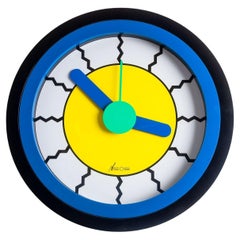
A bright, multicolored postmodern wall clock with blue and green hands designed by Nathalie du Pasquier and George Sowden for Neos of Lorenz in the late 1980s. Co-founders of the Mem...

Category

Vintage 1980s Italian Post-Modern Wall Clocks

Materials

Plastic

Memphis Wall Clock by George Sowden & Nathalie du Pasquier for NEOS Lorenz

Memphis Wall Clock by George Sowden & Nathalie du Pasquier for NEOS Lorenz

By George Sowden, Nathalie du Pasquier

Located in Tilburg, NL

The ‘Neos’ series of clocks consisted of several different kinds of clocks – from table and wall clocks to watches.

Category

Vintage 1980s Swiss Post-Modern Wall Clocks

Materials

Plastic

Recent Sales

Nathalie du PASQUIER George SOWDEN Horloge murale vers 1986 Neos of Lorenz clock

Nathalie du PASQUIER George SOWDEN Horloge murale vers 1986 Neos of Lorenz clock

By George Sowden

Located in PARIS, FR

Nathalie du PASQUIER (née en 1957) et George SOWDEN (né en 1942) Horloge murale, vers 1986 Edition Neos of Lorenz arrêtée Plastique, métal laqué, verre, mécanisme à quartz (pile LR6...

Category

Vintage 1980s Italian Post-Modern Wall Clocks

Materials

Plastic

Nathalie du Pasquier George Sowden Neos Clock Italy 1988 Grey

Nathalie du Pasquier George Sowden Neos Clock Italy 1988 Grey

By George Sowden, Nathalie du Pasquier

Located in Roosendaal, Noord Brabant

Memphis era wall clock designed by Nathalie du Pasquier and George Sowden and manufactured by Neos, Italy, 1988. The style and materials used for this clock represents the Memphis pe...

Category

Vintage 1980s Italian Post-Modern Wall Clocks

Materials

Glass, Plastic

Postmodern Wall Clock by Nathalie du Pasquier & George Sowden for Neos

Postmodern Wall Clock by Nathalie du Pasquier & George Sowden for Neos

By Nathalie du Pasquier, George Sowden, Lorenz

Located in Brooklyn, NY

An amazing orange and gray wall clock designed by Memphis Group founding members George Sowden and Nathalie du Pasquier for Neos of Lorenz.

Category

Late 20th Century Post-Modern Wall Clocks

Materials

Glass, Plastic

Nathalie du Pasquier George Sowden Neos Clock Italy 1988 Salm

Nathalie du Pasquier George Sowden Neos Clock Italy 1988 Salm

By Nathalie du Pasquier

Located in Roosendaal, Noord Brabant

Postmodern wall clock designed by Nathalie du Pasquier and George Sowden and manufactured by Neos, Italy, 1988. This clock represents the Memphis period at its best, the style and co...

Category

Vintage 1980s Italian Post-Modern Wall Clocks

Materials

Glass, Plastic

Nathalie du Pasquier George Sowden Neos Clock Italy 1988 Red

Nathalie du Pasquier George Sowden Neos Clock Italy 1988 Red

By Nathalie du Pasquier

Located in Roosendaal, Noord Brabant

Postmodern wall clock designed by Nathalie du Pasquier and George Sowden and manufactured by Neos, Italy, 1988. This clock is one of the nicest from the collection if you ask me as i...

Category

Vintage 1980s Italian Post-Modern Wall Clocks

Materials

Glass, Plastic

Deadstock Tabletop Clock, Nathalie Du Pasquier and George Sowden for Neos Lorenz

Deadstock Tabletop Clock, Nathalie Du Pasquier and George Sowden for Neos Lorenz

By Nathalie du Pasquier

Located in Las Vegas, NV

Tabletop clock by Nathalie Du Pasquier and George Sowden for Neos of Lorenz. Iconic and rare piece in enameled steel and plastic.

Category

Vintage 1980s Italian Post-Modern Table Clocks and Desk Clocks

Materials

Steel

Neos Lorenz du Pasquier & Sowden Postmodern Clock

Neos Lorenz du Pasquier & Sowden Postmodern Clock

By Nathalie du Pasquier, George Sowden

Located in Chicago, IL

Neos Lorenz du Pasquier & Sowden Postmodern Clock A black and white, bullseye-like design plastic postmodern wall clock with yellow hands and numbers designed by Nathalie du Pasquier...

Category

Vintage 1980s Italian Post-Modern Wall Clocks

Materials

Plastic

Neos Clock George Sowden Nathalie du Pasquier Postmodern

Neos Clock George Sowden Nathalie du Pasquier Postmodern

By Nathalie du Pasquier, George Sowden, Lorenz

Located in Shibuya-ku, Tokyo

Neos clock designed by George Sowden and Nathalie du Pasquier.

Category

Vintage 1980s Italian Post-Modern Table Clocks and Desk Clocks

Materials

Plastic, Acrylic

Nathalie du Pasquier George Sowden Neos Clock Italy 1988 Blue

Nathalie du Pasquier George Sowden Neos Clock Italy 1988 Blue

By George Sowden, Nathalie du Pasquier

Located in Roosendaal, Noord Brabant

Memphis wall clock designed by Nathalie du Pasquier and George Sowden and manufactured by Neos, Italy, 1988. The style of this clock represents the Memphis period at its best, the st...

Category

Vintage 1980s Italian Post-Modern Wall Clocks

Materials

Glass, Plastic

Memphis Milano Nathalie Du Pasquier and George Sowden Neos wall clock 1988

Memphis Milano Nathalie Du Pasquier and George Sowden Neos wall clock 1988

By George Sowden, Nathalie du Pasquier, Naos

Located in Brooklyn, NY

Memphis Milano Nathalie Du Pasquier and George Sowden Neos wall clock 1988. Postmodern design. Lorenz; France/Italy, c. 1988 13.5 dia × 2 d in (34 × 5 cm) Signed with molded manufac...

Category

Late 20th Century Italian Post-Modern Wall Clocks

Materials

Aluminum

Postmodern Table Clock by George Sowden for Neos, Italy, 1988

Postmodern Table Clock by George Sowden for Neos, Italy, 1988

By George Sowden

Located in Chicago, IL

Postmodern clock for desk or table by George Sowden for Neos by Lorenz. Ceramic in grey black and white.

Category

Vintage 1980s Italian Post-Modern Table Clocks and Desk Clocks

Materials

Ceramic

Memphis Clock by Nathalie du Pasquier and George Sowden for Neos Lorenz Italy

Memphis Clock by Nathalie du Pasquier and George Sowden for Neos Lorenz Italy

By George Sowden, Nathalie du Pasquier, Lorenz

Located in Chicago, IL

Created by Nathalie du Pasquier and George Sowden for Neos Lorenz in 1988 Italy, this ceramic table clock, with its bold shapes and patterns, is an excellent example of 1980s design.

Category

Vintage 1980s Italian Post-Modern Table Clocks and Desk Clocks

Materials

Porcelain

Postmodern Wall Clock by du Pasquier and Sowden for Neos, Italy, 1980s

Postmodern Wall Clock by du Pasquier and Sowden for Neos, Italy, 1980s

By George Sowden

Located in Chicago, IL

Postmodern wall clock designed by the Memphis Group founding members and couple, George Sowden and Nathalie du Pasquier. Marbled green and black pattern frame with bold black numeral...

Category

Vintage 1980s Italian Post-Modern Wall Clocks

Materials

Plastic

Postmodern Wall Clock by Du Pasquier and Sowden for Neos, Italy, 1988

Postmodern Wall Clock by Du Pasquier and Sowden for Neos, Italy, 1988

By George Sowden, Nathalie du Pasquier

Located in Chicago, IL

Postmodern wall clock by Natalie du Pasquier and George Sowden for Neos, made in Italy in 1988. Pop colors in blue, yellow, light orange, black and white.

Category

Vintage 1980s Italian Post-Modern Wall Clocks

Materials

Plastic

Memphis Wall Clock, Red Marble Effect, du Pasquier & Sowden x Neos, Italy, 1980s

Memphis Wall Clock, Red Marble Effect, du Pasquier & Sowden x Neos, Italy, 1980s

By George Sowden, Nathalie du Pasquier

Located in Chicago, IL

Signed with molded manufacturer's mark on back, "Neos of Lorenz Design Du Pasquier Sowden Made in Italy".

Category

Vintage 1980s Italian Post-Modern Wall Clocks

Materials

Aluminum

Memphis Wall Clock Green Marble Pattern du Pasquier and Sowden, Neos Italy 1980s

Memphis Wall Clock Green Marble Pattern du Pasquier and Sowden, Neos Italy 1980s

By George Sowden, Nathalie du Pasquier

Located in Chicago, IL

Neos collection reflects the very latest trends in neo-modern design and its power of expression goes beyond any purely functional concept, giving the watch an intensely decorative r...

Category

Vintage 1980s Italian Post-Modern Wall Clocks

Materials

Glass, Plastic

Get Updated with New Arrivals
Save "Neos Sowden", and we’ll notify you when there are new listings in this category.

Neos Sowden For Sale on 1stDibs

At 1stDibs, there are many versions of the ideal neos sowden for your home. Each neos sowden for sale was constructed with extraordinary care, often using plastic, glass and aluminum. You’ve searched high and low for the perfect neos sowden — we have versions that date back to the 20th Century alongside those produced as recently as the 20th Century are available. Each neos sowden bearing hallmarks is very popular. A well-made neos sowden has long been a part of the offerings for many furniture designers and manufacturers, but those produced by George Sowden, Nathalie du Pasquier and Lorenz are consistently popular.

How Much is a Neos Sowden?

Prices for a neos sowden can differ depending upon size, time period and other attributes — at 1stDibs, they begin at $682 and can go as high as $3,200, while the average can fetch as much as $1,280.

A Close Look at Post-modern Furniture

Postmodern design was a short-lived movement that manifested itself chiefly in Italy and the United States in the early 1980s. The characteristics of vintage postmodern furniture and other postmodern objects and decor for the home included loud-patterned, usually plastic surfaces; strange proportions, vibrant colors and weird angles; and a vague-at-best relationship between form and function.

ORIGINS OF POSTMODERN FURNITURE DESIGN

  • Emerges during the 1960s; popularity explodes during the ’80s
  • A reaction to prevailing conventions of modernism by mainly American architects
  • Architect Robert Venturi critiques modern architecture in his Complexity and Contradiction in Architecture (1966)
  • Theorist Charles Jencks, who championed architecture filled with allusions and cultural references, writes The Language of Post-Modern Architecture (1977)
  • Italian design collective the Memphis Group, also known as Memphis Milano, meets for the first time (1980) 
  • Memphis collective debuts more than 50 objects and furnishings at Salone del Milano (1981)
  • Interest in style declines, minimalism gains steam

CHARACTERISTICS OF POSTMODERN FURNITURE DESIGN

  • Dizzying graphic patterns and an emphasis on loud, off-the-wall colors
  • Use of plastic and laminates, glass, metal and marble; lacquered and painted wood 
  • Unconventional proportions and abundant ornamentation
  • Playful nods to Art Deco and Pop art

POSTMODERN FURNITURE DESIGNERS TO KNOW

VINTAGE POSTMODERN FURNITURE ON 1STDIBS

Critics derided postmodern design as a grandstanding bid for attention and nothing of consequence. Decades later, the fact that postmodernism still has the power to provoke thoughts, along with other reactions, proves they were not entirely correct.

Postmodern design began as an architectural critique. Starting in the 1960s, a small cadre of mainly American architects began to argue that modernism, once high-minded and even noble in its goals, had become stale, stagnant and blandly corporate. Later, in Milan, a cohort of creators led by Ettore Sottsass and Alessandro Mendini — a onetime mentor to Sottsass and a key figure in the Italian Radical movement — brought the discussion to bear on design.

Sottsass, an industrial designer, philosopher and provocateur, gathered a core group of young designers into a collective in 1980 they called Memphis. Members of the Memphis Group,  which would come to include Martine Bedin, Michael Graves, Marco Zanini, Shiro Kuramata, Michele de Lucchi and Matteo Thun, saw design as a means of communication, and they wanted it to shout. That it did: The first Memphis collection appeared in 1981 in Milan and broke all the modernist taboos, embracing irony, kitsch, wild ornamentation and bad taste.

Memphis works remain icons of postmodernism: the Sottsass Casablanca bookcase, with its leopard-print plastic veneer; de Lucchi’s First chair, which has been described as having the look of an electronics component; Martine Bedin’s Super lamp: a pull-toy puppy on a power-cord leash. Even though it preceded the Memphis Group’s formal launch, Sottsass’s iconic Ultrafragola mirror — in its conspicuously curved plastic shell with radical pops of pink neon — proves striking in any space and embodies many of the collective’s postmodern ideals. 

After the initial Memphis show caused an uproar, the postmodern movement within furniture and interior design quickly took off in America. (Memphis fell out of fashion when the Reagan era gave way to cool 1990’s minimalism.) The architect Robert Venturi had by then already begun a series of plywood chairs for Knoll Inc., with beefy, exaggerated silhouettes of traditional styles such as Queen Anne and Chippendale. In 1982, the new firm Swid Powell enlisted a group of top American architects, including Frank Gehry, Richard Meier, Stanley Tigerman and Venturi to create postmodern tableware in silver, ceramic and glass.

On 1stDibs, the vintage postmodern furniture collection includes chairs, coffee tables, sofas, decorative objects, table lamps and more.

Materials: Plastic Furniture

Arguably the world’s most ubiquitous man-made material, plastic has impacted nearly every industry. In contemporary spaces, new and vintage plastic furniture is quite popular and its use pairs well with a range of design styles.

From the Italian lighting artisans at Fontana Arte to venturesome Scandinavian modernists such as Verner Panton, who created groundbreaking interiors as much as he did seating — see his revolutionary Panton chair — to contemporary multidisciplinary artists like Faye Toogood, furniture designers have been pushing the boundaries of plastic forever.

When The Graduate's Mr. McGuire proclaimed, “There’s a great future in plastics,” it was more than a laugh line. The iconic quote is an allusion both to society’s reliance on and its love affair with plastic. Before the material became an integral part of our lives — used in everything from clothing to storage to beauty and beyond — people relied on earthly elements for manufacturing, a process as time-consuming as it was costly.

Soon after American inventor John Wesley Hyatt created celluloid, which could mimic luxury products like tortoiseshell and ivory, production hit fever pitch, and the floodgates opened for others to explore plastic’s full potential. The material altered the history of design — mid-century modern legends Charles and Ray Eames, Joe Colombo and Eero Saarinen regularly experimented with plastics in the development of tables and chairs, and today plastic furnishings and decorative objects are seen as often indoors as they are outside.

Find vintage plastic lounge chairs, outdoor furniture, lighting and more on 1stDibs.

Finding the Right Clocks for You

A sophisticated clock design, whether it’s a desk clock, mantel clock or large wall clock for your living room, is a decorative object to be admired in your home as much as it is a necessary functional element. This is part of the reason clocks make such superb collectibles. Given the versatility of these treasured fixtures — they’ve long been made in a range of shapes, sizes and styles — a clock can prove integral to your own particular interior decor.

Antique and vintage clocks can whisk us back to the 18th and 19th centuries. When most people think of antique clocks, they imagine an Art Deco Bakelite tabletop clock or wall clock, named for the revolutionary synthetic plastic, Bakelite, of which they’re made, or a stately antique grandfather clock. But the art of clock-making goes way back, transcending continents and encompassing an entire range of design styles and technologies. In short, there are many kinds of clocks depending on your needs.

A variety of wall clocks can be found on 1stDibs. A large antique hand-carved walnut wall clock is best suited to a big room and a flat background given what will likely be outwardly sculptural features, while Georgian grandfather clocks, or longcase clocks, will help welcome rainswept guests into your entryway or foyer. An interactive cuckoo clock, large or small, is guaranteed to bring outsize personality to your living room or dining room. For conversation pieces of a similar breed, mid-century modern enthusiasts go for the curious Ball clock, the first of more than 150 clock models conceived in the studio of legendary architect and designer George Nelson. 

Minimalist contemporary clocks and books pair nicely on a shelf, but an eye-catching vintage mantel clock can add balance to your home library while drawing attention to your art and design books and other decorative objects. Ormolu clocks dating from the Louis XVI period, designed in the neoclassical style, are often profusely ornate, featuring architectural flourishes and rich naturalistic details. Rococo-style mantel clocks of Meissen porcelain or porcelain originating from manufacturers in cities such as Limoges, France, during the 18th and 19th centuries, exude an air of imperial elegance on your shelves or side tables and can help give your desk a 19th-century upgrade.

On 1stDibs, find a range of extraordinary antique and vintage clocks today.