Untitled 23 Agam
Recent Sales
1980s Op Art Abstract Prints
Screen
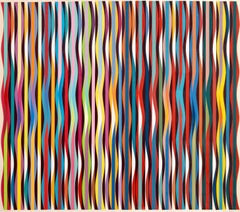

Yaacov Agam for sale on 1stDibs
Influenced by his upbringing in Judaism as well as the teachings of the Bauhaus, Yaacov Agam is a pioneer of kinetic art as well as the Op art movement and is often credited with introducing geometric abstraction to his home country of Israel.
Born in Rishon LeZion, Palestine — now part of Israel — the son of a rabbi, Agam found that the spiritual world had a major influence on his art practice, as did the sand dunes he grew up watching as they constantly shifted with the wind. This perpetual movement would inform his work, whereby riveting, prismatic compositions that transform from different perspectives, patterns that generate optical effects and sculptures that move with a passing breeze all reflect the gradual changes in nature.
Agam studied with Israeli painter Mordecai Ardon at the Bezalel School of Art in Jerusalem in the 1940s before traveling to Zurich where he trained with Swiss Expressionist painter Johannes Itten and was inspired by the abstract work of Russian painter Wassily Kandinsky.
One of the innovative techniques Agam developed was the Agamograph, which uses lenticular printing so that multiple images, which are revealed as the viewer moves around the piece, can be seen on a single work. His art has regularly involved the spectator as a participant, whether it’s the 1972–74 room-size kinetic installation he created for the Elysée Palace that’s now in the Centre Pompidou in which a gleaming abstract sculpture is surrounded on all sides by polychromatic lines or it’s public art like the 1986 Fire and Water Fountain in Tel Aviv with circles of vibrant panels that offer varying colors from every angle.
In 2018, the Yaacov Agam Museum of Art opened in Rishon LeZion, showcasing six decades of Agam’s influential work that engages with perception through color, shape and form, from paintings, prints and installations to new experiments in interactive digital art.
Find a collection of Yaacov Agam art today on 1stDibs.
A Close Look at Op-art Art
The Op art movement emerged in the 1960s, mirroring the counterculture of the time in its embrace of visual trickery, graphic shapes and bright colors.
Spreading across Europe and the Americas, the style — whose name is short for “optical art” — influenced advertising, fashion and interior design before fading in the early ’70s.
Op art remained significant, however, for artists and scientists interested in the nature of perception. And today, it’s seeing a resurgence of interest from collectors and interior designers.
Op artists played with the principles of perception, manipulating line, shape, patterns and color to create the illusion of depth and movement. They drew on and evolved methods developed by past movements, from Impressionism to Abstract Expressionism, to produce intense visual experiences.
All the Op artists shared a focus on the gap between what is and what we perceive. Each, however, had a distinct approach to the issue and a unique visual style.
On 1stDibs, find a collection of Op art that includes works by Josef Albers, Bridget Riley, Jesús Rafael Soto and more.
Finding the Right Abstract-prints-works-on-paper for You
Explore a vast range of abstract prints on 1stDibs to find a piece to enhance your existing collection or transform a space.
Unlike figurative paintings and other figurative art, which focuses on realism and representational perspectives, abstract art concentrates on visual interpretation. An artist may use a single color or simple geometric forms to create a world of depth. Printmaking has a rich history of abstraction. Through materials like stone, metal, wood and wax, an image can be transferred from one surface to another.
During the 19th century, iconic artists, including Edvard Munch, Paul Cézanne, Georgiana Houghton and others, began exploring works based on shapes and colors. This was a departure from the academic conventions of European painting and would influence the rise of 20th-century abstraction and its pioneers, like Pablo Picasso and Piet Mondrian.
Some leaders of European abstraction, including Franz Kline, were influenced by the gestural shapes of East Asian calligraphy. Calligraphy interprets poetry, songs, symbols or other means of storytelling into art, from works on paper in Japan to elements of Islamic architecture.
Bold, daring and expressive, abstract art is constantly evolving and dazzling viewers. And entire genres have blossomed from it, such as Color Field painting and Minimalism.
The collection of abstract art prints on 1stDibs includes etchings, lithographs, screen-prints and other works, and you can find prints by artists such as Joan Miró, Alexander Calder and more.