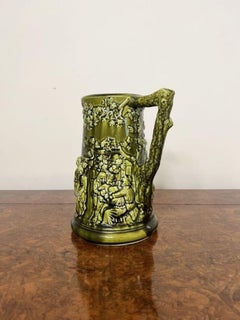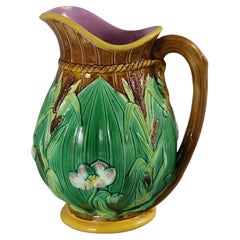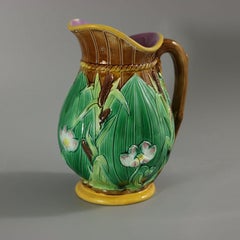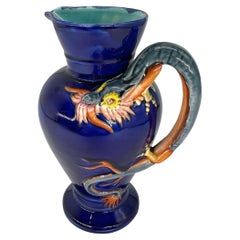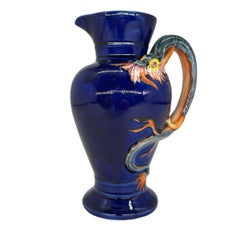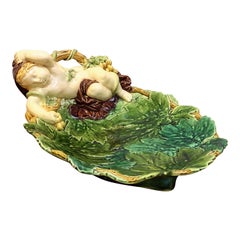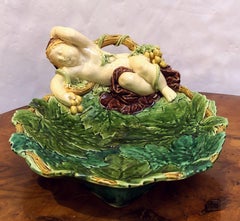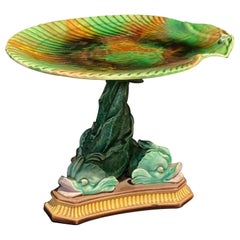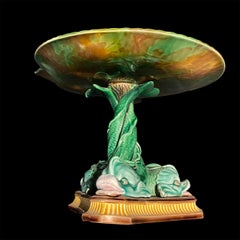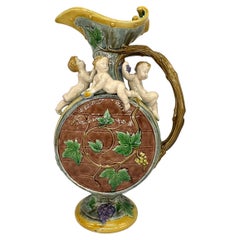
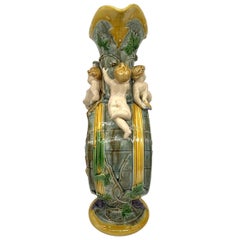
Minton Majolica Wine Ewer Designed by Hugues Protât, English, circa 1875
By Minton
Located in Banner Elk, NC
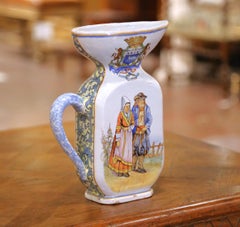
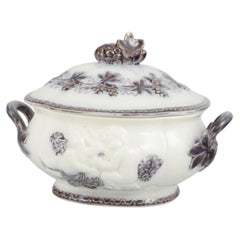
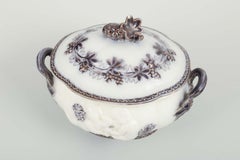
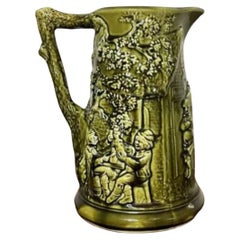
A Minton Majolica Wine Ewer Designed by Hugues Protât (active 1835-90), English, ca. 1875, the body molded as a wine barrel with grape vines to the center, surmounted by four Bacchanalian cherubs, with a Renaissance-style shaped and scrolled spout; the entire piece from the pedestal to the spout is entwined with purple-glazed grapes and green leaves with tendrils, the handle formed by overlapping vines; the reverse with impressed marks, 'MINTONS' and design number '900,' which corresponds to 'Barrel Jug with Cupids (M)' as recorded in the Minton Majolica Ornamental Shape and Design books and partially reprinted in Bergesen. BOOK REFERENCES: Victoria Bergesen, MAJOLICA: British, Continental, and American Wares. London: Barrie & Jenkins, 1989, p. 181. Minton Ornamental Shapes (i.e., design numbers) listed in Appendix D, pp. 180-182. Joan Jones, MINTON: THE FIRST TWO HUNDRED YEARS OF DESIGN AND PRODUCTION. Shrewsbury, England: Swan Hill Press, 1993, p. 348. Susan Weber et al., MAJOLICA MANIA: Transatlantic Pottery in England and the United States, 1850-1915, Volume Two, fig. 12.63. Full-page color photo of this actual piece. The author incorrectly dates the production of this example as 1863, but as it is impressed 'MINTONS,' it would have to be later than 1873 when the 'S' was added Minton. Victoria Cecil, MINTON MAJOLICA, Jeremy Cooper Ltd., Exhibition 7-26 June 1982, Galen Place, London, p. 48, cat. No. 17. Marilyn G. Karmason with Joan B. Stacke, Majolica, A Complete History and Illustrated Survey, New York, 1989, p. 41. The Art Journal Illustrated Catalogue for the International Exhibition 1862...
19th Century English Victorian Antique Earthenware Serveware, Ceramics, Silver and Glass
Majolica