Prints and Multiples

to
287
901
165
117
25
13
Overall Width
to
Overall Height
to
400
371
171
28
13
10
6
1
9
1,217
961
928
836
2
1,216
3
53
34
18
350
553
89
31
1,100
120
1
817
617
354
353
333
297
171
84
44
41
30
29
26
25
16
15
12
9
9
9
830
285
82
82
47
162
448
597
489
Prints and Multiples For Sale
Artist: Marc Chagall
Artist: Guy Bardone
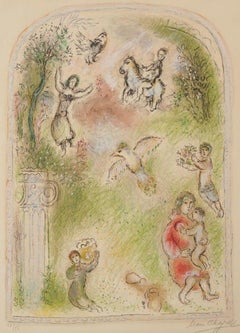
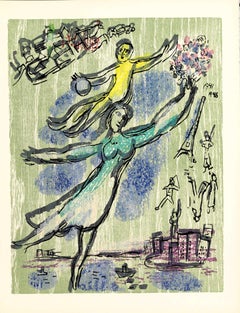
LE JARDIN DE POMONE
Located in New York, NY
A very good impression of this color lithograph. Signed and numbered 38/50 in pencil by Chagall. Catalogue reference: Mourlot 541
Category

1960s Modern Prints and Multiples

Materials

Color, Lithograph

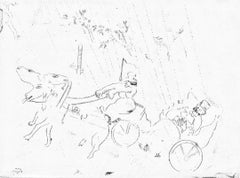
Marc Chagall, On the Way to Sobakevitch, Nicolas Gogol, Dead Souls, 1923-1927
Located in Southampton, NY
This exquisite etching by Marc Chagall (1887–1985), titled En route vers Sobakevitch (On the Way to Sobakevitch), originates from the celebrated folio Nicolas Gogol, Les Ames mortes,...
Category

1920s Expressionist Prints and Multiples

Materials

Etching

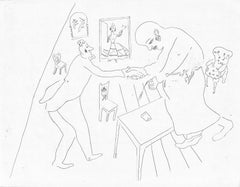
Marc Chagall, Tchitchikov’s Farewell to Manilov, from Dead Souls, 1923-1927
Located in Southampton, NY
This exquisite etching by Marc Chagall (1887–1985), titled Les adieux de Tchitchikov a Manilov (Tchitchikovs Farewell to Manilov), originates from the celebrated folio Nicolas Gogol,...
Category

1920s Expressionist Prints and Multiples

Materials

Etching

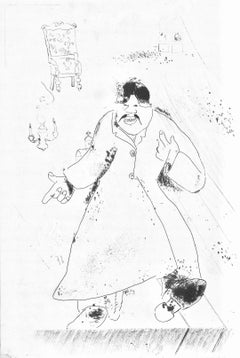
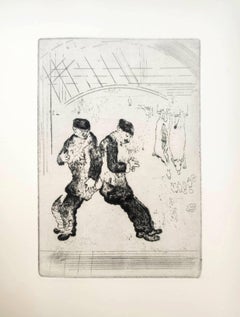
Marc Chagall, The Steward, from Nicolas Gogol, Dead Souls, 1923-1927
Located in Southampton, NY
This exquisite etching by Marc Chagall (1887–1985), titled L'intendant (The Steward), originates from the celebrated folio Nicolas Gogol, Les Ames mortes, Eaux-fortes originales de M...
Category

1920s Expressionist Prints and Multiples

Materials

Etching

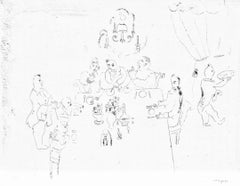
Marc Chagall, Meal at Manilov's, from Nicolas Gogol, Dead Souls, 1923-1927
Located in Southampton, NY
This exquisite etching by Marc Chagall (1887–1985), titled Repas chez Manilov (Meal at Manilov's), originates from the celebrated folio Nicolas Gogol, Les Ames mortes, Eaux-fortes or...
Category

1920s Expressionist Prints and Multiples

Materials

Etching

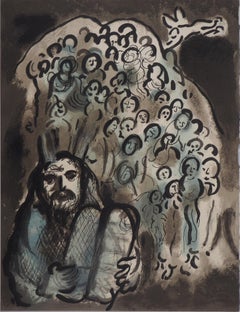
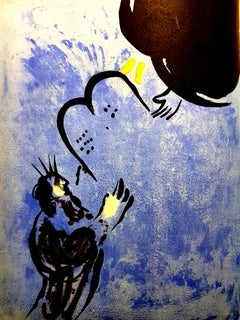
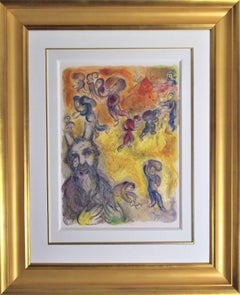
Moses, the Tablets of the Law & His People - Original lithograph - Mourlot #689
Located in Paris, IDF
Marc CHAGALL Moses with the Tablets of the Law & His People, 1973 Original stone lithograph (Printed in Mourlot workshop) Unsigned and not numbered On vellum 32 x 24 cm (c. 13 x 10 ...
Category

1960s Modern Prints and Multiples

Materials

Lithograph

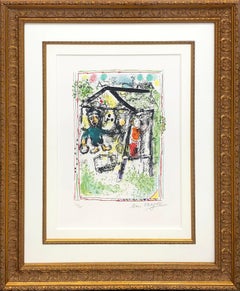
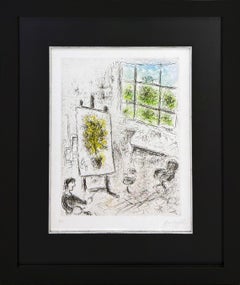
Le Peintre Devant Le Village I (Mourlot 603)
Located in Aventura, FL
Le Peintre Devant Le Village I, 1969. Lithograph in colors on Arches paper. Hand signed lower right by Marc Chagall. Hand numbered 42/75 lower left. Mourlot 603. Published by Mae...
Category

1970s Surrealist Prints and Multiples

Materials

Paper, Lithograph

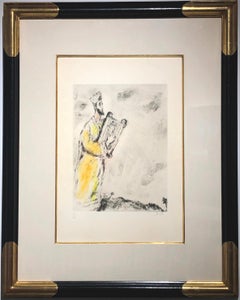
Marc Chagall "Song of the Bow"
Located in Los Angeles, CA
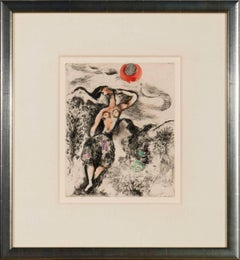
MARC CHAGALL ( 1887- 1985 ) “ Song of the Bow” 1958 from ‘The Bible’ Original Etching with hand-coloring in watercolor. Signed with initials and numbered ##/100 in pencil, published...
Category

Mid-20th Century Prints and Multiples

Materials

Watercolor, Etching

Répit, 1968 (Poèmes, #9)
Located in Greenwich, CT
Répit (Respite) is a woodcut on paper from Marc Chagall's Poèmes portfolio, published in 1968. The image size is 13 x 10 inches and the art is framed in an ornate, gold-tone frame. U...
Category

20th Century Modern Prints and Multiples

Materials

Paper, Woodcut

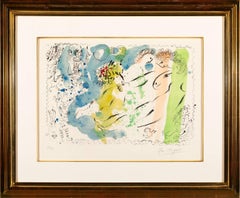
The Rainbow - Signed Lithograph in Colours - French, Russian Art - Symbolism
Located in London, GB
MARC CHAGALL 1887 - 1985 [Shagal, Mark, Zakharovich, Moses] Vitebsk, Belarus 1887 - 1985 Saint-Paul-de-Vence (Russian/French) Title: The Rainbow, 1969 Technique: Original Ha...
Category

1960s Fauvist Prints and Multiples

Materials

Lithograph

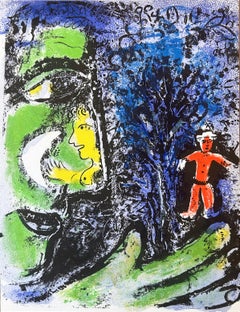
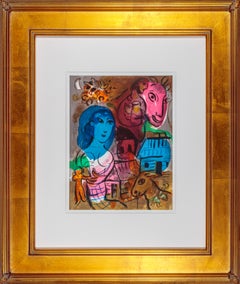
Marc Chagall "Profile and Red Child" lithograph
Located in Boston, MA
Artist: Chagall, Marc Title: Profile and Red Child Date: 1960 Medium: Lithograph Unframed Dimensions: 12 3/4 x 9 1/2" Signature: Unsigned Edition: book edition Literature: Mo...
Category

2010s Modern Prints and Multiples

Materials

Lithograph

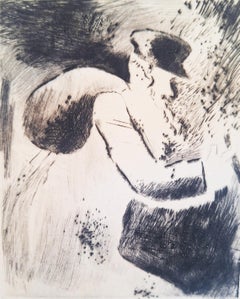
An Old Jew, from: My Life - Russian French Berlin Jewish Surrealism Mein Leben
Located in London, GB
This original etching and drypoint is hand signed in pencil by the artist "Marc Chagall" at the lower right margin. It is also hand numbered in pencil from the edition of 110, at th...
Category

1920s Surrealist Prints and Multiples

Materials

Drypoint, Etching

The Appearance at the Circus - French Russian
Located in London, GB
This original lithograph in colours is hand signed in pencil by the artist "Marc Chagall" at the lower right margin. It is also numbered in pencil 12 from the edition of 40, at the l...
Category

1960s Surrealist Prints and Multiples

Materials

Lithograph

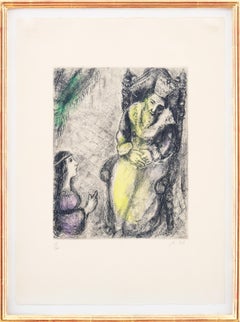
Marc Chagall - Bath-Sheba at the Feet of David - Original Handsigned Etching
Located in Collonge Bellerive, Geneve, CH
Marc Chagall - Bath-Sheba at the Feet of David - Original Handsigned Etching 1958 Printed by Tériade Dimensions: 54 x 39 cm Handsigned and numbered handcolored Edition: 100 Reference: Cramer 30. Etching with hand-coloring, circa 1930, initialled in pencil, numbered 75/100 (there were also twenty hors-commerce copies) , published 1958 by Tériade, Paris, on Arches wove paper Marc Chagall (born in 1887) Marc Chagall was born in Belarus in 1887 and developed an early interest in art. After studying painting, in 1907 he left Russia for Paris, where he lived in an artist colony on the city’s outskirts. Fusing his own personal, dreamlike imagery with hints of the fauvism and cubism popular in France at the time, Chagall created his most lasting work—including I and the Village (1911)—some of which would be featured in the Salon des Indépendants exhibitions. After returning to Vitebsk for a visit in 1914, the outbreak of WWI trapped Chagall in Russia. He returned to France in 1923 but was forced to flee the country and Nazi persecution during WWII. Finding asylum in the U.S., Chagall became involved in set and costume design before returning to France in 1948. In his later years, he experimented with new art forms and was commissioned to produce numerous large-scale works. Chagall died in St.-Paul-de-Vence in 1985. The Village Marc Chagall was born in a small Hassidic community on the outskirts of Vitebsk, Belarus, on July 7, 1887. His father was a fishmonger, and his mother ran a small sundries shop in the village. As a child, Chagall attended the Jewish elementary school, where he studied Hebrew and the Bible, before later attending the Russian public school. He began to learn the fundamentals of drawing during this time, but perhaps more importantly, he absorbed the world around him, storing away the imagery and themes that would feature largely in most of his later work. At age 19 Chagall enrolled at a private, all-Jewish art school and began his formal education in painting, studying briefly with portrait artist Yehuda Pen. However, he left the school after several months, moving to St. Petersburg in 1907 to study at the Imperial Society for the Protection of Fine Arts. The following year, he enrolled at the Svanseva School, studying with set designer Léon Bakst, whose work had been featured in Sergei Diaghilev's Ballets Russes. This early experience would prove important to Chagall’s later career as well. Despite this formal instruction, and the widespread popularity of realism in Russia at the time, Chagall was already establishing his own personal style, which featured a more dreamlike unreality and the people, places and imagery that were close to his heart. Some examples from this period are his Window Vitebsk (1908) and My Fianceé with Black Gloves (1909), which pictured Bella Rosenfeld, to whom he had recently become engaged. The Beehive Despite his romance with Bella, in 1911 an allowance from Russian parliament member and art patron Maxim Binaver enabled Chagall to move to Paris, France. After settling briefly in the Montparnasse neighborhood, Chagall moved further afield to an artist colony known as La Ruche (“The Beehive”), where he began to work side by side with abstract painters such as Amedeo Modigliani and Fernand Léger as well as the avant-garde poet Guillaume Apollinaire. At their urging, and under the influence of the wildly popular fauvism and cubism, Chagall lightened his palette and pushed his style ever further from reality. I and the Village (1911) and Homage to Apollinaire (1912) are among his early Parisian works, widely considered to be his most successful and representative period. Though his work stood stylistically apart from his cubist contemporaries, from 1912 to 1914 Chagall exhibited several paintings at the annual Salon des Indépendants exhibition, where works by the likes of Juan Gris, Marcel Duchamp and Robert Delaunay were causing a stir in the Paris art world. Chagall’s popularity began to spread beyond La Ruche, and in May 1914 he traveled to Berlin to help organize his first solo exhibition, at Der Sturm Gallery. Chagall remained in the city until the highly acclaimed show opened that June. He then returned to Vitebsk, unaware of the fateful events to come. War, Peace and Revolution In August 1914 the outbreak of World War I precluded Chagall’s plans to return to Paris. The conflict did little to stem the flow of his creative output, however, instead merely giving him direct access to the childhood scenes so essential to his work, as seen in paintings such as Jew in Green (1914) and Over Vitebsk (1914). His paintings from this period also occasionally featured images of the war’s impact on the region, as with Wounded Soldier (1914) and Marching (1915). But despite the hardships of life during wartime, this would also prove to be a joyful period for Chagall. In July 1915 he married Bella, and she gave birth to a daughter, Ida, the following year. Their appearance in works such as Birthday (1915), Bella and Ida by the Window (1917) and several of his “Lovers” paintings give a glimpse of the island of domestic bliss that was Chagall’s amidst the chaos. To avoid military service and stay with his new family, Chagall took a position as a clerk in the Ministry of War Economy in St. Petersburg. While there he began work on his autobiography and also immersed himself in the local art scene, befriending novelist Boris Pasternak, among others. He also exhibited his work in the city and soon gained considerable recognition. That notoriety would prove important in the aftermath of the 1917 Russian Revolution when he was appointed as the Commissar of Fine Arts in Vitebsk. In his new post, Chagall undertook various projects in the region, including the 1919 founding of the Academy of the Arts. Despite these endeavors, differences among his colleagues eventually disillusioned Chagall. In 1920 he relinquished his position and moved his family to Moscow, the post-revolution capital of Russia. In Moscow, Chagall was soon commissioned to create sets and costumes for various productions at the Moscow State Yiddish Theater, where he would paint a series of murals titled Introduction to the Jewish Theater as well. In 1921, Chagall also found work as a teacher at a school for war orphans. By 1922, however, Chagall found that his art had fallen out of favor, and seeking new horizons he left Russia for good. Flight After a brief stay in Berlin, where he unsuccessfully sought to recover the work exhibited at Der Sturm before the war, Chagall moved his family to Paris in September 1923. Shortly after their arrival, he was commissioned by art dealer and publisher Ambroise Vollard to produce a series of etchings for a new edition of Nikolai Gogol's 1842 novel Dead Souls. Two years later Chagall began work on an illustrated edition of Jean de la Fontaine’s Fables, and in 1930 he created etchings for an illustrated edition of the Old Testament, for which he traveled to Palestine to conduct research. Chagall’s work during this period brought him new success as an artist and enabled him to travel throughout Europe in the 1930s. He also published his autobiography, My Life (1931), and in 1933 received a retrospective at the Kunsthalle in Basel, Switzerland. But at the same time that Chagall’s popularity was spreading, so, too, was the threat of Fascism and Nazism. Singled out during the cultural "cleansing" undertaken by the Nazis in Germany, Chagall’s work was ordered removed from museums throughout the country. Several pieces were subsequently burned, and others were featured in a 1937 exhibition of “degenerate art” held in Munich. Chagall’s angst regarding these troubling events and the persecution of Jews in general can be seen in his 1938 painting White Crucifixion. With the eruption of World War II, Chagall and his family moved to the Loire region before moving farther south to Marseilles following the invasion of France. They found a more certain refuge when, in 1941, Chagall’s name was added by the director of the Museum of Modern Art (MOMA) in New York City to a list of artists and intellectuals deemed most at risk from the Nazis’ anti-Jewish campaign. Chagall and his family would be among the more than 2,000 who received visas and escaped this way. Haunted Harbors Arriving in New York City in June 1941, Chagall discovered that he was already a well-known artist there and, despite a language barrier, soon became a part of the exiled European artist community. The following year he was commissioned by choreographer Léonide Massine to design sets and costumes for the ballet Aleko, based on Alexander Pushkin’s “The Gypsies” and set to the music of Pyotr Ilyich Tchaikovsky. But even as he settled into the safety of his temporary home, Chagall’s thoughts were frequently consumed by the fate befalling the Jews of Europe and the destruction of Russia, as paintings such as The Yellow Crucifixion...
Category

1960s Surrealist Prints and Multiples

Materials

Etching

From Celui Qui Dit Les Choses Sans Rien Dire (Cramer 99)
Located in Aventura, FL
Untitled from Celui qui dit les choses sans rien dire (One who says things without saying anything). Color etching and aquatint on Japon Imperial paper. Hand signed and numbered by M...
Category

1970s Surrealist Prints and Multiples

Materials

Paper, Lithograph

Marc Chagall - Moses - Original Lithograph
Located in Collonge Bellerive, Geneve, CH
Marc Chagall, Original Lithograph depicting an instant of the Bible. Technique: Original lithograph in colours Year: 1956 Sizes: 35,5 x 26 cm / 14" x 10.2" (sheet) Published by: Éditions de la Revue Verve, Tériade, Paris Printed by: Atelier Mourlot, Paris Documentation / References: Mourlot, F., Chagall Lithograph [II] 1957-1962, A. Sauret, Monte Carlo 1963, nos. 234 and 257 Marc Chagall (born in 1887) Marc Chagall was born in Belarus in 1887 and developed an early interest in art. After studying painting, in 1907 he left Russia for Paris, where he lived in an artist colony on the city’s outskirts. Fusing his own personal, dreamlike imagery with hints of the fauvism and cubism popular in France at the time, Chagall created his most lasting work—including I and the Village (1911)—some of which would be featured in the Salon des Indépendants exhibitions. After returning to Vitebsk for a visit in 1914, the outbreak of WWI trapped Chagall in Russia. He returned to France in 1923 but was forced to flee the country and Nazi persecution during WWII. Finding asylum in the U.S., Chagall became involved in set and costume design before returning to France in 1948. In his later years, he experimented with new art forms and was commissioned to produce numerous large-scale works. Chagall died in St.-Paul-de-Vence in 1985. The Village Marc Chagall was born in a small Hassidic community on the outskirts of Vitebsk, Belarus, on July 7, 1887. His father was a fishmonger, and his mother ran a small sundries shop in the village. As a child, Chagall attended the Jewish elementary school, where he studied Hebrew and the Bible, before later attending the Russian public school. He began to learn the fundamentals of drawing during this time, but perhaps more importantly, he absorbed the world around him, storing away the imagery and themes that would feature largely in most of his later work. At age 19 Chagall enrolled at a private, all-Jewish art school and began his formal education in painting, studying briefly with portrait artist Yehuda Pen. However, he left the school after several months, moving to St. Petersburg in 1907 to study at the Imperial Society for the Protection of Fine Arts. The following year, he enrolled at the Svanseva School, studying with set designer Léon Bakst, whose work had been featured in Sergei Diaghilev's Ballets Russes. This early experience would prove important to Chagall’s later career as well. Despite this formal instruction, and the widespread popularity of realism in Russia at the time, Chagall was already establishing his own personal style, which featured a more dreamlike unreality and the people, places and imagery that were close to his heart. Some examples from this period are his Window Vitebsk (1908) and My Fianceé with Black Gloves (1909), which pictured Bella Rosenfeld, to whom he had recently become engaged. The Beehive Despite his romance with Bella, in 1911 an allowance from Russian parliament member and art patron Maxim Binaver enabled Chagall to move to Paris, France. After settling briefly in the Montparnasse neighborhood, Chagall moved further afield to an artist colony known as La Ruche (“The Beehive”), where he began to work side by side with abstract painters such as Amedeo Modigliani and Fernand Léger as well as the avant-garde poet Guillaume Apollinaire. At their urging, and under the influence of the wildly popular fauvism and cubism, Chagall lightened his palette and pushed his style ever further from reality. I and the Village (1911) and Homage to Apollinaire (1912) are among his early Parisian works, widely considered to be his most successful and representative period. Though his work stood stylistically apart from his cubist contemporaries, from 1912 to 1914 Chagall exhibited several paintings at the annual Salon des Indépendants exhibition, where works by the likes of Juan Gris, Marcel Duchamp and Robert Delaunay were causing a stir in the Paris art world. Chagall’s popularity began to spread beyond La Ruche, and in May 1914 he traveled to Berlin to help organize his first solo exhibition, at Der Sturm Gallery. Chagall remained in the city until the highly acclaimed show opened that June. He then returned to Vitebsk, unaware of the fateful events to come. War, Peace and Revolution In August 1914 the outbreak of World War I precluded Chagall’s plans to return to Paris. The conflict did little to stem the flow of his creative output, however, instead merely giving him direct access to the childhood scenes so essential to his work, as seen in paintings such as Jew in Green (1914) and Over Vitebsk (1914). His paintings from this period also occasionally featured images of the war’s impact on the region, as with Wounded Soldier (1914) and Marching (1915). But despite the hardships of life during wartime, this would also prove to be a joyful period for Chagall. In July 1915 he married Bella, and she gave birth to a daughter, Ida, the following year. Their appearance in works such as Birthday (1915), Bella and Ida by the Window (1917) and several of his “Lovers” paintings give a glimpse of the island of domestic bliss that was Chagall’s amidst the chaos. To avoid military service and stay with his new family, Chagall took a position as a clerk in the Ministry of War Economy in St. Petersburg. While there he began work on his autobiography and also immersed himself in the local art scene, befriending novelist Boris Pasternak, among others. He also exhibited his work in the city and soon gained considerable recognition. That notoriety would prove important in the aftermath of the 1917 Russian Revolution when he was appointed as the Commissar of Fine Arts in Vitebsk. In his new post, Chagall undertook various projects in the region, including the 1919 founding of the Academy of the Arts. Despite these endeavors, differences among his colleagues eventually disillusioned Chagall. In 1920 he relinquished his position and moved his family to Moscow, the post-revolution capital of Russia. In Moscow, Chagall was soon commissioned to create sets and costumes for various productions at the Moscow State Yiddish...
Category

1950s Modern Prints and Multiples

Materials

Lithograph

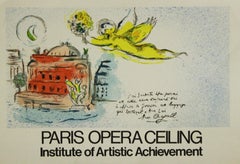
Paris Opera Ceiling - Institute of Artistic Achievement.
Located in Chesterfield, MI
Poster (provenance unknown). Measures 9 x 13 inches and is Unframed. Good Condition.
Category

Late 20th Century Prints and Multiples

Materials

Lithograph

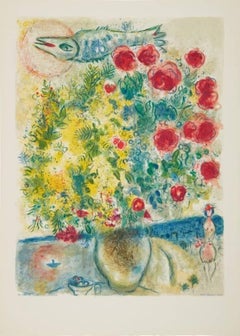
Roses et Mimosas (Roses and Mimosa)
Located in OPOLE, PL
Marc Chagall (1887-1985) - Roses et Mimosas (Roses and Mimosa) Lithograph from 1967. an unsigned proof, from the numbered edition of 150, on Arches paper. Dimensions of work: 73 x...
Category

1960s Modern Prints and Multiples

Materials

Lithograph

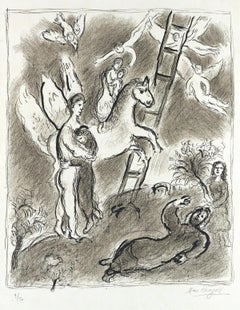
Scène Biblique
Located in New York, NY
A very good impression of this lithograph printed in gray and black. Signed and numbered in pencil by Chagall, from an edition of 50.
Category

1970s Expressionist Prints and Multiples

Materials

Lithograph

Sirène au Poète (Sirene with Poet)
Located in OPOLE, PL
Marc Chagall (1887-1985) - Sirène au Poète (Sirene with Poet) Lithograph from 1967. an unsigned proof, from the numbered edition of 150, on Arches paper. Dimensions of work: 73 x ...
Category

1960s Modern Prints and Multiples

Materials

Lithograph

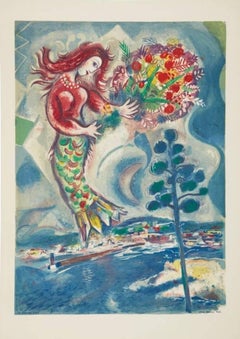
Sirène au pin (Sirene with Pine)
Located in OPOLE, PL
Marc Chagall (1887-1985) - Sirène au pin (Sirene with Pine) Lithograph from 1967. an unsigned proof, from the numbered edition of 150, on Arches paper. Dimensions of work: 73 x 52...
Category

1960s Modern Prints and Multiples

Materials

Lithograph

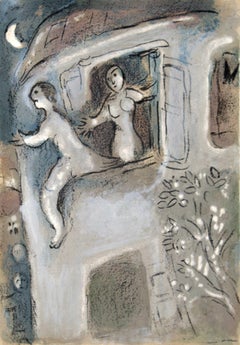
'David Saved by Michal' Lithograph from The Bible
Located in Philadelphia, PA
Marc Chagall David Saved by Michal From the rare limited edition Editions de la Revue VERVE, Paris The Bible Original double sided lithograph on paper 1956 Mint Condition
Category

1950s Prints and Multiples

Materials

Lithograph

XXᵉ Siècle - Hommage à Marc Chagall (20th Century - Homage to Marc Chagall)
Located in Milwaukee, WI
Framed 25.75 x 21.75 in No. 572 in the Catalogue Raisonne of Chagall's lithographs This lithograph came from "Homage to Marc Chagall" edited by G. di San Lazzaro. The lithograph wa...
Category

1960s Prints and Multiples

Materials

Lithograph

Le Sept Péchés Capitaux
Located in OPOLE, PL
Marc Chagall (1887-1985) - Le Sept Péchés Capitaux Etching from 1925. Edition of 300 proofs. Dimensions of work: 25 x 19.5 cm. Publisher: Tériade, Paris. Reference: Kornfeld 47....
Category

1920s Symbolist Prints and Multiples

Materials

Etching

Le Sept Péchés Capitaux
Located in OPOLE, PL
Marc Chagall (1887-1985) - Le Sept Péchés Capitaux Etching from 1925. Edition of 300 proofs. Dimensions of work: 25 x 19.5 cm. Publisher: Tériade, Paris. Reference: Kornfeld 47....
Category

1920s Symbolist Prints and Multiples

Materials

Etching

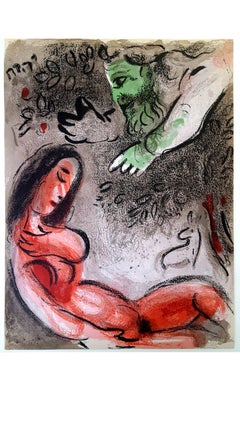
Marc Chagall - The Bible - Eve - Original Lithograph
Located in Collonge Bellerive, Geneve, CH
Marc Chagall, Original Lithograph depicting an instant of the Bible. Technique: Original lithograph in colours (Mourlot no. 234) On the reverse: another black and white original lith...
Category

1960s Modern Prints and Multiples

Materials

Lithograph

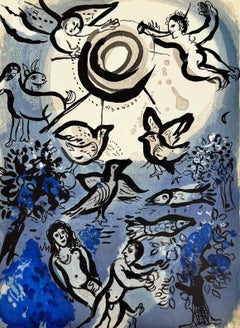
Creation
Located in OPOLE, PL
Marc Chagall (1887-1985) - Creation Lithograph from 1960. Dimensions of work: 35 x 26 cm Publisher: Tériade, Paris. The work is in Excellent condition. Fast and secure shipment.
Category

20th Century Modern Prints and Multiples

Materials

Lithograph

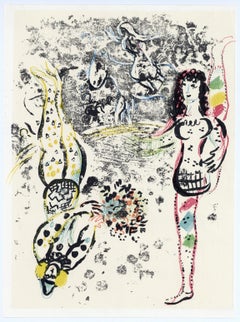
"Le jeu des acrobats" original lithograph
Located in Henderson, NV
Medium: original lithograph. The catalogue reference is Mourlot 401. Printed in 1963 at the Mourlot Freres atelier and published in the "Chagall Lithographe II" catalogue raisonne. S...
Category

1960s Prints and Multiples

Materials

Lithograph

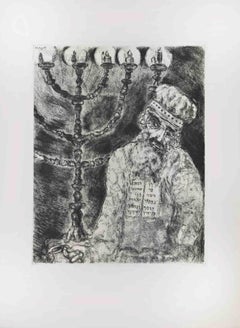
Aaron and the Menorah - Etching by Marc Chagall - 1956
Located in Roma, IT
Etching on Montval wove paper, realized by Marc Chagall in 1931-39 and published by Tériade in 1956. Belongs to the series "The Bible". Edition of 275+30 out of commerce copies. N...
Category

1950s Surrealist Prints and Multiples

Materials

Etching

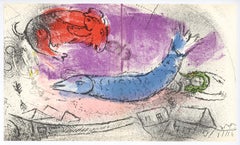
"Le poisson bleu" original lithograph
Located in Henderson, NV
Medium: original lithograph. Catalogue reference: Mourlot 198. Printed in 1957 at the Mourlot atelier and published in Paris by Maeght. This charming composition is one of the origin...
Category

1950s Prints and Multiples

Materials

Lithograph

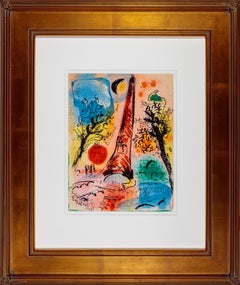
Vision de Paris (Vision of Paris)
Located in Milwaukee, WI
Framed 25.75 x 21.75 in No. 287 in the Catalogue Raisonne of Chagall's lithographs This lithograph came from "The Lithographs of Chagall: Volume I" by Fernand Mourlot and Marc Chag...
Category

1960s Prints and Multiples

Materials

Lithograph

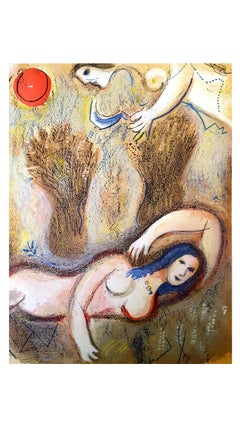
Marc Chagall - The Bible - Boaz wakes up and sees Ruth - Original Lithograph
Located in Collonge Bellerive, Geneve, CH
Marc Chagall, Original Lithograh depicting an instant of the Bible. Technique: Original lithograph in colours (Mourlot no. 234) On the reverse: another black and white original litho...
Category

1960s Modern Prints and Multiples

Materials

Lithograph

Lumiere du cirque (The Light of the Circus)
Located in OPOLE, PL
Marc Chagall (1887-1985) - Lumiere du cirque (The Light of the Circus) Lithograph from 1969. The edition of 41/50 on Arches paper. Dimensions of work: 50.5 x 67 cm. Hand signed. ...
Category

1960s Modern Prints and Multiples

Materials

Lithograph

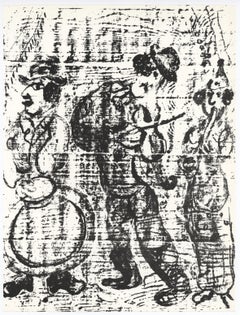
"Le musiciens vagabonds" original lithograph
Located in Henderson, NV
Medium: original lithograph. Printed in Paris in 1963 by the Mourlot Freres atelier. Size: 12 1/2 x 9 1/2 inches (320 x 240 mm). Not signed.
Category

1960s Prints and Multiples

Materials

Lithograph

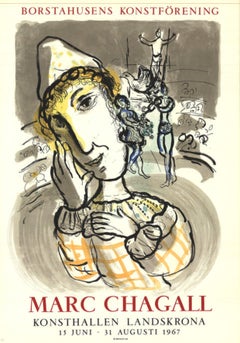
Circus with Yellow Clown By Marc Chagall
Located in Dubai, Dubai
Circus with Yellow Clown By Marc Chagall 1967 Medium: Lithograph Paper Size: 33 x 23 inches ( 84 x 58 cm ) Image Size: 26.25 x 20 inches ( 67 x 51 cm ) Edition Size: Unknown
Category

1960s Contemporary Prints and Multiples

Materials

Lithograph

Moses Sees the Sufferings of his People, from the suite, The Story of Exodus
Located in San Francisco, CA
This artwork Titled "Moses Sees the Sufferings of his People" 1966 from the suite " The Story of Exodus" is an original lithograph on Arches paper ...
Category

Mid-20th Century Modern Prints and Multiples

Materials

Lithograph

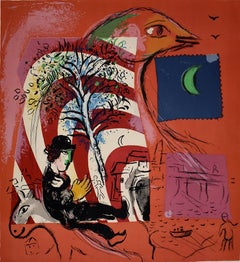
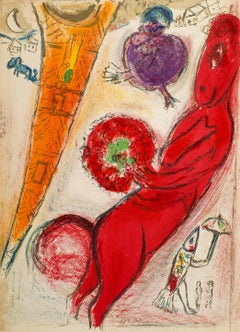
Marc Chagall, The Eiffel Tower and the Donkey, from Derriere le miroir, 1954
Located in Southampton, NY
This exquisite lithograph by Marc Chagall (1887–1985), titled La Tour Eiffel a l'Ane (The Eiffel Tower and the Donkey), from the folio Derriere le miroir, No. 67–68, originates from ...
Category

1950s Expressionist Prints and Multiples

Materials

Lithograph

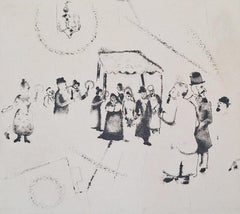
The Wedding, from: My Life Die Hochzeit: Mein Leben - Russian French Berlin
Located in London, GB
This original etching with drypoint is hand signed in pencil by the artist "Marc Chagall" at the lower right margin. It is also hand numbered 50/110 in pencil from the edition of 11...
Category

1920s Surrealist Prints and Multiples

Materials

Drypoint, Etching

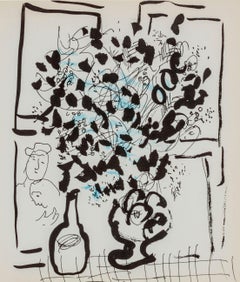
Le Bouquet noir et bleu (The black and blue bouquet)
Located in Milwaukee, WI
Framed 19 x 17.75 in No. 202 in the Catalogue Raisonne of Chagall's lithographs This lithograph was created by Chagall especially for this edition of the book "Chagall" by Jacques ...
Category

1950s Prints and Multiples

Materials

Lithograph

La Souris Metamorphosée en Fille (The Mouse Transformed into a Girl)
Located in OPOLE, PL
Marc Chagall (1887-1985) - La Souris Metamorphosée en Fille (The Mouse Transformed into a Girl) Etching from 1954. Edition of 85. Enhanced with watercolour by the artist. Dimensi...
Category

1950s Modern Prints and Multiples

Materials

Etching

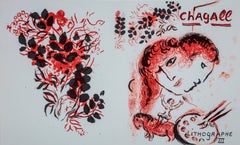
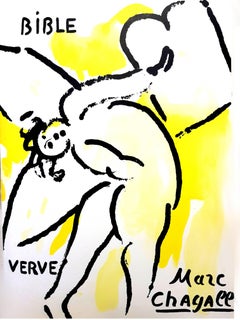
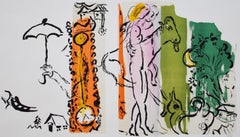
Couverture (Cover-jacket)
Located in Milwaukee, WI
Framed 25 x 33.25 in No. 577 in the Catalogue Raisonne of Chagall's lithographs This is the lithograph cover from Volume III of the Lithographs of Marc Chagall. Julien Cain, Boston...
Category

1960s Prints and Multiples

Materials

Lithograph

Marc Chagall - The Bible - Original Lithograph
Located in Collonge Bellerive, Geneve, CH
Marc Chagall, Original Lithograph depicting an instant of the Bible. Technique: Original lithograph in colours Year: 1956 Sizes: 35,5 x 26 cm / 14" x 10.2" (...
Category

1950s Modern Prints and Multiples

Materials

Lithograph

Le Cirque Fantastique - Etching by Marc Chagall - 1967
Located in Roma, IT
Etching and aquatint on Japan paper. Hand Signed and numbered. Edition of 16/35 prints. Excellent condition. Ref. Cramer, The Illustrated Books,, no. 2.
Category

1960s Surrealist Prints and Multiples

Materials

Etching

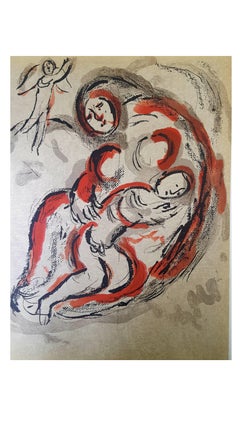
Marc Chagall - The Bible - Hagar in the Desert - Original Lithograph
Located in Collonge Bellerive, Geneve, CH
Marc Chagall, Original Lithograh depicting an instant of the Bible. Technique: Original lithograph in colours (Mourlot no. 234) On the reverse: another black and white original litho...
Category

1960s Modern Prints and Multiples

Materials

Lithograph

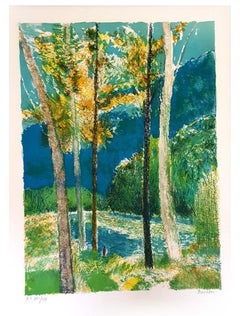
Guy Bardone - Original Handsigned Lithograph - Ecole de Paris
Located in Collonge Bellerive, Geneve, CH
Guy Bardone Original Handsigned Lithograph Dimensions: 76 x 54 cm Edition: HC XXI/XXX HandSigned and Numbered Ecole de Paris au seuil de la mutation des Arts Sentiers Editions Guy Bardone was one of the great painters of the “Ecole de Paris” and of the second mid twenty century. Guy Bardone French, (1927 - ) Guy Bardone Guy Bardone was born in 1927 in Saint-Claude, on of the most beautiful old towns in France. His vocation as a painter was confirmed after admission to the Ecole National Supérieure des Arts Decoratifs in Paris. Here he trained under Brianchon, Cavailles and Desnoyer. He was awarded the prestigious Prix Félix Fénéon in 1952 which set wider horizons and allowed him entry into the Paris arena. Guy Bardone est né en 1927 à Saint-Claude (Jura). Après des études à l'école des Beaux-Arts de Lyon, il entre à l'école supérieure des arts décoratifs où il reçoit les enseignements de Brianchon, Cavaillès et Desnoyers. En 1950, il rencontre le critique George Besson qui l'encourage et le conseille. En 1952, il obtient le Prix Félix Fénéon et commence à exposer dans divers salons et expositions de groupe. il est sélectionné en 1953 à la très importante expositions de groupe "célébrités et révélations de la peinture contemporaine...
Category

1960s Post-Impressionist Prints and Multiples

Materials

Lithograph

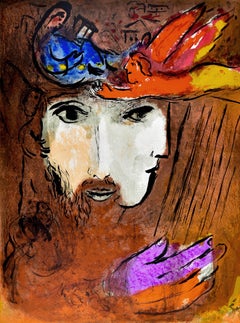
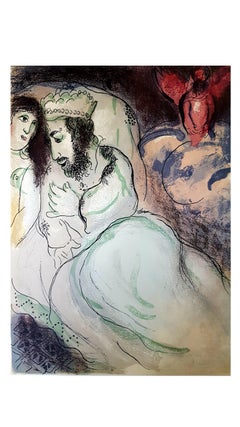
David and Bathsheba
Located in OPOLE, PL
Marc Chagall (1887-1985) - David and Bathsheba Original Lithograph from 1956. Dimensions of work: 35 x 26 cm. Publisher: Tériade, Paris. Reference: Mourlot 132. On the reverse: a...
Category

1950s Modern Prints and Multiples

Materials

Lithograph

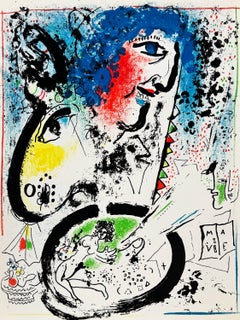
Self-Portrait
Located in OPOLE, PL
Marc Chagall (1887-1985) - Self-Portrait Original Lithograph from 1960. Dimensions of work: 32 x 24 cm. Publisher: Maeght Éditeur, Paris. The work is in Excellent condition.
Category

1960s Modern Prints and Multiples

Materials

Lithograph

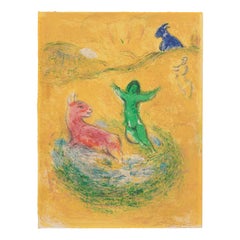
Le Piège à Loups
Located in New York, NY
Color lithograph, 1960. From the unsigned book edition of 250 (aside from the signed and numbered edition of 60). Printed by Mourlot, Paris. Published by Teriade, Paris. From "Da...
Category

1960s Modern Prints and Multiples

Materials

Lithograph, Color

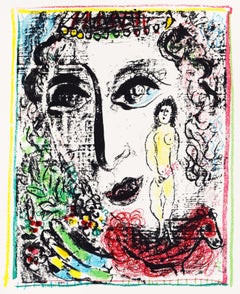
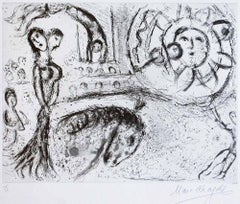
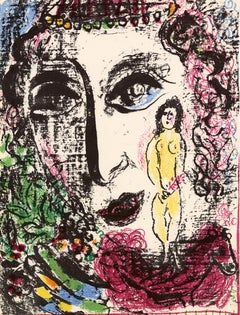
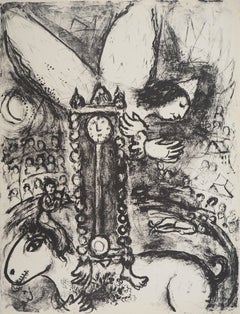
L'Apparition au Cirque (Apparition at the Circus)
Located in Milwaukee, WI
Framed 26 x 22 in No. 392 in the Catalogue Raisonne of Chagall's lithographs This lithograph came from "The Lithographs of Chagall: Volume II" by Fernand Mourlot and Marc Chagall....
Category

1960s Prints and Multiples

Materials

Lithograph

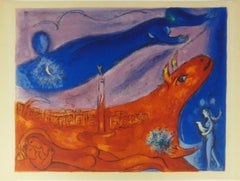
La Bastille (The Bastille)
Located in OPOLE, PL
Marc Chagall (1887-1985) - La Bastille (The Bastille) Lithograph from 1954. an unsigned proof, aside edition of 75 signed proofs. Dimensions of work: 76 x 51.5 cm. Publisher: Mae...
Category

1950s Symbolist Prints and Multiples

Materials

Lithograph

The Beloved of Jerusalem - Héliogravure by Marc Chagall - 1960
Located in Roma, IT
Héliogravure on brown-toned paper, no signature. Héliogravure  on bot sheets, recto and verso. Edition of 6500 unsigned copies. Printed by Mourlot and published by Tériade on the A...
Category

1960s Surrealist Prints and Multiples

Materials

Photogravure

Marc Chagall - The Bible - Sarah And Abimelech - Original Lithograph
Located in Collonge Bellerive, Geneve, CH
Marc Chagall, Original Lithograh depicting an instant of the Bible. Technique: Original lithograph in colours (Mourlot no. 234) On the reverse: another black and white original litho...
Category

1960s Modern Prints and Multiples

Materials

Lithograph

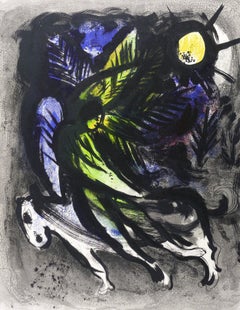
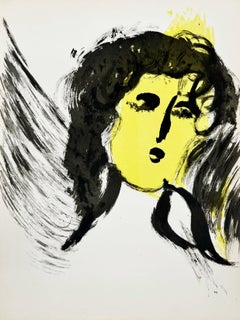
Marc Chagall, The Angel, from The Lithographs of Chagall, 1960
Located in Southampton, NY
This exquisite lithograph by Marc Chagall (1887–1985), titled L’Ange (The Angel), from the album The Lithographs of Chagall, Volume I, originates from the 1960 edition published by A...
Category

1960s Expressionist Prints and Multiples

Materials

Lithograph

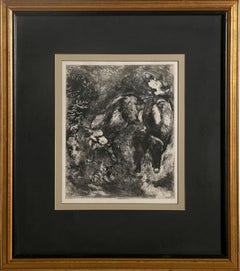
Les Deux Taureaux et une Grenouille, Modern Etching by Marc Chagall
Located in Long Island City, NY
Marc Chagall, Russian (1887 - 1985) - Les Deux Taureaux et une Grenouille, Portfolio: Des Fables De La Fontaine, Year: 1952, Medium: Etching on Japon Nacre, signed in the plate, E...
Category

1950s Modern Prints and Multiples

Materials

Etching

The Circus : a Breathtaking Spectacle - Original Lithograph (Mourlot #514)
Located in Paris, IDF
Marc Chagall (1887-1985) The Circus : a Breathtaking Spectacle, 1967 Original lithograph (Mourlot Workshop) On Arches vellum 42 x 32 cm (c. 17 x 13 in) REFERENCE : Catalog raiso...
Category

Mid-20th Century Modern Prints and Multiples

Materials

Lithograph

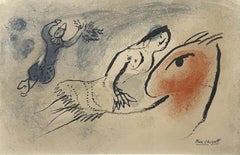
Carte de Voeux pour Aime Maeght
Located in Bournemouth, Dorset
Marc Chagall (1887-1985) Carte de Voeux pour Aime Maeght 1960 Lithograph in Arches paper Signed in stone Image: 22.2 x 29.5 cm Frame: 46.5 x 54.5cm Marc Chagall (1887 – 1985) Russi...
Category

1960s Modern Prints and Multiples

Materials

Lithograph

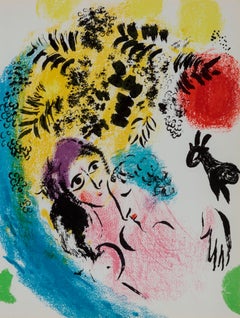
Les Amoureux au Soleil rouge (Lovers with red sun)
Located in Milwaukee, WI
Framed 26 x 22.75 in No. 285 in the Catalogue Raisonne of Chagall's lithographs This lithograph came from "The Lithographs of Chagall: Volume I" by Fernand Mourlot and Marc Chagal...
Category

1960s Prints and Multiples

Materials

Lithograph

Paysage aux Isbas, from: Jacques Lassaigne - French Russian
Located in London, GB
This lithograph in colours is hand signed in pencil by the artist “Marc Chagall” at the lower right margin. It is also numbered 25 in pencil from the deluxe edition of 90, at the low...
Category

1950s Surrealist Prints and Multiples

Materials

Lithograph

The Angel
Located in OPOLE, PL
Marc Chagall (1887-1985) - The Angel Original Lithograph from 1956. Dimensions of work: 35 x 26 cm. Publisher: Tériade, Paris. Reference: Mourlot 120. On the reverse: blank, as i...
Category

20th Century Modern Prints and Multiples

Materials

Lithograph

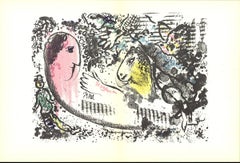
1969 Marc Chagall "Reverie"
Located in Brooklyn, NY
The artwork featured on pages 4 and 5 of Derrière le Miroir No. 182 (1969) by Marc Chagall is titled "Reverie". This double-page lithograph presents a dreamlike composition, reflecti...
Category

1960s Modern Prints and Multiples

Materials

Lithograph

Fine Art Prints for Sale — Animal Prints, Abstract Prints, Nude Prints and Other Prints

Decorating with fine art prints — whether they’re figurative prints, abstract prints or another variety — has always been a practical way of bringing a space to life as well as bringing works by an artist you love into your home.

Pursued in the 1960s and ’70s, largely by Pop artists drawn to its associations with mass production, advertising, packaging and seriality, as well as those challenging the primacy of the Abstract Expressionist brushstroke, printmaking was embraced in the 1980s by painters and conceptual artists ranging from David Salle and Elizabeth Murray to Adrian Piper and Sherrie Levine.

Printmaking is the transfer of an image from one surface to another. An artist takes a material like stone, metal, wood or wax, carves, incises, draws or otherwise marks it with an image, inks or paints it and then transfers the image to a piece of paper or other material.

Fine art prints are frequently confused with their more commercial counterparts. After all, our closest connection to the printed image is through mass-produced newspapers, magazines and books, and many people don’t realize that even though prints are editions, they start with an original image created by an artist with the intent of reproducing it in a small batch. Fine art prints are created in strictly limited editions — 20 or 30 or maybe 50 — and are always based on an image created specifically to be made into an edition.

Many people think of revered Dutch artist Rembrandt as a painter but may not know that he was a printmaker as well. His prints have been preserved in time along with the work of other celebrated printmakers such as Pablo Picasso, Salvador Dalí and Andy Warhol. These fine art prints are still highly sought after by collectors.

“It’s another tool in the artist’s toolbox, just like painting or sculpture or anything else that an artist uses in the service of mark making or expressing him- or herself,” says International Fine Print Dealers Association (IFPDA) vice president Betsy Senior, of New York’s Betsy Senior Fine Art, Inc.

Because artist’s editions tend to be more affordable and available than his or her unique works, they’re more accessible and can be a great opportunity to bring a variety of colors, textures and shapes into a space.

For tight corners, select small fine art prints as opposed to the oversized bold piece you’ll hang as a focal point in the dining area. But be careful not to choose something that is too big for your space. And feel free to lean into it if need be — not every work needs picture-hanging hooks. Leaning a larger fine art print against the wall behind a bookcase can add a stylish installation-type dynamic to your living room. (Read more about how to arrange wall art here.)

Find fine art prints for sale on 1stDibs today.

Still Thinking About These?

All Recently Viewed