Etching Nude Prints
to
75
413
140
106
22
14
Overall Width
to
Overall Height
to
194
166
148
27
10
10
8
5
3
2
67
30
28
27
24
7
17
610
75
10
23
32
67
12
21
98
178
33
13
4
493
193
6
552
399
337
203
178
131
127
84
66
25
15
12
8
8
7
7
7
7
6
6
944
709
458
183
150
61
225
361
288
Medium: Etching
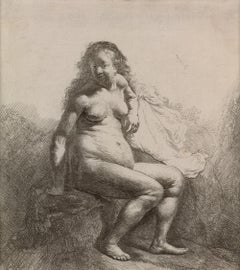
Naked Woman on a Mound by Rembrandt van Rijn
Located in New Orleans, LA
Rembrandt van Rijn
1606-1669 Dutch
Naked Woman on a Mound
Etching on paper
Etched by Rembrandt
New Hollstein 88, second state of II; Bartsch, Hollstein 198; Hind 43
One of the gr...
Category
17th Century Old Masters Etching Nude Prints
Materials
Etching
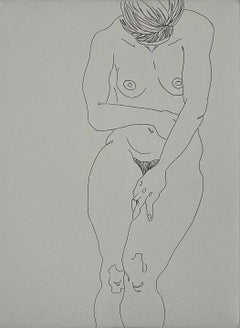
SLF IV (Single Line Female IV)
Located in Palm Springs, CA
Female nude etching, from a series of 6 male and 6 female images.
Reyes attended The School of the Art Institute of Chicago, where he received a Bachelor of Fine Arts degree in 19...
Category
21st Century and Contemporary Contemporary Etching Nude Prints
Materials
Etching
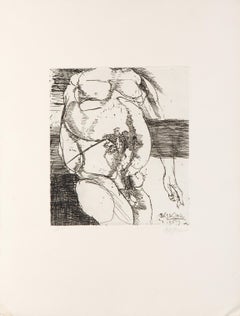
Torso, Nude Signed Etching by Leonard Baskin
Located in Long Island City, NY
Torso
Leonard Baskin, American (1922–2000)
Date: 1967
Etching, signed and numbered in pencil, dated in the plate
Edition of HP
Image Size: 10 x 8.75 inches
Size: 20 x 15 in. (50.8 x ...
Category
1960s Etching Nude Prints
Materials
Etching
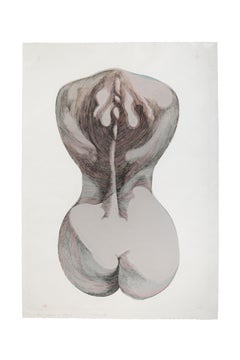
Nude from the Back - Silhouette VI - Original Etching by Giacomo Porzano - 1972
Located in Roma, IT
Image dimensions: 97 x 69.5 cm.
Silhouette VI is an original color etching realized by the Italian artist Giacomo Porzano (Lerici, 1925 - Rome, 2006) in 1972.
Hand-signed and dated...
Category
1970s Contemporary Etching Nude Prints
Materials
Etching
Nude Figure Study, Surrealist Etching and Aquatint by Martin Barooshian
Located in Long Island City, NY
Martin Barooshian, American (1929 - 2022) - Nude Figure Study, Year: circa 1979, Medium: Etching and Aquatint on Arches, signed in pencil, Image Size: 9.5 x 15.75 inches, Size: ...
Category
1970s Surrealist Etching Nude Prints
Materials
Etching, Aquatint
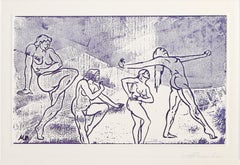
German Surrealist Hans Bellmer Etching Engraving Print Cecile Reims Surrealism
By Hans Bellmer
Located in Surfside, FL
After Hans Bellmer (German, 1902-1975)
Surrealist engraving, etching
after drawings from a 1942 notebook,
engraved in 1974-75 by Cecile Reims
Printed by L'Atelier de Chalcographie du Louvre, Paris,
Having printed monogram lower left in plate, pencil notations verso Editioned from a very small edition of #7/10 and 'Musee du Louvre' blindstamp.
Dimensions: Sheet 11 X 7.5, Plate size 6.5 X 4
Hans Bellmer ( 1902 – 1975) was a Polish born German artist, best known for his drawings, etchings that illustrates the 1940 edition of Histoire de l’œil, and the life-sized female sculpture mannequin dolls he produced in the mid-1930s. Historians of art and photography also consider him a Surrealist photographer.
Bellmer was born in the city of Kattowitz, then part of the German Empire (now Katowice, Poland). Up until 1926, he worked as a draftsman for his own advertising company.
Bellmer is most famous for the creation of a series of dolls as well as photographs of them. He was influenced in his choice of art form in part by reading the published letters of Oskar Kokoschka (Der Fetisch, 1925) and Surrealism. Bellmer's puppet doll project is also said to have been catalysed by a series of events in his personal life.
Hans Bellmer takes credit for provoking a physical crisis in his father and brings his own artistic creativity into association with childhood insubordination and resentment toward a severe and humorless paternal authority. Perhaps this is one reason for the nearly universal, unquestioning acceptance in the literature of Bellmer's promotion of his art as a struggle against his father, the police, and ultimately, fascism and the state. Events of his personal life also including meeting a beautiful teenage cousin in 1932 (and perhaps other unattainable beauties), attending a performance of Jacques Offenbach's Tales of Hoffmann (in which a man falls tragically in love with an automaton), and receiving a box of his old toys. After these events, he began to actually construct his first dolls. In his works, Bellmer explicitly sexualized the doll as a young girl (his work bears connection to the works of Bathus). Hirschfeld has claimed (without further argumentation) that Bellmer initiated his doll project to oppose the fascism of the Nazi Party by declaring that he would make no work that would support the new German state. Represented by mutated forms and unconventional poses, his dolls (according to this view) were directed specifically at the cult of the perfect body then prominent in Germany.
He visited Paris in 1935 and made contacts there, such as Paul Éluard, but returned to Berlin because his wife Margarete was dying of tuberculosis. He was part of the circle of Surrealist luminaries such as Man Ray, Marcel Duchamp, Max Ernst, Joan Miro, André Masson, René Magritte, Alberto Giacometti and Salvador Dali as well as women artists—such as Frida Kahlo, Dorothea Tanning and Leonora Carrington.
Bellmer produced the first doll in Berlin in 1933. Long since lost, the assemblage can nevertheless be correctly described thanks to approximately two dozen photographs Bellmer took at the time of its construction. Standing about fifty-six inches tall, the doll consisted of a modeled torso made of flax fiber, glue, and plaster; a mask-like head of the same material with glass eyes and a long, unkempt wig; and a pair of legs made from broomsticks or dowel rods. One of these legs terminated in a wooden, club-like foot; the other was encased in a more naturalistic plaster shell, jointed at the knee and ankle. As the project progressed, Bellmer made a second set of hollow plaster legs, with wooden ball joints for the doll's hips and knees. There were no arms to the first sculpture, but Bellmer did fashion or find a single wooden hand, which appears among the assortment of doll parts the artist documented in an untitled photograph of 1934, as well as in several photographs of later work.
Bellmer's 1934 anonymous book, The Doll (Die Puppe), produced and published privately in Germany, contains 10 black-and-white photographs of Bellmer's first doll arranged in a series of "tableaux vivants" (living pictures). The book was not credited to him, as he worked in isolation, and his photographs remained almost unknown in Germany. Yet Bellmer's work was eventually declared "degenerate" (entartete kunst) by the Nazi Party, and he was forced to flee Germany to France in 1938, where Bellmer's work was welcomed by the Surrealists around Andre Breton.
He aided the French Resistance during the war by making fake passports. He was imprisoned in the Camp des Milles prison at Aix-en-Provence, a brickworks camp for German nationals, from September 1939 until the end of the Phoney War in May 1940.
After the war, Bellmer lived the rest of his life in Paris. Bellmer gave up doll-making and spent the following decades creating erotic drawings, etchings, sexually explicit photographs, paintings, and prints of pubescent girls. In 1954, he met Unica Zürn...
Category
20th Century Etching Nude Prints
Materials
Etching
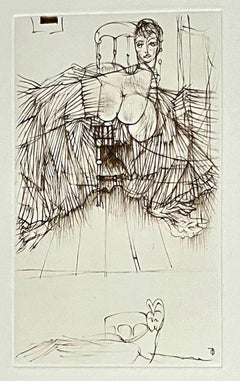
Woman from the Back - Original Etching by Giacomo Porzano - 1972
Located in Roma, IT
Woman from the Back is an etching on paper, realized by the Italian artist Giacomo Porzano (1925-2006).
Hand-signed on the lower right.
Numbered on the lower left. Edition of 50.
...
Category
1970s Contemporary Etching Nude Prints
Materials
Etching
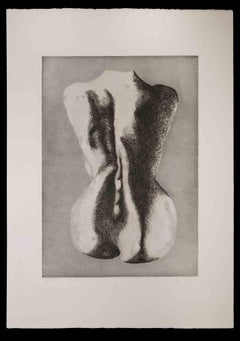
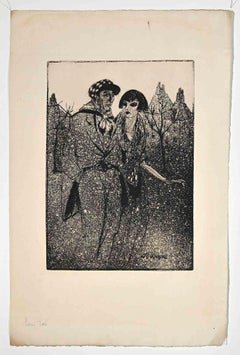
Nude - Etching by Edouard Chimot - 1930s
Located in Roma, IT
Nude is an etching realized by Edouard Chimot in the 1930s.
Signed on the plate by the artist on the lower right corner.
Good conditions.
Édouard Chimot (26 November 1880 – 7 June...
Category
1930s Modern Etching Nude Prints
Materials
Etching

$395 Sale Price
30% Off
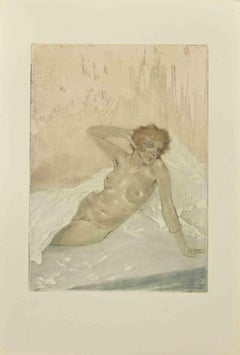
Woman from the Back - Original Etching by Giacomo Porzano - 1970s
Located in Roma, IT
Woman from the backis an etching on paper, realized by the Italian artist Giacomo Porzano (1925-2006).
Hand-signed on the lower right.
Numbered edition,10/20.
In good condition
...
Category
1970s Contemporary Etching Nude Prints
Materials
Etching
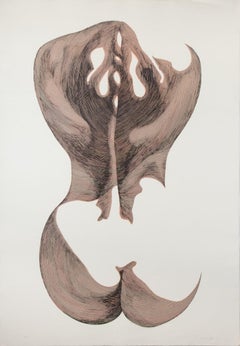
Sustris' Venuses - Contemporary Figurative Etching Print, Nude, Landscape
Located in Warsaw, PL
PAWEL ZABLOCKI (born in 1960)
Pawel Zablocki is a graduate of the Academy of Fine Arts in Cracow. He received his diploma in 1987. Between 1991 and 1998, Zablocki studied semiotics a...
Category
Early 2000s Contemporary Etching Nude Prints
Materials
Paper, Etching
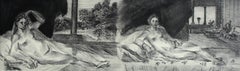
Nude - Etching by Edouard Chimot - 1930s
Located in Roma, IT
Nude is an etching realized by Edouard Chimot in the 1930s.
Signed on the plate by the artist on the lower right corner.
Good conditions.
Édouard Chimot (26 November 1880 – 7 June...
Category
1930s Modern Etching Nude Prints
Materials
Etching
$370 Sale Price
30% Off
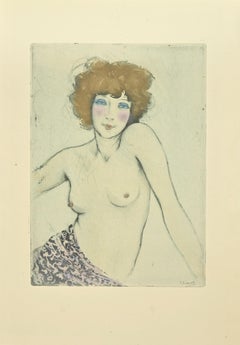
La femme au poisson, Surrealist Etching by Andre Masson
By André Masson
Located in Long Island City, NY
Andre Masson, French (1896 - 1987) - La femme au poisson, Year: 1972, Medium: Etching, signed in pencil, Image Size: 6 x 5.5 inches, Size: 12.5 x 11 in. (31.75 x 27.94 cm), Descript...
Category
1970s Surrealist Etching Nude Prints
Materials
Etching
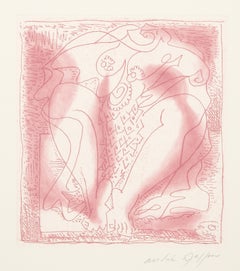
$720 Sale Price
20% Off
Couple - Original Etching by Louis Jou - Early 20th Century
By Louis Jou
Located in Roma, IT
Couple is an original etching realized by Louis Jou in the Early 20th Century.
Good conditions.
Specimen before the lettering.
Louis Jou (Gracia, 1882 - Baux, 1968), the twentieth-century etcher and wood engraver, was a prolific illustrator of a large number of books in France, authored by big names like Andre Gide...
Category
1920s Modern Etching Nude Prints
Materials
Etching
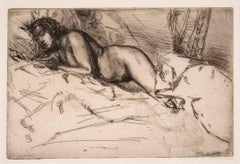
Venus
Located in New York, NY
James Whistler (1834-1903), Venus, 1859. Etching and drypoint, printed in black ink on laid paper, an impression in the second (final) state: there was no published edition. 6 x 9 inches (15 x 22.6 cm) sheet 73/8 x 117/8 inches (18.8 x 30.3 cm) Reference: Kennedy 59; Glasgow 60
A very fine impression.
A study of Héloïse, ‘Fumette’, asleep in bed, her head pressed into the pillow and the bedclothes covering her lower legs. This is one of three portraits Whistler made of Fumette in 1859: one of the others shows her standing and in the third only her head and shoulders are depicted. Venus is a work in the Realist tradition, and may be compared with Courbet’s nudes of the same period. The artist may also have had in mind Rembrandt’s study of Antiope in his etching Jupiter and Antiope.
Venus was never published and there is no record of it being shown until 1898 when it was included in an Exhibition of Etchings, Drypoints and Lithographs by Whistler at H. Wunderlich & Co., New York. To have been overlooked for exhibition until so late in Whistler’s life might suggest that the subject was considered improper. Frederick Wedmore, whose catalogue of Whistler’s etchings...
Category
1850s Impressionist Etching Nude Prints
Materials
Drypoint, Etching
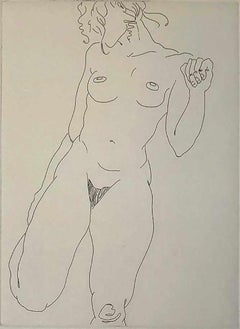
SLF V (Single Line Female V)
Located in Palm Springs, CA
Signed, titled and numbered by the artist. Edition of 50.
Female nude etching, from a series of 6 male and 6 female images.
Reyes attended The School of the Art Institute of Chica...
Category
21st Century and Contemporary Contemporary Etching Nude Prints
Materials
Etching
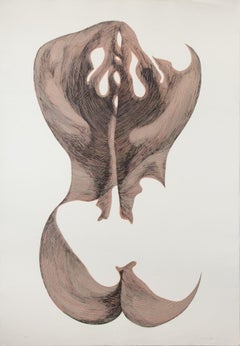
Price - Woman from Shouldes - Etching by Giacomo Porzano - 1970s
Located in Roma, IT
Woman from Shoulders is an etching on paper, realized by the Italian artist Giacomo Porzano (1925-2006).
Hand-signed on the lower right.
Numbered edition, 11/20.
In good condition...
Category
1970s Contemporary Etching Nude Prints
Materials
Etching
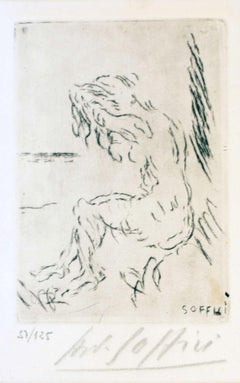
Nude on the Beach - Original Etching and Drypoint by A. Soffici - 1957
Located in Roma, IT
Hand signed. Very rare edition of 125 prints.
Good conditions.
This artwork is shipped from Italy. Under existing legislation, any artwork in Italy created over 70 years ago by an a...
Category
1950s Etching Nude Prints
Materials
Drypoint, Etching
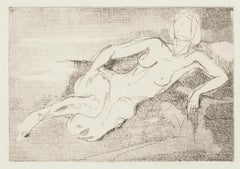
Nude - Etching - 1960s
Located in Roma, IT
Nude is an original etching realized by an Anonymous artist in the 1960s.
Sheet dimension: 32.5 x 25 cm; Image dimensions: 10 x 14.5 cm.
Very good conditions.
The artwork represe...
Category
1960s Etching Nude Prints
Materials
Etching, Aquatint
$230 Sale Price
30% Off
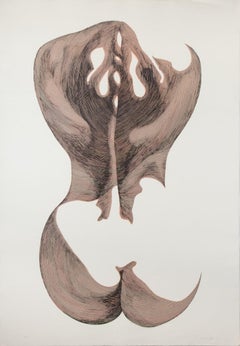
Woman from the Back - Etching by Giacomo Porzano - 1970s
Located in Roma, IT
Woman from Shoulders is an etching on paper, realized by the Italian artist Giacomo Porzano (1925-2006).
Hand-signed on the lower right.
Numbered edition, 2/20.
In good condition ...
Category
1970s Contemporary Etching Nude Prints
Materials
Etching
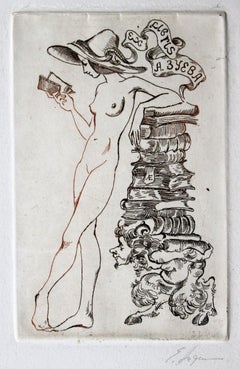
Ex Libris. Paper, etching, 11x7 cm
Located in Riga, LV
Ex Libris A. Zuyeva
Paper, etching, 11x7 cm
Category
1990s Jugendstil Etching Nude Prints
Materials
Paper, Etching
$169 Sale Price
20% Off
L'Espagne assassinée from Solidarité, Surrealist Etching by Andre Masson
By André Masson
Located in Long Island City, NY
Andre Masson, French (1896 - 1987) - L'Espagne assassinee from Solidarite, Year: 1938, Medium: Etching on wove paper, signed and numbered in pencil, Edition: 1/15, Image Size: 9.25 ...
Category
1930s Surrealist Etching Nude Prints
Materials
Etching
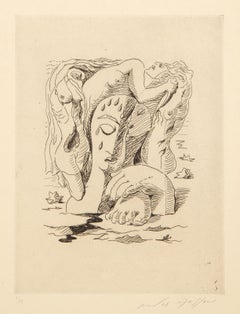
Chrysalides, Surrealist Etching by Andre Masson
By André Masson
Located in Long Island City, NY
Andre Masson, French (1896 - 1987) - Chrysalides, Year: Circa 1947, Medium: Etching and Aquatint on Arches, signed and numbered in pencil, Edition: EA, Image Size: 10 x 14 inches, S...
Category
1940s Surrealist Etching Nude Prints
Materials
Etching, Aquatint
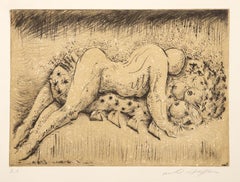
$1,200 Sale Price
20% Off
Woman Nude from the back - Etching by Giacomo Porzano - 1972
Located in Roma, IT
Limited edition of 66 prints, 50 in arab numbers and 16 in roman numbers, all hand signed and numbered.
Category
20th Century Etching Nude Prints
Materials
Etching
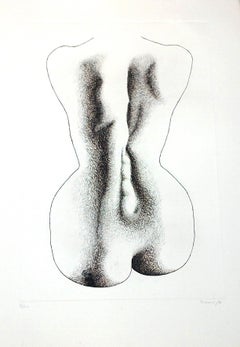
Nude II
Located in San Francisco, CA
This artwork "Nude II" 1982, is an original etching on Wove paper by noted American artist Charles Eckart, b.1935. It is hand signed and dated in pencil by the artist. The plate mark...
Category
21st Century and Contemporary Abstract Expressionist Etching Nude Prints
Materials
Etching

Cleopatre, Old Masters Heliogravure Etching by Marcantonio Raimondi
Located in Long Island City, NY
Marcantonio Raimondi, After by Amand Durand, Italian (1480 - 1534) - Cleopatre, Year: 1875, Medium: Heliogravure, Size: 4.75 x 7 in. (12.07 x 17.78 cm), Printer: Amand Durand, Des...
Category
1870s Old Masters Etching Nude Prints
Materials
Etching
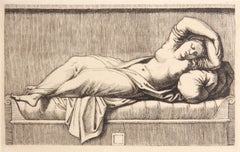
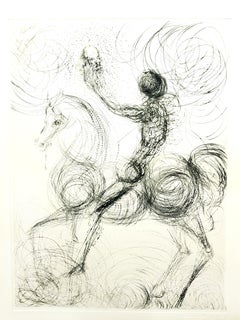
Salvador Dali - Knight & Death, from "Faust"
Located in Collonge Bellerive, Geneve, CH
Salvador Dali - "Knight & Death" from Faust - Original Etching
With embossed signature (from the standard book edition of 731)
Dimensions: 38,5 x 28,5 cm
1969
References : Field 69-1...
Category
1960s Surrealist Etching Nude Prints
Materials
Etching
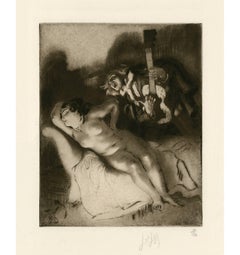
'The Serenade' — Fin-de-siècle French Romantic Eroticism
Located in Myrtle Beach, SC
Louis Legrand, 'The Serenade', soft-ground etching, drypoint, and aquatint, c. 1895, edition 20. Signed and numbered '9/20' in pencil. Annotated '20 proofs taken' in pencil, bottom l...
Category
1890s Post-Impressionist Etching Nude Prints
Materials
Drypoint, Etching, Aquatint
$960 Sale Price
20% Off
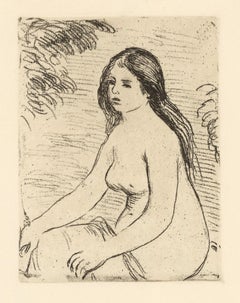
"Femme nue assise" original etching
Located in Henderson, NV
Medium: original soft ground etching. Catalogue reference: Delteil 12. Executed in 1906, this is a lifetime impression published in 1909 in Berlin by Cassirer for "Kunst und Kunstler...
Category
Early 1900s Impressionist Etching Nude Prints
Materials
Etching
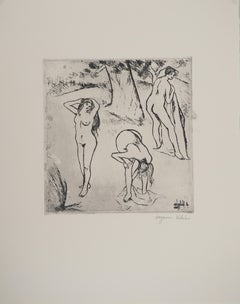
Naked Women Under the Trees - Original Etching Signed (Petrides #E9)
Located in Paris, IDF
Suzanne VALADON (1865-1938)
Naked Women Under the Trees, 1932
Original etching
Signed in pencil
On BFK Rives vellum 47 x 37 cm (c. 18.5 x 14.5 in)
INFORMATION : Printed in 1932, th...
Category
1930s Academic Etching Nude Prints
Materials
Etching
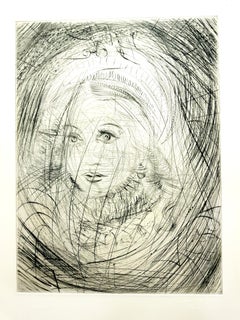
Salvador Dali - Marguerite - Original Etching
Located in Collonge Bellerive, Geneve, CH
Salvador Dali - Marguerite - Original Etching from "Faust" suite
Stamped signature, as issued
From the standard edition of 731
Edition number 7
Dimensions: 38,5 x 28,5 cm
Edition Arg...
Category
1960s Surrealist Etching Nude Prints
Materials
Etching
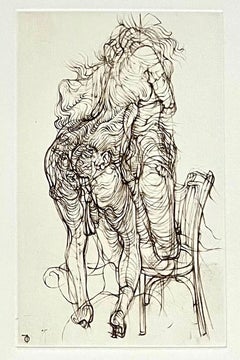
German Surrealist Hans Bellmer Etching Engraving Print Cecile Reims Surrealism
By Hans Bellmer
Located in Surfside, FL
After Hans Bellmer (German, 1902-1975)
Surrealist engraving, etching
after drawings from a 1942 notebook,
engraved in 1974-75 by Cecile Reims
Printed by L'Atelier de Chalcographie du Louvre, Paris,
Having printed monogram lower left in plate, pencil notations and #7/10 and 'Musee du Louvre' blindstamp verso
Dimensions: Sheet 11 X 7.5, Plate size 6.5 X 4
Hans Bellmer ( 1902 – 1975) was a Polish born German artist, best known for his drawings, etchings that illustrates the 1940 edition of Histoire de l’œil, and the life-sized female sculpture mannequin dolls he produced in the mid-1930s. Historians of art and photography also consider him a Surrealist photographer.
Bellmer was born in the city of Kattowitz, then part of the German Empire (now Katowice, Poland). Up until 1926, he worked as a draftsman for his own advertising company.
Bellmer is most famous for the creation of a series of dolls as well as photographs of them. He was influenced in his choice of art form in part by reading the published letters of Oskar Kokoschka (Der Fetisch, 1925) and Surrealism. Bellmer's puppet doll project is also said to have been catalysed by a series of events in his personal life.
Hans Bellmer takes credit for provoking a physical crisis in his father and brings his own artistic creativity into association with childhood insubordination and resentment toward a severe and humorless paternal authority. Perhaps this is one reason for the nearly universal, unquestioning acceptance in the literature of Bellmer's promotion of his art as a struggle against his father, the police, and ultimately, fascism and the state. Events of his personal life also including meeting a beautiful teenage cousin in 1932 (and perhaps other unattainable beauties), attending a performance of Jacques Offenbach's Tales of Hoffmann (in which a man falls tragically in love with an automaton), and receiving a box of his old toys. After these events, he began to actually construct his first dolls. In his works, Bellmer explicitly sexualized the doll as a young girl (his work bears connection to the works of Bathus). Hirschfeld has claimed (without further argumentation) that Bellmer initiated his doll project to oppose the fascism of the Nazi Party by declaring that he would make no work that would support the new German state. Represented by mutated forms and unconventional poses, his dolls (according to this view) were directed specifically at the cult of the perfect body then prominent in Germany.
He visited Paris in 1935 and made contacts there, such as Paul Éluard, but returned to Berlin because his wife Margarete was dying of tuberculosis. He was part of the circle of Surrealist luminaries such as Man Ray, Marcel Duchamp, Max Ernst, Joan Miro, André Masson, René Magritte, Alberto Giacometti and Salvador Dali as well as women artists—such as Frida Kahlo, Dorothea Tanning and Leonora Carrington.
Bellmer produced the first doll in Berlin in 1933. Long since lost, the assemblage can nevertheless be correctly described thanks to approximately two dozen photographs Bellmer took at the time of its construction. Standing about fifty-six inches tall, the doll consisted of a modeled torso made of flax fiber, glue, and plaster; a mask-like head of the same material with glass eyes and a long, unkempt wig; and a pair of legs made from broomsticks or dowel rods. One of these legs terminated in a wooden, club-like foot; the other was encased in a more naturalistic plaster shell, jointed at the knee and ankle. As the project progressed, Bellmer made a second set of hollow plaster legs, with wooden ball joints for the doll's hips and knees. There were no arms to the first sculpture, but Bellmer did fashion or find a single wooden hand, which appears among the assortment of doll parts the artist documented in an untitled photograph of 1934, as well as in several photographs of later work.
Bellmer's 1934 anonymous book, The Doll (Die Puppe), produced and published privately in Germany, contains 10 black-and-white photographs of Bellmer's first doll arranged in a series of "tableaux vivants" (living pictures). The book was not credited to him, as he worked in isolation, and his photographs remained almost unknown in Germany. Yet Bellmer's work was eventually declared "degenerate" (entartete kunst) by the Nazi Party, and he was forced to flee Germany to France in 1938, where Bellmer's work was welcomed by the Surrealists around Andre Breton.
He aided the French Resistance during the war by making fake passports. He was imprisoned in the Camp des Milles prison at Aix-en-Provence, a brickworks camp for German nationals, from September 1939 until the end of the Phoney War in May 1940.
After the war, Bellmer lived the rest of his life in Paris. Bellmer gave up doll-making and spent the following decades creating erotic drawings, etchings, sexually explicit photographs, paintings, and prints of pubescent girls. In 1954, he met Unica Zürn...
Category
20th Century Etching Nude Prints
Materials
Etching
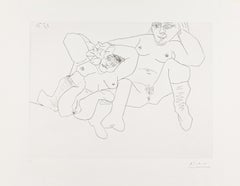
Untitled, 1971
Located in Wien, 9
- Plate 118 from the Suite 156
- edition 48/50
- stamp signature
- dated in the plate 17.5.71
- cat. raisonné Bloch 1973; cat. raisonné Baer 1982
Category
1970s Modern Etching Nude Prints
Materials
Drypoint, Etching
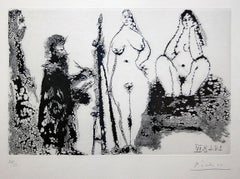
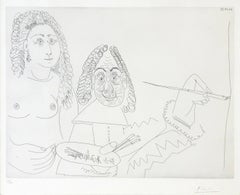
Peintre barbu en robe de chambre, avec deux femmes nues et un visiteur
Located in Aventura, FL
Peintre barbu en robe de chambre, avec deux femmes nues et un visiteur, from « 347 Series » Aquatint on paper. Hand signed and numbered by the artist. Bloch 1715. Edition of 50. ...
Category
1960s Cubist Etching Nude Prints
Materials
Paper, Aquatint
$18,800 Sale Price
20% Off
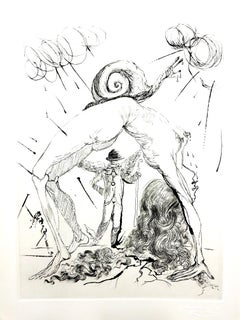
Salvador Dali - Nude with Snail
Located in Collonge Bellerive, Geneve, CH
Salvador Dali - Nude with Snail - Original Etching
Dimensions: 38 x 28 cm
Edition: 235
1967
embossed signature
On Arches Vellum
References : Field 67-10 (p. 34-35)
Category
1960s Surrealist Etching Nude Prints
Materials
Etching
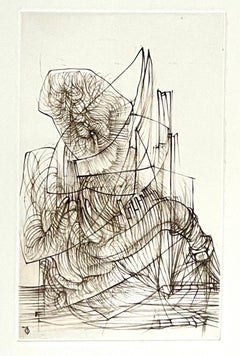
German Surrealist Hans Bellmer Etching Engraving Print Cecile Reims Surrealism
By Hans Bellmer
Located in Surfside, FL
After Hans Bellmer (German, 1902-1975)
Surrealist engraving, etching
after drawings from a 1942 notebook,
engraved in 1974-75 by Cecile Reims
Printed by L'Atelier de Chalcographie du Louvre, Paris,
Having printed monogram lower left in plate, pencil notations and #7/10 and 'Musee du Louvre' blindstamp verso
Dimensions: Sheet 11 X 7.5, Plate size 6.5 X 4
Hans Bellmer ( 1902 – 1975) was a Polish born German artist, best known for his drawings, etchings that illustrates the 1940 edition of Histoire de l’œil, and the life-sized female sculpture mannequin dolls he produced in the mid-1930s. Historians of art and photography also consider him a Surrealist photographer.
Bellmer was born in the city of Kattowitz, then part of the German Empire (now Katowice, Poland). Up until 1926, he worked as a draftsman for his own advertising company.
Bellmer is most famous for the creation of a series of dolls as well as photographs of them. He was influenced in his choice of art form in part by reading the published letters of Oskar Kokoschka (Der Fetisch, 1925) and Surrealism. Bellmer's puppet doll project is also said to have been catalysed by a series of events in his personal life.
Hans Bellmer takes credit for provoking a physical crisis in his father and brings his own artistic creativity into association with childhood insubordination and resentment toward a severe and humorless paternal authority. Perhaps this is one reason for the nearly universal, unquestioning acceptance in the literature of Bellmer's promotion of his art as a struggle against his father, the police, and ultimately, fascism and the state. Events of his personal life also including meeting a beautiful teenage cousin in 1932 (and perhaps other unattainable beauties), attending a performance of Jacques Offenbach's Tales of Hoffmann (in which a man falls tragically in love with an automaton), and receiving a box of his old toys. After these events, he began to actually construct his first dolls. In his works, Bellmer explicitly sexualized the doll as a young girl (his work bears connection to the works of Bathus). Hirschfeld has claimed (without further argumentation) that Bellmer initiated his doll project to oppose the fascism of the Nazi Party by declaring that he would make no work that would support the new German state. Represented by mutated forms and unconventional poses, his dolls (according to this view) were directed specifically at the cult of the perfect body then prominent in Germany.
He visited Paris in 1935 and made contacts there, such as Paul Éluard, but returned to Berlin because his wife Margarete was dying of tuberculosis. He was part of the circle of Surrealist luminaries such as Man Ray, Marcel Duchamp, Max Ernst, Joan Miro, André Masson, René Magritte, Alberto Giacometti and Salvador Dali as well as women artists—such as Frida Kahlo, Dorothea Tanning and Leonora Carrington.
Bellmer produced the first doll in Berlin in 1933. Long since lost, the assemblage can nevertheless be correctly described thanks to approximately two dozen photographs Bellmer took at the time of its construction. Standing about fifty-six inches tall, the doll consisted of a modeled torso made of flax fiber, glue, and plaster; a mask-like head of the same material with glass eyes and a long, unkempt wig; and a pair of legs made from broomsticks or dowel rods. One of these legs terminated in a wooden, club-like foot; the other was encased in a more naturalistic plaster shell, jointed at the knee and ankle. As the project progressed, Bellmer made a second set of hollow plaster legs, with wooden ball joints for the doll's hips and knees. There were no arms to the first sculpture, but Bellmer did fashion or find a single wooden hand, which appears among the assortment of doll parts the artist documented in an untitled photograph of 1934, as well as in several photographs of later work.
Bellmer's 1934 anonymous book, The Doll (Die Puppe), produced and published privately in Germany, contains 10 black-and-white photographs of Bellmer's first doll arranged in a series of "tableaux vivants" (living pictures). The book was not credited to him, as he worked in isolation, and his photographs remained almost unknown in Germany. Yet Bellmer's work was eventually declared "degenerate" (entartete kunst) by the Nazi Party, and he was forced to flee Germany to France in 1938, where Bellmer's work was welcomed by the Surrealists around Andre Breton.
He aided the French Resistance during the war by making fake passports. He was imprisoned in the Camp des Milles prison at Aix-en-Provence, a brickworks camp for German nationals, from September 1939 until the end of the Phoney War in May 1940.
After the war, Bellmer lived the rest of his life in Paris. Bellmer gave up doll-making and spent the following decades creating erotic drawings, etchings, sexually explicit photographs, paintings, and prints of pubescent girls. In 1954, he met Unica Zürn...
Category
20th Century Etching Nude Prints
Materials
Etching
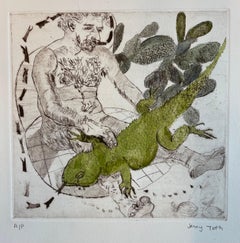
Lizard Tongues and Tears, nude male and lizard, mostly monochromatic w green
By Jenny Toth
Located in Brooklyn, NY
The image is 8 x 8 inches, and the paper it is printed on is 15 x 13.5 inches. This is a quirky and tender image of a naked man sitting on the floor holding a giant iguana on his la...
Category
2010s Feminist Etching Nude Prints
Materials
Paper, Ink, Etching, Watercolor
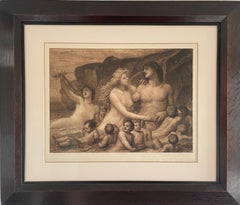
A Greek Idyll - Proof Etching by Robert Walker MacBeth after G F Watts
Located in London, GB
ROBERT WALKER MACBETH
(British 1848-1910)
After GEORGE FREDERIC WATTS
(British 1817-1904)
A Greek Idyll
Proof etching
Signed in pencil by both the artist l.l. and engraver l.r.
Framed
Plate size 42 by 54 cm., 16 ½ by 21 ¼ in.
(frame size 72.5 by 85 cm., 28 ½ by 33 ½ in.)
After Watt’s 1894 painting...
Category
Early 1900s Pre-Raphaelite Etching Nude Prints
Materials
Etching
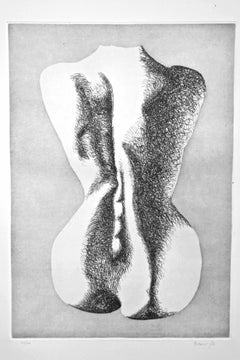
Nude from the Back - Etching by Giacomo Porzano - 1972
Located in Roma, IT
This original print is hand signed. This is an edition of 50 pieces plus 16 pieces in Roman Numbers.
Giacomo Porzano (1925 – 2006) was an Italian painter. He lived and worked in Rome. He exhibited his art in many private and public galleries, both in Italy and abroad. In 1968, he participated in the Venice Biennial. The most important art critics and magazines wrote about him.
Prints are the most affordable and reasonably priced artworks...
Category
1970s Contemporary Etching Nude Prints
Materials
Etching
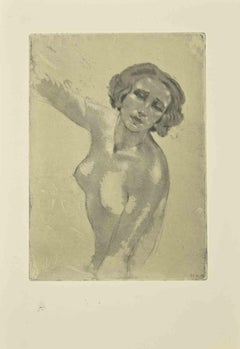
Nude - Etching by Edouard Chimot - 1930s
Located in Roma, IT
Nude is an etching realized by Edouard Chimot in the 1930s.
Signed on the plate by the artist on the lower right corner.
Good conditions.
Édouard Chimot (26 November 1880 – 7 June...
Category
1930s Modern Etching Nude Prints
Materials
Etching
$378 Sale Price
30% Off
Confidences /// Antique Modern Etching Figurative Nude Girls Impressionist Print
By Emil Fuchs
Located in Saint Augustine, FL
Artist: Emil Fuchs (Austrian, 1866-1929)
Title: "Confidences"
*Signed by Fuchs in pencil lower right. It is also signed in the plate (printed signature) lower left
Circa: 1920
Medium...
Category
1920s Modern Etching Nude Prints
Materials
Drypoint, Etching, Intaglio
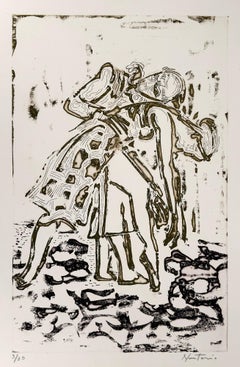
The Couple
Located in Middletown, NY
Milan: c1970.
Aquatint in colors on white wove paper with an unknown watermark, 19 1/2 x 12 1/2 inches (495 x 317 mm); sheet 20 x 24 1/4 inches (508 x 615 mm), full margins. Signed ...
Category
Mid-20th Century Modern Etching Nude Prints
Materials
Aquatint
Shakespeare & Company
Located in Middletown, NY
Milan: c1970.
Aquatint in colors on white wove paper with an unknown watermark, 19 1/2 x 12 1/2 inches (495 x 317 mm); sheet 20 x 24 1/4 inches (508 x 615 mm), full margins. Signed,...
Category
Mid-20th Century Modern Etching Nude Prints
Materials
Aquatint
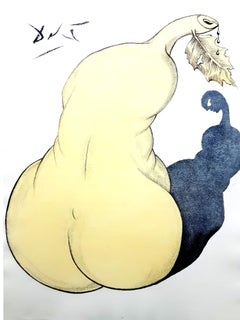
Salvador Dali - Pear and Nude Back
Located in Collonge Bellerive, Geneve, CH
Salvador Dali - Pear and Nude Back - Original Etching
Dimensions: 38 x 28 cm
Edition: 272/390
1967
On Rives Vellum
References : Field 67-4 (p. 32-33) / Michler & Lopsinger 174 to 187.
Category
1960s Surrealist Etching Nude Prints
Materials
Etching
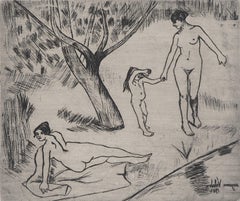
Women and Children by the River - Original Etching Signed (Petrides #E6)
Located in Paris, IDF
Suzanne VALADON (1865-1938)
Women and Children by the River, 1932
Original etching
Signed in pencil
On BFK Rives vellum 47 x 37 cm (c. 18.5 x 14.5 in)
INFORMATION : Printed in 1932...
Category
1930s Academic Etching Nude Prints
Materials
Etching
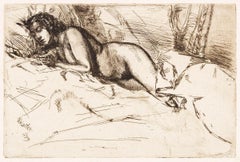
Venus
Located in New York, NY
A brilliant, richly-inked impression of this etching and drypoint printed in dark brownish black on antique cream laid paper with very strong contrasts....
Category
1850s Impressionist Etching Nude Prints
Materials
Drypoint, Etching
Salvador Dali - Nude, Horse and Death
Located in Collonge Bellerive, Geneve, CH
Salvador Dali - Nude, Horse and Death - Original Etching
Dimensions: 38 x 28 cm
Edition: 235
1967
embossed signature
On Arches Vellum
References : Field 67-10 (p. 34-35)
Category
1960s Surrealist Etching Nude Prints
Materials
Etching
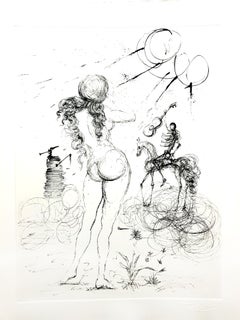
Nude Crouching Woman - Original Etching Signed (Petrides #E3)
Located in Paris, IDF
Suzanne VALADON (1865-1938)
Nude Crouching Woman, 1932
Original etching
Signed in the plate
On BFK Rives vellum 15 x 15 cm (c. 5.9 x 5.9 in)
INFORMATION : Printed in 1932, this etc...
Category
1930s Academic Etching Nude Prints
Materials
Etching
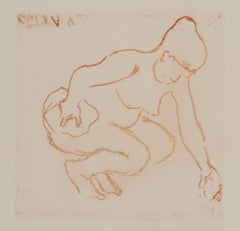
Nude - Etching by Carlo Marcantonio - 1970s
Located in Roma, IT
Nude is an etching on paper realized by Carlo Marcantonio.
Hand-signed in the lower right in pencil.
Good conditions.
Edition of 50.
Category
1970s Contemporary Etching Nude Prints
Materials
Etching
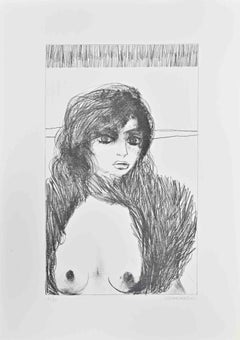
Monica Nude with Matisse
Located in New York, NY
A very good impression of this etching and aquatint. Signed 75/75 in pencil by Wesselmann.
Category
1990s Modern Etching Nude Prints
Materials
Etching, Aquatint
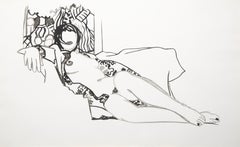
347 SERIES (BLOCH 1502)
Located in Aventura, FL
Etching on paper. Hand signed and numbered by the artist. From the 347 series. Bloch 1502. Edition of 50. Sheet size: 18 x 22 inches. Image size 12.375 x 16.375 inches. Frame si...
Category
1960s Cubist Etching Nude Prints
Materials
Paper, Etching
$14,400 Sale Price
20% Off
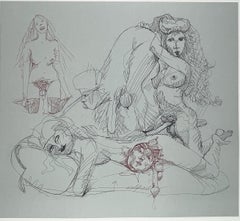
Four Figures and a Head, on Giant Phallus by Claes Oldenburg erotic nude scene
Located in New York, NY
This sensuous and playful scene is characteristic of Oldenburg’s printmaking ouevre: a veritable heap of women displaying various expressions of joy and come-hither coquettishness. T...
Category
1970s Modern Etching Nude Prints
Materials
Etching
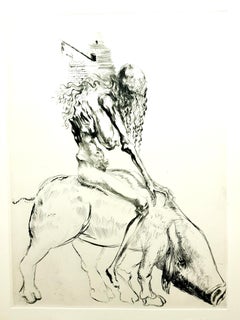
Salvador Dali - Baubo (Woman Riding a Sow), from Faust - Original Etching
Located in Collonge Bellerive, Geneve, CH
Salvador Dali - Baubo (Woman Riding a Sow), from Faust
Embossed signature (from the standard book edition of 731)
Dimensions: 38,5 x 28,5 cm
1969
References : Field 69-1 B / Michler ...
Category
1960s Surrealist Etching Nude Prints
Materials
Etching
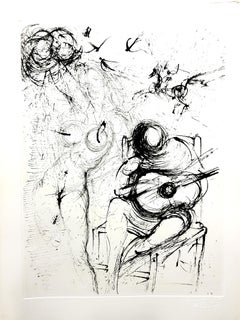
Salvador Dali - Nude with Guitar - Original Etching
Located in Collonge Bellerive, Geneve, CH
Salvador Dali - Nude with Guitar - Original Etching
Dimensions: 38 x 28 cm
Edition: 235
1967
embossed signature
On Arches Vellum
References : Field 67-10 (p. 34-35)
Category
1960s Surrealist Etching Nude Prints
Materials
Etching
Salvador Dali - Oysters and Nude
Located in Collonge Bellerive, Geneve, CH
Salvador Dali - Oysters and Nude - Original Etching
Dimensions: 38 x 28 cm
Edition: 390
1967
On Rives Vellum
References : Field 67-4 (p. 32-33) / Michler & Lopsinger 174 to 187.
Category
1960s Surrealist Etching Nude Prints
Materials
Etching
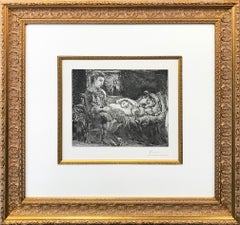
GARCON ET DORMEUSE A LA CHANDELLE (BLOCH 226)
Located in Aventura, FL
Plate 26 from La Suite Vollard. Bloch 226. Baer 440. Etching, engraving and aquatint, on Montval paper. Signed in pencil, from the edition of 260 (there was also an edition of 50 wit...
Category
1930s Cubist Etching Nude Prints
Materials
Paper, Etching, Engraving, Aquatint
$39,600 Sale Price
43% Off
Frontal Nude, Right Leg Folded Nu de face, jambe droite repliée, 1929
Located in London, GB
HENRI MATISSE 1869-1954
(Emile Benoît)
Le Cateau-Cambrésis 1869-1954 Nice (French)
Title: Frontal Nude, Right Leg Folded Nu de face, jambe droite repliée, 1929
Technique: Original...
Category
1920s Impressionist Etching Nude Prints
Materials
Etching
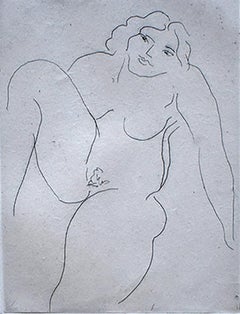
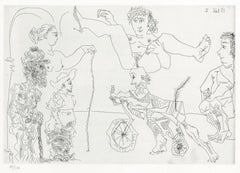
Plate V, Le Cocu Magnifique
Located in Fairlawn, OH
Plate V, Le Cocu Magnifique
Etching, 1968
Unsigned
From the unsigned edition of 200 impressions printed on Rives BFK paper
There is also a signed edition of 30 impressions
The set of...
Category
1960s Modern Etching Nude Prints
Materials
Etching
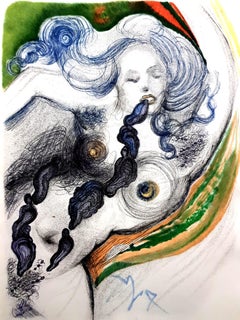
Salvador Dali - David Ben Gurion - Original Handsigned Etching
Located in Collonge Bellerive, Geneve, CH
Salvador Dali - David Ben Gurion - Original Handsigned Etching
Dimensions: 38 x 28 cm
1968
Signed in pencil
EA in Sanguine
Jean Schneider, Basel
References ...
Category
1960s Surrealist Etching Nude Prints
Materials
Etching
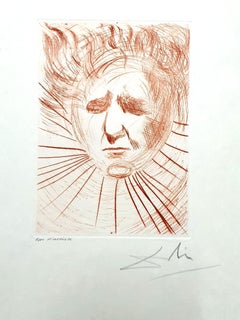
Salvador Dali - King Marc
Located in Collonge Bellerive, Geneve, CH
Salvador Dali - King Marc - Original Etching
Dimensions: 45 x 33 cm
Edition: 125
1970
Signed in pencil.
On Arches Vellum
References : Field 70-10 (p. 60-61)
Category
1970s Surrealist Etching Nude Prints
Materials
Etching
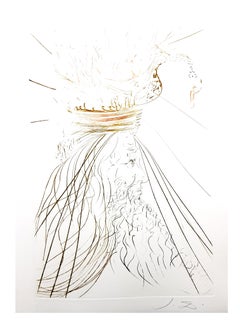
'Surreal Boudoir', San Francisco Bay Area Modernist, Atelier 63 Woman Artist
Located in Santa Cruz, CA
Created circa 1975 and stamped, verso, with certification of authenticity for Jane Voitle Mellin (American, born 1952).
Paper dimensions: 17.25 x 12 inches
An atmospheric, sugar-lift aquatint showing a young woman seated at a claw foot table...
Category
1970s Etching Nude Prints
Materials
Paper, Aquatint
Etching nude prints for sale on 1stDibs.
Find a wide variety of authentic Etching nude prints available on 1stDibs. While artists have worked in this medium across a range of time periods, art made with this material during the 21st Century is especially popular. If you’re looking to add nude prints created with this material to introduce a provocative pop of color and texture to an otherwise neutral space in your home, the works available on 1stDibs include elements of blue, yellow, orange and other colors. There are many well-known artists whose body of work includes ceramic sculptures. Popular artists on 1stDibs associated with pieces like this include Salvador Dalí, Jean-Baptiste Valadie, Leo Guida, and Pablo Picasso. Frequently made by artists working in the Modern, Contemporary, all of these pieces for sale are unique and many will draw the attention of guests in your home. Not every interior allows for large Etching nude prints, so small editions measuring 0.04 inches across are also available Prices for nude prints made by famous or emerging artists can differ depending on medium, time period and other attributes. On 1stDibs, the price for these items starts at $11 and tops out at $1,500,000, while the average work can sell for $852.