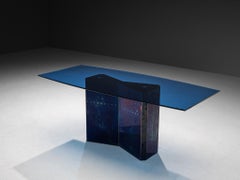
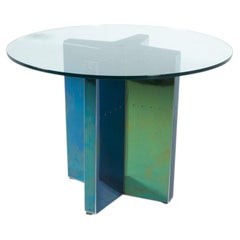
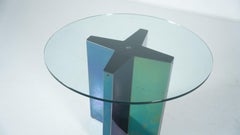
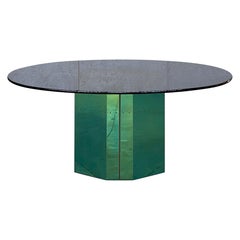
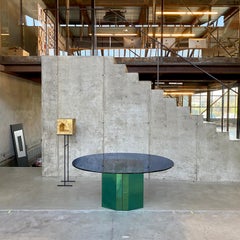
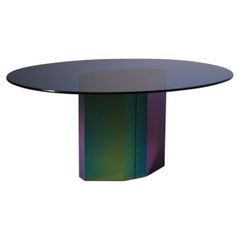
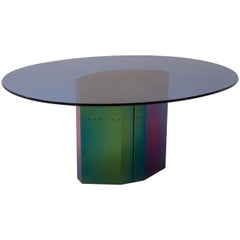
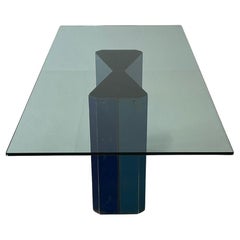
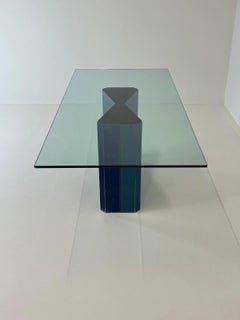
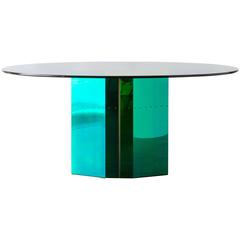
Widely recognized as superstars of postmodern Italian design, husband-and-wife team Afra and Tobia Scarpa (1937–2011; b. 1935) collaboratively created chairs, sofas and other furniture that work equally well in both traditional and cutting-edge environments.
Ranging from architecture and interior design to furniture and clothing, the Scarpas’ practice from its beginnings in the mid-1950s to the 21st century has included a diverse scope of projects combining new technology with thoughtful function and sculptural yet simple forms.
Afra Bianchin and Tobia Scarpa met as architecture students at the Università Iuav di Venezia. In a class led by architect and furniture designer Franco Albini, they created their first collaborative piece, the Pigreco armchair, later produced with Gavina. After graduating in 1957, Tobia worked for Murano glass company Venini & Co. before the couple opened a studio in Afra’s hometown, Montebelluna, in 1960. (Tobia, the son of famed glass artist and architect Carlo Scarpa, was born in Venice.)
For Afra and Tobia, a close collaborative process was pivotal to the success of their designs. The duo was also prolific — they designed for the most influential European manufacturers, including B&B Italia, Cassina, Knoll and FLOS. With respect to the latter, Afra and Tobia were among the legendary Italian lighting maker’s earliest collaborators, and their pioneering designs for the brand included the Papillon lamp, one of the first fixtures to use halogen technology. Their most recognized designs include the Bastiano sofa (1962), the Vanessa bed (1959), the Coronado sofa (1966) and the Soriana seating collection (1970). Work on the Soriana sofa began in late 1969 for an early 1970 debut, and it feels as radical today as it did in its heyday.
Architecture was also a central part of Afra and Tobia’s practice, which spanned residential buildings and factories for Italian companies such as Benetton. Their commissions for the global fashion brand included numerous industrial projects, from textile plants to storefronts. By 1985, Afra and Tobia Scarpa’s work was celebrated in a 30-year retrospective at Center Four in Queens, New York. Looking around the 30,000-square-foot exhibition space, Afra joked to the New York Times, “Seeing all those things makes us feel very tired, and now we feel that maybe we worked too much.”
It was not too much for their legacy, as Afra and Tobia Scarpa’s work continues to inspire new generations. Scarpa designs are in collections at the Louvre, the Museum of Modern Art and the Victoria and Albert Museum. The couple was awarded the Compasso d’Oro in 1970 for the Soriana armchair.
Find vintage Afra & Tobia Scarpa lounge chairs, dining chairs, floor lamps and other furniture today on 1stDibs.
Antique and vintage dining room tables have long been the anchor of the home's most social room. The round pedestal and long banquet forms most collected today trace back to the 18th and 19th centuries, when the dining room itself first came into fashion.
Styles to Know
Round and oval tables suit smaller or open-plan rooms, while rectangular pedestal and trestle tables remain the standard for larger, more formal spaces. A credenza adds extra serving storage nearby, and a vintage wall mirror overhead opens up the room. For layout ideas, browse 20 dining rooms arranged for entertaining.
How to Choose the Right Vintage Dining Table
A dining table is usually the largest piece in the room, which makes delivery details worth confirming: White Glove service, disassembly options, and the table's full length, leaves included, measured against the space you have. Every table comes from a vetted 1stDibs seller, with era, designer and condition detailed, backed by the 1stDibs Promise.