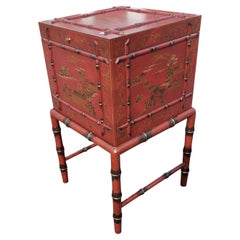
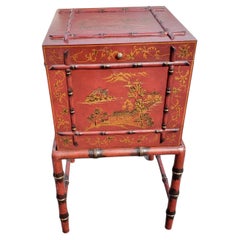
Emerging in the 17th century, chinoiserie appropriated the aesthetics and imagery of popular East Asian design for European-made versions. Reflecting the exoticization of China, Japan and other countries in this era, the word directly translates from French to “Chinese-esque,” which reveals its shortcomings as a style of furniture and decor that often stereotypically and reductively mimics Asian culture rather than showcasing and paying tribute to its artistic traditions.
The enthusiastically decorative chinoiserie style was propelled by influential tastemakers including French King Louis XIV, whose Trianon de Porcelaine in 1670 was inspired by Chinese architecture. Expanded trade between the East and West led to a demand for porcelain, lacquer objects, silk and other goods, which further informed the fanciful furniture being crafted in Europe.
Artisans working in the chinoiserie style used materials and elements like pagoda shapes, bamboo, lacquer surfaces, bird and flower motifs and other interpretations of Asian design on pieces that were frequently set against vibrant wallcoverings. This whimsical approach yielded chinoiserie furniture that boasted dramatic flourishes drawing on the natural world and reflected the dominance of Rococo during the 18th century.
As chinoiserie was shaped by approximations of Asian design by European creators, it had regional variations, such as Chinese Chippendale in England where cabinets, chairs and tea tables had wooden fretwork designs and “japanned” surfaces intended to resemble lacquer work that was created in East Asia. In North America, furniture makers in Boston and New York integrated chinoiserie-painted scenes into Queen Anne furniture.
Antique chinoiserie furniture has continued to be fashionable, from its popularity with decorators of the Hollywood Regency era — James Mont, Tommi Parzinger, William Haines and Samuel Marx favored the style — to contemporary interior designers, although it brings with it a complex history.
Find a collection of chinoiserie bedroom furniture, cabinets, decorative objects and more on 1stDibs.
Bamboo — the reed-like, woody grass revered the world over for its attractiveness, durability and unbeatable versatility — has a purity and elegance that Ming Dynasty dignitaries, European royals and workaday folks alike have appreciated for centuries. Antique and vintage bamboo furniture can help introduce an air of relaxation in any space, and pairs well with chinoiserie decor and a range of porcelain decorative objects.
So why is bamboo — in its many forms — so enduringly popular? The grass itself is classic-looking and pleasingly geometric, and it evokes a subtle exoticism that’s both glamorous and (due in large part to its sustainability) highly attainable.
Bamboo is harder than mahogany. It’s a rigid and hollow reed, and as such it is not rattan, which is dense, steamable and bendable, and has become its own ultimate decorative-arts chameleon over the years. But like rattan, bamboo is an organic material that provides a link to nature, helping us to bring a bit of the outside in, in an elegant yet no-frills way that seems comforting and familiar. Plus, bamboo’s lightness and slight irregularities make it the perfect counterpoint to heavy-feeling interiors.
For organic modern interiors — or any space that would benefit from a dose of the natural world — a variety of vintage bamboo outdoor furniture, side tables, dining chairs and more can be found on 1stDibs.
Antique and vintage blanket chests go by many names. You may have heard them called hope chests, dowry chests or Lane cedar chests, with the latter referring to the now-famous case pieces manufactured by the Lane Furniture company.
No matter the name, these were initially large crude wooden boxes with hinged lids where you stowed away your blankets, household linens and possibly some valuables. Everyone can always use a bit more storage in our bedrooms or guest bedrooms, and blanket chests can be a stylish solution to help you stay organized, particularly if you’re short on closet space.
Blanket storage trunks are still typically equipped with hinges on their lids for easy access to their large storage capacity. They’re often rectangular pieces, but in the hands of today’s furniture designers, contemporary blanket chests take on many shapes and are made of varying materials. Most antique blanket chests are made out of wood, from rich mahogany to oak.
Find a wide range of antique, new and vintage blanket chests available for sale on 1stDibs.