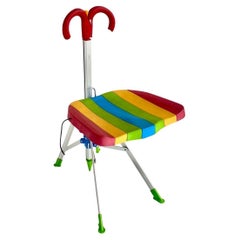
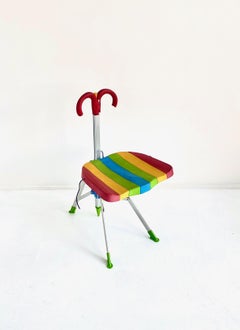
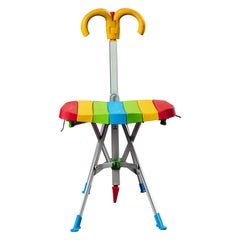
Gaetano Pesce was of a generation of Italian architects who in the early 1960s rebelled against the industrial perfection of modernism by conceiving new furniture and objects that were at once expressive and eccentric in form; or you might say they were more like art than functionalist design.
Born in the picturesque coastal Italian city of La Spezia in 1939, Pesce was a precocious talent who could have forged a career as an artist but opted instead to go to Venice to study architecture because, as he has said, it was “the most complex of all the arts.” Rather than having new worlds opened to him at design school, however, Pesce found the rationalist curriculum oppressive in its insistence on standardization and prescribed materials and technologies.
Pesce wanted to explore the latest of both materials and technologies to create objects and buildings never before imagined, with what he called “personalities” that spoke to the issues of the day. He was keen to examine ways to diversify mass production so that each manufactured work could be distinct.
In 1964, Pesce met Cesare Cassina, of the forward-looking furniture company C&B Italia in Milan (now known as B&B Italia), for whom he would create many important designs, beginning with a collection of what he called “transformational furniture” — two chairs and a loveseat — made entirely out of high-density polyurethane foam. To make the pieces easy to ship and cost-efficient, he proposed that after being covered in a stretch jersey, they be put in a vacuum, then heat-sealed flat between vinyl sheets. Once the foam was removed from its packaging, the piece returned to its original shape — hence, the name Up for the series, which debuted in 1969.
In addition to these pieces, Pesce proposed for the collection something he referred to as an “anti-armchair,” which took the shape of a reclining fertility goddess, the iconic Donna.
Producing the piece's complex form turned out to be a technical challenge. Bayer, the foam’s manufacturer, deemed it impossible to accomplish. Pesce persisted and came up with a new procedure, demonstrating not only the designer’s key role in researching the nature and potential of new materials but also his vital importance in “doubting rules.” The Up chair and accompanying ottoman were born, and they were revolutionary in more ways than one.
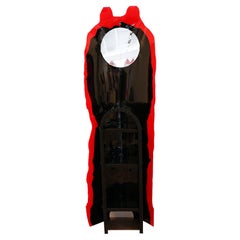
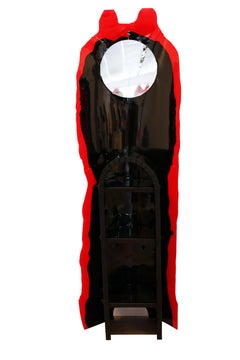
In the early 1970s, Pesce began exploring one of his key concepts, the idea of the industrial originals. Employing a mold without air holes, and adding a blood-red dye to the polyurethane, he cast a bookcase that resembled a demolished wall, the rough edges of the shelves and posts resulting from fissures in the material made by trapped air.
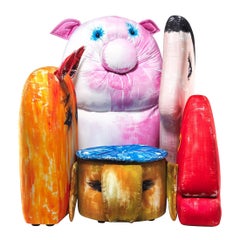
Through his research into polyurethane, Pesce figured out a way to make a loveseat and armchair using only a simple wood frame and strong canvas covering as a mold. Since the fabric developed random folds during the injection process, the pieces were similar but not identical. Cassina named the suite of furnishings Sit Down and introduced it in 1975. By experimenting with felt soaked in polyurethane and resin, Pesce conceived I Feltri, another collection of armchairs introduced by Cassina in 1987.
Pesce went on to live a life that defied expectation and convention and along the way became one of the most seminal figures in art and design.
Find vintage Gaetano Pesce chairs, sofas, vases and more on 1stDibs.
Chairs are an indispensable component of your home and office. Can you imagine your life without the vintage, new or antique chairs you love?
With the exception of rocking chairs, the majority of the seating in our homes today — Windsor chairs, chaise longues, wingback chairs — originated in either England or France. Art Nouveau chairs, the style of which also originated in those regions, embraced the inherent magnificence of the natural world with decorative flourishes and refined designs that blended both curved and geometric contour lines. While craftsmanship and styles have evolved in the past century, chairs have had a singular significance in our lives, no matter what your favorite chair looks like.
“The chair is the piece of furniture that is closest to human beings,” said Hans Wegner. The revered Danish cabinetmaker and furniture designer was prolific, having designed nearly 500 chairs over the course of his lifetime. His beloved designs include the Wishbone chair, the wingback Papa Bear chair and many more.
Other designers of Scandinavian modernist chairs introduced new dynamics to this staple with sculptural flowing lines, curvaceous shapes and efficient functionality. The Paimio armchair, Swan chair and Panton chair are vintage works of Finnish and Danish seating that left an indelible mark on the history of good furniture design.
“What works good is better than what looks good, because what works good lasts,” said Ray Eames.
Visionary polymaths Ray and Charles Eames experimented with bent plywood and fiberglass with the goal of producing affordable furniture for a mass market. Like other celebrated mid-century modern furniture designers of elegant low-profile furnishings — among them Ludwig Mies van der Rohe and Finn Juhl — the Eameses considered ergonomic support, durability and cost, all of which should be top of mind when shopping for the perfect chair. The mid-century years yielded many popular chairs.
The Eameses introduced numerous icons for manufacturer Herman Miller, such as the Eames lounge chair and ottoman, molded plywood dining chairs the DCM and DCW (which can be artfully mismatched around your dining table) and a wealth of other treasured pieces for the home and office.
A good chair anchors us to a place and can become an object of timeless appeal. Take a seat and browse the rich variety of vintage, new and antique chairs on 1stDibs today.